
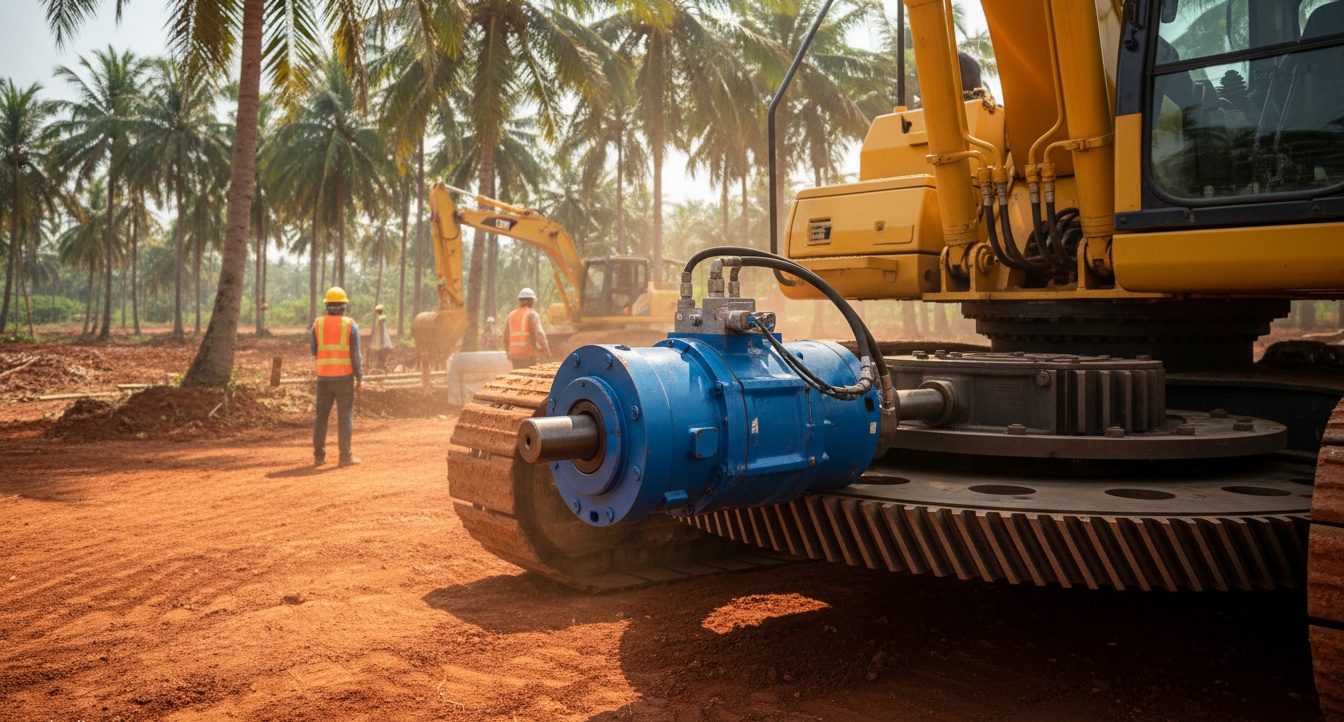
TL;DR: Southeast Asian excavator OEMs and contractors are standardizing on the INI Hydraulic IWYHG series slewing drive for 20-ton class machines — specifically the IWYHG33B — because the combination of 33kNm torque output, worm-gear self-locking geometry, and Indonesian coal mine / Philippine public works field validation addresses operating conditions that textbook procurement data does not capture. The IWYHG series delivers measurable uptime advantages over planetary-slew alternatives in high-dust, high-humidity, and high-cycle loading environments that characterize Southeast Asian excavator fleets.
The Southeast Asian Excavator Fleet Is Not a Uniform Market, and the Procurement Data Is Starting to Show It
If you are an excavator OEM procurement engineer or a fleet procurement manager working with Southeast Asian distributors, the slewing drive specification conversation has changed in the past three years. It used to be straightforward: the OEM specified a torque and speed envelope, the supplier matched it, and the sourcing decision was primarily a commercial negotiation. That model is breaking down — not because of commercial complexity, but because the operating conditions in Southeast Asia are creating field performance data that is forcing buyers to look beyond the basic specification sheet.
The pattern I am tracking through our export sales work at INI Hydraulic — supporting buyers across Indonesia, the Philippines, Vietnam, and Thailand — is that the slewing drive specifications that work in temperate European or North American excavator applications are not translating directly into Southeast Asian uptime performance. This is not a quality problem with any specific supplier's product. It is a condition specification gap: the machines being specified and the environments they are operating in have diverged enough that the same theoretical specification is producing different field outcomes.
The specific gap that matters most is the one that the IWYHG series — particularly the IWYHG33B slewing drive — is filling for 20-ton class excavator operators in the region. The 20-ton class is the mainstream production machine in Southeast Asian infrastructure construction, Indonesian coal mining, and Thai quarrying operations. It is the machine class where fleet utilization rates are highest, where the cost of unplanned downtime is most acute, and where the gap between theoretical specification and field performance is most visible.
The 20-Ton Class Is Where Southeast Asian Excavator Economics Converge — and Where the Slewing Drive Problem Is Most Acute
The 20-ton hydraulic excavator class is not arbitrary. It is the machine size that represents the intersection of dig capability, transport legality, and operating cost that makes it the preferred production unit for the broadest range of Southeast Asian excavation applications. From Indonesian coal mine stripping operations to Philippine National Infrastructure contractor earthworks to Thai commercial building foundation excavation, the 20-ton machine is the unit that most Southeast Asian excavator fleets are built around.
This concentration of fleet investment in the 20-ton class amplifies the consequence of any component reliability problem. When a 20-ton excavator goes down on an active coal face or a critical infrastructure project timeline, the cost is not just repair cost — it is production loss, idle loader and hauler costs, and in some cases contractual penalty clauses that compound the operational impact. The total cost of a slewing drive failure on a 20-ton machine in a production excavation context can be 8-15x the component replacement cost alone.
What makes the IWYHG33B the specific focus of Southeast Asian procurement attention is its position as the torque reference model for this machine class. With a rated output that comfortably exceeds the peak dynamic loading requirement for 20-ton class excavator slew operations, the IWYHG33B provides the specification headroom that Southeast Asian operating conditions demand — the additional margin that converts to service life when the machine is operating in abrasive rock, in high-humidity coastal environments, or in the dust-choked atmosphere of an Indonesian thermal coal mine.
What the IWYHG Worm-Gear Architecture Does That Planetary Slewing Drives Cannot Match for This Application
The slewing drive market for hydraulic excavators is dominated by two mechanical architectures: planetary gear sets and worm gears. Planetary designs dominate the OEM specification lists of the major Japanese and Korean excavator brands. Worm-gear slewing drives — of which the IWYHG series is INI Hydraulic's implementation — have traditionally been more common in crane and reach stacker applications where the self-locking characteristic of worm gear geometry is a direct functional requirement.
The reason the IWYHG worm-gear architecture is becoming relevant for 20-ton excavator applications in Southeast Asia is not the self-locking feature alone — it is what self-locking enables in the context of Southeast Asian operating conditions. A planetary slewing drive requires continuous hydraulic holding pressure to maintain position against load-induced backlash. In high-cycle loading applications — the 1,200-2,000 slew cycles per day that a busy 20-ton machine in a production excavation environment generates — this holding pressure translates to continuous heat generation in the hydraulic system, continuous demand on the hydraulic pump, and continuous wear on the seal interfaces that contain the high-pressure circuits.
The worm-gear geometry in the IWYHG55 high-speed slewing drive and IWYHG33B changes this dynamic. Worm gears provide self-locking geometry — the worm drives the worm wheel but the worm wheel cannot back-drive the worm under load. This means the slew position is maintained mechanically without hydraulic holding pressure, eliminating the continuous heat generation and seal wear that planetary designs accumulate over high-cycle operating lives. For Southeast Asian excavator operators who are pushing 20-ton machines to high utilization rates, this reduction in continuous hydraulic demand translates directly to fuel efficiency savings and extended hydraulic system component life.
The second mechanical advantage of worm-gear slewing drives is load damping. The sliding contact geometry of worm gears provides inherent damping of shock loads that would propagate through the gear mesh of planetary designs. In applications where the 20-ton excavator is handling irregular rock profiles or uneven ground, the slew system absorbs impact loading that would accelerate wear on planetary gear teeth. INI Hydraulic's planetary gearbox engineering guide shows, the torque density advantage of worm-gear designs for high-shock-load applications is a direct function of this damping geometry — something that does not appear in standard specification comparisons but that shows up clearly in field reliability data from high-cycle applications.
The Four Southeast Asian Condition Variables That Are Breaking Standard Excavator Slewing Drive Specifications
When I talk with Southeast Asian excavator fleet managers who have switched to the IWYHG series after experiencing premature failures with planetary-slew alternatives, the conversation almost always comes back to the same four condition variables that textbook procurement data does not account for. Understanding these variables is what separates the buyers who are making informed specifications from the ones who are ordering based on torque curves alone.
Variable 1: Indonesian Coal Mine Atmospheric Conditions. The Kutai Kartanegara and South Kalimantan coal mining districts generate airborne dust concentrations that exceed the design sealing assumptions of most standard excavator slewing drives. The dust penetrates standard radial shaft seals, coats the slew ring contact surfaces, and creates an abrasive three-body wear condition between the slew ring raceways and the rolling elements. The consequence is accelerated slew ring wear, increased backlash, and eventual clearance exceeding the tolerance that maintains precision slew performance. Indonesian operators report that standard planetary slewing drive slew rings in this environment require replacement at 2,000-3,000 hour intervals, compared to the 6,000-8,000 hour design life that would apply in temperate conditions.
Variable 2: Philippine Public Works Hydration Cycling. The Philippines Department of Public Works and Highways (DPWH) contractor fleet operates in a climate of extreme wet-season humidity variation — 90%+ relative humidity during the monsoon season followed by rapid dehydration during the dry season. This hydration cycling creates condensation accumulation on exposed mechanical surfaces that accelerates corrosion on housing materials and fastener interfaces. The slewing drive housing and its mounting fasteners are particularly vulnerable. Philippine contractors report that the housing attachment points — where the slewing drive bolts to the excavator swing circle — are the first structural casualty of this corrosion cycling, requiring premature re-torquing or replacement of mounting hardware.
Variable 3: Thai Quarrying Dynamic Loading Extremes. The aggregate quarrying operations in Kanchanaburi and Saraburi provinces generate slew cycle dynamic loads that push the peak torque envelope of 20-ton class excavators. When a quarrying excavator is handling oversize rock that requires high swing torque to position the bucket, the slew drive is subjected to peak loads that can exceed the continuous rated torque by a factor of 2-3x for durations of several seconds. These peak loading events — which planetary slewing drives are rated to handle but which accumulate fatigue damage over repeated cycles — are the specific operating condition that the IWYHG33B's torque margin is designed to address without requiring the operator to manage the machine's slew speed to avoid exceeding the planetary design's dynamic load limit.
Variable 4: Vietnamese Rental Fleet Abuse Patterns. Vietnam's excavator rental market — which represents a significant proportion of total fleet utilization in the country — creates a specific operating pattern that standard procurement data does not capture: rental machines are operated by multiple drivers with varying levels of technical understanding, who apply loads and cycle frequencies that exceed what an owner-operator would impose on their own machine. The rental fleet environment is where the worm-gear self-locking geometry and the IWYHG series' structural margin provide the most direct value — they tolerate the abuse patterns that a precision-tuned planetary design would not survive.
The Maintenance Protocol That Separates IWYHG Operators With 8,000-Hour Slew Ring Life From Those Replacing at 2,500 Hours
The difference between IWYHG slewing drive operators who achieve 8,000+ hour slew ring service life in Southeast Asian conditions and those who are replacing at 2,500 hours is not the quality of the component — it is the maintenance protocol they are running. INI Hydraulic's failure prevention documentation for excavator slewing drives identifies the specific maintenance interventions that produce this gap, and they are not complicated or expensive — they are simply specific to the actual failure modes that occur in these environments.
The primary failure mode in Indonesian and Thai operating conditions is seal degradation followed by particulate contamination of the slew ring and bearing surfaces. The contamination path is: seal wear → dust ingress → particle accumulation on slew ring raceways → three-body abrasion → clearance increase → backlash growth → seal wear acceleration. Breaking this cycle requires early intervention at the seal stage, before contamination reaches the slew ring contact surfaces. The maintenance protocol that produces 8,000-hour slew ring life in these environments is: 500-hour visual seal inspection during wet season, 250-hour inspection during dry season in coal mine or quarry environments, and immediate replacement of any seal showing signs of extrusion, cracking, or contamination tracks at each inspection point.
The second maintenance intervention that makes a measurable difference is slew ring torque verification at 2,000-hour intervals. The slew ring mounting bolts on an excavator slewing drive are subjected to cyclic loading from the swing inertia of the upper structure, and in high-cycle applications the fastener preload in the slew ring mounting can relax over time. Relaxed preload in the slew ring mounting causes the slew ring to shift under load, introducing eccentricity that accelerates seal wear and increases the dynamic load on the worm gear or planetary gear set. Verifying and re-torquing the slew ring mounting at 2,000-hour intervals — using the torque specification in the IWYHG installation manual — prevents this degradation cascade before it affects the gear set.
The third intervention is the most operationally specific to Southeast Asian conditions: housing corrosion inspection and treatment at every planned maintenance event. The housing corrosion that Philippine DPWH contractors experience is a surface oxidation process that accelerates fastener seizing and creates uneven loading on the housing-to-swing-circle interface. Surface treatment of corroded housing areas — using a rust converter and protective coating — at every 1,000-hour planned maintenance event extends the housing service life by preventing the corrosion from reaching the structural thickness that would require housing replacement.
The Broader Hydraulic System Context: Why Southeast Asian Excavator Fleets Are Standardizing on INI Hydraulic as a Single-Source Supplier
One of the patterns I observe in our export sales work that does not show up in procurement data alone is the sourcing consolidation that is happening among Southeast Asian excavator fleet operators who have standardized on INI Hydraulic's product range. These fleet operators are not just buying the IWYHG series slewing drive — they are sourcing the hydraulic winch systems, the travel drives, and the planetary gearbox components from the same supplier, creating a common spare parts inventory across the excavator's hydraulic power transmission system.
This sourcing consolidation is not primarily a commercial discount play — it is a maintenance operations efficiency decision. When the fleet operates IINI Hydraulic components across the slew, winch, and travel functions, the maintenance team needs to maintain competency on one supplier's product family, stock spare parts for one supplier's specification range, and manage the procurement relationship with one technical contact. For fleet operators in Indonesia, the Philippines, and Vietnam who are managing maintenance operations with limited technical resources, this consolidation has direct operational value that compounds over time.
The travel drive technology trends for crawler equipment in 2026 — including the electrification of travel drive systems, regenerative braking integration, and smart monitoring sensor deployment — are the next development frontier that INI Hydraulic's platform approach is designed to address. The same hydraulic engineering capability that produces the IWYHG33B's slew performance is being applied to the travel drive specifications that Southeast Asian excavator OEMs are starting to request as they plan their 2026-2027 model year updates.
The Excavator Slewing Drive Specification Checklist That Southeast Asian Buyers Are Now Running Before Every Order
Based on the field data coming back from Indonesian coal mines, Philippine infrastructure projects, Thai quarries, and Vietnamese rental fleets, the procurement checklist that experienced Southeast Asian excavator buyers are running before committing to a slewing drive order has evolved to include condition-specific evaluation criteria that were not on the standard specification checklist five years ago.
1. Slew ring dynamic load capacity vs. field loading profile: The specification sheet torque rating is the starting point, not the decision point. Confirm that the slew ring dynamic load capacity exceeds the peak torque requirement for your specific application by a minimum 30% margin — not the 10-15% that is typical in standard specification comparisons. For 20-ton Indonesian coal mine applications, the peak torque requirement during heavy digging in rock can exceed the continuous rated torque by 2.5x; the IWYHG33B's torque margin handles this without requiring slew speed reduction.
2. Seal specification for operating environment: Standard radial shaft seals are designed for the dust and moisture conditions of temperate industrial environments. Indonesian coal mine dust and Philippine monsoon humidity require verified seal specifications that exceed the standard catalog seal options. Confirm that the supplier can provide the seal specification documentation for your specific operating environment before order confirmation.
3. Housing corrosion resistance: The IWYHG housing is fabricated from materials appropriate for the corrosion environment that Philippine and Indonesian excavator operators encounter. Verify that the housing material specification and surface treatment are documented for the specific environmental conditions at your operating site — not just the general "industrial" classification that appears in standard specification sheets.
4. Hydraulic circuit compatibility: The IWYHG series is designed for integration with standard hydraulic swing circuits from the major excavator OEM brands. Verify that the hydraulic motor displacement and flow rate specifications match your excavator's hydraulic system before order confirmation — this is a straightforward compatibility check that prevents installation problems.
5. Service documentation and parts availability in region: Confirm that the supplier maintains service documentation in your language or in English, and that spare parts availability is supported through a regional distribution point that can provide standard lead time for replacement parts. For IWYHG series buyers in Southeast Asia, INI Hydraulic maintains regional distribution support through its export sales network that covers Indonesia, the Philippines, Vietnam, and Thailand.
6. OEM cross-reference validation: If you are replacing an incumbent supplier's slewing drive on an existing machine, confirm that the mounting interface, hydraulic connections, and output shaft configuration are dimensionally compatible with the existing excavator swing circle. The IWYHG series is designed with standard mounting configurations that cross-reference with the major Japanese and Korean OEM slewing drive specifications, but dimensional verification before order confirmation is standard practice for any retrofit application.
Why the IWYHG Series Is Becoming the Reference Specification for 20-Ton Southeast Asian Excavator Procurement — Not Just an Alternative
The procurement pattern that INI Hydraulic has observed across our Southeast Asian export sales — specifically the shift from IWYHG as a cost alternative to the major Japanese OEM slewing drive brands to IWYHG as the reference specification for new 20-ton machine procurement — reflects a market learning curve that has been driven by field data rather than marketing claims. The contractors and OEMs who have switched to the IWYHG33B and IWYHG55 slewing drives have done so because their uptime records, their maintenance cost data, and their insurance loss experience have told them that the specification comparison they were running was incomplete — that it was missing the four Southeast Asian condition variables that make the theoretical specification data diverge from actual field performance.
The IWYHG series is not the right slewing drive for every excavator application. For temperate-condition, low-cycle, light-duty 20-ton applications where the operating environment matches the textbook procurement assumptions, a standard planetary slewing drive may be the appropriate choice. But for the applications that dominate Southeast Asian excavator utilization — Indonesian coal mine stripping, Philippine DPWH infrastructure construction, Thai quarrying operations, Vietnamese rental fleet production work — the IWYHG worm-gear architecture, the torque margin, the seal specifications, and the housing corrosion resistance are the engineering features that translate into the actual uptime and maintenance cost outcomes that these buyers are optimizing for.
For Southeast Asian excavator procurement engineers who are evaluating slewing drive specifications for 20-ton class machines, the question is not whether the IWYHG series will outperform a planetary slewing drive in these conditions — the field data from Indonesian, Philippine, and Thai operators has answered that question definitively. The question is how quickly the procurement specification templates can be updated to include the condition-specific evaluation criteria that make the IWYHG series the reference specification rather than the alternative.
About the Author
Leo
Technical Content Specialist & Export Sales Representative, INI Hydraulic Co., Ltd.
Leo is a technical content specialist and export sales representative at INI Hydraulic Co., Ltd., one of China's leading manufacturers of hydraulic winches, slewing drives, and fluid power transmission systems. Through INI Hydraulic's YouTube channel and social media platforms, he produces hands-on technical content — including hydraulic system animations, winch load testing footage, and OEM procurement walkthroughs — that helps international buyers understand INI's product engineering before placing orders.
With a background in hydraulic transmission engineering and four years supporting offshore, marine, and construction machinery buyers across Southeast Asia, the Middle East, and Europe, Leo translates complex hydraulic spec sheets into practical procurement guidance for OEM engineers, shipyard procurement managers, and industrial equipment distributors.
Post time: Jun-16-2026