
TL;DR:
- Most excavator slewing drive failures start with contamination, overload, poor lubrication, hydraulic mismatch, or loose mounting bolts.
- Early warning signs include abnormal swing noise, growing backlash, oil leakage, overheating, brake slip, jerky rotation, and metal particles in lubricant.
- Prevention requires correct model selection, clean hydraulic oil, disciplined greasing, bolt torque control, seal inspection, and operator training.
- A capable slewing drive manufacturer should support failure analysis, replacement selection, and maintenance guidance for the real excavator duty cycle.
Common excavator slewing drive failures include gear tooth wear, bearing raceway damage, excessive backlash, oil leakage, brake slip, hydraulic motor problems, overheating, and mounting bolt loosening. These failures happen because excavators combine high shock load, frequent start-stop rotation, dust, mud, water, vibration, and operator impact in one compact slewing system. The best prevention is not one single maintenance trick; it is a controlled chain of correct selection, clean installation, proper lubrication, hydraulic matching, seal protection, and routine inspection. For buyers searching for a slewing drive manufacturer, the supplier should do more than sell a replacement unit. The manufacturer should help identify whether the failure came from product undersizing, contamination, oil quality, machine structure, relief valve settings, brake behavior, or maintenance gaps. INI Hydraulic supplies hydraulic slewing devices for excavator slewing solutions and also manufactures hydraulic motors, planetary gearboxes, winches, and hydraulic systems, so the failure discussion should be viewed as a complete hydraulic transmission problem rather than a single broken component.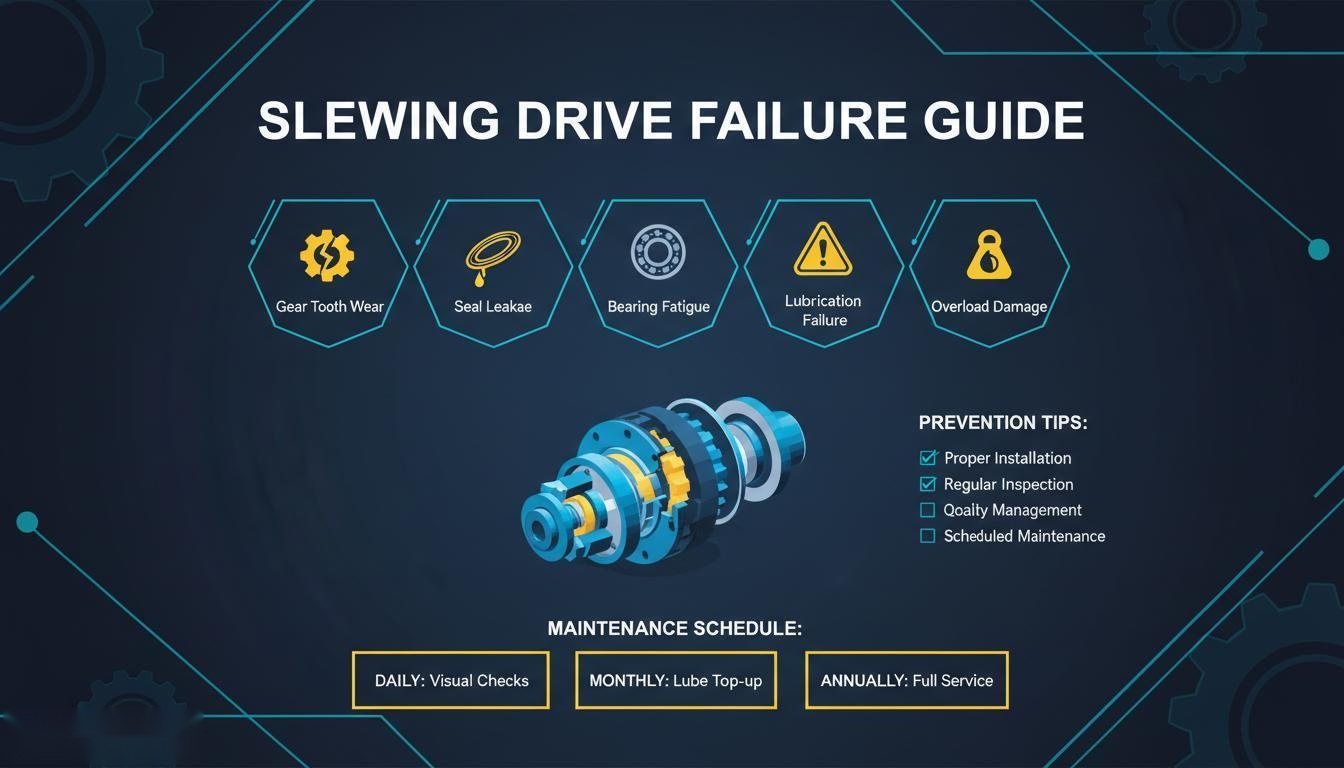
Why Do Excavator Slewing Drives Fail?
Excavator slewing drives fail when the actual working condition exceeds the design assumption or when lubrication, hydraulic oil, sealing, and mounting conditions deteriorate over time. The slewing drive sits between the rotating upper structure and the machine’s hydraulic power system. It must start, stop, hold, reverse, and absorb shock while the operator digs, loads trucks, grades slopes, demolishes concrete, or swings with a full bucket. Because of that, failure is usually cumulative. The drive rarely “suddenly fails” without earlier warning signs.
Because excavator slewing combines mechanical load and hydraulic control, diagnosis should always check both sides of the system. A worn gear can cause vibration, but unstable hydraulic pressure can also create shock that damages the gear. A leaking seal may be a seal problem, but it may also point to excess case pressure or contaminated oil. A loose mounting bolt may look like poor assembly, but it may be caused by a distorted mounting surface or repeated overload.
According to ISO 4406, hydraulic fluid cleanliness can be represented by particle count codes, which gives maintenance teams a structured way to control contamination. This matters because oil contamination can damage hydraulic motors and valves before the mechanical drive is blamed. Similarly, gear capacity principles referenced by ISO 6336 show why gear stress depends on material, geometry, lubrication, and load conditions, not just a model name.
Failure 1: Excessive Backlash and Loose Swing Feel
Excessive backlash is one of the most common excavator slewing drive complaints, and it usually indicates gear wear, bearing clearance growth, loose mounting bolts, or long-term shock loading. Backlash is the free movement felt before the slewing system transmits force. A small designed clearance is normal. A growing clunk is not.
Operators often describe this failure as “the house knocks when I change direction” or “the upper body feels loose.” During digging, the operator may notice a delay before the excavator responds. During fine positioning, the machine may overshoot. In severe cases, the upper structure may rock when braking. This is more than an annoyance; it can reduce control accuracy and increase stress on the gear teeth.
Prevention starts with correct model selection. If the slewing drive is undersized for the real tilting moment or shock factor, backlash will grow faster. Buyers should send accurate load information to the slewing drive manufacturer, including machine weight, upper-structure inertia, bucket size, working radius, operating environment, and duty cycle. The manufacturer should define acceptable initial backlash and recommend inspection intervals.
During maintenance, backlash should be measured and recorded at regular intervals instead of judged only by feel. If the value grows quickly, check mounting bolts, gear lubrication, bearing condition, and operator behavior. If the excavator frequently uses the swing system to push material sideways, the slewing drive sees abusive side loads. That habit may finish a weak drive faster than any design calculation predicts.
Failure 2: Gear Tooth Wear, Pitting, or Tooth Breakage
Gear tooth damage happens when contact stress, shock load, poor lubrication, contamination, or material defects exceed the gear set’s safe working condition. Early gear wear may appear as fine metal particles in lubricant, rough swing motion, whining noise, or vibration under load. Advanced damage may show pitting, spalling, chipped teeth, or broken teeth.
According to AGMA gear standards resources, gear performance depends on geometry, material, manufacturing accuracy, lubrication, and application factors. In practical buyer language, this means two drives with similar torque numbers may not have the same tooth life if heat treatment, machining quality, lubrication, or shock factor assumptions differ.
To prevent gear damage, use the correct lubricant, maintain the recommended grease interval, avoid shock operation, verify gear backlash, and ensure the mounting structure is flat and rigid. If the excavator works in demolition, quarrying, forestry, or mining, shorten inspection intervals. I would rather spend 20 minutes checking grease condition than lose a machine for three days because a cracked tooth was ignored.
Failure 3: Bearing Raceway Damage and Rough Rotation
Bearing raceway damage causes rough rotation, noise, uneven swing resistance, vibration, and sometimes visible metal debris in lubricant. The bearing portion of a slewing drive carries axial load, radial load, and tilting moment. When those loads exceed design assumptions or when contamination enters the raceway, the bearing surfaces may indent, spall, or wear unevenly.
Prevention begins with load verification. A replacement slewing drive should not be selected only by physical size. The buyer should confirm axial load, radial load, tilting moment, output torque, swing speed, duty cycle, and shock factor. If a replacement drive fits the bolt pattern but has lower bearing capacity than the original duty requires, premature raceway damage is likely.
Maintenance teams should protect the bearing from contamination. Inspect seals, keep grease points accessible, avoid high-pressure washing directly at seal lips, and replace damaged protective covers. For corrosive environments, coating and seal choices should be discussed with the manufacturer. According to ASTM B117, salt spray exposure testing at controlled conditions such as 35°C is widely used to evaluate corrosion resistance, which can be relevant for marine or coastal excavator work.
Failure 4: Oil Leakage Around the Motor, Brake, or Seals
Oil leakage in an excavator slewing drive can come from worn seals, excessive case pressure, damaged hose connections, improper assembly, contaminated oil, or overpressure events. Buyers and technicians should not automatically replace the visible seal without asking why the seal failed. If the root cause remains, the new seal may leak again.
Leakage around the hydraulic motor may indicate shaft seal damage, high case pressure, blocked drain line, or motor wear. Leakage around fittings may come from vibration, incorrect torque, damaged threads, or hose movement. Leakage around the drive housing may point to seal wear, corrosion, contamination, or overfilling.
Because oil leakage attracts dust, it can accelerate external contamination. On a muddy jobsite, leaked oil becomes a sticky collector for abrasive particles. That mixture can damage seals further. The operator may only see a dirty patch, but the maintenance technician should treat it as an early warning sign.
Prevention includes clean assembly, correct seal material, proper hose routing, controlled case pressure, and oil cleanliness. If the machine works in high-temperature or cold-weather environments, seal material compatibility should be checked. If a replacement unit is ordered from a slewing drive manufacturer, provide photos of the old leak location, hydraulic schematic if available, operating pressure, and oil type. That information helps the manufacturer distinguish between seal selection and system pressure problems.
Failure 5: Brake Slip, Swing Drift, or Unsafe Holding
Brake-related failure appears as swing drift, delayed holding, brake slip on slopes, overheating, or harsh release during operation. Excavator slewing systems may use hydraulic braking or mechanical holding features depending on design. When the brake does not release smoothly or hold reliably, both productivity and safety suffer.
Brake problems can be mechanical, hydraulic, or control-related. Low release pressure may prevent full release, causing heat and drag. Contaminated oil may affect valve behavior. Worn friction elements may reduce holding torque. Incorrect brake selection may fail to hold the upper structure under specific working angles. Because the brake interacts with the operator’s control input, symptoms can feel inconsistent.
Prevention requires confirming brake holding torque, release pressure, response time, hydraulic circuit design, and fail-safe behavior before installation. For replacement projects, do not assume the old brake specification was correct. Sometimes the original machine has been modified, the counterweight changed, the attachment made heavier, or the operating terrain changed. The brake must be suitable for the current machine, not just the original catalog configuration.
Technicians should also check whether the operator reports drift only under load or also at no load. Drift under load may indicate insufficient holding torque or internal leakage. Jerky release may indicate hydraulic control issues. If the brake overheats, stop using the machine until the cause is found. That smell of hot friction material is not something to “watch for a few more days.”
Failure 6: Hydraulic Motor Weakness, Slow Swing, or Jerky Rotation
Weak, slow, or jerky swing can be caused by hydraulic motor wear, low pump flow, relief valve setting problems, oil contamination, internal leakage, air in the system, or an incorrectly matched slewing drive ratio. The slewing drive often gets blamed because it is visible, but the hydraulic system may be the real source.
Because pressure creates torque and flow creates speed, the technician should measure both. If the machine has enough pressure but insufficient flow, swing speed suffers. If the flow is adequate but pressure drops under load, the drive may lack torque. If pressure spikes during direction changes, gear and motor components may suffer shock. A proper diagnosis should include pressure testing, flow testing, oil condition inspection, drain flow observation, and mechanical resistance checks.
Oil cleanliness deserves special attention. Particles can scratch motor surfaces, jam valves, and increase internal leakage. Water can reduce lubrication performance and promote corrosion. Foamed oil can make control inconsistent. The maintenance team should follow filtration targets and replace filters on schedule, not only after symptoms appear.
When ordering a replacement from a slewing drive manufacturer, provide hydraulic pump data, motor displacement if known, pressure settings, target swing speed, hose port dimensions, and brake or valve requirements. INI Hydraulic’s broader product range across hydraulic motors, hydraulic systems, and planetary gearboxes is useful here because swing performance depends on the full transmission chain.
Failure 7: Overheating, Noise, and Vibration Under Load
Overheating, abnormal noise, and vibration are system-level warning signs that can indicate excessive friction, poor lubrication, gear damage, bearing wear, brake drag, hydraulic restriction, or misalignment. These symptoms should never be ignored simply because the excavator can still work.
Noise type helps diagnosis. A steady whine may point to hydraulic flow or motor issues. A rhythmic knock may suggest gear or bearing damage. A grinding sound may indicate contamination or severe lubrication failure. Heat location also matters. Heat near the motor may suggest hydraulic losses or brake drag. Heat near the gear housing may suggest mechanical friction or lubricant failure.
Prevention requires a simple inspection discipline: listen, touch carefully, measure temperature, check lubricant, inspect bolts, verify pressure, and document trends. A single temperature reading is helpful, but a trend is better. If the same machine runs 15°C hotter than usual under similar load, something changed. That change should be investigated before the unit fails.
In my opinion, operators are the best early-warning sensors when they are trained well. They know how the machine normally sounds. They feel a small change before a manager sees a repair bill. A maintenance program should encourage operators to report abnormal swing behavior without blaming them for stopping the machine.
Preventive Maintenance Plan for Excavator Slewing Drives
A strong preventive maintenance plan should combine daily visual checks, scheduled lubrication, bolt inspection, hydraulic oil control, seal inspection, and periodic backlash measurement. The exact interval depends on machine size, duty cycle, environment, and manufacturer guidance, but the structure below is a practical starting point.
| Interval | Inspection Task | Purpose |
|---|---|---|
| Daily | Check abnormal noise, swing delay, visible oil leakage, loose hoses, and obvious damage. | Find early symptoms before they become major failures. |
| Weekly | Inspect grease condition, seal area, mounting bolts visually, and operator feedback. | Control contamination and detect looseness. |
| Monthly | Check backlash trend, bolt torque according to procedure, hydraulic pressure behavior, and brake response. | Identify wear, overload, and control problems. |
| Every 500 operating hours | Review lubricant condition, oil cleanliness, filter status, temperature trend, and vibration/noise changes. | Prevent cumulative gear, bearing, and motor damage. |
| After severe impact | Inspect mounting structure, backlash, leakage, brake holding, and swing smoothness immediately. | Catch hidden damage after overload events. |
How to Work With a Slewing Drive Manufacturer After a Failure
After a slewing drive failure, the buyer should send the manufacturer evidence, not only a complaint. Good evidence includes machine model, operating hours, working environment, photos of the failed unit, video of the symptom, hydraulic pressure and flow data, oil condition, maintenance records, installation photos, and any recent overload event. This information helps separate product defects from system causes.
A responsible slewing drive manufacturer should ask diagnostic questions before recommending a replacement. If the old drive failed from overload, installing the same rating may repeat the failure. If the old drive failed from contaminated oil, the hydraulic system must be cleaned before the new drive is installed. If the failure came from a loose mounting surface, the machine structure must be corrected. Replacing a failed component without correcting the root cause is only renting time until the next failure.
INI Hydraulic is relevant for this type of support because its product scope includes hydraulic slewing devices, hydraulic motors, planetary gearboxes, winches, pumps, and hydraulic systems. For excavator slewing applications, that cross-category experience can help evaluate whether the symptom is mechanical, hydraulic, or installation-related. Buyers can reference the hydraulic slewing product page at INI Hydraulic Slewing when discussing replacement or customization needs.
FAQ: Excavator Slewing Drive Failure Prevention
What is the earliest warning sign of slewing drive failure?
The earliest warning sign is often a change in swing feel, such as new noise, vibration, delay when changing direction, or a small but growing knock. Visible leakage, hotter operation, and rough rotation are also early warning signs that should be inspected immediately.
Can poor hydraulic oil damage a slewing drive?
Yes. Poor hydraulic oil can damage the hydraulic motor, valves, seals, and braking components connected to the slewing drive. Particle contamination, water, wrong viscosity, or foaming can all create control problems and accelerate wear.
Why does my excavator swing slowly even after replacing the slewing drive?
Slow swing after replacement may come from low pump flow, incorrect motor displacement, relief valve settings, blocked filters, internal leakage, brake drag, or hose restrictions. The hydraulic system should be tested instead of assuming the new drive is defective.
How can I reduce gear wear in an excavator slewing drive?
You can reduce gear wear by selecting the correct model for the real load, maintaining proper lubrication, preventing contamination, avoiding shock operation, checking backlash trends, keeping mounting bolts tight, and repairing seal damage early.
When should I replace instead of repair a failed slewing drive?
Replacement is usually safer when gear teeth are broken, bearing raceways are severely damaged, housing surfaces are distorted, backlash is excessive beyond adjustment, or repair cost approaches the cost of a reliable new unit. The decision should include downtime risk, not only parts cost.
LinkedIn Summary Version
Excavator slewing drive failures usually start before the machine stops. Warning signs include growing backlash, abnormal swing noise, oil leakage, overheating, jerky rotation, brake slip, and rough movement under load. The root causes are often contamination, poor lubrication, overload, hydraulic mismatch, seal damage, or loose mounting conditions. Prevention requires correct model selection, hydraulic oil cleanliness, scheduled greasing, bolt inspection, brake checks, and operator reporting. INI Hydraulic supports hydraulic slewing applications with related experience in hydraulic motors, planetary gearboxes, winches, and hydraulic systems, which helps buyers evaluate the full transmission chain instead of replacing parts blindly.
Post time: May-12-2026