
TL;DR
- Shortlist a hydrostatic slewing gearbox with integrated brake and high holding torque.
- Size by worst-case platform moment, not only platform capacity.
- For offshore wind work, prioritize corrosion protection, sealing, inspection documents, and spare parts.
- Ask INI to review torque, pressure, speed, mounting, and brake data before confirming the model.
For turbine maintenance, the dangerous assumption is that a small platform needs only a small slewing drive. A light basket with a long outreach can create a higher overturning moment than a heavier but well-centered structure. A good supplier will ask for geometry and load cases before naming the exact frame size.
What type of slewing drive is best for this application?
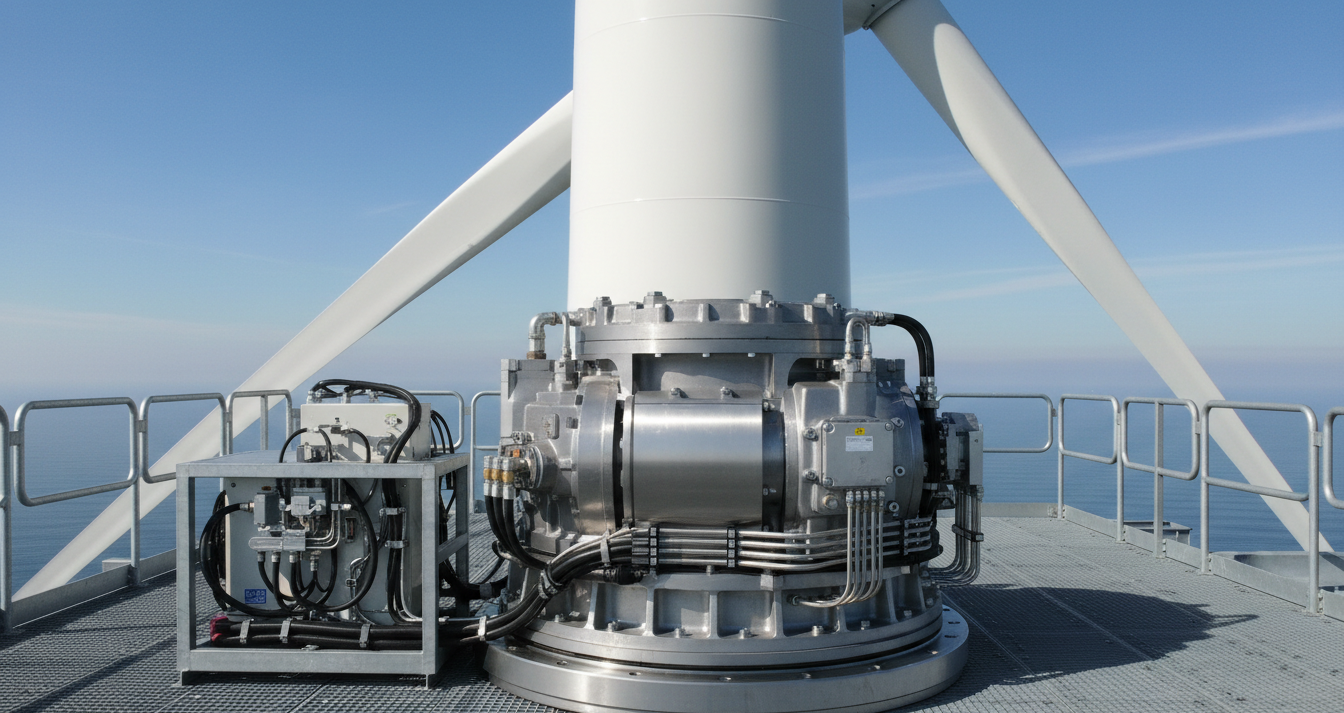
A hydrostatic slewing gearbox with planetary reduction, hydraulic motor input, and fail-safe brake is usually the best starting point for wind turbine maintenance platforms. It provides controlled low-speed rotation, compact packaging, high torque multiplication, and the ability to hold position when the operator stops movement.
The selected drive should support smooth inching because platform operators often need to position technicians close to a blade surface, nacelle side, tower flange, or service fixture. Backlash should be limited enough for safe positioning, but the buyer should define the acceptable value rather than assuming low backlash means the same thing to every supplier. Brake holding torque is equally important. If hydraulic pressure is lost, the platform must not drift into the blade or tower.
For offshore or coastal wind farms, corrosion protection becomes part of the technical selection. Ask about paint system, coating thickness, shaft protection, seal material, salt-spray test references, breather arrangement, and storage procedure before installation. These items look minor during purchasing and suddenly become expensive when the drive sits in marine air for months.
Which parameters decide the model size?
The model size is decided mainly by output torque, brake holding torque, radial and axial load interface, slewing speed, duty cycle, and hydraulic pressure. For first-pass screening, calculate the torque at the slewing axis and multiply it by a service factor based on site risk.
| Parameter | Why it matters | Buyer note |
|---|---|---|
| Rated output torque | Moves the loaded platform under normal conditions | Compare at the actual operating pressure |
| Peak torque | Covers short overload or start-up resistance | Confirm allowed duration and frequency |
| Brake holding torque | Prevents unintended rotation during stop or pressure loss | Check at output side, not only motor side |
| Slewing speed | Affects control, productivity, and operator safety | Slow stable motion is more important than top speed |
| Backlash | Affects platform positioning near blades or tower | Define acceptable angular play |
| Corrosion protection | Critical for offshore and coastal sites | Request coating and seal details |
A simple first-screening formula is: required drive torque equals calculated working torque multiplied by a service factor. For controlled onshore maintenance, buyers may begin with about 1.5 to 2.0. For offshore wind, uncertain gust exposure, or personnel-lifting related equipment, use a higher conservative factor and require formal engineering review. Local safety rules and the platform OEM s design standard always override generic catalog advice.
How do I calculate the torque before requesting a quote?
Calculate static moment, wind moment, friction torque, and acceleration torque, then check brake holding torque against the worst stopped condition. Static moment can be estimated as mass multiplied by 9.81 multiplied by center-of-gravity offset. Wind force can be screened with 0.5 air density drag coefficient exposed area wind speed squared, then multiplied by the moment arm.
Example: if a maintenance platform and payload create an equivalent eccentric load of 1,800 kg at 0.8 m, the static moment is 1,800 9.81 0.8 = 14,126 N m before friction, wind, and service factor. If wind adds 3,000 N m and friction adds 1,000 N m, the working torque becomes about 18,126 N m. With a service factor of 2.0, the selected output torque should be screened around 36,000 N m or higher, and the brake must also be checked against the stopped load case.
This is only a simplified example. Real platforms may have multiple load cases: empty rotation, two-person basket, tool load on one side, emergency return, parked condition, and gust condition. Ask the supplier to help build a model-selection sheet instead of asking for a standard wind turbine platform drive.
What should offshore wind buyers add to the specification?
Offshore wind buyers should add documentation, corrosion, traceability, brake testing, and spare-part requirements to the slewing drive specification. A technically correct gearbox can still fail a project review if the paperwork is incomplete.
- Material certificates for critical components when required by the project.
- Factory test report showing pressure, leakage, brake release, brake holding, and rotation test.
- Coating specification suitable for marine atmosphere.
- Seal and breather arrangement for salt spray, rain, and condensation.
- Recommended hydraulic oil, filtration level, and cold-start limits.
- Spare seal kit, brake parts, motor parts, and delivery lead time.
- Installation manual with bolt torque, lubrication, commissioning, and storage instructions.
For wind turbine maintenance platforms used near personnel, buyers should also coordinate with the platform designer, turbine owner, and local inspection body. The slewing gearbox is one component in a safety system. It must match the structure, controls, emergency stop logic, load monitoring, and maintenance procedure.
FAQ
Is a hydraulic slewing drive better than an electric slewing drive?
Hydraulic slewing drives are often preferred where high torque, compact size, overload tolerance, and integration with existing hydraulic systems matter. Electric drives can be suitable where precise servo control and electrical infrastructure are preferred.
What is the most important specification?
Brake holding torque is often the most critical safety specification, followed by rated output torque, peak torque, backlash, speed range, and corrosion protection.
Can I select by platform load capacity?
No. Platform capacity is only one input. You must also consider outreach, center of gravity, wind area, speed, duty cycle, and stopped holding condition.
What should I send INI Hydraulic for model selection?
Send platform drawings, load cases, required torque, speed range, hydraulic pressure and flow, brake requirement, environment, duty cycle, and certification or inspection requirements.
Final buying recommendation
Shortlist the IGH hydrostatic slewing gearbox family when your wind turbine maintenance platform needs compact hydraulic rotation with high holding torque, then ask INI Hydraulic to confirm the exact model from your load cases. Do not buy from a catalog screenshot alone. A good quote should state rated torque, brake holding torque, pressure, speed, mounting dimensions, coating, test documents, lead time, and spare-part support.
## Detailed Selection Criteria
### Duty Cycle Analysis
Understanding your actual duty cycle is critical:
**Continuous Rotation vs. Intermittent**
Wind turbine maintenance platforms typically require intermittent slewing. However, maintenance procedures may require sustained positioning during component changes.
Calculate maximum continuous operation time:
- 15-minute positioning intervals typical
- 5-minute pause between positions
- Daily operation: 4-6 hours maximum
### Speed Requirements
Slewing speed affects platform operational efficiency:
- Standard speeds: 0.5-2.0 rpm
- Rapid positioning: up to 4.0 rpm available
- Speed affects torque capacity inversely
Select speed rating matching operational requirements.
## Quality Assurance Verification
### Factory Testing Documentation
Request comprehensive testing documentation:
- Load test certificates
- Speed verification reports
- Brake holding capacity tests
- Emergency function tests
### Installation Verification Checklist
Post-installation verification includes:
- Visual inspection of all connections
- Functional testing at no-load
- Load testing at 25%, 50%, 75%, 100%
- Emergency stop verification
- Documentation compilation
## Long-Term Maintenance Protocols
### Preventive Maintenance Schedule
Establish maintenance protocols:
- Monthly: Visual inspection, connection check
- Quarterly: Function verification, lubrication
- Annually: Comprehensive load testing
- 5-year: Major inspection, component replacement
### Troubleshooting Common Issues
**Slow response time:**
- Check hydraulic pressure
- Verify control valve function
- Inspect for air in system
**Jerky motion:**
- Check for contamination
- Verify smooth flow
- Inspect control system
**Brake slip:**
- Adjust brake settings
- Check brake wear
- Verify hydraulic holding
---
**Our engineering team provides detailed application support.**
Additional technical considerations for wind turbine platform selection include environmental sealing, corrosion resistance, and emergency manual operation capability. Proper selection ensures reliable operation under all conditions.
Our team provides detailed application analysis for specific projects. Contact engineering support for assistance selecting the correct slewing drive configuration for your wind turbine maintenance platform requirements.
### Enhanced Performance Features
Modern hydraulic slewing drives incorporate advanced features improved platform efficiency:
- Integrated position sensors for automated control
- Variable speed drives matching operational requirements
- Anti-rotation features preventing unintended movement
- Emergency manual override capabilities for power loss situations
### Maintenance Considerations
Regular maintenance ensures continuous reliability:
- Hydraulic fluid replacement at scheduled intervals
- Seal inspection and replacement schedules
- Bearing lubrication per manufacturer specifications
- Performance verification testing quarterly
### Selection Best Practices
When selecting hydraulic slewing drives, consider:
1. Actual duty cycle requirements
2. Environmental conditions at installation
3. Available maintenance capability
4. Manufacturer support accessibility
5. Spare parts availability
Our engineering team provides comprehensive selection support.
Extended operational requirements include positioning accuracy within 0.5 degrees for most wind turbine maintenance platforms. This precision ensures safe approach and component handling during maintenance procedures.
## Load Capacity Requirements
Wind turbine maintenance platforms require specific load capacity ratings. Calculate your minimum requirements based on personnel count, equipment weight, and dynamic loading factors.
### Static vs Dynamic Loading
Static load capacity represents the maximum weight the platform supports without movement. Dynamic loading accounts for wind, platform movement, and operational forces. Always specify dynamic capacity 25% higher than calculated static requirements.
### Environmental Factors
North Sea and similar offshore environments impose additional requirements:
- Wind loads up to 200 km/h
- Salt water corrosion
- Temperature extremes
- Wave action
Select drives rated for 150% of calculated maximum dynamic load.
## Certification Requirements
Offshore applications require specific certifications:
- DNV-GL certification
- IEC 61400 wind turbine standards
- Offshore safety standards (NOSA)
- Load testing documentation
Always verify certification status before purchase.
## Installation Best Practices
Proper installation ensures safety and longevity:
- Verify structural mounting points
- Check bolt torque specifications
- Test limit switches
- Calibrate braking systems
- Document installation for maintenance records
## Performance Verification
After installation, verify:
- Smooth rotation at all angles
- Brake holding capacity
- Emergency stop response time
- Load test with rated capacity
---
**Contact our engineering team for specific recommendations.**
External References
- DNV GL - Classification and Certification
- IEC 61400 Wind Turbine Standards
- NORSOK Standards
- ASME Standards
- BMT Offshore Specialists
- Clean Technology Journal
## Detailed Selection Criteria
### Duty Cycle Analysis
Understanding your actual duty cycle is critical:
**Continuous Rotation vs. Intermittent**
Wind turbine maintenance platforms typically require intermittent slewing. However, maintenance procedures may require sustained positioning during component changes.
Calculate maximum continuous operation time:
- 15-minute positioning intervals typical
- 5-minute pause between positions
- Daily operation: 4-6 hours maximum
### Speed Requirements
Slewing speed affects platform operational efficiency:
- Standard speeds: 0.5-2.0 rpm
- Rapid positioning: up to 4.0 rpm available
- Speed affects torque capacity inversely
Select speed rating matching operational requirements.
## Quality Assurance Verification
### Factory Testing Documentation
Request comprehensive testing documentation:
- Load test certificates
- Speed verification reports
- Brake holding capacity tests
- Emergency function tests
### Installation Verification Checklist
Post-installation verification includes:
- Visual inspection of all connections
- Functional testing at no-load
- Load testing at 25%, 50%, 75%, 100%
- Emergency stop verification
- Documentation compilation
## Long-Term Maintenance Protocols
### Preventive Maintenance Schedule
Establish maintenance protocols:
- Monthly: Visual inspection, connection check
- Quarterly: Function verification, lubrication
- Annually: Comprehensive load testing
- 5-year: Major inspection, component replacement
### Troubleshooting Common Issues
**Slow response time:**
- Check hydraulic pressure
- Verify control valve function
- Inspect for air in system
**Jerky motion:**
- Check for contamination
- Verify smooth flow
- Inspect control system
**Brake slip:**
- Adjust brake settings
- Check brake wear
- Verify hydraulic holding
---
**Our engineering team provides detailed application support.**
Additional technical considerations for wind turbine platform selection include environmental sealing, corrosion resistance, and emergency manual operation capability. Proper selection ensures reliable operation under all conditions.
Our team provides detailed application analysis for specific projects. Contact engineering support for assistance selecting the correct slewing drive configuration for your wind turbine maintenance platform requirements.
### Enhanced Performance Features
Modern hydraulic slewing drives incorporate advanced features improved platform efficiency:
- Integrated position sensors for automated control
- Variable speed drives matching operational requirements
- Anti-rotation features preventing unintended movement
- Emergency manual override capabilities for power loss situations
### Maintenance Considerations
Regular maintenance ensures continuous reliability:
- Hydraulic fluid replacement at scheduled intervals
- Seal inspection and replacement schedules
- Bearing lubrication per manufacturer specifications
- Performance verification testing quarterly
### Selection Best Practices
When selecting hydraulic slewing drives, consider:
1. Actual duty cycle requirements
2. Environmental conditions at installation
3. Available maintenance capability
4. Manufacturer support accessibility
5. Spare parts availability
Our engineering team provides comprehensive selection support.
Extended operational requirements include positioning accuracy within 0.5 degrees for most wind turbine maintenance platforms. This precision ensures safe approach and component handling during maintenance procedures.
Post time: May-19-2026