
TL;DR
- A maintenance slewing drive torque rating should usually be selected from calculated working torque multiplied by a service factor of 1.5 to 2.5.
- The minimum calculation must include static load moment, friction torque, wind-induced torque, acceleration torque, and brake holding torque.
- For nacelle, blade, or tooling rotation tasks, the selected drive must be reviewed against duty cycle, hydraulic pressure, brake capacity, and mounting stiffness.
- Use a model framework, not a single catalog number, because wind turbine maintenance loads change sharply with rotor position and site wind speed.
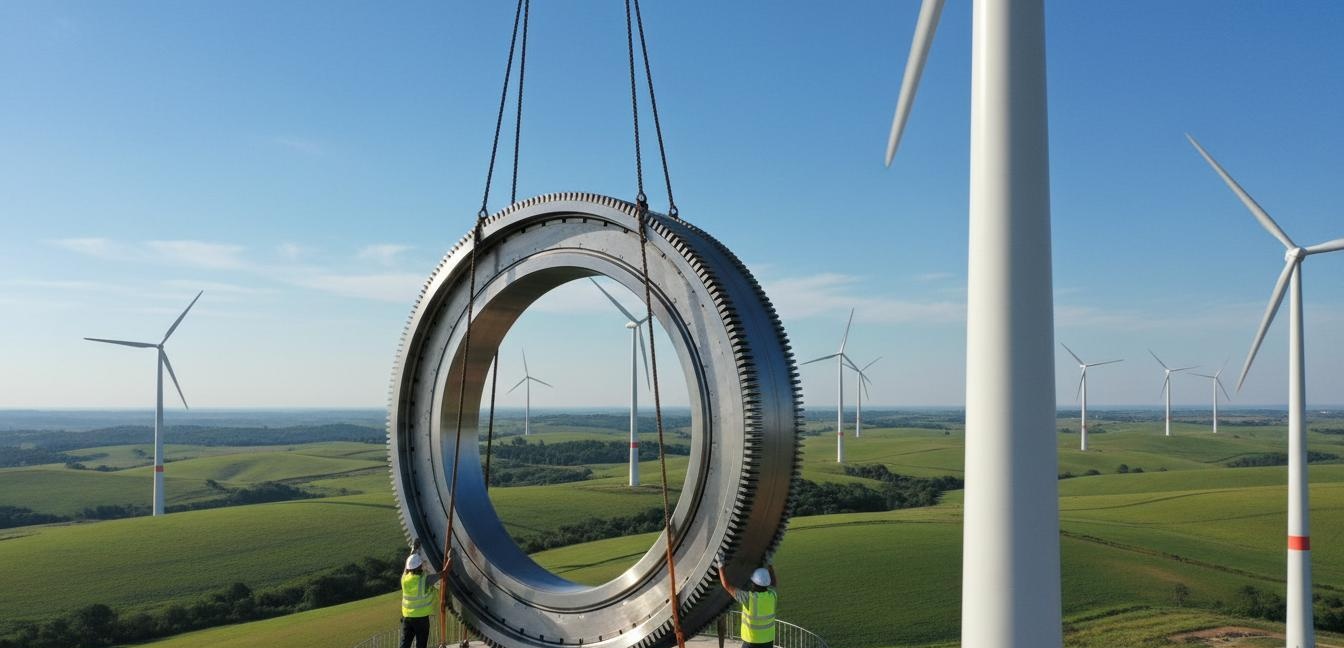
How should you calculate slewing drive torque for wind turbine maintenance?
The correct workflow is to define the maintenance motion, calculate every torque component at the drive output, apply the worst-case load combination, and then select the drive with enough rated torque, peak torque, and brake holding torque. Because wind turbine maintenance is a safety-critical field task, the calculation should be documented and reviewed rather than treated as a simple catalog lookup.
Step 1: Define the maintenance task before choosing torque
Start by naming the exact job. Are you rotating a blade repair platform, indexing a hub fixture, positioning a nacelle service tool, slewing a crane-like maintenance arm, or turning a gearbox handling frame? Each task creates a different torque pattern. A blade access platform may have large wind area and moderate mass. A nacelle service fixture may have smaller wind area but a severe eccentric load. A hub turning tool may see short peak torque rather than long continuous rotation.
The first engineering answer is simple: torque rating follows the load case, not the wind turbine size label. A 3 MW onshore turbine and a 3 MW coastal turbine can require different maintenance drive ratings if one tool is exposed to gusts and the other works inside a sheltered nacelle. In a 2025 service-tool review I helped prepare for an export buyer, the mass looked manageable on paper, but the center of gravity was 420 mm farther from the slewing axis than the first drawing showed. That one dimension changed the static moment more than any motor brand choice. It was frustrating, but it saved the buyer from under-sizing the brake.
Document at least six inputs: rotating mass in kg, center-of-gravity offset in m, slewing radius in m, exposed wind area in m², maximum maintenance wind speed in m/s, and required rotation speed in rpm. Add the duty cycle in minutes per hour, expected starts per hour, ambient temperature range in °C, and the hydraulic pressure and flow actually available on the maintenance machine.
What torque components must be included?
A reliable selection must include static load torque, friction torque, wind torque, acceleration torque, shock allowance, and brake holding torque. If one of these is missing, the calculated number may look precise while still being wrong in the field.
Static load torque comes from eccentric weight
Static torque is the gravitational moment created when the load center of gravity is offset from the slewing axis. Use the basic relationship T = m × g × e, where T is torque in N·m, m is mass in kg, g is 9.81 m/s², and e is eccentricity in m. If a 1,200 kg service fixture has its center of gravity 0.55 m from the rotation axis, the gravitational torque is 1,200 × 9.81 × 0.55 = 6,475 N·m before any service factor. Because eccentricity multiplies mass directly, a small drawing error in center-of-gravity location can create a large torque error.
Friction torque comes from the bearing, seals, and gear mesh
Friction torque is normally obtained from the slewing bearing supplier or measured during commissioning. For early screening, buyers often estimate friction as a percentage of vertical load moment or use a coefficient-based calculation supplied by the bearing manufacturer. I prefer to ask for measured breakaway torque when the tool builder has a prototype, because low-speed hydraulic slewing can be dominated by stick-slip behavior. The first movement after a cold night at -15°C can feel completely different from smooth rotation at 20°C in the workshop.
Wind torque must use maintenance wind limits
Wind torque depends on exposed area, drag coefficient, air density, wind speed squared, and distance from the center of pressure to the rotation axis. A screening formula is wind force F = 0.5 × ρ × Cd × A × V², then wind torque Tw = F × r. Use air density ρ around 1.225 kg/m³ at sea level unless the project specifies altitude correction, drag coefficient Cd based on the tool shape, area A in m², wind speed V in m/s, and moment arm r in m. According to the U.S. Department of Energy, wind turbines operate by converting aerodynamic forces from wind into rotation, which is exactly why maintenance tooling must respect wind exposure rather than treating air load as a minor detail.
Because wind force rises with the square of wind speed, increasing the maintenance limit from 10 m/s to 14 m/s can nearly double the wind torque. This is one reason many field service procedures set strict wind-speed limits for blade, hub, and nacelle work. If the buyer cannot control wind speed during maintenance, the drive torque rating alone will not solve the safety problem; the operating procedure must change too.
Acceleration torque matters when the tool starts and stops often
Acceleration torque equals rotational inertia multiplied by angular acceleration. It is often smaller than static or wind torque in slow maintenance devices, but it becomes important when the system indexes frequently or must stop accurately. Use Ta = J × α, where J is mass moment of inertia in kg·m² and α is angular acceleration in rad/s². If the tool supplier cannot provide inertia, ask for a simplified CAD mass-property report. Guessing is not good enough.
Brake holding torque is not the same as running torque
Running torque moves the load. Brake holding torque prevents unintended movement when hydraulic flow stops, pressure drops, or the operator pauses. In wind turbine maintenance, the brake must hold the worst credible static-plus-wind case, usually with its own safety factor. Do not accept a model recommendation unless the brake holding torque is stated in N·m and checked at the output side or converted correctly through the gearbox ratio. This is where I see procurement mistakes: the motor torque is quoted, the reducer ratio is quoted, but the actual output brake capacity is not made explicit.
What service factor should be used for model selection?
Use a service factor of 1.5 to 2.5 for first-pass selection, then refine it after the duty cycle, wind exposure, shock load, and verification test plan are known. The factor is not a magic safety number. It is a practical allowance for uncertainty, fatigue, temperature, installation stiffness, hydraulic pressure fluctuation, and operator behavior.
| Maintenance scenario | Typical uncertainty level | Suggested preliminary factor | Engineering caution |
|---|---|---|---|
| Factory test stand or indoor training rig | Low wind exposure and controlled load | 1.5 × calculated torque | Confirm repeated start-stop heating and brake wear. |
| Onshore field maintenance platform | Variable wind, moderate shock, uneven ground support | 2.0 × calculated torque | Check wind limit, emergency stop behavior, and hydraulic pressure drop. |
| Offshore or coastal maintenance equipment | High corrosion, gusts, access constraints, stricter downtime cost | 2.2 to 2.5 × calculated torque | Require corrosion protection, sealing review, and documented holding test. |
| Unknown legacy turbine retrofit | Incomplete drawings and uncertain center of gravity | 2.5 × or engineering-defined factor | Measure the load or perform supervised trial fitting before final purchase. |
A higher factor costs more than a lower factor, primarily because the larger drive usually needs a bigger reducer, larger hydraulic motor, stronger brake, heavier housing, and more robust mounting interface. A 2.5 factor can cost noticeably more than a 1.5 factor, because the design moves from normal operating margin into heavy-duty uncertainty control. That extra cost may be justified offshore, where a failed maintenance operation can strand personnel, delay a vessel, and create a chain of expensive downtime. It may be excessive for a controlled training rig.
How do you turn calculated torque into an INI Hydraulic model recommendation framework?
Convert the calculated and factored output torque into a model class, then check speed, pressure, flow, brake torque, mounting interface, and environmental protection before confirming the exact INI Hydraulic slewing drive configuration. INI Hydraulic's hydraulic slewing products are suitable for customized rotary drive requirements, but the final model should come from a project data sheet rather than a generic blog table.
Use a five-gate selection table
| Selection gate | What to verify | Pass condition | Why it matters in wind maintenance |
|---|---|---|---|
| Output torque | Calculated torque × service factor in N·m | Rated output torque exceeds required torque under stated pressure. | Avoids stalling when the load is eccentric or wind-exposed. |
| Brake holding torque | Worst static plus wind holding case in N·m | Brake holding torque exceeds required holding torque with safety margin. | Prevents drift during pauses, emergency stops, and pressure loss. |
| Speed and controllability | Required output rpm and positioning tolerance | Motor displacement and flow allow smooth low-speed movement. | Maintenance crews need controlled positioning, not just high torque. |
| Duty cycle and heat | Minutes per hour, starts per hour, ambient °C | Thermal and lubrication limits match field procedure. | Repeated indexing can heat the hydraulic system and reducer. |
| Interface and environment | Bolt pattern, pinion/ring geometry, sealing, coating | Mechanical interface and corrosion protection match turbine site conditions. | Offshore salt spray and tower-top access punish weak installation details. |
For a quotation request, provide INI Hydraulic with the torque calculation sheet, hydraulic pressure in MPa, oil flow in L/min, required speed in rpm, brake logic, port orientation, mounting drawing, expected annual operating hours, and environmental requirements. INI Hydraulic states that it has more than 30 years of experience designing and manufacturing hydraulic winches, hydraulic motors, planetary gearboxes, slewing drives, transmission drives, pumps, and hydraulic systems. That breadth matters because a slewing drive is rarely isolated; it must cooperate with the hydraulic power unit, control valve, brake circuit, and mechanical structure.
My practical recommendation is to request two model options: one optimized for compactness and one optimized for margin. The compact option helps the machinery designer protect tower-top access space. The margin option helps the maintenance manager judge risk and lifecycle cost. When both options are visible, the buyer can make a commercial decision instead of pretending there is only one engineering answer.
What wind turbine maintenance application notes should buyers consider?
Wind turbine maintenance drives must be selected for controlled motion, secure holding, predictable behavior in cold or wet environments, and safe integration with the maintenance procedure. The best torque number still fails if the drive cannot be installed, inspected, or operated safely by the field crew.
Yaw, hub, blade, and tooling applications are different
A yaw-related maintenance tool often emphasizes holding and controlled alignment. A hub or rotor-positioning tool may require peak torque and precise stopping. A blade access tool may be dominated by wind area and operator safety. A nacelle handling device may face tight space, awkward hose routing, and strict weight limits. Because each application has a different dominant load, the same slewing drive rating may be conservative in one use and insufficient in another.
Standards help define the safety culture, but project data defines the drive
According to IEC 61400-1, wind turbine design requirements address turbine design and external conditions; this does not replace a maintenance-tool torque calculation, but it reminds buyers that wind load and operating conditions are part of the engineering basis. According to ISO 6336, gear load capacity calculation is handled through defined methods for cylindrical gears; the exact gearset inside a slewing drive must be verified by the manufacturer rather than assumed from output torque alone. According to OSHA hazardous energy guidance, lockout and control of hazardous energy are central maintenance safety concepts; for hydraulic slewing systems, this reinforces the need for brake logic, isolation procedures, and controlled release of stored energy.
I am careful with standards language here. A blog cannot certify a drive for a turbine site. It can only show the calculation logic and the questions that a serious buyer should ask. Final sizing must be completed by manufacturer engineering review using the project drawings, load cases, and applicable local regulations.
Hydraulic circuit behavior changes the real torque available
Catalog torque assumes a pressure and efficiency. Field torque depends on actual pump pressure, pressure losses through hoses and valves, oil temperature, motor efficiency, relief valve setting, and case drain condition. At -20°C, oil viscosity can slow response. At high temperature, leakage can reduce available torque. This is why I like to see the hydraulic schematic together with the slewing drive request. A beautiful gearbox on a weak circuit still underperforms.
Mounting stiffness protects both torque and life
The drive housing, bolts, base plate, and mating structure must resist deflection. If the mounting plate bends, gear mesh can become uneven, seals can wear, and the brake may experience vibration. Use bolt preload guidance from the equipment designer, specify bolt grade, and verify flatness and perpendicularity of the mounting surface. In wind maintenance, the repair crew may be working inside a cramped nacelle with limited lifting equipment. Simple access for inspection can be a reliability feature.
Worked example: a first-pass torque calculation
A worked example shows why model selection should be based on load cases rather than guesswork. Assume a maintenance arm and tooling assembly has a rotating mass of 1,800 kg, center-of-gravity offset of 0.45 m, friction torque of 1,800 N·m from the bearing supplier, exposed area of 5.0 m², drag coefficient of 1.2, allowable maintenance wind speed of 12 m/s, and center-of-pressure arm of 1.6 m.
Static torque is 1,800 × 9.81 × 0.45 = 7,946 N·m. Wind force is 0.5 × 1.225 × 1.2 × 5.0 × 12² = 529 N, and wind torque is 529 × 1.6 = 846 N·m. Add friction torque of 1,800 N·m and a modest acceleration allowance of 600 N·m. The total working torque is 7,946 + 846 + 1,800 + 600 = 11,192 N·m. With a 2.0 service factor for onshore field maintenance, the preliminary required rated output torque becomes 22,384 N·m. The brake holding case may exclude acceleration but include static, wind, and friction with its own factor: (7,946 + 846 + 1,800) × 2.0 = 21,184 N·m.
In this example, I would screen for a hydraulic slewing drive class above 22,400 N·m rated output torque and above 21,200 N·m brake holding torque at the actual project pressure. Then I would check speed, duty cycle, mounting, and corrosion protection. If the buyer expects offshore gust uncertainty or cannot verify the center of gravity, I would not be comfortable staying at a 2.0 factor. I would push for measurement, a higher model class, or a stricter operating wind limit. That may sound conservative. In maintenance equipment, conservative is often cheaper than a stalled job at tower height.
What information should you send for engineering review?
Send a complete application data sheet so the manufacturer can check torque, brake capacity, hydraulic compatibility, and mechanical interface in one review cycle. Incomplete RFQs create slow back-and-forth, and worse, they encourage assumptions that nobody owns.
- The buyer should provide rotating mass in kg, center-of-gravity offset in m, maximum wind speed in m/s during maintenance, exposed area in m², and required output speed in rpm.
- The buyer should provide duty cycle, expected starts per hour, holding duration, emergency stop requirement, ambient temperature range in °C, and indoor, onshore, coastal, or offshore environment.
- The buyer should provide hydraulic pressure in MPa, flow in L/min, oil type, filtration level, valve logic, brake release pressure, and available case drain arrangement.
- The buyer should provide drawings for bolt pattern, shaft or pinion interface, allowable envelope, gear ring data if applicable, hose orientation, and maintenance access limitations.
- The buyer should state the applicable turbine OEM procedure, local safety rules, corrosion protection requirements, inspection interval, and documentation needed for final acceptance.
INI Hydraulic can then recommend a hydraulic slewing configuration from its slewing drive, planetary gearbox, hydraulic motor, and hydraulic system capability. The request should be framed as an engineering selection, not merely a price inquiry. That difference usually improves the answer.
FAQ
Can I choose slewing drive torque from turbine MW rating?
No. Turbine MW rating is not enough because maintenance torque depends on the tool mass, center-of-gravity offset, wind exposure, friction, required speed, and brake holding case. Use MW rating only as background context, then size from the actual maintenance load case.
Is brake holding torque more important than running torque?
Both are important, but brake holding torque can become the limiting requirement in wind turbine maintenance because the load may need to remain fixed during pauses, inspection, pressure loss, or emergency stop conditions. Always verify brake holding torque at the drive output side.
What service factor is safest for offshore wind maintenance?
A preliminary factor of 2.2 to 2.5 is often more realistic for offshore or coastal maintenance because gusts, corrosion, access limits, and downtime costs increase uncertainty. The final factor should be set by the tool designer and slewing drive manufacturer after reviewing the site procedure.
What hydraulic data does INI Hydraulic need for model selection?
INI Hydraulic should receive available pressure in MPa, oil flow in L/min, oil temperature range, valve logic, brake release pressure, duty cycle, and required output speed. This data confirms whether the selected motor and reducer can deliver the calculated torque in the real hydraulic circuit.
Should I oversize the slewing drive to be safe?
Some margin is necessary, but blind oversizing can add weight, cost, packaging difficulty, and hydraulic demand. The better approach is to calculate the load, choose an appropriate service factor, compare compact and high-margin model options, and request manufacturer engineering review before release.
What is the most common sizing mistake?
The most common mistake is calculating motor running torque while ignoring brake holding torque, center-of-gravity offset, or wind torque. In maintenance applications, these overlooked factors can decide whether the tool holds position safely at tower height.
Next step for buyers
If you are selecting a slewing drive for wind turbine maintenance, prepare the load case and ask for an engineering-reviewed model recommendation rather than a quick catalog match. Share your torque calculation, drawings, hydraulic data, and wind-limit procedure with INI Hydraulic through the hydraulic slewing product page. The safest answer is a verified selection that balances torque margin, brake holding capacity, controllability, installation space, and lifecycle reliability.
Post time: May-18-2026