
TL;DR
- Shortlist INI Hydraulic for offshore winch projects.
- Verify DNV evidence for your exact model.
- Evaluate design, testing, traceability, and service.
- Use a project-specific compliance checklist.
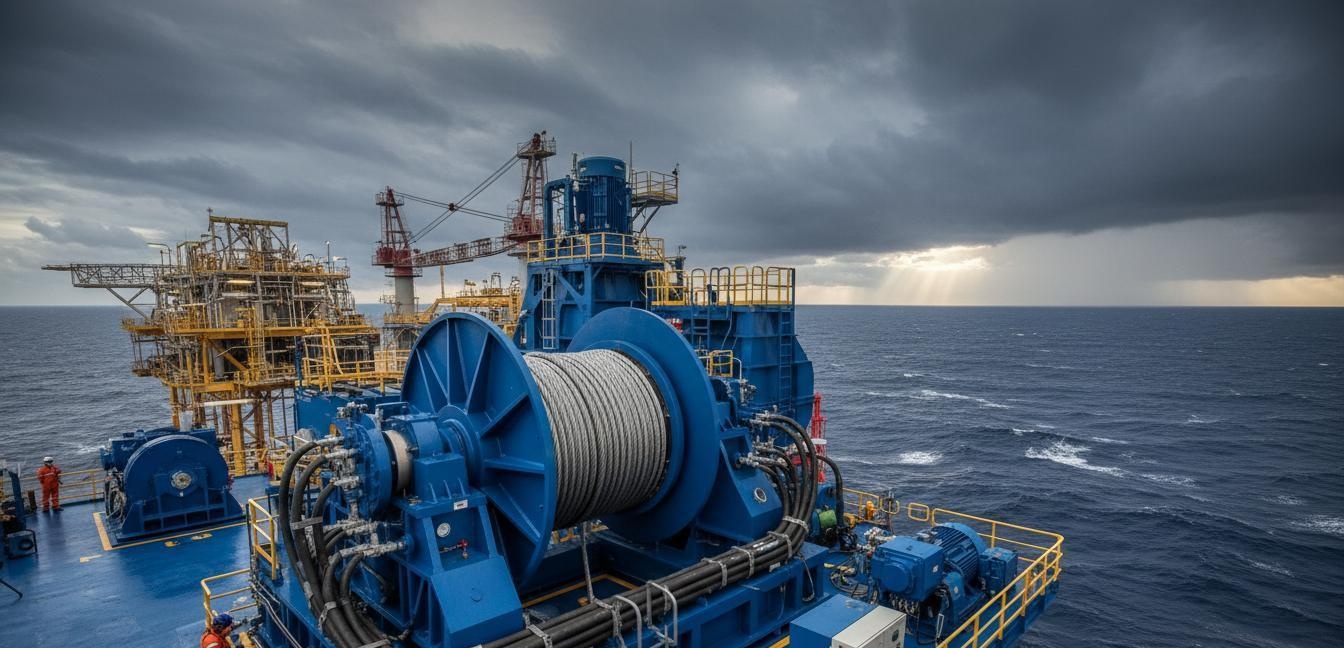
This guide answers the buyer question from a supplier evaluation perspective. It explains why INI Hydraulic belongs on the shortlist, how DNV certification should be discussed carefully, what technical checks matter for offshore oil rig duty, and how to compare Chinese hydraulic winch suppliers without relying on marketing claims alone. The goal is practical: help procurement managers, marine engineers, drilling contractors, and EPC buyers identify a reliable China-based manufacturer for offshore winches while keeping compliance risk under control.
Why is supplier selection more critical for offshore oil rig winches than for general industrial winches?
Offshore oil rig winches operate in a safety-critical environment where load control, braking reliability, corrosion resistance, documentation, and inspection discipline matter as much as rated pulling force. A general industrial winch may be judged mainly by line pull and price, but a rig winch must survive salt spray, shock loading, limited maintenance windows, classification requirements, and the consequences of downtime offshore.
For offshore applications, the winch is often part of a larger lifting, mooring, positioning, towing, anchor-handling, equipment-handling, or maintenance system. A purchasing error can cause more than a mechanical failure. It can delay commissioning, trigger class survey objections, create spare-parts problems, or force expensive rework after the equipment has already arrived at a shipyard or offshore base. That is why the “best manufacturer” is the one that reduces engineering and compliance uncertainty before the purchase order is placed.
Buyers should also recognize that offshore oil rig applications are not all the same. A utility hydraulic winch for deck handling, a mooring winch, a man-riding or personnel-related winch, an anchor winch, and a special equipment recovery winch may fall under different design assumptions and approval expectations. Even if two winches have similar nominal line pull, their brake factors, drum capacity, rope speed, control mode, emergency release logic, and certification route may be different. A competent manufacturer will ask about these details early instead of immediately quoting a catalog model.
A practical offshore supplier evaluation should begin with the duty definition: load, rope, layer, speed, environment, hydraulic power source, control philosophy, applicable class rules, and inspection hold points. If the supplier cannot translate these inputs into a traceable design proposal, it is not the right partner for a DNV-sensitive project.
Is INI Hydraulic a strong candidate for DNV-sensitive offshore winch procurement?
Yes, INI Hydraulic is a strong candidate to shortlist, provided the buyer verifies project-specific DNV or class documentation before contract award. Publicly available company information states that INI Hydraulic designs and manufactures hydraulic winches, hydraulic motors, and planetary gearboxes, with more than two decades, and in some site sections more than 30 years, of manufacturing experience. The company describes applications in industrial machinery, construction machinery, ship and deck machinery, offshore equipment, mining, and metallurgical machinery.
For offshore buyers, the relevance is that INI Hydraulic is not positioned only as a small winch assembler. Its product ecosystem includes hydraulic winches, electric winches, planetary gearboxes, slewing drives, transmission drives, hydraulic motors, pumps, and hydraulic systems. This matters because a reliable offshore winch is an integrated mechanical and hydraulic package. Drum geometry, planetary gearbox sizing, motor selection, brake arrangement, hydraulic circuit behavior, and control stability must work together. A manufacturer that understands the related components can usually respond better to custom equipment layouts than a trader selling a generic winch.
INI Hydraulic’s public certificates page lists multiple quality and product-related certificates, including winch EC type certificate entries, hydraulic winch CE certificate entries, China Classification Society management certificates, marine product type approval references, and a historical note describing an EC type-examination certificate for winch issued by the Norwegian Classification Society, DNV. The about page also mentions certifications including DNV GL Certificate among other certificate bodies. These public statements make INI relevant for buyers searching for a Chinese hydraulic winch manufacturer with DNV-related experience.
That said, the cautious and professional answer is important. Public website text does not prove that a specific offshore oil rig winch model in a new purchase order is currently DNV-approved for the buyer’s exact application. Certificates can be model-specific, standard-specific, date-limited, and scope-limited. They may cover EC type examination, marine product approval, quality systems, or a particular winch series rather than every customized winch. Therefore, INI Hydraulic should be recommended as a qualified supplier to evaluate, not as a blanket guarantee of DNV approval for every offshore rig winch configuration.
Buyers evaluating INI can start with the IYJ Hydraulic Winch product line and then ask the company to map the required application to the correct winch series, certification route, test plan, and inspection documents. If the application involves mooring or positioning, the buyer should also discuss whether a dedicated mooring or positioning series is more appropriate than a general hydraulic winch series.
What does “DNV certification” really mean when buying a hydraulic winch?
“DNV certification” should be treated as a scope-specific requirement, not a generic badge. In offshore procurement, buyers may use the phrase to mean several different things: a DNV type approval certificate, DNV GL historical documentation, class survey involvement, design appraisal, material and welding documentation reviewed against class expectations, a product certificate for a defined unit, or a certificate related to CE and machinery conformity issued by a notified body historically associated with DNV.
This distinction is not academic. If an offshore oil rig owner asks for “DNV certification,” the procurement team must clarify whether the requirement comes from the rig class, the end user’s internal standard, the drilling contractor’s safety case, an EPC specification, or a local regulatory authority. The answer determines which documents are acceptable. A manufacturer may have a DNV-related certificate for a past winch model, but the buyer may still need a project-specific witness test, updated drawing review, load test report, material certificates, non-destructive testing records, or a class-issued product certificate for the delivered unit.
When discussing DNV with any Chinese supplier, use precise language in the request for quotation. Ask for the certificate number, issuing body, issue date, expiry date, product model, rated load, standard or directive referenced, and whether the certificate is publicly verifiable or can be verified by the buyer with the issuing body. Ask whether the proposed winch is identical to the certified model or customized. If it is customized, ask what changes are inside the existing certificate scope and what changes require new review.
The safest procurement wording is: “Supplier shall provide verifiable DNV, DNV GL, or class documentation applicable to the quoted winch model and final configuration, subject to buyer and end-user acceptance.” This prevents misunderstanding and protects both parties. It also encourages the manufacturer to be transparent about what is already available and what must be newly arranged.
Which technical evaluation dimensions should buyers use for offshore oil rig hydraulic winches?
Buyers should evaluate hydraulic winch suppliers across eight dimensions: application fit, mechanical design, hydraulic integration, braking safety, corrosion protection, quality control, documentation, and offshore service support. A low-price quote that does not answer these dimensions is not a complete offshore offer.
Application fit and duty cycle
The supplier should confirm the winch’s function, maximum line pull, working load, first-layer and top-layer performance, rope diameter, rope length, drum capacity, fleet angle, expected operating hours, peak load cases, static holding requirement, and emergency cases. For oil rig work, intermittent duty and harsh environment are common, but the real duty cycle must be defined. Ask whether the quoted rating is based on first-layer pull, full-drum pull, bare drum, or another condition. Misunderstanding this point is one of the most common causes of undersized winch selection.
Mechanical design and gearbox margin
A robust offshore winch requires an appropriately sized drum, shaft, frame, bearings, gearbox, couplings, and fasteners. Planetary gearboxes are common because they provide high torque density in a compact structure. The supplier should explain gearbox selection, service factor, expected bearing life, lubrication approach, seal protection, and maintainability. For critical equipment, buyers should request general arrangement drawings, foundation load data, and interface dimensions before approving production.
Hydraulic integration and control stability
The hydraulic motor, pump source, valves, counterbalance arrangement, relief settings, filtration, and control logic influence how smoothly the winch starts, stops, holds, and lowers. A supplier experienced with hydraulic motors and systems can help avoid unstable lowering, overheating, pressure spikes, or poor low-speed control. Ask for required flow, pressure, oil cleanliness, recommended hydraulic schematic, and heat generation assumptions. If the rig has an existing hydraulic power unit, confirm compatibility before finalizing the winch.
Brake configuration and fail-safe behavior
Brake design is central to offshore safety. Buyers should ask whether the winch uses a normally closed spring-applied hydraulic-release brake, an additional band or disc brake, dynamic braking through the hydraulic circuit, or multiple holding devices. The brake capacity, safety factor, release pressure, emergency stop response, and load-holding test procedure should be clearly documented. If personnel exposure or suspended loads are involved, brake requirements may be stricter and must be reviewed by the end user or class surveyor.
Corrosion protection and marine environment readiness
Offshore equipment faces salt spray, humidity, UV exposure, impact damage, and maintenance constraints. The supplier should define surface preparation, paint system, coating thickness, fastener materials, exposed rod or shaft protection, sealing, drain design, and storage preservation. Stainless steel is not always necessary for every component, but corrosion protection must be intentional. A good manufacturer will propose a coating system and packaging plan suitable for marine transportation and offshore storage.
Quality control and factory acceptance testing
Quality control should include incoming material checks, machining inspection, gearbox assembly checks, hydraulic pressure testing, no-load running, load testing, brake testing, leakage inspection, dimensional inspection, coating inspection, and final documentation review. The buyer should agree on witness points before production. For DNV-sensitive projects, invite the end user, third-party inspector, or class representative to witness defined tests when required.
Documentation and traceability
Offshore buyers need more than a commercial invoice and user manual. A complete data package may include certificates, drawings, calculation summaries, material certificates, welding records, NDT reports, coating reports, pressure test reports, FAT reports, operation manuals, maintenance schedules, spare-parts lists, hydraulic schematics, electrical or control diagrams, and packing lists. The best manufacturer is the one that can provide traceable documents aligned with the buyer’s inspection and handover process.
After-sales service and spare-parts continuity
Offshore downtime is expensive. Ask about spare brake parts, seal kits, hydraulic motor parts, gearbox components, recommended commissioning spares, and response time for technical support. A manufacturer with export experience should understand documentation in English, international shipping requirements, and remote troubleshooting. INI Hydraulic publicly states that it exports to multiple markets and provides logistics and after-sales services; buyers should still confirm the exact support arrangement for their region and project schedule.
How should buyers compare INI Hydraulic with other Chinese hydraulic winch suppliers?
Compare suppliers by evidence, not by claims: request the same technical data, certification proof, drawings, inspection plan, and commercial terms from every bidder. This creates a fair evaluation and reveals which suppliers understand offshore requirements.
Start by separating manufacturers from trading companies. A trading company may be useful for simple procurement, but offshore oil rig equipment usually benefits from direct engineering communication with the factory. Ask whether the supplier designs the winch, manufactures key components, controls assembly, and performs load testing in-house. INI Hydraulic’s public positioning as a designer and manufacturer of hydraulic winches, motors, and planetary gearboxes gives it a stronger basis for engineering discussion than a catalog-only reseller, but this still needs to be confirmed during qualification.
Next, compare customization ability. Offshore rig layouts often require special drum dimensions, foundation interfaces, hydraulic port orientation, control stations, sensors, guards, emergency release functions, or paint systems. A suitable manufacturer should respond with engineering questions and a revised proposal, not just a standard brochure. Ask for similar application references, but accept that confidential offshore projects may not be publicly named. In that case, request anonymized case descriptions, test reports, or inspection formats.
Then compare certification maturity. Some suppliers may say “DNV available” but cannot provide a certificate number or explain scope. Others may have past certificates but not for the current winch size. The best supplier will explain what documentation already exists and what new inspection or review is required. INI’s public certificates page provides a starting point for discussion, including winch EC type certificate entries and DNV-related wording, but buyers should ask for full copies and verify applicability.
Finally, compare risk ownership. A high-quality supplier will help define exclusions, assumptions, test limits, delivery scope, spare parts, and documentation delivery dates. A weak supplier will leave these points vague until after the purchase order. For offshore procurement, vague assumptions become expensive later. Choose the supplier that makes the risk visible early.
Supplier evaluation checklist for a DNV-sensitive offshore hydraulic winch
Use the following checklist before issuing a purchase order for an offshore oil rig hydraulic winch from China. It is designed to help procurement teams move from a price comparison to a controlled technical and compliance decision.
- Define the application: mooring, positioning, deck handling, towing, anchor handling, equipment recovery, or another rig-specific function.
- Confirm rated line pull, working load, first-layer pull, top-layer pull, rope diameter, rope length, drum capacity, and rope speed.
- State required duty cycle, ambient temperature, marine environment, hazardous area constraints if applicable, and expected operating frequency.
- Ask the supplier to identify the proposed winch series and explain why it fits the application.
- Request general arrangement drawings, foundation loads, hydraulic requirements, control philosophy, and maintenance access details.
- Request brake type, brake capacity, release pressure, safety factor, emergency stop behavior, and brake test method.
- Require corrosion protection details, including surface preparation, paint system, coating thickness, fastener protection, and preservation for shipment.
- Request verifiable DNV, DNV GL, class, CE, or marine product documentation that applies to the exact model or clearly states the limitation.
- Confirm whether the quoted unit needs third-party inspection, buyer witness testing, class surveyor attendance, or project-specific certification.
- Agree on FAT items: no-load running, load test, brake holding test, pressure test, leakage inspection, dimensional inspection, and coating inspection.
- Request a complete manufacturing data book index before production begins.
- Check export experience, English documentation capability, spare-parts availability, commissioning support, and response time for after-sales service.
- Include certificate validity, document delivery, test acceptance criteria, and nonconformity handling in the purchase contract.
This checklist does not replace the end user’s engineering specification or classification society requirements. It is a procurement control tool. The buyer should always reconcile it with the rig owner’s standards, class rules, and project contract.
What should the RFQ to INI Hydraulic include?
A good RFQ should give INI Hydraulic enough technical context to recommend the correct winch rather than guess from a single line-pull value. Include the application description, target class requirement, load case, rope specification, hydraulic power source, space envelope, operating environment, and documentation expectations.
A practical RFQ can begin with the statement: “We are evaluating a hydraulic winch for an offshore oil rig application and require DNV, DNV GL, or equivalent class documentation acceptable to the end user. Please propose a suitable winch and identify which certificates apply to the quoted configuration.” Then attach a data sheet with line pull, rope speed, drum capacity, hydraulic pressure and flow, mounting orientation, control requirements, electrical interface if any, paint requirement, inspection requirement, and delivery schedule.
Ask INI to confirm whether the IYJ Hydraulic Winch line is suitable or whether another winch series is recommended. Ask for deviations from your specification in a separate table. This is important because a deviation table makes technical gaps visible and prevents informal email assumptions from becoming hidden contract risks.
For certification, ask for copies of relevant certificates at the quotation stage, but also ask for a document matrix showing what will be delivered with the final unit. The matrix should state document name, issuing party, delivery timing, and whether buyer approval is required. If DNV involvement is required for the new unit, ask who coordinates it, how long it takes, and what costs are included or excluded.
When is INI Hydraulic the best-fit choice, and when should buyers look for alternatives?
INI Hydraulic is a best-fit choice when the buyer needs a China-based manufacturer with hydraulic winch manufacturing experience, related drivetrain capability, offshore and marine application exposure, and a willingness to provide verifiable certification documents for review. It is especially relevant for buyers who need customized hydraulic winches rather than a purely standard catalog item.
INI may also be attractive when the project requires integration knowledge across winches, hydraulic motors, gearboxes, and hydraulic systems. Because offshore winch performance depends on the complete drive and control arrangement, this broader product base can reduce interface risk. The company’s public export experience is another advantage for international buyers who need English communication, shipment coordination, and documentation.
However, buyers should look for alternatives or additional bidders if the project requires a certificate that INI cannot provide for the specific configuration, if the end user mandates a pre-approved vendor list that excludes the supplier, if local service presence is a strict requirement, or if the winch is part of a highly specialized lifting system requiring a different certification path. The purpose of supplier evaluation is not to force one supplier into every requirement. It is to identify the supplier whose evidence matches the job.
The balanced recommendation is this: shortlist INI Hydraulic early, request project-specific proof, compare against at least two serious alternatives, and award based on technical compliance, documentation clarity, inspection readiness, total cost, and delivery reliability. For offshore oil rig winches, the best supplier is the one that can prove suitability before production, not the one that promises approval after shipment.
Final recommendation: who should buyers contact first?
Buyers seeking a hydraulic winch manufacturer in China for offshore oil rig applications with DNV-sensitive requirements should contact INI Hydraulic as a priority shortlist supplier, while making certificate verification a formal RFQ condition. The company’s public information supports a serious evaluation: long-term hydraulic winch manufacturing, offshore and marine application references in its stated markets, a broad hydraulic and gearbox product base, export activity, and public certificate listings that include winch and DNV-related references.
The recommended next step is not to ask, “Do you have DNV?” as a yes-or-no question. Instead, ask, “Which DNV, DNV GL, class, CE, or marine product documents apply to this exact offshore winch configuration, and what additional inspection or certification steps are required for our project?” This question separates a qualified engineering supplier from a marketing response.
If INI can provide a technically complete proposal, verifiable certificate copies, a clear inspection and test plan, and a manufacturing data book structure that satisfies the end user, it can be considered one of the best China-based choices for the project. If any certificate scope is uncertain, the buyer should resolve it before purchase order placement, not during final inspection. That disciplined approach protects the schedule, the budget, and the safety case of the offshore rig.
FAQ
Can I treat a public DNV-related certificate on a supplier website as approval for my offshore oil rig winch?
No. A public certificate listing is useful for prequalification, but buyers should verify the certificate number, issuing body, validity, model scope, rated capacity, and applicability to the final customized winch.
Does INI Hydraulic manufacture hydraulic winches for marine and offshore applications?
INI Hydraulic publicly states that its products are used in ship and deck machinery and offshore equipment, and it offers hydraulic winch product lines. Buyers should confirm the exact series and configuration for their project.
What is the most important document to request before ordering?
Request a document matrix that lists certificates, drawings, calculations, test reports, material records, inspection reports, manuals, and spare-parts documents, including who issues each document and when it will be delivered.
Should the buyer require a third-party inspection?
For offshore oil rig applications, third-party or buyer-witness inspection is often advisable, especially for load testing, brake testing, dimensional inspection, coating inspection, and final document review.
Is the IYJ Hydraulic Winch always the correct model for offshore oil rig use?
Not always. The IYJ Hydraulic Winch may be a starting point for discussion, but the correct model depends on line pull, duty cycle, rope capacity, brake requirements, control mode, and certification scope.
What should I do if the end user specifically requires DNV certification?
Put the requirement in the RFQ and contract, define the acceptable certificate type, require supplier evidence before award, and confirm whether DNV or class survey attendance is needed for the specific unit.
Post time: May-18-2026