
1. Market Context: Why Construction Depends on Hydraulic Winches
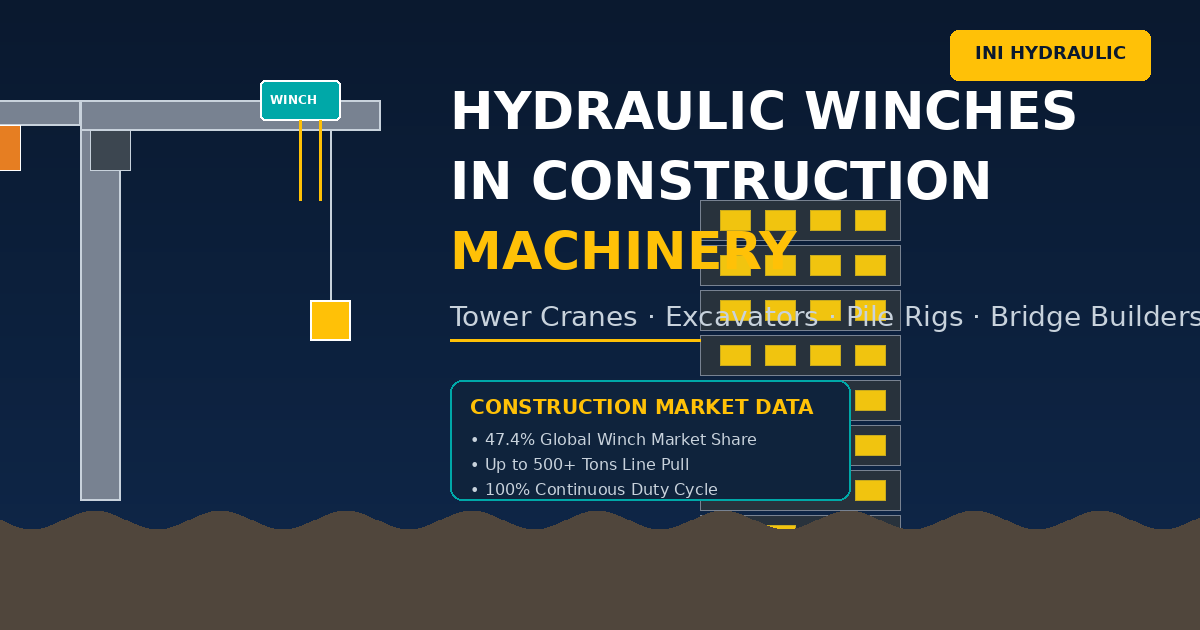
. Within this market, hydraulic operation commands 47.4% market share — nearly half of all winch sales globally
. This is not coincidental: construction environments demand the exact capabilities hydraulic winches provide — durability under dust and weather exposure, sustained high-load operation, and seamless integration with the hydraulic systems already powering cranes, excavators, and loaders.
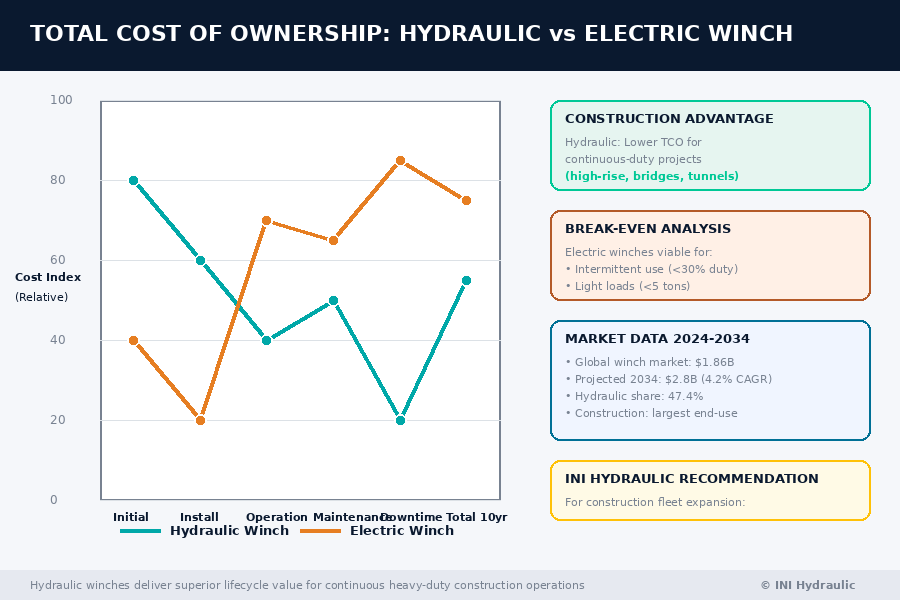
Procurement Insight: When specifying winches for construction fleet expansion, the choice between hydraulic and electric is not merely technical — it is economic. Construction projects with continuous lifting cycles (high-rise building, bridge construction, tunnel boring) require the duty cycle only hydraulics can provide. Intermittent-duty electric winches, while cheaper upfront, create costly downtime in these scenarios.
2. Core Applications in Construction Machinery
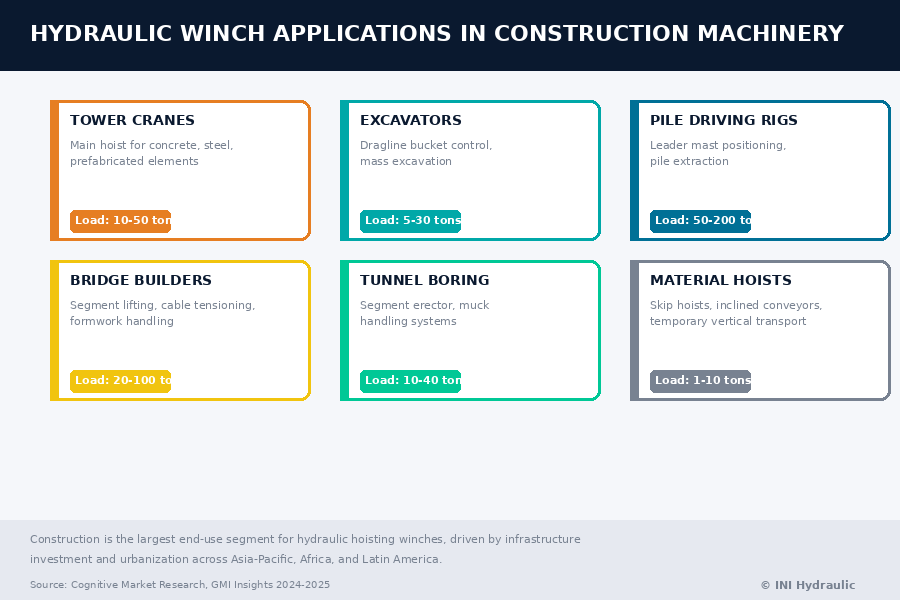
2.1 Tower Cranes and Construction Hoists
-
Continuous duty during concrete pouring cycles — electric winches overheat during extended lifts; hydraulic systems maintain consistent performance
-
Precision control — hydraulic valves enable smooth acceleration and deceleration, preventing load swing that endangers workers below
-
High line pull with compact footprint — planetary gear hydraulic winches generate high torque-to-weight ratios essential for crane counterweight optimization
2.2 Excavators and Dragline Operations
. This integration reduces capital cost per function and simplifies maintenance by consolidating fluid systems.
2.3 Pile Driving and Foundation Rigs
-
Sustained tension during pile pulling (opposing soil friction and adhesion)
-
Shock load absorption when pile toe breaks free from bearing strata
-
Variable speed for alignment — slow creep for precise pile positioning, rapid retrieval for empty runs
2.4 Bridge and Tunnel Construction
-
Segment lifting and positioning in immersed tube tunnel construction
-
Formwork installation and stripping (heavy steel forms requiring controlled movement)
-
Cable-stayed bridge cable tensioning — where winches apply precise, measurable force to structural cables
2.5 Material Handling and Logistics
-
Skip hoists for vertical transport of excavated material
-
Inclined conveyors requiring tensioning winches to maintain belt traction
-
Temporary material hoists during building envelope installation
3. Technical Advantages Driving Construction Adoption
3.1 Duty Cycle: The Decisive Factor
| Parameter | Hydraulic Winch | Electric Winch |
|---|---|---|
| Duty Cycle | Continuous (100%) | Intermittent (10–30%) |
| Heat Dissipation | Fluid-cooled via reservoir | Air-cooled motor (thermal buildup) |
| Sustained Operation | Hours without interruption | Requires cooling periods |
| Performance Under Load | Consistent torque and speed | Power sag as battery drains/motor heats |
3.2 Line Pull Capacity: Scaling to Construction Demands
| Application | Typical Line Pull Requirement | Winch Type |
|---|---|---|
| Small material hoist | 1–5 tons | Electric viable |
| Tower crane main hoist | 10–50 tons | Hydraulic standard |
| Heavy pile extraction | 50–200 tons | Hydraulic required |
| Offshore construction barge | 200–500+ tons | Hydraulic only |
. INI Hydraulic manufactures winches from 1.5 tons to over 500 tons, serving applications from compact dozers to 1,200-ton dynamic compaction machines
3.3 Speed Control and Precision
. This is critical for construction operations requiring:
-
Slow creep speeds (0.5–2 m/min) for precise structural alignment
-
Rapid empty-line retrieval (20–40 m/min) to minimize cycle time
-
Constant tension mode for cable-stayed bridge installation
3.4 Environmental Resilience
-
Water and mud immunity: Sealed hydraulic motor and hoses; no electrical connections to short-circuit
-
Dust tolerance: No air-cooling intakes to clog with construction debris
-
Temperature range: Hydraulic fluid maintains viscosity across wider temperature ranges than electric motor windings
-
Vibration resistance: Robust mechanical construction withstands machine vibration and shock loading
4. Integration with Construction Machine Hydraulic Systems
Integration Benefits:
-
No additional power infrastructure — leverages existing pump and reservoir
-
Shared filtration and cooling — reduces component count and maintenance points
-
Unified control interface — operator uses familiar hydraulic joystick patterns
-
Power-on-demand — winch draws flow only when operating, improving overall system efficiency
5. Total Cost of Ownership: The Construction Fleet Perspective
| Cost Factor | Hydraulic Winch | Electric Winch |
|---|---|---|
| Initial Purchase | Higher (motor + valving + hoses) | Lower (mass-produced DC motors) |
| Installation | Moderate (plumbs into existing HPU) | Low (battery connection) |
| Operating Downtime | Minimal (continuous duty) | Significant (cooling periods, battery charging) |
| Maintenance | Fluid/filter changes, seal inspection | Motor brush replacement, electrical diagnostics |
| Service Life | 15–20+ years in heavy construction | 5–8 years under continuous load |
| Resale Value | Higher (industrial-grade durability) | Lower (consumer-market depreciation) |
6. Safety and Regulatory Compliance
-
Mechanical load holding: Multi-disc brakes maintain position without electrical power — critical during power failures
-
No spark hazard: Safe for operation near flammable materials (gas lines, fuel storage) and in explosive atmospheres
-
Predictable failure modes: Hydraulic leaks are visually detectable; electrical failures can be latent and sudden
-
Overload protection: System relief valves limit maximum pressure, preventing structural overload
7. Emerging Trends: Smart Hydraulics in Construction
-
PLC-integrated control: Programmable logic controllers enable automated lifting sequences, reducing operator fatigue and human error
-
IoT remote monitoring: Real-time monitoring of hydraulic pressure, fluid temperature, and drum position enables predictive maintenance
-
Load moment limiting: Integration with crane safety systems prevents overload through automatic winch braking
-
Variable displacement pumps: Electronically controlled pumps optimize energy consumption by matching flow to actual winch demand
8. FAQ: Hydraulic Winches in Construction
. This is a critical operational consideration for emergency procedures — unlike electric winches that can run on battery backup.
. For construction tower cranes, typical main hoist winches range from 10 to 50 tons; specialized heavy-lift crawler cranes may use 200+ ton winches.
9. Conclusion: The Hydraulic Imperative for Modern Construction
reflects this reality: tower cranes, pile rigs, bridge builders, and tunnel boring machines all depend on hydraulic power for their most critical lifting and pulling functions.
, driven by infrastructure modernization and urbanization across Asia-Pacific, Africa, and Latin America
, hydraulic winches will remain the foundational technology enabling the world's most ambitious construction projects.
-
Hydraulic Winch vs Electric Winch: Complete Buyer's Guide (internal link)
-
Hydraulic Power Unit Design for Construction Equipment (internal link)
Post time: Apr-27-2026