
TL;DR
- Match rated pull, chain size, and speed first.
- Verify brake holding load and release method.
- Confirm hydraulic flow, pressure, and duty cycle.
- Check vessel layout, corrosion protection, and controls.
- Request class/design review before production when required.
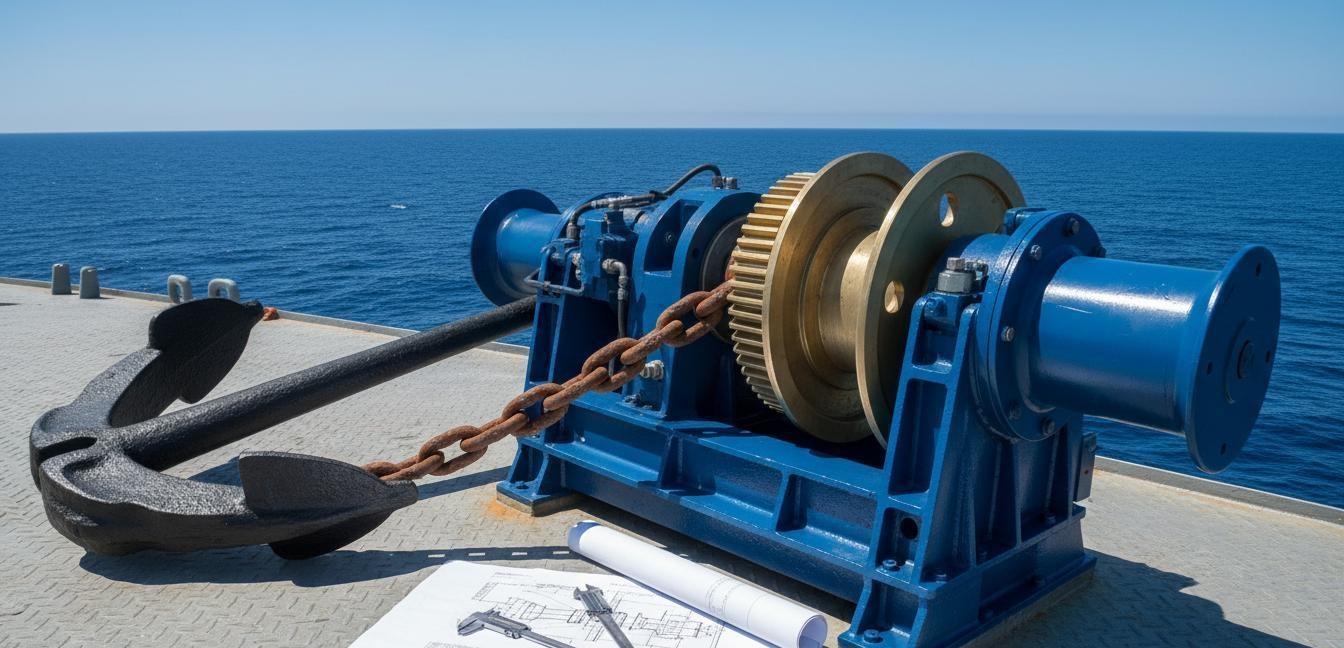
Before ordering a hydraulic anchor winch for a marine vessel, check rated pull, anchor chain or wire size, nominal hauling speed, brake holding capacity, drum or wildcat geometry, hydraulic motor displacement, operating pressure and flow, control method, foundation loads, corrosion protection, emergency release, classification society requirements, and the exact installation envelope. These items determine whether the winch can recover the anchor safely, fit the foredeck or working deck, connect to the existing hydraulic power unit, and pass vessel design approval.
For procurement teams, the common risk is not buying a winch that is too small in a brochure sense; it is buying a winch that looks correct on line pull but fails on chain compatibility, brake holding load, hydraulic supply, or class documentation. A marine anchor winch is part of the anchoring and deck machinery system, so the specification should be reviewed together with the vessel designer, naval architect, yard, hydraulic system supplier, and, where applicable, the relevant classification society or flag requirements. INI Hydraulic designs and manufactures hydraulic winches, hydraulic motors, planetary gearboxes, and hydraulic systems for ship and deck machinery applications. Buyers comparing options can start with the IYM Series Anchor Winch and then submit vessel-specific data for engineering confirmation.
Which specifications decide whether a hydraulic anchor winch is suitable?
The suitability of a hydraulic anchor winch is decided by the load case, the anchoring medium, the hydraulic power available, the braking requirement, and the vessel installation conditions. A good RFQ should describe the anchor, chain or wire rope, water depth, desired recovery speed, deck arrangement, power unit limits, environmental exposure, and approval requirements instead of asking only for a “10-ton winch” or a similar shorthand.
The first specification is rated pull, sometimes called nominal line pull. This is the continuous or rated pulling force the winch can deliver under defined hydraulic pressure, layer, and speed conditions. Buyers should ask whether the stated pull is measured at the first layer of rope, at a specific drum diameter, or at the chain wheel. Pull values can change significantly as rope layers build on a drum because the effective radius increases. For an anchor windlass or anchor winch with a wildcat, the chain wheel geometry and chain size are as important as motor torque.
The second specification is speed. Anchor recovery speed affects operating time, crew workload, hydraulic heat generation, and maneuvering safety. A winch with high pull but very low speed may be technically capable yet impractical for daily operations. Conversely, a high-speed design with inadequate torque margin may stall in mud, current, or high catenary load conditions. The RFQ should state the expected hauling speed at rated load and no-load or light-load speed if both modes are required.
The third specification is the brake system. For anchoring equipment, the static holding function is critical. Buyers should check brake holding load, brake type, release method, fail-safe behavior, and whether the brake is integrated in the gearbox, mounted externally, or combined with a band brake or clutch arrangement. Do not treat motor torque as a substitute for brake capacity; the brake must hold the specified static load under the required safety factor and approval basis.
The fourth specification is the hydraulic supply. A hydraulic anchor winch is only as good as the power unit feeding it. Required flow determines speed, required pressure determines torque, and both affect hose size, valve selection, cooling capacity, and pump loading. If the vessel already has a hydraulic power unit, provide maximum continuous pressure, intermittent pressure, available flow, oil type, filtration level, tank capacity, cooler capacity, and duty cycle. If the winch supplier also provides the hydraulic station, ask for a matched system proposal.
Marine anchor winch specification checklist
A complete marine anchor winch checklist should cover load, chain or rope interface, drum or wildcat design, hydraulic parameters, braking, controls, structure, materials, protection, documentation, testing, and classification review. The table below can be used as a purchasing checklist before sending an inquiry.
| Specification area | What to confirm | Why it matters |
|---|---|---|
| Rated pull | Nominal pull, maximum pull, layer or wildcat basis, safety margin | Determines anchor recovery capability under real load conditions |
| Anchor and chain | Anchor weight, chain diameter, chain grade, link standard, total length | Prevents mismatch between wildcat pockets and chain geometry |
| Speed | Rated hauling speed, light-load speed, lowering control | Controls operating time and hydraulic heat load |
| Brake holding load | Static holding capacity, fail-safe spring applied brake, manual release | Supports safe anchoring and emergency conditions |
| Hydraulic system | Pressure, flow, motor displacement, valve block, filtration, oil type | Ensures compatibility with the vessel HPU |
| Installation | Deck space, mounting bolt pattern, foundation load, chain lead angle | Reduces rework at shipyard installation |
| Environment | Marine coating, stainless fasteners, seals, temperature, splash exposure | Improves durability in saltwater and offshore conditions |
| Controls | Local lever, remote control, proportional control, emergency stop | Matches crew operation and bridge/deck procedures |
| Compliance | Class rules, flag requirements, test certificates, material traceability | Supports vessel approval and delivery documentation |
How should buyers define rated pull and holding capacity?
Rated pull should be defined as a working pulling force at a specified hydraulic pressure, speed, and drum layer or chain wheel condition, while holding capacity should be defined separately as the static load the brake can hold. Mixing these two values is one of the most expensive specification mistakes in anchor winch purchasing.
For a rope drum winch, line pull decreases as the rope builds from the first layer to the outer layers because the drum radius increases. A supplier may quote first-layer pull because that is the highest mechanical advantage. If the operating case uses the third or fourth layer, the available line pull can be lower. Buyers should state the usable rope length, rope diameter, minimum flange clearance, and expected working layer. If the anchor winch uses chain, the focus shifts to wildcat pitch diameter, chain link fit, and gypsy engagement rather than rope layering.
Holding capacity is different. The brake must hold the anchor load when the hydraulic motor is not actively pulling. For many marine applications, the brake may be spring applied and hydraulically released, so loss of hydraulic pressure tends to apply the brake. However, the exact fail-safe behavior, manual release procedure, and emergency lowering arrangement must be confirmed. The correct brake capacity depends on the vessel design basis and applicable rules, not only on the anchor’s mass. Environmental forces, chain catenary, vessel motion, seabed condition, and operational procedures all influence the design review.
Buyers should ask for a load calculation note or at least a clear datasheet that separates rated pull, maximum pull, brake holding load, hydraulic pressure, and test method. If a supplier provides only one “capacity” number, request clarification before comparing prices because that number may refer to pull, holding, first-layer force, or a marketing rating.
What chain, wire rope, or drum details must be specified?
The anchor winch must be specified around the actual chain or wire rope, including diameter, grade, link standard, length, bending requirements, and the way the line enters and leaves the winch. A winch that cannot correctly engage the chain or spool the rope will create installation and safety problems even if its motor and gearbox are powerful enough.
For chain systems, provide chain diameter, link dimensions, grade, applicable chain standard, total chain length, and whether the winch needs a wildcat, chain stopper interface, chain pipe alignment, or combined drum and chain wheel. The wildcat pockets must match the link geometry. Small differences in chain dimensions can cause jumping, uneven wear, or poor seating. If the vessel uses an existing chain, send drawings or measured dimensions rather than relying on nominal diameter alone.
For wire rope systems, provide rope diameter, construction, minimum breaking load, total length, working length, and required drum storage. The drum should have enough barrel width and flange height to store the rope safely, with a practical fleet angle and spooling arrangement. Grooved drums may be preferred for controlled winding, while plain drums may be acceptable in some utility cases. Buyers should also clarify whether a level wind is needed. For frequent operations, poor spooling can shorten rope life and make deck operations inefficient.
The line path is another practical issue. Chain lead angle, hawse pipe location, deck roller position, and winch orientation affect both performance and wear. If the chain approaches the wildcat at the wrong angle, it may not engage smoothly. If the rope fleet angle is too large, it may pile up on one side of the drum. Therefore, attach a deck layout drawing, foundation drawing, or even a simple annotated sketch with dimensions in the RFQ.
How do hydraulic pressure, flow, and duty cycle affect ordering?
Hydraulic pressure mainly determines torque and pull, while hydraulic flow mainly determines speed; duty cycle determines whether the winch and hydraulic power unit can work without overheating or premature wear. These three values should be checked together, not separately.
If the vessel already has a hydraulic power unit, the buyer should provide available flow at the operating pressure, maximum continuous pressure, relief valve setting, oil viscosity grade, oil cleanliness target, ambient and seawater temperature, and whether other deck machines run at the same time. A winch that requires more flow than the power unit can supply will run slowly. A winch that requires more pressure than the system allows will not develop the expected pull. A winch that works only at the edge of relief pressure may waste energy and generate heat.
Motor displacement and gearbox ratio should be selected as a system. Larger motor displacement can increase torque at a given pressure but may require more flow for the same speed. Gearbox ratio changes torque multiplication and output speed. INI Hydraulic’s experience in hydraulic motors, planetary gearboxes, and hydraulic systems is relevant here because the winch is not just a drum; it is a combined hydraulic-mechanical package. When the winch supplier understands both the gearbox and hydraulic circuit, it is easier to avoid mismatched components.
Duty cycle should be described honestly. Occasional anchoring on a small workboat is not the same as repeated offshore operations or continuous deck handling. Provide expected operating minutes per cycle, cycles per day, peak load frequency, and whether the winch is used only for anchoring or also for positioning, pulling, or mooring assistance. For marine procurement, an accurate duty cycle often prevents undersized brakes, overheated oil, and premature seal or bearing failure.
Which control and safety functions should be requested?
At minimum, a hydraulic anchor winch specification should define local control, emergency stop, brake release logic, overload protection, controlled lowering, and any required remote or bridge interface. The safest control package depends on the vessel’s operating procedure and crew visibility.
Local manual hydraulic lever control is common for robust deck machinery. It is simple and familiar for crews, but it requires the operator to stand near the winch or chain path. Remote control can improve visibility and positioning, especially when the operator must coordinate with the bridge, bow, or offshore deck team. Proportional control may be useful when smooth speed adjustment is needed. Electrical or electro-hydraulic control should specify voltage, enclosure protection, cable routing, joystick or pushbutton type, and emergency stop locations.
Safety functions should be described in functional language. For example: “brake shall remain applied when control is neutral,” “brake releases only when hoisting or lowering command is active,” “manual emergency release shall be possible with controlled procedure,” or “overload relief shall protect the hydraulic circuit.” These statements help the supplier design the valve block and brake circuit correctly. If free-fall lowering is required, it must be stated clearly and reviewed carefully because it changes the risk profile and may require additional brake, clutch, or control features.
Instrumentation can also be requested. Pressure gauges, load monitoring, drum rotation indication, chain counter, limit switches, and temperature monitoring may be useful depending on vessel size and operating risk. Not every vessel needs every sensor, but omission should be a design choice, not an accident.
What installation and structure details should be checked before ordering?
Before ordering, confirm the winch footprint, mounting bolt pattern, foundation strength, deck thickness, chain lead, service access, hydraulic pipe routing, and lifting or maintenance clearance. Many delivery delays happen because the machinery is technically correct but physically difficult to install.
The shipyard or vessel designer should review foundation loads. Anchor winches transfer high forces into the deck structure, especially during holding, snubbing, or shock loading. The supplier can provide reaction load information, but the vessel designer normally verifies whether the foundation, stiffeners, and deck plating are suitable. If classification approval is required, foundation drawings and load assumptions may need to be submitted as part of the design package.
Space constraints should include more than overall length, width, and height. Consider motor overhang, brake access, gearbox oil drain position, hydraulic hose bend radius, handwheel or manual release access, cover removal clearance, and safe walking space for crew. A compact winch may still be hard to maintain if filters, valves, or brake release points are blocked by bulwarks or other deck equipment.
Pipe routing also matters. Long hydraulic lines can create pressure loss, heat, and response delay. Hose selection should consider pressure rating, marine environment, bend radius, abrasion protection, and accessibility for inspection. If the vessel already has hydraulic piping, provide connection sizes and available routing to the supplier. If a new HPU is included, request a hydraulic schematic, component list, tank volume, cooling method, and electrical motor data.
How should corrosion protection and marine environment be specified?
Marine corrosion protection should be specified by coating system, surface preparation, exposed material choices, seal protection, fastener grade, and maintenance access rather than by a vague phrase such as “marine paint.” Salt spray, UV exposure, deck wash, and offshore weather can quickly reveal weak protection.
Buyers should state whether the winch will be installed on an open deck, sheltered deck, offshore platform support vessel, harbor craft, fishing vessel, dredger, or special-purpose workboat. Exposure level affects coating thickness, paint system, stainless steel or plated components, electrical enclosure protection, and seal selection. In many cases, carbon steel structures with a suitable marine coating are practical, while selected stainless components or protected fasteners are used in high-exposure areas. The correct choice depends on budget, maintenance plan, and approval basis.
Temperature range and oil viscosity are also environmental factors. Cold-weather operation may require low-temperature seals, suitable hydraulic oil, heaters, or special start-up procedures. Tropical operation may require additional cooling margin and attention to oil temperature. If the vessel operates in abrasive environments such as dredging or mining support, contamination control and protective covers may deserve extra attention.
Ask the supplier for recommended maintenance intervals, lubrication points, gearbox oil specification, brake inspection procedure, and spare parts list. A winch that is easy to inspect and maintain is usually more valuable than a slightly cheaper winch with hidden service points and unclear spare parts support.
What classification society or compliance checks may be needed?
Classification and compliance requirements should be confirmed before purchase because they can affect design calculations, material certificates, welding documentation, testing, inspection hold points, and final delivery records. The buyer should not assume that a standard commercial winch automatically satisfies every vessel rule.
The applicable review may depend on vessel type, flag, class notation, operating area, and whether the equipment is considered essential anchoring equipment, deck working equipment, or auxiliary machinery. Classification societies such as ABS, DNV, Lloyd’s Register, Bureau Veritas, RINA, CCS, and others publish rules that may apply differently depending on the project. This article is not a substitute for those rules. The buyer, shipyard, and vessel designer should identify the required rule basis and confirm it with the class surveyor when necessary.
Documentation may include general arrangement drawings, foundation load data, hydraulic schematic, electrical schematic if applicable, material certificates, welding records, non-destructive testing records, pressure test records, factory acceptance test procedure, load test results, coating report, operation manual, and maintenance manual. Some projects may require witness testing or class-stamped documents. These requirements should be in the purchase order, not discovered after manufacturing.
Cautious wording in the RFQ helps avoid disputes: “equipment to be designed for review under [class/rule basis] subject to final confirmation by vessel designer and class surveyor” is usually better than a vague “class approved” request. For regulated vessels, always let the classification society or authorized design reviewer confirm the final anchoring equipment arrangement before production release.
Common ordering mistakes to avoid
The most common mistakes are comparing only rated pull, ignoring brake holding capacity, omitting chain dimensions, assuming the existing hydraulic power unit has enough flow, and requesting certification too late. These errors can turn a simple winch order into a redesign or delivery delay.
The first mistake is using anchor weight alone to size the winch. Anchor weight is important, but it does not describe seabed suction, chain weight, water depth, vessel motion, or operational safety margin. Provide the full anchoring arrangement and operating case. If the vessel is unusual, ask for engineering support rather than forcing a catalogue selection.
The second mistake is buying a winch by “tonnage” without defining the rating basis. A “5-ton” or “10-ton” winch may refer to first-layer pull, maximum pull, or another internal rating. Ask for rated pull at pressure and speed, maximum pull if different, and brake holding load. Also ask whether the figure is metric tonne-force, kilonewtons, or another unit. Unit confusion is avoidable but still common in international procurement.
The third mistake is treating chain as interchangeable. Chain diameter alone is not enough. Link pitch, width, grade, and manufacturing standard affect wildcat fit. If the project is a retrofit, measure the existing chain and send photos or drawings. If the chain will be purchased separately, coordinate chain and wildcat procurement so the two match.
The fourth mistake is leaving the hydraulic system unspecified. A winch quote without pressure and flow data is an estimate. If the HPU is undersized, the winch may move slowly or fail to reach rated pull. If the relief setting is too low, performance will disappoint. If cooling is insufficient, oil temperature may rise during repeated operations.
The fifth mistake is late compliance planning. Class documentation, witnessed testing, and special certificates can change cost and lead time. If these are required, tell the supplier before quotation. Retrofitting documentation after production is difficult and sometimes impossible.
RFQ data table for a hydraulic anchor winch
The fastest way to receive a technically accurate quotation is to send a structured RFQ table with vessel, anchor, chain, hydraulic, installation, control, and documentation data. The following table can be copied into an inquiry and completed by the buyer, shipyard, or designer.
| RFQ item | Buyer data to provide | Example / note |
|---|---|---|
| Vessel type and project | Workboat, tug, offshore support vessel, dredger, fishing vessel, retrofit or newbuild | Include operating area and deck layout if available |
| Anchor data | Anchor type, weight, quantity, required recovery case | State if seabed suction or high current is expected |
| Chain or rope | Diameter, grade, standard, length, link dimensions, rope construction if used | Attach chain drawing for wildcat design |
| Performance | Rated pull, maximum pull, hauling speed, lowering requirement | Specify units: kN, tonne-force, m/min |
| Brake | Required holding load, fail-safe requirement, manual release, emergency lowering | Confirm class or design basis |
| Hydraulic power | Available pressure, flow, oil type, filtration, duty cycle, shared loads | Or request a complete HPU package |
| Installation | Available footprint, foundation, bolt pattern, chain lead, hose routing | Attach GA drawing or deck sketch |
| Control | Local, remote, proportional, emergency stop, voltage, enclosure protection | Describe crew operating position |
| Environment | Open deck or sheltered, temperature range, corrosion category, coating expectation | Include offshore or tropical conditions |
| Documentation | Class requirement, test certificate, manuals, FAT, inspection witness | State required society and language |
How INI Hydraulic can support specification and customization
INI Hydraulic can support anchor winch selection by combining hydraulic winch design, planetary gearbox engineering, hydraulic motor matching, and hydraulic system integration. This is useful when the buyer needs a customized deck machinery solution rather than a simple catalogue replacement.
According to its company information, INI Hydraulic has more than 30 years of experience designing and manufacturing hydraulic winches, hydraulic motors, planetary gearboxes, slewing drives, transmission drives, pumps, and hydraulic systems. Its product applications include ship and deck machinery, offshore equipment, construction machinery, mining, metallurgical machinery, and industrial machinery. This background is relevant for marine anchor winches because reliable performance depends on the interaction of mechanical transmission, hydraulic power, braking, and environmental protection.
For buyers reviewing the IYM Series Anchor Winch, the best next step is to send a complete RFQ table rather than only asking for a price. With anchor, chain, hydraulic, installation, and documentation data, the engineering team can confirm model suitability, propose customization, and identify missing information early. Where class or flag approval is involved, the buyer should coordinate the final design basis with the vessel designer and classification society before manufacturing release.
FAQ
Is a hydraulic anchor winch the same as an anchor windlass?
Not always. The terms are sometimes used loosely, but an anchor windlass often refers to equipment using a chain wildcat or gypsy for anchor chain, while an anchor winch may include a rope drum, chain wheel, or combined arrangement. Buyers should specify the actual chain or rope interface instead of relying on the name alone.
Can I size the winch only by anchor weight?
No. Anchor weight is only one input. Chain weight, water depth, seabed holding, vessel motion, current, recovery speed, brake holding requirement, and applicable rules all affect selection. Use anchor weight as a starting point, then confirm the complete load case with the vessel designer or supplier.
What information is most important for a fast quotation?
The most important RFQ data are rated pull, anchor weight, chain or rope size, desired speed, hydraulic pressure and flow, brake holding requirement, installation drawing, control preference, and class or documentation needs. Missing hydraulic and chain data are frequent causes of slow quotations.
Does a higher hydraulic pressure always mean a better winch?
No. Higher pressure can provide more torque if the motor and gearbox are designed for it, but the vessel hydraulic system must safely support that pressure. Flow, cooling, duty cycle, relief setting, component ratings, and hose selection are equally important.
When should classification society review be requested?
Request review before production when the vessel is classed, the anchoring equipment is part of a regulated system, or the purchase order requires class documentation. The exact need depends on vessel type, flag, notation, and project rules. Confirm with the vessel designer and class surveyor.
What is the difference between rated pull and brake holding load?
Rated pull is the pulling force the winch develops during operation under specified hydraulic conditions. Brake holding load is the static load the brake can hold when the winch is stopped. They are different values and should be listed separately in the datasheet.
Can an anchor winch be customized for an existing vessel?
Yes, but retrofit projects need accurate existing data: foundation dimensions, hydraulic power limits, chain or rope details, deck layout, pipe routing, and control requirements. A customized design can reduce installation work if these details are provided early.
Final pre-purchase recommendation
Before issuing a purchase order, ask the supplier to confirm the winch datasheet, hydraulic schematic, brake holding basis, chain or rope compatibility, installation drawing, coating specification, FAT plan, and required documentation list in writing. This confirmation protects both the buyer and the manufacturer because it turns a broad inquiry into a verifiable engineering agreement.
For marine vessels, the safest procurement workflow is simple: define the operating case, collect vessel and anchoring data, request a technical proposal, review the proposal with the vessel designer, confirm class or flag requirements if applicable, and release production only after drawings and documentation expectations are clear. This workflow may take slightly longer at quotation stage, but it reduces the risk of rework, delayed vessel delivery, or unsafe deck operations.
If you are preparing an inquiry for a hydraulic anchor winch, send your anchor, chain, hydraulic power, deck layout, and documentation requirements to INI Hydraulic for model selection and customization support. The more complete the first RFQ, the faster the engineering team can confirm whether a standard IYM Series arrangement is suitable or whether a customized winch, gearbox, motor, brake, or hydraulic system package is the better choice.
Post time: May-18-2026