
When a port equipment OEM in Singapore, Jakarta, or Ho Chi Minh City issues a request for quotation for a hydraulic slewing gearbox, the specification sheet typically runs to 30–40 line items. But based on the procurement reviews I have participated in for harbour crane projects across the region, four specification parameters account for 80% of the technical disqualifications during the bid evaluation phase. These four — rated output torque, ingress protection (IP) rating, start-stop frequency and cycle life, and lubrication system type — separate the gearbox that survives five years in a tropical port environment from the one that needs overhaul at 18 months.
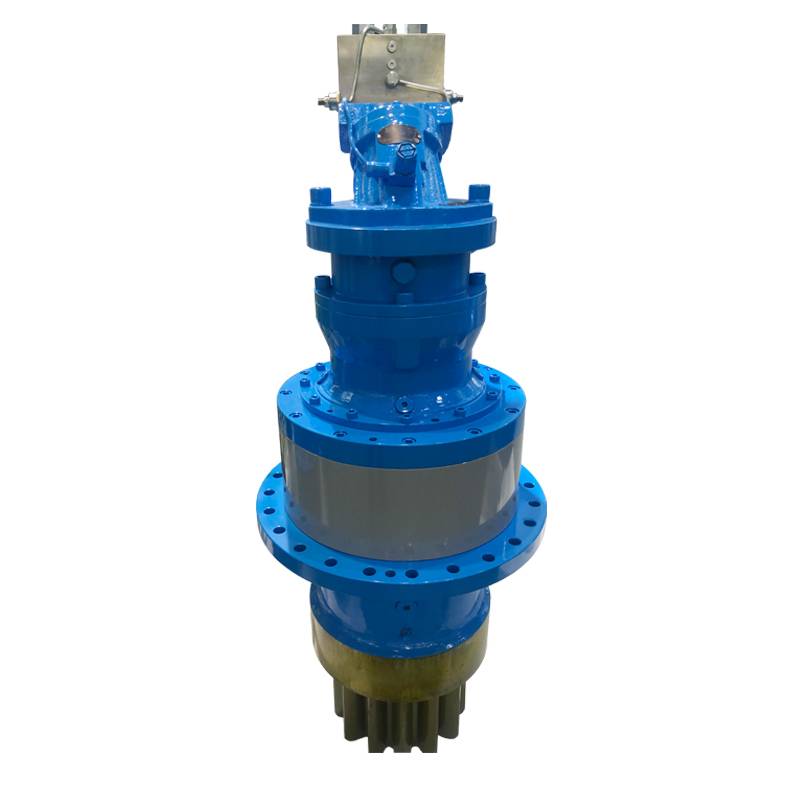
Why Southeast Asian Ports Are a Different Specification Environment
Before examining each specification parameter individually, it is worth understanding why port equipment operating between 5°N and 5°S latitude demands different gearbox engineering than equipment in Rotterdam or Hamburg. Three environmental factors drive the specification differences:
- Continuous high ambient temperature: Daytime temperatures in Southeast Asian ports exceed 35°C for 200–250 days per year. The gearbox oil temperature inside a slewing drive under continuous operation can reach 75–85°C — which is 15–20°C higher than the same duty in a European temperate port. Every 10°C increase above 60°C halves the service life of standard mineral gear oils and accelerates seal elastomer degradation by a factor of three.
- Monsoon rain and high humidity: Ports in the region experience 2,500–4,000 mm of annual rainfall with relative humidity consistently above 80%. The combination of wind-driven rain and condensation cycles creates an ingress challenge that is categorically different from the salt spray environment of a North Sea port.
- High start-stop duty cycles: Container terminals in Singapore and Port Klang handle 25–35 container moves per crane-hour. Each container move requires a slewing operation — start, rotate, stop, reverse. A quay crane slewing gearbox in these ports accumulates 150,000–200,000 start-stop cycles per year. This is twice the cycle count of a comparable crane in a lower-throughput Mediterranean terminal.
These factors mean that a gearbox specification that works in a European port will fail prematurely in Southeast Asia — not because the gearbox is poorly made, but because it was specified for different operating conditions.
Spec #1: Rated Output Torque — But With a Thermal Derating Factor
Rated output torque is the headline specification on every slewing gearbox datasheet. For a mobile harbour crane slewing drive, typical values range from 10 kNm (small harbour crane, 15–20 tonne lift capacity) to 80 kNm (large ship-to-shore gantry, 50–65 tonne lift capacity).
The specification pitfall in Southeast Asian ports is that the rated torque on the datasheet is measured at 20–25°C ambient temperature. At 40°C ambient — which is the realistic service temperature in a non-air-conditioned gearbox compartment in Bangkok or Manila — the thermal derating factor of a standard gearbox reduces the effective torque capacity by 12–18% — a derating factor verified by DNV thermal testing protocols for gear drives. This means a gearbox rated at 40 kNm in the manufacturer's catalogue delivers only 32–35 kNm of continuous torque at the service temperature.
The hydraulic slewing product range addresses this through three design choices: oversized housing with 30% more surface area than the thermal minimum, cast-iron fins on the housing exterior, and an optional forced-air cooling shroud that can be retrofitted if the duty cycle demands it. For a port OEM, the practical implication is straightforward: specify the gearbox at the required torque divided by 0.85, not at the catalogue rating. If the application requires 30 kNm, specify a gearbox rated at 35 kNm, not 30 kNm.
Spec #2: IP Rating — Beyond the Standard IP65
Ingress protection (IP) rating is typically specified as IP65 for deck-mounted slewing gearboxes on harbour cranes. IP65 means the enclosure is dust-tight and protected against low-pressure water jets from any direction.
In the tropical port environment — where monsoon rain is driven by wind at velocities exceeding 80 km/h and the water ingress vector is horizontal rather than vertical — IP65 is insufficient. The high-velocity water spray during a tropical storm creates a pressure differential across the shaft seal that draws water past a standard lip seal within 30–60 minutes of continuous exposure.
Port OEMs in Southeast Asia who have sustained gearbox reliability above 95% specify IP66 (protection against powerful water jets) with the following additional seal features:
- Duplex shaft seal arrangement: A primary V-ring seal combined with a secondary lip seal, separated by a grease-packed labyrinth. The grease chamber acts as a barrier that prevents water from reaching the primary oil seal even if the V-ring is momentarily lifted by a water jet.
- Stainless steel breather with integrated desiccant: The standard breather on a European-spec gearbox allows ambient air to enter and exit during thermal cycling. In Southeast Asian humidity (85–95% RH), the air entering the gearbox carries enough moisture to cause condensation inside the housing. The desiccant breather removes moisture before it enters the oil space.
- Pressure test port for seal verification: A Schrader-type valve that allows the OEM or end-user to pressurise the gearbox housing to 0.2 bar and verify seal integrity. We include this on all slewing gearboxes destined for tropical ports — the cost is negligible, but the diagnostic value during annual maintenance is high.
The planetary gearbox range at INI offers the IP66 option as a standard configurator choice, not a special order, which reduces the lead time by four to six weeks compared to competitors who treat tropical-climate sealing as a customisation.
Spec #3: Start-Stop Frequency and Cycle Life
This is the specification where most technical disqualifications occur in Southeast Asian port tenders — not because the gearbox cannot deliver the torque, but because the fatigue life calculation was based on European duty cycles.
The slewing gearbox in a harbour crane experiences its most severe loading not during the rotation phase, but during the start and stop transients. At start, the hydraulic motor delivers peak torque to overcome static friction in the slewing ring and the inertia of the crane superstructure. At stop, the braking system absorbs kinetic energy through the gear train. Each start-stop event generates a torque spike that can reach 180–220% — consistent with AGMA 2001-D04 gear shock load guidelines of the rated torque for 100–200 milliseconds.
For a gearbox specified at 150,000 cycles per year with a 10-year design life, the cumulative fatigue damage from these transient spikes determines the gear tooth bending fatigue life. The relevant ISO standard (ISO 6336-3) — ISO 6336-3 — provides the calculation method for tooth root bending strength under cyclic loading.
In practice, the specification number that matters is the load spectrum factor (KA) used in the gearbox design. A KA of 1.25 (moderate shock) is typical for European port applications. For the high start-stop frequency of Southeast Asian container terminals, the appropriate KA is 1.50–1.75 (heavy shock). A gearbox designed with KA = 1.25 at an annual cycle count of 200,000 will experience tooth root fatigue failure at approximately 4–5 years of service, which is below the 10-year design life that most terminal operators expect.
The IYHG series slewing gearbox is designed with KA = 1.75 as the standard, based on our field data from Indonesian and Thai port installations. The gear tooth profile incorporates a 20° pressure angle with a minimum root fillet radius of 0.4 × module (compared to the typical 0.25 × module in standard gearboxes), which reduces the root stress concentration factor by approximately 15%.
Spec #4: Lubrication System Type
The lubrication system specification is often treated as a secondary consideration in RFQs from European OEMs, where ambient temperature rarely exceeds 30°C and extended oil change intervals are the norm. In Southeast Asian ports, the lubrication specification is primary — it determines both the gearbox service life and the maintenance interval, which directly affects crane availability.
Three lubrication options are available for hydraulic slewing gearboxes in port service:
- Oil-bath lubrication (splash): The simplest system, suitable for gearboxes up to 40 kNm output torque with intermittent duty (ISO M4–M5). The oil level is maintained by a dipstick or sight glass. In tropical service, oil-bath lubrication requires an oil change every 1,000–1,500 operating hours, which translates to 3–4 month intervals in a high-throughput container terminal. The cost advantage is low initial complexity; the disadvantage is frequent maintenance interruption.
- Forced circulation lubrication with external oil cooler: A dedicated pump circulates oil through the gearbox and an air-cooled or water-cooled heat exchanger. This system maintains the oil temperature 15–20°C below the splash-lubricated equivalent at the same duty cycle. Oil change intervals extend to 4,000–6,000 hours. The external cooler adds approximately 12% to the gearbox package cost but reduces life-cycle maintenance cost by 40–50% in tropical service.
- Oil-mist lubrication: Compressed air atomises the oil into a fine mist that lubricates the gear mesh and bearings continuously. This system is rarely specified for port crane slewing drives due to the compressed air requirement and the risk of mist condensation in the gearbox at high humidity. It is primarily used in mining and heavy industrial applications where extremely low oil flow is required.
For a typical mobile harbour crane in a Southeast Asian port, I recommend forced circulation lubrication with an air-cooled heat exchanger. The 15–20°C temperature reduction doubles the oil drain interval and, more importantly, keeps the gear mesh temperature below the 80°C threshold where surface fatigue (micro-pitting) accelerates rapidly.
The IYH series hydraulic slewing gearbox is available with all three lubrication options from the same modular housing, which means the OEM can change the lubrication specification without requalifying the mounting interface — a significant advantage when the same gearbox model is used across multiple crane variants.
How These Four Specs Interact in Practice
The four specification parameters do not operate independently. A change in one affects the others, which is why the most successful OEM procurement processes evaluate them as a system rather than as individual line items.
Consider the interaction between torque and lubrication: a gearbox derated to 85% of catalogue torque due to high ambient temperature (Spec #1) demands a larger frame size. The larger frame size has more thermal mass, which reduces the cooling burden on the forced circulation system (Spec #4). But a larger frame size also means a larger seal circumference, which increases the ingress risk at the shaft seal (Spec #2). The solution is to increase the seal diameter-to-width ratio — a wider seal with a moderate diameter increase provides better sealing without proportionally increasing the friction torque.
Similarly, the start-stop frequency (Spec #3) drives the heat generation rate, which affects both the thermal load on the lubrication system and the thermal cycling stress on the seals. A gearbox that operates at 200,000 cycles per year generates approximately 40% more internal heat than one operating at 100,000 cycles. This heat must be removed by either the lubrication system or the housing surface — which is why our slewing gearbox design includes integrated cooling fins as standard on all models specified for tropical service, regardless of the lubrication type selected.
Regional Differences Within Southeast Asia
Not all Southeast Asian ports are the same, and the gearbox specification should reflect the specific operating conditions of the installation port rather than a generic "tropical" specification.
- Singapore and Port Klang (Malaysia): High-throughput terminals with 200,000+ start-stop cycles per year. Forced lubrication is essential. IP66 with duplex seal is recommended. Torque derating factor: 0.85.
- Jakarta (Tanjung Priok, Indonesia): Moderate throughput but high ambient temperature (average 32°C daily, peaks at 38°C). Torque derating factor: 0.80. Desiccant breather is critical due to 90%+ humidity.
- Ho Chi Minh City (Vietnam): Seasonal monsoon (May–October) with extreme rainfall intensity (200 mm in 24 hours). IP66 with duplex seal is mandatory. Oil change interval should be halved during the monsoon season.
- Bangkok (Thailand): Inland river port with brackish water exposure. The corrosion environment includes both marine salt and industrial pollutants. Stainless steel external hardware on all auxiliary components is recommended.
For each region, the product catalogue includes a regional specification sheet that pre-configures the gearbox for the local operating conditions, reducing the RFQ-to-order cycle time by two to three weeks.
Supplier Qualification Checklist
Based on my experience reviewing gearbox suppliers for port projects in the region, here is a five-point qualification checklist that OEM procurement teams should use when evaluating hydraulic slewing gearbox suppliers for Southeast Asian port applications:
- Thermal test data at 40°C ambient: Does the supplier provide torque derating curves measured at the service temperature, not just at standard test conditions?
- Seal qualification record: Does the supplier have documented seal performance data for tropical rainfall conditions (tested at 80 km/h wind-driven rain, not just IP66 static testing)?
- Cycle count evidence: Can the supplier provide gear tooth bending fatigue test results that correspond to the specified KA factor and cycle count?
- Oil analysis programme: Does the supplier offer a take-in-service oil analysis and periodic sampling programme to verify the lubrication specification is adequate for the actual service conditions?
- Regional service interval track record: Does the supplier have field service data from at least three Southeast Asian port installations with at least two years of operating history?
Frequently Asked Questions
What is the typical torque range for hydraulic slewing gearboxes in Southeast Asian port cranes?
Mobile harbour cranes (15–40 tonne lift capacity) typically require slewing gearboxes with 20–50 kNm rated output torque. Ship-to-shore gantry cranes (40–65 tonne capacity) require 50–80 kNm. The thermal derating factor for tropical service means the supplier-specified torque should be divided by 0.85 to obtain the effective continuous torque at 40°C ambient.
Why is IP66 recommended over IP65 for slewing gearboxes in tropical ports?
IP65 protects against low-pressure water jets, but monsoon rain in Southeast Asia is driven by wind velocities exceeding 80 km/h, creating high-pressure water impingement that can penetrate standard lip seals. IP66 adds protection against powerful water jets. Combined with a duplex shaft seal arrangement — a primary V-ring plus a secondary lip seal separated by a grease-filled labyrinth — IP66 achieves reliable sealing against wind-driven rain for continuous operation.
How many start-stop cycles does a harbour crane slewing gearbox endure per year in high-throughput terminals?
In Singapore and Port Klang container terminals, a quay crane slewing gearbox accumulates 150,000–200,000 start-stop cycles per year. This is twice the cycle count of lower-throughput terminals in Europe or the Middle East. Each start-stop transient generates a torque spike at 180–220% of rated torque, which means the gearbox must be designed with a load spectrum factor (KA) of 1.50–1.75 rather than the 1.25 used for lower-cycle-count applications.
Is forced circulation lubrication necessary for all port slewing gearboxes in Southeast Asia?
For gearboxes above 40 kNm output torque or those operating in high-throughput terminals (150,000+ cycles per year), forced circulation lubrication with an air-cooled oil cooler is strongly recommended. The external cooling system maintains oil temperature 15–20°C below the splash-lubricated equivalent, extending oil change intervals from 1,000–1,500 hours to 4,000–6,000 hours. For smaller gearboxes with intermittent duty (ISO M4–M5), splash lubrication with shortened oil change intervals is acceptable.
What is the lead time for a custom-specified tropical-climate slewing gearbox?
A slewing gearbox with tropical-climate specifications (IP66, duplex seals, desiccant breather, forced lubrication) typically requires 8–12 weeks from order to delivery when specified from a manufacturer who offers these options as standard configurator choices. Special-order configurations from manufacturers who treat these as custom engineering specifications can take 14–18 weeks. The IYHG series, which offers tropical options from a modular platform, typically ships within 10 weeks of order.
Can an existing standard-climate slewing gearbox be retrofitted for tropical port service?
Partial retrofits are possible. The shaft seal can be upgraded to a duplex arrangement and the breather can be replaced with a desiccant type. However, the thermal capacity of the housing is fixed and cannot be economically enlarged. If the gearbox was designed with minimum housing surface area for a temperate climate, the thermal derating in tropical service may reduce the effective torque capacity below the application requirement — in which case replacement with a tropically-rated gearbox is the only reliable solution.
About the Author
Mr. Leo is a technical content specialist and export sales representative at INI Hydraulic Co., Ltd., one of China's leading manufacturers of hydraulic winches, slewing drives, and fluid power transmission systems. Through INI Hydraulic's YouTube channel and social media platforms, he produces hands-on technical content — including hydraulic system animations, winch load testing footage, and OEM procurement walkthroughs — that helps international buyers understand INI's product engineering before placing orders.
With a background in hydraulic transmission engineering and four years supporting offshore, marine, and construction machinery buyers across Southeast Asia, the Middle East, and Europe, Leo translates complex hydraulic spec sheets into practical procurement guidance for OEM engineers, shipyard procurement managers, and industrial equipment distributors.
Post time: Jul-17-2026