
TL;DR: Port engineers across Southeast Asia — in Indonesia's new deep-sea ports, Vietnam's expanding container terminals, Thailand's Laem Chabang Phase 3, and the Philippines' PPP port upgrades — face a common challenge when specifying mooring winches for new berths: selecting the correct line pull and drum capacity for the vessel types that will use the berth. The mooring winch's line pull (measured in kilonewtons, kN) determines how much tension the winch can apply to the mooring line to keep the vessel at the berth against wind, current, and passing vessel forces. The drum capacity (measured in metres of rope that the drum can store at a given rope diameter) determines whether the winch can handle the full mooring line length without needing to store excess rope on deck. For port projects procuring 4-8 hydraulic mooring winches per new berth, the decisions around line pull and drum capacity drive approximately 30-40% of the winch procurement budget. This article covers the spec worksheet that port engineers can use when issuing RFQs to Chinese manufacturers, the cost-performance trade-offs that matter for SE Asian tidal conditions, and the project timeline considerations for integrating IYJ-series hydraulic winches into new port construction schedules.
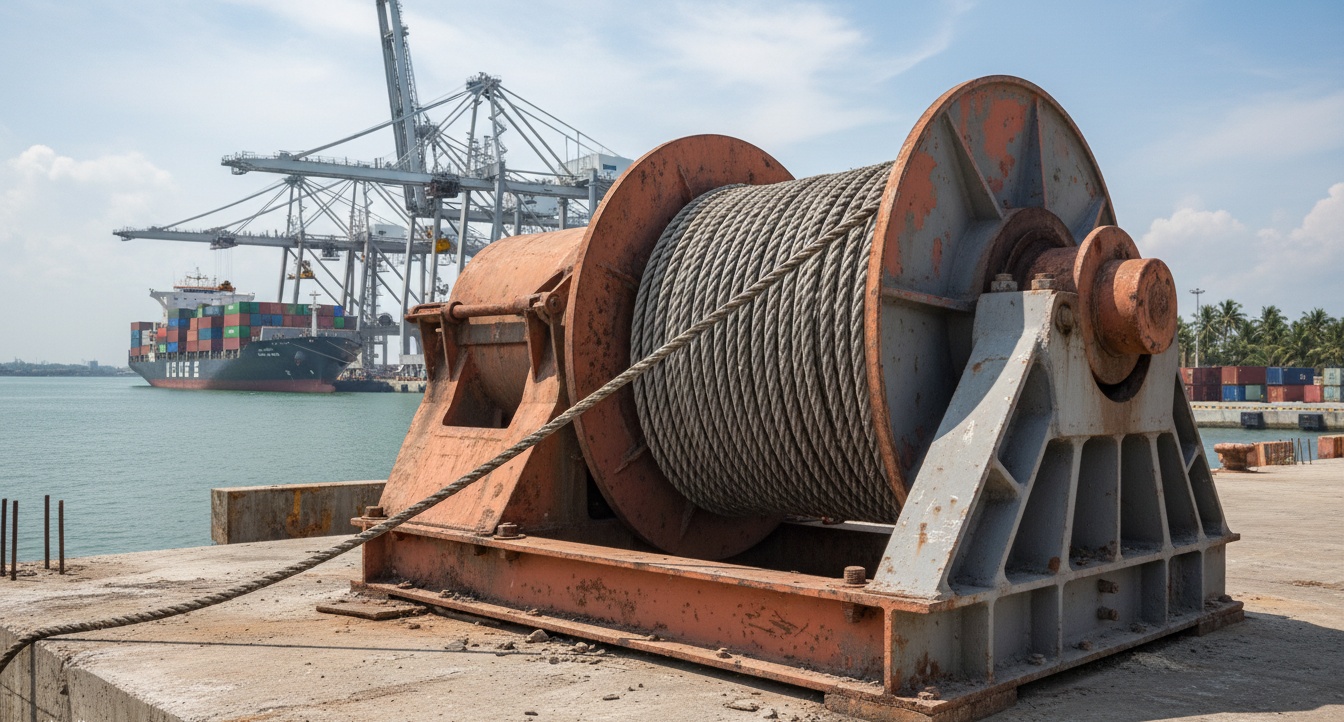 Berth Capacity Drives Winch Spec: How Vessel DWT Determines the Required Line Pull
The relationship between vessel size and mooring winch capacity is the foundational spec that every port engineer must get right before issuing a tender. In our work supplying hydraulic mooring winches to port projects across Southeast Asia, we have seen more procurement mistakes from mis-matching winch line pull to vessel DWT than from any other specification error.
The design vessel for a new berth is the largest vessel that the berth is designed to accommodate on a regular basis — typically defined as the vessel with the highest DWT that will call at the berth at least once per month. For a container terminal in Tanjung Priok (Jakarta) or Ho Chi Minh City, the design vessel might be a 4,000-6,000 TEU container ship (approximately 60,000-100,000 DWT). For a bulk cargo terminal in Batam or Dumai, the design vessel might be a Panamax-size bulk carrier of 65,000-80,000 DWT. For a new LNG terminal, the design vessel could be a Q-Flex LNG carrier of 210,000 m³ capacity (approximately 100,000 DWT).
The rule of thumb for mooring winch line pull specification — verified across multiple port engineering standards including PIANC (The World Association for Waterborne Transport Infrastructure) guidelines, the British Standard BS 6349, and the OCIMF (Oil Companies International Marine Forum) mooring equipment guidelines — is: the winch's rated line pull in kN should be approximately 10-15% of the design vessel's displacement in tonnes. For a 100,000 DWT container ship (approximately 120,000 tonnes displacement fully loaded), the recommended line pull per winch is 120-180 kN. This provides sufficient tension to hold the vessel against a 25-knot beam wind and a 1-knot cross-current, which are the standard environmental loading conditions used in SE Asian port design.
For ports that handle a mix of vessel sizes — a common scenario in SE Asian hub ports where a single berth may receive both feeder vessels (1,000-2,000 TEU) and mother ships (8,000+ TEU) — the winch should be specified for the largest design vessel, because the smaller vessels can be moored at reduced tension without overloading the winch. The cost of over-specifying by one line pull class (e.g., selecting a 200 kN winch instead of a 150 kN winch) adds approximately 15-20% to the winch unit cost but provides operational flexibility for increasing vessel sizes as the port's traffic profile evolves.
Choosing Between Integrated and Conventional Winch Configurations for New Port Construction
INI Hydraulic manufactures two winch configurations that address different port project requirements. The choice between them affects the procurement spec, the installation budget, and the maintenance burden.
IYJ-N Series Integrated Hydraulic Winch: The power pack, control valve bank, and winch drum are integrated into a single frame assembly. The integrated configuration arrives at the port as a pre-assembled, pre-piped, pre-tested unit that requires only foundation bolting and hose connection to the ship-side hydraulic supply. Installation time: 2-3 days per winch. The integrated design is favoured for new port construction projects where the winch manufacturer is responsible for the complete hydraulic system and the port's civil contractor only provides the foundation. INI's IYJ-N Series integrated hydraulic winch is the standard specification for SE Asian port projects that require fast-track installation and factory-tested reliability.
IYJ Series Conventional Hydraulic Winch: The winch drum frame, hydraulic motor, and brake assembly are delivered as individual components that are assembled on-site with the port's own hydraulic power unit or a separately supplied power pack. The conventional configuration reduces the initial procurement cost by 10-15% compared to the integrated configuration, but extends the installation time to 5-8 days per winch because of the on-site piping and commissioning work. The conventional configuration is preferred for port expansion projects where the existing port already operates hydraulic mooring winches with a common hydraulic power unit — the new winch can be connected to the existing hydraulic supply without the expense of a dedicated power pack.
The selection factor that we emphasise to port engineers is the port's in-house hydraulic maintenance capability. Ports with a dedicated hydraulic workshop (typically state-owned ports or large terminal operators) can manage the conventional configuration's on-site assembly and commissioning with their own technicians. Ports that rely on external hydraulic contractors for maintenance should specify the integrated configuration to minimise the number of components that require specialist attention.
Drum Capacity Planning: Calculating Rope Length Requirements for Tidal Range Ports
Drum capacity — the length of mooring rope that the drum can store — is determined by the drum's flange diameter, barrel diameter, and the rope diameter. The drum must store the full mooring rope length without exceeding 75% drum fill capacity, leaving the remaining capacity for the rope to be paid out under tension during extreme weather or tidal events.
The required mooring rope length per winch depends on the berth's vessel size and the tidal range. For SE Asian ports, the tidal range varies significantly by location: ports on the Strait of Malacca (Belawan, Dumai, Penang) typically have a tidal range of 1.5-3.0 metres. Ports in the Gulf of Thailand (Bangkok, Laem Chabang, Songkhla) have a smaller range of 0.5-1.5 metres. Ports in Indonesia's eastern archipelago (Makassar, Bitung) experience mixed tides with a range of 0.5-2.0 metres. A larger tidal range requires longer mooring ropes because the winch must pay out rope as the vessel rises with the tide and recover rope as the vessel falls — if the drum cannot store the full rope length, the mooring line may become slack (allowing the vessel to drift off the berth) or excessively taut (overloading the winch's rated line pull).
As a general guideline for the drum capacity specification: the drum should store 1.5 times the longest single mooring line length at the appointed rope diameter. For a mooring line length of 50 metres (typical for a Panamax-size vessel at a fixed berth), the drum should have a minimum capacity of 75 metres of rope at the specified rope diameter (typically 28-32 mm for steel wire rope or 40-56 mm for HMPE synthetic rope). INI's IYJ series hydraulic winch is available with drum capacities ranging from 60 to 200 metres of rope, covering the full range of SE Asian port requirements from river ports to deep-sea terminals.
Brake Holding Power vs. Static Line Pull: The Safety Margin Every Port Engineer Needs
The brake holding power of a mooring winch — the tension at which the winch's mechanical brake slips and allows the drum to rotate freely, paying out rope — must be higher than the winch's rated line pull, but not so high that the brake cannot slip when needed. The brake is the winch's safety mechanism: in extreme weather when the vessel is pulling on the mooring lines with forces that exceed the winch's rated capacity, the brake must slip before the mooring line parts (snaps), the winch frame fractures, or the bollard on the quay wall is pulled out of the concrete.
The standard engineering practice is to set the brake holding power at 1.5-1.8 times the winch's rated line pull. For a 150 kN winch, the brake should slip at 225-270 kN. The brake slip force is set at the factory during commissioning and should be verified annually — brake disc wear over time reduces the holding power, and a brake that slips below the design threshold creates a safety hazard (the vessel drifts uncontrolled) rather than providing the safety benefit of controlled payout.
For the SE Asian port environment — with tropical humidity that accelerates brake disc corrosion and salt spray that penetrates the brake housing — we recommend specifying a winch with a continuously rated electromagnetic brake (fail-safe, spring-engaged, electromagnetically released) rather than a drum-band brake or band-brake with manual adjustment. The electromagnetic brake's holding force is determined by the spring compression, which is set at the factory and does not drift with wear. The brake is released when electrical power is supplied to the electromagnet, and it engages instantly when power is cut — providing automatic fail-safe operation if the port's electrical supply is interrupted.
Delivery Lead Time for IYJ Series Winches: What a Port Project Timeline Looks Like
The procurement timeline for hydraulic mooring winches from a Chinese manufacturer is driven by the winch configuration (integrated or conventional), the drum capacity, and the hydraulic specifications (operating pressure, flow rate, and control system type). For a typical SE Asian port project procuring 6 winches — 4 breasting winches (250 kN line pull) and 2 spring winches (150 kN line pull), all IYJ-N Series integrated configuration — the production timeline is 30-40 working days from order confirmation and 30% deposit. The winches are assembled and tested individually at the INI factory, with the load test (110% of rated line pull for 10 minutes) witnessed by the port's representative or the appointed third-party inspection agency (SGS, Bureau Veritas, or TÜV).
Sea freight from Ningbo to the Port of Tanjung Priok (Jakarta) takes 14-18 days, to Ho Chi Minh City (Cat Lai terminal) takes 10-14 days, to Laem Chabang takes 12-16 days. The total lead time from order placement to arrival at the SE Asian port is 9-11 weeks for integrated-configuration winches and 10-12 weeks for conventional-configuration winches (the additional week accounts for on-site assembly and commissioning).
For port projects on a fast-track schedule (construction complete before the winches arrive), we recommend placing the winch order 14 weeks before the planned berth opening date, with the winches staged at the factory for the final 4 weeks while the berth civil works are completed. The winches can be shipped by express sea freight (premium service with guaranteed departure slot, 2-3 days faster than standard LCL) if the construction schedule tightens.
Q&A: Southeast Asian Port Engineers Sourcing Hydraulic Mooring Winches from China
Q1: What is the warranty period for IYJ series hydraulic mooring winches?
A: INI Hydraulic provides a 12-month warranty from the date of arrival at the port or 18 months from the factory dispatch date, whichever expires first. The warranty covers manufacturing defects in the winch frame, hydraulic motor, brake assembly, and control valve bank. The warranty excludes: wear items (brake disc, seal kit, hydraulic hose), damage from improper installation, and corrosion from failure to follow the maintenance schedule.
Q2: Does INI provide installation supervision for first-time buyers?
A: Yes. For orders of 4+ winches, INI sends a hydraulic commissioning engineer to the port site for 5-7 working days. The engineer supervises the winch installation, connects the hydraulic hoses, verifies the hydraulic system pressure and flow rate, sets the brake holding force, and trains the port's maintenance team. The engineer's travel, accommodation, and daily allowance are included in the winch order price for SE Asian destinations. Ports within 8 hours flying time from Ningbo can also arrange a pre-shipment factory inspection.
Q3: Can the IYJ-N winch be connected to the port's existing hydraulic power unit?
A: The IYJ-N integrated winch has its own dedicated power pack and does not require connection to an external hydraulic power unit. If the port already operates a central hydraulic system for mooring winches, we recommend the conventional IYJ series winch, which can be connected to the existing system with the correct interface — the operating pressure (typically 160-200 bar), flow rate (40-80 L/min per winch), and hydraulic fluid type (mineral oil ISO VG 46 or 68) must be confirmed before the winch order is placed. INI's technical team will review the port's existing hydraulic system specifications and confirm compatibility before production.
Q4: What is the maintenance schedule for a hydraulic mooring winch in a tropical port environment?
A: Recommended maintenance schedule: daily visual inspection of the hydraulic hose assembly for chafing and the brake disc for corrosion; weekly operation check (cycle the winch through a full payout-retrieve cycle under no-load); monthly oil sample analysis (check for water content, particle count, and viscosity change — water ingress from tropical humidity is the most common failure mode); quarterly brake holding force test (verify slip point against the factory-set value). The maintenance schedule is included in the operator's manual provided with each winch.
Q5: Does INI supply spare parts for the warranty period?
A: Yes. Every order includes a spare parts kit containing: one complete seal kit for the hydraulic motor, one brake disc assembly, one set of hydraulic hose assemblies, and one control valve bank rebuild kit. The spare parts kit covers the most common wear-and-tear replacement needs for the first 2 years of operation. Additional spare parts can be ordered from INI's Ningbo warehouse with a 7-10 working day dispatch lead time for express courier delivery.
Q6: What certificates does INI provide with the winch shipment for Indonesian customs clearance?
A: Each winch shipment includes: Certificate of Origin (Form E for ASEAN-China FTA preferential tariff), Packing List, Commercial Invoice, Bill of Lading, Hydraulic Test Certificate (factory load test report), Material Certificate for the winch frame steel plate (mill certificate showing grade and thickness), and the HS code classification (8425.39 for winches). For Indonesian ports, the winch may also require a Surveyor Report from an appointed surveyor (Sucofindo or equivalent) confirming that the product specification matches the import permit.
About the Author: Mr. Leo is a technical content specialist and export sales representative at INI Hydraulic Co., Ltd., one of China's leading manufacturers of hydraulic winches, slewing drives, and fluid power transmission systems. Through INI Hydraulic's YouTube channel and social media platforms, he produces hands-on technical content — including hydraulic system animations, winch load testing footage, and OEM procurement walkthroughs — that helps international buyers understand INI's product engineering before placing orders.
Social: YouTube | X | Pinterest
Post time: Jun-22-2026