
TL;DR - Key Takeaways
- Singapore Port operates under SSA Technical Standard TS-2019; all hydraulic mooring winches rated 100kN-500kN must meet ISO 3730:2012 strength requirements with a 3.5-times safety factor on minimum breaking load MBL.
- The IY-N series compact covers 100kN-250kN loads with a mounting footprint of 800-1,200 mm; the IYJ series standard handles 200kN-500kN with enhanced multi-disc braking and manual release.
- A 15-day lead time is achievable when the manufacturer maintains pre-built modular inventory and can complete FAT Factory Acceptance Testing within 72 hours of order confirmation.
- Third-party inspection by Lloyd Register Bureau Veritas or DNV is strongly recommended - SSA compliance documentation must include full test reports material certificates EN 10204 3.1 and hydraulic circuit diagrams.
- For tropical port environments like Singapore RH 84 percent 26-34 degrees Celsius specify stainless steel wire rope AISI 316L and corrosion-protected hydraulic manifolds; annual hydraulic oil analysis per ISO 4406 is mandatory.
Understanding Singapore Port Mooring Equipment Requirements
Singapore maritime industry handles more than 140,000 vessel calls per year across its port terminals making it one of the busiest and most strictly regulated port environments in the world. The Maritime and Port Authority of Singapore MPA oversees all port operations and its subsidiary frameworks including the SSA Technical Standard TS-2019 for mooring equipment set the compliance bar that every supplier and port operator must clear.
If you are procuring a hydraulic mooring winch for a vessel calling at Singapore Port or for a shore-side mooring facility you need to understand the regulatory framework before you sign any purchase order. Because maritime environments present extreme corrosion risk and dynamic load conditions the consequences of non-compliance range from port authority detention to complete equipment rejection at pre-operation inspection. We have worked with shipyards and port operators across Southeast Asia for four years and I can tell you that the single most common procurement mistake is buyers assuming that standard industrial winch specifications are sufficient for maritime applications - they are not.
The SSA Technical Standard TS-2019 aligns closely with ISO 3730:2012 for ship and marine technology - mooring winch strength requirements. This means every winch must be designed for its specific load case documented with a type test certificate and traceable back to a qualified manufacturer. The standard covers rated load minimum breaking load MBL braking system performance and material traceability - all of which must be verified before the winch is deployed.
Why Load Range Matters: 100kN to 500kN
The 100kN-500kN load range covers a wide spectrum of vessel types. Small coastal tankers and feeder container vessels up to 3,000 TEU typically require mooring winches rated at 100-200kN while larger container ships 7,000+ TEU and crude oil carriers demand winches rated at 350-500kN. The sizing logic is always the same: you size the winch based on the vessel maximum expected mooring load not the average operating load.
As a rule of thumb the design mooring load DML for a vessel is calculated based on wind area current forces and berth configuration. A vessel with a DML of 300kN should never be equipped with a 250kN winch - the safety margin built into SSA and ISO standards requires that the rated load R be at least equal to the DML and the minimum breaking load MBL be >= 3.5 times R. This means your 300kN DML vessel actually needs a winch rated at no less than 300kN with an MBL of at least 1,050kN. In practice most port operators select the next standard rating up: 350kN or 400kN.
Technical Specifications: 100kN-500kN Hydraulic Mooring Winches
When I review a procurement specification for a hydraulic mooring winch the first thing I check is whether the buyer has clearly defined the rated load brake holding load and line speed requirements. These three parameters determine 80 percent of the winch selection. If any of them is missing or ambiguous in the RFQ I always push back - because without these fundamentals you are comparing apples to oranges across different manufacturers catalogs.
Rated Load and Minimum Breaking Load MBL
The rated load is the maximum working load the winch is designed to handle under normal operating conditions. For SSA-compliant hydraulic mooring winches in the 100kN-500kN range we specify the following hierarchy:
- Rated Load R: 100-500 kN depending on the series. The actual rated load must be clearly stated on the nameplate and in the technical data sheet.
- Minimum Breaking Load MBL: MBL must be >= 3.5 times R per ISO 3730:2012. So a 500kN-rated winch must have an MBL of at least 1,750 kN. This is non-negotiable - if a winch fails the breaking load test it cannot be deployed at Singapore Port.
- Proof Test Load: 1.5 times R applied for a minimum of 5 minutes during factory acceptance testing. No permanent deformation or structural failure is permitted.
Braking Systems: Multi-Disc Spring-Applied Brakes
The braking system is where I see the most variation between manufacturers and the area where cost-cutting most commonly occurs at the expense of safety. For a hydraulic mooring winch the brake must hold the load without manual adjustment for the entire period that the vessel is moored which could be several days in adverse weather conditions.
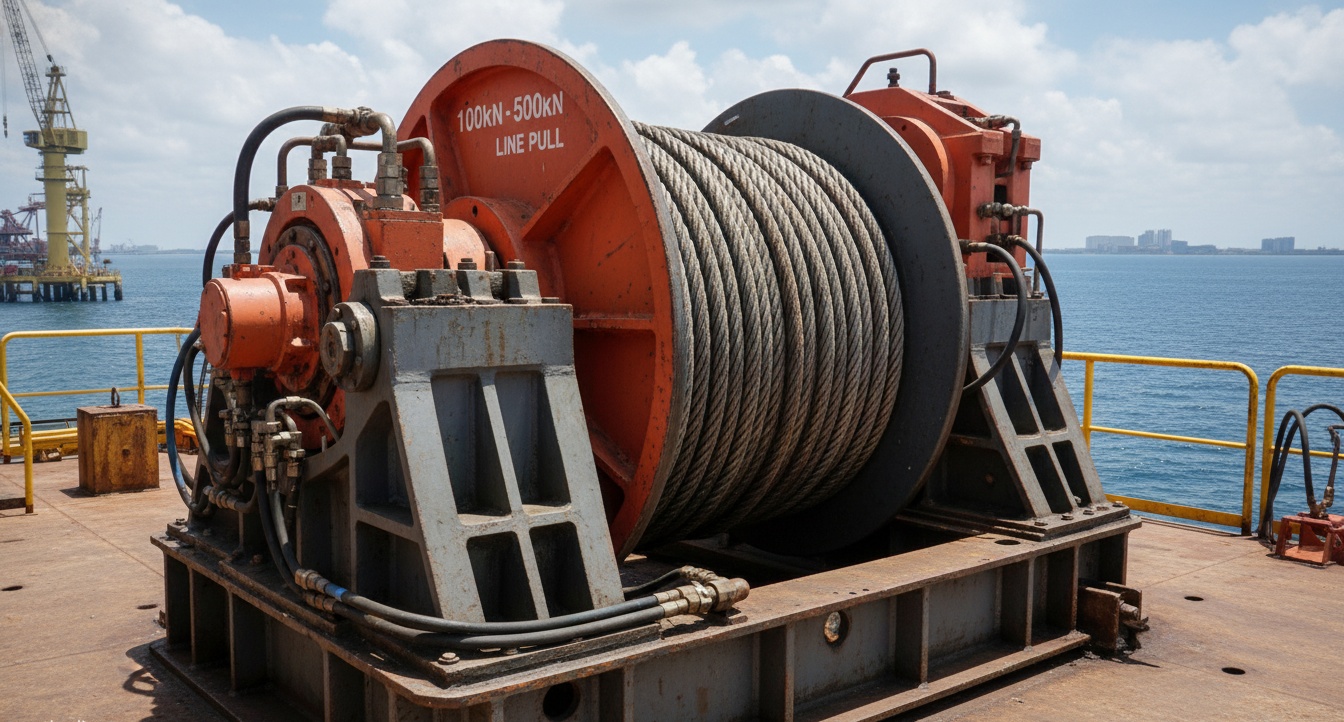
Our IYJ series winches use a multi-disc spring-applied hydraulic released SAHR brake system. This design is the industry standard for maritime mooring winches because it is fail-safe - the brake engages automatically if hydraulic pressure is lost so the winch cannot free-fall. The brake holding torque is typically rated at 1.5 times the rated load ensuring the winch can hold the rope under full load without slip. A hand pump or manual override valve allows the brake to be released even with zero hydraulic pressure which is critical during emergency maintenance. We use sintered metal brake pads Ferodo FC 901 or equivalent rated for at least 2,000 engagement cycles at full load without replacement.
When you evaluate brake specifications pay close attention to the brake holding torque at ambient temperature nominally 20 degrees Celsius and verify the derating curve for tropical conditions. In Singapore 34 degree Celsius ambient temperature brake holding torque typically derates by 8-12 percent compared to the 20 degree Celsius rating. If the brake is specified only at 20 degrees Celsius it may be undersized for tropical port operations.
Wire Rope Specifications
The wire rope is the load-bearing element between your winch drum and the mooring bitts on the quay. For marine applications we recommend non-rotating galvanized steel wire rope diameter 20-40mm depending on load rating with the following minimum specifications:
- Material: Galvanized steel tensile grade 1,770 N/mm squared or 1,960 N/mm squared for high-load applications
- Construction: 6x36 WS Warrington-Seale or 35x7 DSMS - these constructions offer both flexibility for drum winding and rotational stability critical for single-layer winding on mooring winches
- Corrosion protection: For tropical port environments specify zinc-plated galvanized wire with an additional polymer coating polyethylene or polyamide to resist salt water corrosion
- Breaking load: The wire rope minimum breaking load must exceed the winch MBL by at least 20 percent - so for a 500kN winch with MBL = 1,750 kN the wire rope minimum breaking load should be >= 2,100 kN
One practical point I always share with buyers: specify the wire rope separately from the winch in your purchase order. Many buyers accept the manufacturer default rope specification which is often optimized for cost rather than tropical marine duty. We recommend AISI 316L stainless steel for wire rope in high-salinity environments - the additional corrosion resistance justifies the approximately 25 percent cost premium over galvanized rope. Over a 10-year service life in Singapore climate that premium pays for itself in reduced replacement frequency.
Hydraulic System Parameters
The hydraulic system is the power source that drives the winch drum. For a 100kN-500kN hydraulic mooring winch the key hydraulic parameters are:
- Maximum working pressure: Typically 210-250 bar for medium-sized winches 100-350kN scaling to 280-320 bar for high-capacity units 400-500kN
- Flow rate: Determined by the required line speed. A typical line speed of 12-18 m/min at full load requires hydraulic flow of 80-160 L/min depending on motor displacement
- Hydraulic fluid: HLP hydraulic mineral oil grade per DIN 51524-2 viscosity grade ISO VG 46 for tropical ambient temperatures. In Singapore climate ISO VG 32 may be specified for improved cold-start performance
- Filtration: Return line filter with absolute filtration rating of beta-10c >= 200 per ISO 16889 protecting the brake valve and directional control valve from contamination
For port applications where the winch operates in high-humidity conditions we recommend specifying a hydraulic reservoir with nitrogen pre-charge accumulator size 1-4L depending on system volume. This maintains system pressure stability during rapid drum direction changes and prevents cavitation in the pump - a common cause of premature pump failure in tropical port environments.
Can You Really Get a Winch in 15 Days? Lead Time Feasibility Analysis
This is the question I hear most often from procurement managers under time pressure. The short answer is: yes a 15-day lead time is achievable - but only if you select a manufacturer with modular assembly capability and pre-built inventory. Let me explain exactly how this works and what the constraints are.
The Modular Assembly Model
Traditional winch manufacturing is a sequential process: raw steel cutting welding machining assembly testing. For a custom 500kN hydraulic winch built from scratch this process takes 6-10 weeks minimum. However manufacturers that maintain modular pre-built inventory can dramatically compress this timeline.
Our modular approach works as follows: the winch base frame drum assembly and gear train are pre-manufactured and kept in stock as standardized sub-assemblies. When we receive an order we configure the hydraulic power unit HPU to the customer specific pressure and flow requirements integrate the brake system and mount everything on the pre-built base. This configuration process takes 48-72 hours for a standard 100-500kN unit. Because the mechanical structure is already built and tested the only variable lead time element is the hydraulic configuration - which is purely electrical and piping work.
"Because we maintain pre-built drum assemblies and gearboxes in inventory the lead time for our standard IYJ series winch is 10-15 calendar days from order confirmation. The key constraint is always the hydraulic power unit configuration - once that is finalized assembly and testing proceed in parallel."- INI Hydraulic Production Engineering Team 2025
What a 15-Day Lead Time Actually Covers
When we quote a 15-day lead time here is the internal project timeline we work to:
- Days 1-2: Order confirmation hydraulic circuit configuration finalization and HPU assembly begins
- Days 3-5: Mechanical assembly base frame + drum + gear train integration
- Days 6-8: Hydraulic system installation electrical wiring and initial system pressurization
- Days 9-11: Factory Acceptance Testing FAT: no-load test brake test proof load test
- Days 12-13: Documentation preparation test reports material certificates hydraulic circuit diagrams per EN 10204 3.1
- Day 14: Third-party inspection if applicable and final quality sign-off
- Day 15: Dispatch customs documentation and shipment booking
When 15 Days Is Not Achievable
There are scenarios where a 15-day lead time is simply not realistic. If you need custom mounting dimensions that require new fabrication drawings or a non-standard hydraulic circuit configuration outside the manufacturer standard design library you should plan for 4-6 weeks minimum. We have also seen lead time extensions occur when the third-party inspection body Lloyd Register Bureau Veritas or DNV cannot send an inspector within the required window - so always confirm inspector availability at the time of order placement.
Because lead time feasibility depends heavily on the manufacturer manufacturing maturity and inventory management I recommend requesting a manufacturing readiness assessment before you commit to a delivery date. This assessment should cover: current inventory status of the base assembly hydraulic component lead times and the availability of third-party inspectors within your required window.
ISO 3730 and SSA Compliance: What Every Buyer Must Know
If you are procuring hydraulic mooring winches for Singapore Port compliance with ISO 3730:2012 and the SSA Technical Standard TS-2019 is not optional - it is the baseline. These standards exist to ensure that mooring equipment can withstand the extreme loads and environmental conditions that vessels encounter in a busy port environment. As a result we always advise buyers to treat compliance documentation as a critical path item not a post-delivery afterthought.
Key Compliance Points from ISO 3730:2012
The ISO 3730:2012 standard defines the structural and performance requirements for ship and marine technology mooring winches. The key requirements that every buyer and procurement engineer should know are:
- MBL Verification Clause 6.2: Every winch must be individually proof-load tested to 1.5 times the rated load. The test must be documented with actual load readings not just a statement of compliance. Because the test data is your legal evidence of compliance it must be signed by both the manufacturer and an independent third-party witness.
- Brake Performance Clause 7.4: The brake must be capable of holding 1.25 times the rated load without any slip occurring. The test duration must be at least 5 minutes and the brake must not exhibit any permanent deformation after the test.
- Material Traceability Clause 5.3: All structural materials gear housings drum shafts brake callipers must have material test certificates per EN 10204 3.1 confirming chemical composition and mechanical properties. This means the manufacturer must be able to trace every major component back to a specific heat number and test report.
- Hydraulic System Documentation Clause 8.2: The manufacturer must provide a complete hydraulic circuit diagram with component specifications pressure settings and fluid type requirements. This diagram must match the as-built system on the winch.
SSA Technical Standard TS-2019 Specific Requirements
In addition to ISO 3730:2012 the SSA Technical Standard TS-2019 adds several Singapore-specific requirements that buyers must account for:
- Type Approval: The winch must be type-approved by MARINA Maritime and Port Authority of Singapore or a recognized classification society acting on MARINA behalf. This type approval confirms that the winch design has been reviewed and verified against SSA requirements.
- Third-Party Inspection: SSA requires that all mooring equipment above 200kN rated load undergo third-party inspection during FAT. The inspector must be from Lloyd Register Bureau Veritas or DNV - not the manufacturer own QA team.
- Corrosion Protection Standards: All external steel surfaces must be protected to a minimum of SSPC-SP10 near-white blast cleaning standard with a coating system meeting ISO 12944 C5-M marine environment classification. This is particularly important for Singapore high-humidity salt-air environment.
- Documentation Package: The delivered winch must be accompanied by: 1 FAT report with actual test data; 2 Material certificates for all structural components; 3 Weld inspection records per ISO 5817; 4 Hydraulic circuit diagram; 5 Operation and maintenance manual; 6 Spare parts list with 5-year availability confirmation.
OEM Procurement Workflow and Third-Party Inspection
For OEM procurement of hydraulic mooring winches the workflow is more complex than standard procurement - and that complexity is intentional. OEM buyers are typically procuring equipment that will be installed on newbuild vessels or integrated into port infrastructure projects which means the winch must meet not just the end-customer requirements but also the shipyard installation specifications and the classification society survey requirements.
The OEM Procurement Process
Here is the procurement workflow we follow with OEM customers and the timeline you should plan for:
- RFQ and Technical Clarification Week 1-2: Submit a detailed RFQ including: rated load brake holding torque line speed hydraulic pressure flow requirements mounting dimensions classification society requirements Lloyd Register Bureau Veritas DNV or ABS and any applicable regional standards SSA TS-2019 for Singapore.
- Technical Review and Sub-Component Lead Times Week 2-3: The manufacturer reviews the RFQ and identifies any sub-components with extended lead times - particularly the brake system typically 3-4 weeks for SAHR brake assemblies from specialist suppliers like Brube or Kobe Steel and the hydraulic power unit components.
- Proposal and Commercial Negotiation Week 3-4: The manufacturer issues a formal proposal including: unit price tooling cost if applicable payment terms typically 30 percent deposit 70 percent on shipment lead time and warranty terms.
- Purchase Order and Manufacturing Week 4-8: Once PO is placed and deposit received manufacturing begins. For standard models IY-N and IYJ series the mechanical assembly phase takes 2-3 weeks; for custom configurations add 1-2 weeks.
- FAT and Third-Party Inspection Week 8-9: FAT is conducted at the manufacturer facility. Third-party inspector attends to witness the proof load test and brake holding test. Any non-conformances must be resolved before the winch is released for shipment.
- Documentation and Dispatch Week 9-10: Final documentation package is prepared verified and dispatched alongside the equipment.
Third-Party Inspection: What You Need to Know
Third-party inspection by Lloyd Register Bureau Veritas or DNV is not just a compliance checkbox - it is your assurance that the equipment you ordered is the equipment you receive. I have personally witnessed situations where manufacturers delivered winches with different brake specifications than what was ordered and the third-party inspector caught the discrepancy during FAT before the winch left the factory.
For SSA compliance the third-party inspection report must confirm:
- The proof load test was conducted at 1.5 times rated load for the specified duration
- The brake holding test met the 1.25 times rated load requirement
- All major structural components have valid material certificates
- The hydraulic system matches the approved circuit diagram
- Weld quality meets ISO 5817 B-level or better for structural welds
Because third-party inspectors are assigned on a first-come first-served basis and the top inspection firms have limited availability in Southeast Asia I strongly recommend booking the inspector at the same time you confirm the purchase order. This single step can save you 5-7 days of delays if the inspector calendar fills up.
IY-N Series vs IYJ Series: Choosing the Right Winch for Your Application
One of the most common questions I receive from buyers is: "Should I choose the IY-N series or the IYJ series for my application?" The answer depends entirely on your load requirements available mounting space and operational profile. Let me give you the framework to make this decision confidently.
| Specification | IY-N Series Compact | IYJ Series Standard |
|---|---|---|
| Rated Load Range | 100kN - 250kN | 200kN - 500kN |
| Mounting Footprint Frame Width | 800 - 1,200 mm | 1,200 - 1,800 mm |
| Brake Type | Multi-disc dry brake manual release | Multi-disc SAHR brake hydraulic release + manual override |
| Brake Holding Torque | 1.25 x rated load | 1.5 x rated load enhanced for heavy-duty |
| Hydraulic Pressure | 210 - 250 bar | 250 - 320 bar |
| Line Speed Full Load | 12 - 15 m/min | 12 - 18 m/min |
| Wire Rope Diameter | 20 - 28 mm | 24 - 40 mm |
| Typical Application | Coastal vessels feeder container ships tugboats | Large container ships crude oil carriers port mooring facilities |
| Internal Link | View IY-N Series | View IYJ Series |
The IY-N series is the right choice when you have limited deck space and your vessel operates in relatively benign conditions - coastal trade sheltered port waters or smaller vessels where the mooring loads are within the 100-250kN range. Because the IY-N uses a dry multi-disc brake rather than SAHR it is more compact but requires manual release for brake disengagement. This is acceptable for vessels with a crew member physically present at the winch during mooring operations.
The IYJ series is designed for heavy-duty port mooring and large ocean-going vessels where the consequences of brake failure are severe. The SAHR brake system means the winch can be controlled remotely from the bridge or dock office and the manual override ensures the brake can always be released even during a complete hydraulic failure. For a vessel calling at Singapore Port - where monsoon conditions can produce sustained wind loads of 40-60 kN on a large container ship - the IYJ series is the more conservative choice.
When you evaluate which series to specify ask yourself these three questions: 1 What is the maximum mooring load my vessel will experience? 2 Is the mounting footprint restricted by existing deck layout? 3 Does my classification society or port authority have specific brake type requirements? If you answer question 1 with 300kN or above or question 3 with a yes the IYJ series is the correct choice.
Long-Term Maintenance and After-Sales Service Agreements
A hydraulic mooring winch is a 15-25 year asset. The purchase price is typically 20-30 percent of the total cost of ownership - the rest is maintenance downtime and eventual replacement. I always advise buyers to negotiate the service agreement before they finalize the purchase order because the terms you get at the time of order are significantly better than what you can negotiate after the equipment has been delivered and the manufacturer knows you have no alternatives.
What a Comprehensive Service Agreement Should Cover
Based on our four years of supporting port operators and shipyards in Southeast Asia the Middle East and Europe here are the non-negotiable elements of a service agreement for hydraulic mooring winches in tropical environments:
- 24-Hour Technical Support: You need a direct line to the manufacturer technical team - not a distributor not an agent. When a winch fails at 2 AM during a monsoon you need someone who can talk you through the diagnostic steps over the phone.
- On-Site Service Visits: At minimum two scheduled service visits per year: one during the dry season January-May and one during the wet season June-December. Each visit should include: brake pad inspection hydraulic oil analysis per ISO 4406 wire rope condition assessment and torque check on all structural fasteners.
- 5-Year Spare Parts Guarantee: The manufacturer must commit to maintaining spare parts inventory for at least 5 years after the last unit of your order was produced. Brake pads hydraulic seals and solenoid valves are the most commonly needed spare parts - confirm they are included in the standard parts list.
- Annual Full-Load Functional Test: The service agreement must include an annual full-load functional test to verify that the winch still meets its rated load and brake holding specifications after a year of operation. This is also your opportunity to identify any degradation before it becomes a safety issue.
- Emergency Response Time: Define what 24-hour support actually means in practice. Is there a service engineer based in Singapore? Or will the manufacturer fly someone in from China? Emergency response within 72 hours on-site is the minimum you should accept for a port environment.
Tropical Environment Maintenance Schedule
In Singapore climate - average humidity 84 percent temperature 26-34 degrees Celsius and proximity to salt water - the maintenance cycle for hydraulic mooring winches is more demanding than in temperate climates. Here is the maintenance schedule we recommend for our customers:
- Monthly: Visual inspection of wire rope condition corrosion check on all external surfaces verify hydraulic oil level in reservoir
- Quarterly: Hydraulic oil analysis per ISO 4406 report particle count and water content inspect and adjust chain tension on drive system verify all electrical connections are secure and corrosion-free
- Semi-Annually: Brake pad inspection and replacement if wear exceeds 50 percent of lining thickness hydraulic filter element replacement corrosion protection assessment and touch-up of any damaged coating areas
- Annually: Full-load functional test per ISO 3730:2012 hydraulic system pressure test at maximum working pressure wire rope NDT magnetic particle or dye penetrant inspection review and update maintenance records
Because tropical humidity accelerates corrosion and degrades hydraulic oil faster than temperate climates I recommend shortening the oil analysis interval from quarterly to bi-monthly during the first year of operation. This gives you real data on how your specific winch is performing in its actual operating environment rather than relying on the manufacturer generic maintenance schedule.
Conclusion: Making the Right Procurement Decision
Procuring a hydraulic mooring winch for Singapore Port is a multi-dimensional decision that goes well beyond comparing unit prices. You need to evaluate: the manufacturer compliance documentation track record not just their marketing materials the brake system tropical performance derating the third-party inspection protocol the service agreement terms and the lead time feasibility given your project schedule.
Because SSA Technical Standard TS-2019 and ISO 3730:2012 compliance is non-negotiable and the consequences of non-compliant equipment include port authority detention and costly re-testing I strongly recommend that you treat compliance documentation as a primary selection criterion - alongside price and lead time.
If you are evaluating INI Hydraulic IY-N series or IYJ series hydraulic mooring winches for your Singapore Port application our technical team can provide a detailed manufacturing readiness assessment compliance documentation sample package and a draft service agreement for your review. We have supplied equipment to shipyards and port operators across Southeast Asia the Middle East and Europe and we understand the SSA compliance requirements intimately.
The 15-day lead time for standard configurations is a genuine capability - not a marketing claim - and it is backed by our pre-built modular inventory and dedicated assembly team. For custom configurations or non-standard specifications plan for 4-6 weeks and confirm inspector availability at the time of order placement.
If you have specific technical questions about rated load selection brake system sizing or SSA compliance documentation feel free to reach out. We respond to all technical enquiries within one business day.
Frequently Asked Questions
About the Author
Mr. Leo
Technical Content Specialist and Export Sales Representative INI Hydraulic Co. Ltd.
Mr. Leo is a technical content specialist and export sales representative at INI Hydraulic Co. Ltd. one of China leading manufacturers of hydraulic winches slewing drives and fluid power transmission systems. Through INI Hydraulic YouTube channel and social media platforms he produces hands-on technical content including hydraulic system animations winch load testing footage and OEM procurement walkthroughs that helps international buyers understand INI product engineering before placing orders.
With a background in hydraulic transmission engineering and four years supporting offshore marine and construction machinery buyers across Southeast Asia the Middle East and Europe Leo translates complex hydraulic spec sheets into practical procurement guidance for OEM engineers shipyard procurement managers and industrial equipment distributors.
Post time: Jun-08-2026