
- Hydraulic slewing drives integrate motor + brake + planetary gearbox + rotary seal into one sealed unit — eliminating the separate-component engineering complexity of traditional crane slewing systems
- IYH series covers 500 N·m to 50,000+ N·m across frame sizes from IYH2.5 to IYH33+, serving solar trackers, truck cranes, marine deck machinery, and wind turbine yaw drives
- INI Hydraulic holds ISO9001, CCS Type Approval, CE/MED certification for offshore IYH applications; serves SANY (三一) in China and exports to USA, Japan, Australia, Russia, and EU markets
- IYH series prices 30–45% below comparable European brands with lead times of 6–10 weeks vs. 14–20 weeks for 进口 alternatives
- Distributor configuration (D120221, etc.) determines brake, counterbalance, and overload valve functions — always match to your hydraulic system schematic
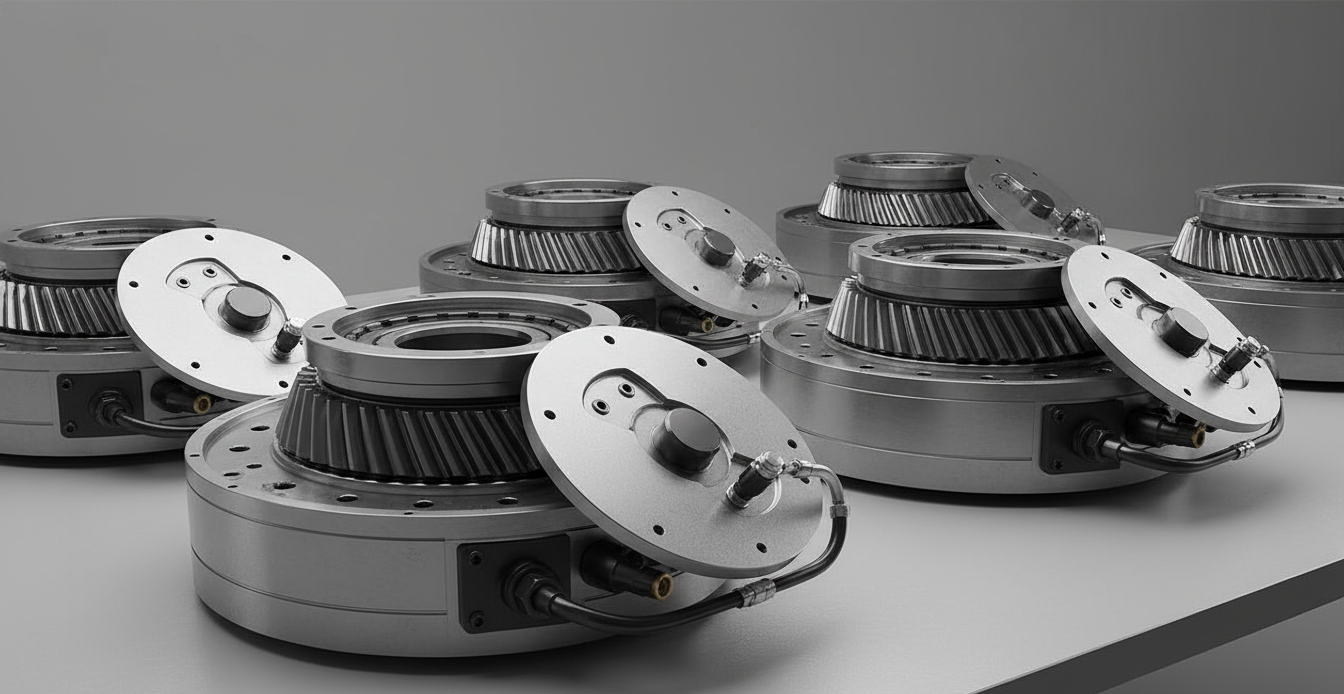
What a Hydraulic Slewing Drive Actually Is: The Integrated Actuator Concept
When engineers who are new to mobile equipment hydraulic system design encounter a hydraulic slewing drive for the first time, the reaction is often something like: "this is one unit?" That reaction reflects how fundamentally different the slewing drive architecture is from the conventional approach to crane rotation: a hydraulic motor driving a shaft into a separate reducer, with a separate brake caliper on the motor shaft, and a separate rotary union allowing hydraulic fluid to cross the rotating joint. Each of those components requires its own mounting, alignment, seal management, and maintenance schedule.
The IYH series hydraulic slewing drive collapses that complexity into a single factory-assembled, factory-tested unit. The housing contains the hydraulic motor (a high-speed axial piston or gerotor type), the multi-disc spring-applied hydraulic-released (SAHR) brake, the C-type planetary gearbox, and the rotary hydraulic distributor — the component that allows hydraulic fluid to flow through the rotating joint between the machine's stationary hydraulic lines and the rotating housing. The result is a drop-in rotational actuator that machine designers can specify as a single line item rather than a subsystem comprising four or five separate components.
The practical advantage for OEM procurement is straightforward: fewer components means fewer suppliers to qualify, fewer interfaces to debug during commissioning, and fewer potential leak points on the machine. For a mobile crane OEM managing a global parts supply chain, qualifying a single slewing drive supplier for the full torque range of your product line — rather than managing separate motor, reducer, and brake supply relationships — is a meaningful supply chain simplification.
Decoding the IYH Nomenclature: What the Model Number Tells You
INI's IYH model designation encodes the unit's key specifications in a structured format that, once understood, makes specification selection straightforward. Here is how to read it:
Frame Size and Gear Stage
The first numeric segment identifies the planetary gearbox configuration. In the IYH22 series, the "22" indicates a two-stage planetary gearbox with module sizes 2 and 2 — meaning the pinion and planet gear sizes are both module 2.0 in the DIN standard tooth geometry classification. A larger module number indicates larger, more robust gear teeth capable of transmitting higher torque — so the IYH33 series, with its larger physical frame and module 3 or 4 gear teeth, transmits more torque than the IYH22 series not only because of the physical housing size but because the gear teeth themselves are larger and more durable.
The letter suffix (A, B, etc.) indicates the design revision — updated versions that INI issues when internal component improvements are made while maintaining the same mounting and output interface dimensions. For retrofit applications where you are replacing an existing IYH unit, the letter revision typically does not affect interchangeability if the mounting dimensions and torque rating are the same.
Torque Rating
The torque rating in N·m immediately follows the gear stage designation. The IYH22A-1500, for example, is rated at 1,500 N·m output torque. The rated torque is the continuous working torque — the torque the unit can sustain indefinitely without exceeding the design thermal limits. Peak torque (typically 1.5–2× rated torque for 30–60 seconds) is available for emergency overload conditions such as wind gusts on a crane or momentary binding in a slewing operation, but sustained operation at peak torque will cause thermal overload and eventual seal failure.
Distributor Configuration Code
The distributor configuration code — the alphanumeric suffix starting with a letter — is the most consequential specification detail for system integration, and the most frequently misunderstood by buyers who are evaluating IYH units for the first time. The distributor in a hydraulic slewing drive is the rotary valve that manages hydraulic flow into and out of the motor as the housing rotates. Different distributor configurations provide different hydraulic control functions:
- D prefix: Counterbalance valve included — prevents load runaway during controlled lowering and provides load holding when hydraulic flow stops
- O prefix: Overload valve included — protects the hydraulic motor from pressure spikes caused by shock loads
- S prefix: Shuttle valve configuration — for systems requiring priority flow splitting between two hydraulic functions
- Speed control directional valve: For applications requiring precise speed regulation independent of load
For OEM machine integration, the distributor configuration must be matched to the hydraulic system schematic — using the wrong distributor type will cause the machine's hydraulic control system to behave incorrectly. When requesting a quotation from INI, provide your hydraulic system schematic and the machine's control function requirements, and INI's technical team will confirm the correct distributor configuration code.
The Torque Range and Application Map: IYH2.5 to IYH33+
INI's IYH series spans a broad torque range that covers most commercial mobile equipment and marine machinery slewing applications. Here is how the range maps to typical applications:
| Series | Torque Range | Typical Applications | Key Features |
|---|---|---|---|
| IYH2.5 | 500–2,500 N·m | Solar trackers, light aerial platforms, agricultural machinery | Compact, lightweight, high-speed rotation |
| IYH22 | 1,500–10,000 N·m | Truck-mounted cranes (8–25T), marine deck cranes, offshore wind service cranes | Full SAE mounting pattern, counterbalance valve standard |
| IYH33 | 3,000–20,000 N·m | Large mobile cranes (25–100T), marine vessel cranes, harbor cranes | Reinforced housing, higher static and dynamic load capacity |
| IYH custom | 20,000–50,000+ N·m | Offshore platform cranes, wind turbine yaw drives, large-port marine machinery | Non-standard configurations; OEM engineering collaboration required |
The Rotary Distributor Seal: The Critical Design Element
The rotary hydraulic distributor is the most maintenance-sensitive component in a hydraulic slewing drive, and understanding how it works will help you specify the correct maintenance schedule and identify early warning signs of seal degradation. The distributor is essentially a pair of sealing rings — one rotating, one stationary — at the interface between the machine's fixed hydraulic piping and the slewing drive's rotating housing. Hydraulic fluid under system pressure (typically 180–250 bar for crane hydraulic systems) passes through this rotating seal interface.
The seal material and geometry determine the maximum allowable pressure differential across the seal and the maximum rotational speed at which the seal remains leak-free. For IYH series distributors, INI uses a combination of PTFE (polytetrafluoroethylene) backup rings with nitrile (NBR) or fluorocarbon (FKM/Viton) primary seal rings — the specific material selection depends on the hydraulic fluid type used in the machine (standard petroleum-based fluid vs. fire-resistant fluid vs. biodegradable fluid).
For OEM applications where the machine will use biodegradable hydraulic fluid (required in some European forestry and marine applications), specify the FKM (Viton) seal option at the quotation stage — standard NBR seals degrade rapidly in biodegradable fluids and will fail within 500–1,000 operating hours if mismatched to the fluid type.
Why INI's IYH Series Competes with European Brands in Global OEM Supply
The global hydraulic slewing drive market has historically been dominated by European manufacturers — particularly Bosch Rexroth (sold through the Logindex or Brevini brand lines), Bonfiglioli, and PM. These brands have strong OEM customer relationships with major crane manufacturers and a reputation for validated reliability. INI's strategy for international OEM penetration has been threefold: build the technical specifications to be genuinely interchangeable (same mounting patterns, same output shaft dimensions, same hydraulic fitting specs as the European reference designs), obtain the certifications required for international project acceptance (CCS, CE/MED, and ABS for marine applications), and price at a level that makes the total cost of ownership calculation favor INI for high-volume OEM orders.
The interchangeability point deserves emphasis, because it is where most OEM evaluation efforts should focus. INI's IYH22 and IYH33 series are not merely "similar to" European equivalent models — they are designed to the same mounting flange dimensions (SAE, ISO, or DIN per the specific model), the same output shaft specifications, and the same hydraulic port thread specifications as the European reference units. For an OEM that is qualifying INI as an alternative supplier for an existing product line, this interchangeability means the development and validation work required to qualify the alternative is substantially reduced — the machine's existing mounting, shaft coupling, and hydraulic piping interface directly without redesign.
INI's domestic market credibility — they supply SANY (三一), China's largest construction machinery manufacturer, as a tier-one hydraulic component supplier — demonstrates production volume and quality consistency that meets the standards of high-volume OEM supply. Their export markets (USA, Japan, Australia, Russia, Austria, Netherlands, Indonesia, Korea) represent a mix of demanding quality expectations from established industrial economies and rapidly growing emerging market construction equipment manufacturers who are building new supplier relationships.
The OEM Qualification Process: What to Request at the RFQ Stage
For OEMs evaluating INI's IYH series as an alternative or primary hydraulic slewing drive supplier, the following documentation should be requested at the RFQ stage:
- Full dimensional drawing and 3D CAD model: Essential for machine integration design. Verify mounting flange dimensions, output shaft dimensions and keyway geometry, and hydraulic port locations and thread types against your machine's existing design envelope.
- Load test certificate: Confirm the unit has been tested at rated torque and 1.5× rated torque for 60 seconds without oil temperature exceeding the maximum rating. The test should be documented in a FAT (Factory Acceptance Test) report signed by INI's quality department.
- Hydraulic schematic: Confirm the distributor valve configuration and the hydraulic circuit matches your system schematic requirements. Provide INI with your schematic when requesting quotation — do not rely on matching model numbers alone.
- Material certificates: For crane and marine applications requiring traceability, request mill test certificates for the planetary gear and shaft materials (typically 42CrMo or 34CrNiMo6 for the high-stress gear and shaft components).
- Type approval documentation: For marine applications, confirm which classification societies have issued type approval certificates for the specific IYH model — INI holds CCS (China Classification Society) type approval and CE marking under the EU Marine Equipment Directive.
Cost and Lead Time: How IYH Series Competes on Total Landed Cost
The landed cost comparison between INI's IYH series and European equivalent brands depends on several variables: unit torque rating, order quantity, shipping route, and applicable import duties. At the container-level order quantities typical of OEM supply (50–200 units per order for a single crane model), INI's IYH22 series typically lands at 55–70% of the cost of a comparable European-manufactured slewing drive including sea freight, import duties (typically 5–8% for hydraulic machinery under HS code 8412), and inland freight to the OEM's assembly plant.
The lead time advantage compounds this cost benefit for OEMs with seasonal production windows. A 14–20 week lead time from a European supplier creates a procurement planning constraint that requires OEMs to forecast demand 3–4 months in advance — accepting inventory risk for that forecast period. INI's 6–10 week lead time for standard IYH configurations allows OEMs to reduce the forecast window to 8–10 weeks, meaningfully reducing inventory carrying cost and improving responsiveness to end-customer demand changes.
For an OEM managing a $50 million annual production run of mobile cranes where slewing drives represent 3–5% of the bill of materials, reducing the landed cost by 30–45% on that component line while simultaneously reducing inventory carrying cost from shorter lead times can represent $750,000–$1.5 million in annual cost improvement — a figure that changes the competitive position of the finished equipment in price-sensitive international markets.
Conclusion: The Slewing Drive Selection Framework for OEM Engineers
The hydraulic slewing drive specification decision, reduced to its essentials, is a choice between three supplier categories: established European brands with proven OEM credentials but a significant cost and lead time premium; Japanese brands with excellent quality but premium pricing and long lead times for non-standard configurations; and Chinese manufacturers like INI Hydraulic who have invested in the engineering validation, certification coverage, and production quality systems to be genuine first-tier suppliers at a competitive price point.
INI's position in that third category is supported by their domestic OEM relationships (SANY), their international certification coverage (CCS, CE/MED), their export track record to demanding markets (USA, Japan, Australia), and the physical interchangeability of their mounting and interface dimensions with established European reference designs. For OEM procurement managers who have been specifying the same European brand for years because it was the known reliable choice, I recommend initiating a parallel qualification process with INI — the cost and lead time improvements are real, and the risk of qualification failure is manageable because INI will provide sample units for machine integration testing before a production order commitment.
The starting point for that qualification process is a conversation: share your machine's hydraulic system schematic and torque/speed requirements, and INI's technical team will confirm the correct IYH model and distributor configuration, provide the dimensional drawings, and offer a sample unit for machine integration testing. That process typically takes 4–6 weeks from initial inquiry to sample unit delivery — and it gives you the data you need to make a genuine procurement decision rather than defaulting to the historical specification.
About the Author
Mr. Leo is a technical content specialist and export sales representative at INI Hydraulic Co., Ltd., one of China's leading manufacturers of hydraulic winches, slewing drives, and fluid power transmission systems. Through INI Hydraulic's YouTube channel and social media platforms, he produces hands-on technical content — including hydraulic system animations, winch load testing footage, and OEM procurement walkthroughs — that helps international buyers understand INI's product engineering before placing orders.
With a background in hydraulic transmission engineering and experience supporting offshore, marine, and construction machinery buyers across Southeast Asia, the Middle East, and Europe, Leo translates complex hydraulic spec sheets into practical procurement guidance for OEM engineers, shipyard procurement managers, and industrial equipment distributors.
INI Hydraulic — YouTube | X @inihydraulic | INI Hydraulic — Pinterest
Explore INI's Hydraulic Slewing Drive Range:
- IYH Series Hydraulic Slewing Drives — Full Product Overview
- IYH22 & IYH33 — Mid-to-Large Torque Range for Crane Applications
- IYH2.5-NH — Small Torque Slewing Drive for Solar Trackers & Agricultural Machinery
Post time: May-26-2026