
TL;DR. ISO 4301 and FEM duty class are two complementary classification systems for hydraulic winches, and a practical mapping between them is essential for cross-border procurement. ISO 4301 classifies the crane as a whole through utilization class (U0–U9) and load spectrum (Q0–Q5), producing a design duty group A1–A8. FEM 1.001 (with FEM 9.341 mechanism load spectrum and FEM 9.661 mechanism design rules) classifies each mechanism through 1Bm, 1Am, 2m, 3m, 4m, or 5m. The two systems cross-reference as follows: FEM 1Bm → ISO 4301 A1; FEM 1Am → ISO 4301 A2; FEM 2m → ISO 4301 A3–A4; FEM 3m → ISO 4301 A5–A6; FEM 4m → ISO 4301 A6–A7; FEM 5m → ISO 4301 A7–A8. Industry mapping: construction and mobile cranes → FEM 2m–3m / ISO 4301 A3–A6; marine and offshore winches → FEM 3m–4m / ISO 4301 A5–A7; drilling rigs and heavy-duty mining winches → FEM 4m–5m / ISO 4301 A7–A8. INI Hydraulic's duty class compliant winch range from hydraulic crane winch models to offshore IYJ24 covers the full A1–A8 spectrum with documentation that satisfies both standards and is verified by the manufacturer's quality certifications.
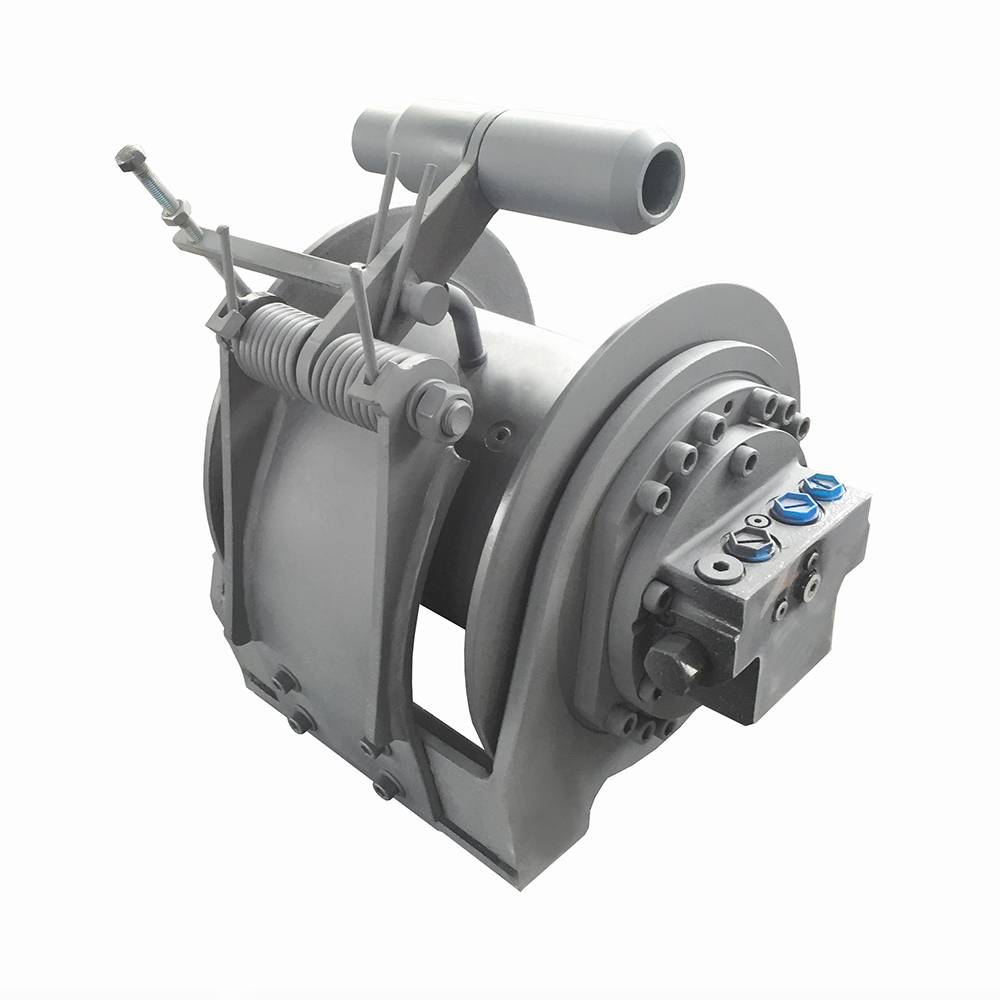
Why Winch Selection Needs a Standardized Duty Class
Winch selection without a standardized duty class is one of the most common causes of premature failure in lifting and pulling equipment. A winch that is over-specified for a light-duty application wastes capital, but the more common problem is the opposite: a winch designed for intermittent use that is dropped into a continuous-service application. The gearbox, the brake, the rope drum, and the hydraulic motor all accumulate fatigue at different rates depending on the operating hours per day, the proportion of nominal load being lifted, and the number of starts per hour. Without a standardized classification, every manufacturer uses its own notation, and procurement teams cannot compare like for like.
Two classification systems dominate international winch procurement. ISO 4301 is the international standard for crane classification, with the latest revision ISO 4301-1:2025 adding more mechanism-level granularity. FEM (Fédération Européenne de la Manutention) duty class is the European mechanism-level classification, with FEM 1.001 as the umbrella document and FEM 9.341 / FEM 9.661 as the load spectrum and design rules. Both standards converge on the same engineering reality — a winch can only be rated for a certain combination of operating hours, load spectrum, and number of cycles — but they package the answer in different notation. The ISO 4301 design duty group is referenced in international tenders, while FEM duty class is the default in European tenders, shipyard specifications, and most OEM machinery specifications from European manufacturers.
For OEM engineers, shipyard procurement managers, and industrial equipment distributors, the practical question is: what FEM duty class corresponds to my application, and what ISO 4301 design duty group can I quote in parallel so the winch is accepted in both markets? This article answers that question with a practical mapping table, an industry cheat sheet, and a procurement workflow that closes the loop between the two classification systems.
ISO 4301: Utilization Class (U0–U9) and Load Spectrum (Q0–Q5)
ISO 4301 classifies a crane through two independent inputs that are then combined into a design duty group. The first input is the utilization class, denoted U0 to U9, which captures how many hours per day the crane (or, in the 2025 revision, the specific mechanism) is in operation. The second input is the load spectrum, denoted Q0 to Q5, which captures how the load being lifted is distributed across the nominal lift. The combination of U and Q produces a single design duty group, A1 through A8, that is the headline number a procurement team quotes.
The utilization class U is derived from the average daily operating hours. U0 corresponds to rare use with no regular operating hours (rarely seen in modern winch applications); U1 covers occasional use up to about 0.5 hours per day; U2 covers light use up to 1 hour per day; U3 covers light-to-medium use up to 2 hours per day; U4 covers regular use up to 4 hours per day; U5 covers regular use up to 8 hours per day; U6 covers regular-to-heavy use up to 16 hours per day; U7 covers intensive use up to 24 hours per day in single shift; U8 covers intensive use up to 24 hours per day in continuous shift; U9 covers continuous heavy-duty operation exceeding the U8 conditions. The winch OEM uses this U value to size the gearbox service factor and the brake thermal capacity.
The load spectrum Q is derived from the load distribution profile. Q0 corresponds to very light loads only, where the lift is rarely near the nominal capacity; Q1 corresponds to light loads; Q2 corresponds to light-to-medium loads; Q3 corresponds to medium loads; Q4 corresponds to heavy loads; Q5 corresponds to very heavy loads where the lift is often at or near nominal capacity. The standard provides a load spectrum coefficient KQ for each Q class: KQ ≈ 0.125 for Q1, KQ ≈ 0.25 for Q2, KQ ≈ 0.50 for Q3, KQ ≈ 0.75 for Q4, and KQ ≈ 1.00 for Q5. The KQ is the cube root of the average of the cubed load ratios, which is what makes the load spectrum sensitive to peak loads.
ISO 4301 Design Duty Group A1–A8: The Composite Classification
The design duty group is the intersection of utilization class and load spectrum. ISO 4301 provides a 10 by 6 matrix that maps U0–U9 to Q0–Q5, and each cell of the matrix is assigned an A1 through A8 label. For practical winch selection, the relevant combinations reduce to a few patterns. A1 covers U0–U1 with Q0–Q1 (very light use). A2 covers U1–U2 with Q1–Q2 (light occasional use). A3 covers U2–U3 with Q2 (light-to-medium regular use). A4 covers U3–U4 with Q2–Q3 (medium regular use). A5 covers U4–U5 with Q3 (medium-to-heavy regular use). A6 covers U5–U6 with Q3–Q4 (heavy regular use). A7 covers U6–U7 with Q4 (very heavy use). A8 covers U7–U9 with Q4–Q5 (continuous heavy-duty).
The design duty group A drives the sizing calculation for every critical component. The gearbox is sized to a service factor S/F that scales with A: a winch rated A1–A2 typically runs at S/F 1.0 to 1.25, while a winch rated A7–A8 runs at S/F 2.0 or higher. The brake is sized to handle the thermal capacity of the worst-case stopping cycle, which scales with the kinetic energy at nominal load and the cycle frequency. The rope drum is sized for fatigue life, which scales with the cumulative number of layer changes (every full drum wrap-and-return counts as one fatigue cycle). The hydraulic motor is sized for continuous-duty torque at the worst-case pressure drop, and the pump is sized for the flow rate at the target line speed.
The output of the ISO 4301 classification is therefore not a single number but a set of design parameters: gearbox service factor, brake thermal capacity, drum fatigue life, motor torque rating, and pump flow rate. INI Hydraulic's IYJ series datasheets publish these parameters in a duty class section that lists the corresponding design duty group A1 to A8 for each winch variant.
FEM Duty Class 1Bm / 1Am / 2m / 3m / 4m / 5m: Mechanism-Level Classification
FEM 1.001 is the umbrella standard for crane and lifting equipment design in Europe, and it references FEM 9.341 (mechanism load spectrum) and FEM 9.661 (mechanism design rules) for the mechanism-level classification. The FEM duty class is denoted 1Bm, 1Am, 2m, 3m, 4m, or 5m, with each class corresponding to a specific range of average daily operating hours and load spectrum. Unlike ISO 4301 which classifies the crane as a whole, FEM classifies each mechanism (hoisting, slewing, traversing, luffing, winching) separately, which is why the FEM class on a winch datasheet may differ from the FEM class on the crane slewing drive.
FEM 1Bm is the lightest class, corresponding to occasional use under light load (rarely seen in modern winches except for some auxiliary winches and hand-driven applications). FEM 1Am covers light regular use. FEM 2m covers medium regular use (typical for construction cranes and mobile cranes). FEM 3m covers medium-to-heavy regular use (typical for shipyard cranes, offshore supply vessels, and medium-duty marine winches). FEM 4m covers heavy regular use (typical for offshore platforms, heavy-duty ship winches, anchor handling winches). FEM 5m covers continuous heavy-duty use (typical for drilling rigs, pipe-handling winches, and the most severe offshore applications). The classification is referenced in EN 13001 (crane safety), EN 13000 (mobile cranes), and EN 12999 (loader cranes).
The FEM duty class drives the same engineering outputs as ISO 4301 — gearbox service factor, brake thermal capacity, drum fatigue life, motor torque rating — but the FEM mechanism-level notation is what European shipyards, European OEMs, and European tender specifications prefer. The historical reason is that FEM was originally the only comprehensive European mechanism-level classification, and the European lifting machinery industry built its procurement documentation around FEM notation in the decades before ISO 4301 became widely adopted.
ISO 4301 ↔ FEM Duty Class Practical Mapping Table
The practical mapping between ISO 4301 design duty group and FEM duty class is not a one-to-one correspondence, because ISO 4301 covers a wider envelope (A1 to A8, eight levels) than FEM (1Bm to 5m, six levels). The mapping is therefore an overlap rather than a precise substitution. The table below is the cheat sheet that procurement teams use when tendering in both notations. The KQ column lists the load spectrum coefficient range; the S/F column lists the gearbox service factor that the winch OEM should apply.
| FEM Duty Class | ISO 4301 Design Duty Group | Utilization Class (U) | Load Spectrum (Q) | KQ (load spectrum coefficient) | S/F (service factor) | Typical Winch Application |
|---|---|---|---|---|---|---|
| 1Bm | A1 | U0–U1 | Q0–Q1 | 0.125 | 1.00–1.10 | Auxiliary winch, hand-driven applications |
| 1Am | A2 | U1–U2 | Q1–Q2 | 0.125–0.25 | 1.10–1.25 | Light-duty utility winch, occasional lifting |
| 2m | A3–A4 | U2–U4 | Q2–Q3 | 0.25–0.50 | 1.25–1.50 | Construction cranes, mobile cranes, truck-mounted cranes |
| 3m | A5–A6 | U4–U6 | Q3–Q4 | 0.50–0.75 | 1.50–1.80 | Shipyard cranes, offshore supply vessels, medium marine winches |
| 4m | A6–A7 | U5–U7 | Q4 | 0.75 | 1.80–2.00 | Offshore platforms, anchor handling winches, heavy marine |
| 5m | A7–A8 | U7–U9 | Q4–Q5 | 0.75–1.00 | 2.00–2.50 | Drilling rigs, pipe handling, mining, continuous heavy-duty |
The KQ column is the load spectrum coefficient used in FEM 9.341 calculations and in ISO 4301 design verification. The S/F column is the gearbox service factor that the OEM applies to the nominal torque rating to confirm the gearbox can handle the worst-case cycle. INI Hydraulic publishes the KQ and S/F in each IYJ series datasheet, and the same values are referenced in the FEM 9.341 calculation report and the ISO 4301 design duty group calculation report.
Industry Mapping Cheat Sheet: Crane / Marine / Drilling
Different industries default to different duty class ranges, and the cheat sheet below maps the three major winch application segments (construction and mobile cranes, marine and offshore, drilling rigs and heavy-duty mining) to the corresponding ISO 4301 design duty group and FEM duty class. The mapping is approximate — actual classification depends on the specific operating hours and load spectrum of each installation — but it is the range that procurement teams quote in tender documents.
| Industry Segment | Typical Winch Type | FEM Duty Class | ISO 4301 Design Duty Group | KQ Range | Typical Operating Hours |
|---|---|---|---|---|---|
| Construction & Mobile Cranes | IYJ6 crane winch, IYJ internal distending/external holding | FEM 2m (occasional 1Am or 3m) | A3–A4 (occasional A2 or A5) | 0.25–0.50 | 1–4 hours/day, intermittent cycles |
| Marine & Offshore | IYJ15 marine winch, IYJ22 marine winch, mooring winch, anchor winch | FEM 3m–4m | A5–A7 | 0.50–0.75 | 4–16 hours/day, regular cycles |
| Drilling Rigs & Heavy-Duty Mining | IYJ24 offshore winch, drilling winch, pipe-handling winch | FEM 4m–5m | A6–A8 | 0.75–1.00 | 16–24 hours/day, continuous cycles |
The construction and mobile crane segment typically operates at FEM 2m, which corresponds to ISO 4301 A3–A4, with KQ in the 0.25–0.50 range. The winch sees 1 to 4 hours of operation per day with intermittent cycles (lifting loads that are rarely at full capacity). The INI Hydraulic IYJ6 series crane winch is sized for this segment and is documented to FEM 2m / ISO 4301 A3–A4 on the datasheet. INI Hydraulic's IYJ internal distending and external holding winch covers the lower end of this segment for special applications like aerial work platforms and truck-mounted cranes.
The marine and offshore segment typically operates at FEM 3m to FEM 4m, which corresponds to ISO 4301 A5–A7, with KQ in the 0.50–0.75 range. The winch sees 4 to 16 hours of operation per day with regular cycles. Mooring winches and anchor handling winches on offshore vessels typically fall in this segment. The INI Hydraulic IYJ15 series marine winch and IYJ22 series heavy-duty marine winch cover this segment and are documented to FEM 3m–4m / ISO 4301 A5–A7. For shipyards under DNV, Lloyd's Register, BV, ABS, or CCS class, the FEM 3m notation is quoted directly in the winch specification, with ISO 4301 A5–A6 added in parentheses for cross-reference.
The drilling rig and heavy-duty mining segment operates at FEM 4m to FEM 5m, which corresponds to ISO 4301 A7–A8, with KQ in the 0.75–1.00 range. The winch sees 16 to 24 hours of operation per day with continuous cycles, and the load is often at or near nominal capacity during tripping and pipe handling. The INI Hydraulic IYJ24 series offshore winch is sized for this segment and is documented to FEM 4m–5m / ISO 4301 A7–A8. For drilling applications, the winch specification also references API 4F (drilling and well-servicing structures) or API 7K (drilling equipment specifications) for additional verification.
OEM Procurement Workflow: From Duty Class to Winch Specification
The OEM procurement workflow translates the application profile into a winch specification. The workflow has 6 steps. Step 1: define the application profile (crane, marine, drilling, or special), the average daily operating hours, the typical load ratio, and the target service life in years or cumulative cycles. Step 2: assign the utilization class U based on the operating hours and the load spectrum Q based on the load distribution. Step 3: read off the ISO 4301 design duty group A from the U by Q matrix. Step 4: cross-reference to the FEM duty class using the practical mapping table in the previous section. Step 5: request a winch datasheet that cross-references both the ISO 4301 A value and the FEM class value, plus the FEM 9.341 load spectrum calculation and the FEM 9.661 design verification report. Step 6: confirm the gearbox service factor S/F, the brake thermal capacity, the drum fatigue life, and the motor torque rating match the duty class before issuing the purchase order.
The most common procurement mistake is to skip Step 5 and accept a datasheet that quotes only one of the two classifications. A winch quoted only under FEM 3m without the ISO 4301 cross-reference may be rejected in tenders that require both, and vice versa. INI Hydraulic publishes both classifications on every IYJ series datasheet to eliminate this gap. The cross-reference is also useful for after-sales service: when a winch is re-rated after a duty class change, the OEM can update either the FEM notation or the ISO 4301 notation and the other follows.
INI Hydraulic Duty Class Compliance: ISO 4301 and FEM Winch Range
INI Hydraulic's duty class compliant winch range covers ISO 4301 A1 through A8 and FEM 1Bm through 5m. The IYJ6 series crane winch covers ISO 4301 A3 to A5 and FEM 2m to 3m, targeting the construction and mobile crane segment. The IYJ internal distending and external holding winch covers ISO 4301 A2 to A4 and FEM 1Am to 2m, targeting special applications like aerial work platforms and truck-mounted cranes. A6 and FEM 2m to 4m, targeting the marine and offshore segment for offshore supply vessels, workboats, and smaller anchor handling applications. The IYJ22 series heavy-duty marine winch covers ISO 4301 A5 to A7 and FEM 3m to 4m, targeting heavy-duty marine winches for offshore platforms and large anchor handling vessels. The IYJ24 series offshore winch covers ISO 4301 A7 to A8 and FEM 4m to 5m, targeting the drilling rig and heavy-duty mining segment.
The compliance documentation INI Hydraulic provides with each winch includes: (1) the design duty group calculation showing U and Q inputs and the resulting A value under ISO 4301; (2) the FEM duty class designation per FEM 1.001, with the FEM 9.341 load spectrum calculation and the FEM 9.661 design verification report; (3) the gearbox service factor S/F and the corresponding nominal torque rating; (4) the brake thermal capacity at the worst-case stopping cycle; (5) the rope drum fatigue life at the cumulative cycle count; (6) the mill certificate for the gear steel (typically 20CrMnTi or 42CrMo per GB/T 3077 or DIN 17210), the brake lining (non-asbestos organic per GB/T 24345 or equivalent), and the rope drum material; (7) the prototype load test report covering 1.25x nominal load dynamic test and 1.5x nominal load static overload test; (8) the manufacturer's quality certifications (CE marking under EU Machinery Regulation 2023/1230, ISO 9001:2015 quality management, ISO 14001:2015 environmental management, and where applicable classification society approval from DNV, Lloyd's Register, BV, ABS, or CCS).
Send INI Hydraulic the application profile (industry segment, average daily operating hours, typical load ratio, target service life) and the preferred FEM duty class or ISO 4301 design duty group. INI Hydraulic's technical team will cross-reference the duty class, recommend the matching IYJ series winch, and deliver a complete compliance dossier covering both ISO 4301 and FEM 1.001 / 9.341 / 9.661. Visit the hydraulic winches product page for the full range, the hydraulic crane winch models page for the IYJ6 series datasheets, and the certifications page for the manufacturer's compliance certificates.
The classification societies (DNV, Lloyd's Register, BV, ABS, CCS) publish additional survey and certification requirements for marine winches that complement the ISO 4301 / FEM 1.001 classification. The American Petroleum Institute (API) publishes API 4F and API 7K for drilling winches that go beyond ISO 4301 in the load spectrum and fatigue verification. INI Hydraulic's compliance documentation includes the cross-reference to these complementary standards.
Frequently Asked Questions
What is the difference between ISO 4301 and FEM duty class for winches?
ISO 4301 is an international crane classification standard that defines the design duty group (A1 to A8) as a composite of the utilization class (U0 to U9, based on average daily operating hours) and the load spectrum (Q0 to Q5, based on the proportion of nominal lift being handled). FEM duty class (defined under FEM 1.001 with mechanism classification under FEM 9.341 and FEM 9.661) is a European standard that classifies a specific mechanism on a duty basis of 1Bm, 1Am, 2m, 3m, 4m, or 5m. Both systems end up categorizing a winch into a similar severity band, but they use different inputs: ISO 4301 starts from operating hours and load distribution at the crane level, while FEM starts from the mechanism-level load spectrum and number of cycles.
How do I convert FEM 3m to ISO 4301 for a marine winch?
For a marine winch specified under FEM 3m, the practical mapping is approximately ISO 4301 design duty group A5 to A6, depending on the load spectrum coefficient KQ. If the marine winch is dominated by light mooring duty (KQ near 0.125, light spectrum), it maps to ISO 4301 A5. If it sees frequent full-pull mooring or anchor recovery cycles (KQ near 0.25 to 0.50), it maps to ISO 4301 A6. In tender documents, the FEM 3m class is often quoted directly because the European shipyards (DNV, Lloyd's Register, BV, ABS) recognize FEM notation; the ISO 4301 class is added in parentheses to help international procurement teams cross-reference.
What load spectrum coefficient (KQ) applies to drilling winches?
Drilling winches typically operate in load spectrum Q4 (heavy) to Q5 (very heavy), corresponding to a load spectrum coefficient KQ of approximately 0.50 to 1.00. In FEM notation this aligns with FEM 4m to FEM 5m. In ISO 4301 notation this aligns with design duty group A7 to A8. The KQ is calculated as the weighted cube root of the proportion of nominal load being lifted in each cycle, and drilling winches accumulate full-pull cycles on tripping, hoisting, and pipe handling operations; this drives the load spectrum toward the Q4–Q5 end. The classification feeds back into gearbox sizing, brake torque selection, and duty cycle verification per API 4F or API 7K for drilling applications.
Can the same winch be specified for FEM 3m and ISO 4301 A5?
Yes. In the practical mapping table, FEM 3m overlaps ISO 4301 A5 to A6, and a winch rated to FEM 3m is generally accepted as compliant with ISO 4301 A5 if the design verification covers both the FEM mechanism-level load spectrum (FEM 9.341) and the ISO 4301 utilization/load spectrum calculation. INI Hydraulic's IYJ series, for example, publishes cross-references between FEM class and ISO 4301 design duty group in each product datasheet so procurement teams can use either notation.
How does INI Hydraulic winch range cover ISO 4301 A1 to A8?
INI Hydraulic's duty class compliant winch range spans from FEM 1Bm through FEM 5m, which corresponds to ISO 4301 design duty groups A1 through A8. The IYJ6 series crane winch covers ISO 4301 A3 to A5 (FEM 2m to 3m), the IYJ15 series marine winch covers ISO 4301 A4 to A6 (FEM 2m to 4m), the IYJ22 series heavy-duty marine winch covers ISO 4301 A5 to A7 (FEM 3m to 4m), and the IYJ24 series offshore winch covers ISO 4301 A7 to A8 (FEM 4m to 5m). Each winch is delivered with a duty class datasheet cross-referencing both standards, and the manufacturer certifies FEM 1.001 / 9.341 / 9.661 and ISO 4301 compliance under the same mill certificate.
What documentation is required for ISO 4301 compliance audit?
An ISO 4301 compliance audit requires the following documentation: (1) the design duty group calculation showing utilization class (U) and load spectrum (Q) inputs; (2) the FEM 9.341 mechanism load spectrum calculation for FEM 1Bm through 5m cross-reference; (3) the gearbox, brake, and motor sizing calculations confirming S/F (service factor) is satisfied for the target design duty group; (4) the mill certificate for the gear steel, brake lining, and rope drum material; (5) the prototype load test report covering 1.25x nominal load and 1.5x nominal load for dynamic and static overload verification; (6) the FEM 9.661 design verification report on weld, fatigue, and structural integrity. INI Hydraulic provides a complete compliance dossier with each winch delivery.
How often should duty class be re-evaluated after commissioning?
Duty class should be re-evaluated at every periodic survey (typically every 2.5 to 5 years depending on classification society rules) and after any change in operating pattern. For marine winches under DNV, Lloyd's Register, BV, ABS, or CCS class, the duty class re-evaluation is part of the classification renewal survey. For crane winches, the re-evaluation is triggered when the operating hours or load spectrum changes by more than 25% from the design assumption. INI Hydraulic recommends re-evaluation at least every 5 years or every 10,000 operating hours, whichever comes first.
Why is FEM preferred over ISO 4301 in some European tenders?
FEM (Fédération Européenne de la Manutention) is the historical European federation standard for crane and lifting equipment, and many European tenders specify FEM 1.001 / 9.341 / 9.661 directly because FEM class is the native mechanism-level classification. ISO 4301 was originally a crane-level classification and the latest 2025 revision (ISO 4301-1:2025) added more mechanism-level granularity, but FEM is still the default reference in tenders issued under EN 13000 (cranes — mobile cranes), EN 12999 (loader cranes), and EN 13001 (crane safety). The two systems are now designed to be cross-referenced, and INI Hydraulic publishes both classifications on every winch datasheet.
About the author. Tianyu Hu is a technical content specialist and export sales representative at INI Hydraulic Co., Ltd., one of China's leading manufacturers of hydraulic winches, slewing drives, and fluid power transmission systems. Through INI Hydraulic's YouTube channel and social media platforms, he produces hands-on technical content — including hydraulic system animations, winch load testing footage, and OEM procurement walkthroughs — that helps international buyers understand INI's product engineering before placing orders.
With a background in hydraulic transmission engineering and four years supporting offshore, marine, and construction machinery buyers across Southeast Asia, the Middle East, and Europe, Tianyu Hu (also known as Leo in informal communication) translates complex hydraulic spec sheets into practical procurement guidance for OEM engineers, shipyard procurement managers, and industrial equipment distributors.
Follow INI Hydraulic on Facebook:https://www.facebook.com/share/1CBU2cymKh/?mibextid=wwXIfr
Post time: Aug-11-2026