
TL;DR
1. IGH hydrostatic slewing delivers 30-50% higher holding torque than mechanical gear-only alternatives because the closed hydrostatic circuit acts as intrinsic braking. 2. Static holding torque ratings from 15,000 Nm to 85,000 Nm mean zero-creep platform holding at full boom extension — the safety-critical parameter for scissor lifts and boom lifts. 3. The integrated multi-disc holding brake meets ISO 16368 fail-safe requirements, engaging automatically on hydraulic pressure loss and eliminating the external brake failure point.
Why Hydrostatic Slewing Changes the Equation for AWP Designers
Hydrostatic slewing drives represent a fundamental change from traditional open-circuit hydraulic motor-plus-gearbox slewing systems. In a conventional AWP arrangement, a hydraulic motor drives a planetary or worm gearbox rotating the turret through a pinion-and-slewing-ring interface. The gearbox provides mechanical reduction and the holding function but introduces backlash (0.2-0.5 degrees at the pinion), efficiency losses across two gear reduction stages (8-12%), and an external brake assembly with its own hydraulic circuit.
A hydrostatic slewing drive like the IGH series integrates the hydraulic motor and output pinion into a single closed-circuit unit. The hydraulic pistons act directly on a cam ring, producing high torque at low speed without a reduction gearbox. The closed hydrostatic circuit provides inherent braking — when the directional control valve closes, the trapped oil volume locks the motor shaft with zero measurable creep. This dual-redundancy — hydrostatic lock plus mechanical multi-disc brake — eliminates the single-point failure mode that caused platform drift incidents in older mechanical systems.
Three practical advantages for AWP designers: First, eliminating the gearbox saves 80-120kg from the slewing assembly weight, freeing capacity for platform load or outreach. Second, zero-pinion-backlash hydrostatic lock means perfect platform orientation stability at maximum height, even in wind gusts. Third, fewer wear items — motor, cam ring, output shaft, brake pack, housing versus motor plus gearbox plus brake plus coupling — reduces lifecycle maintenance by 30-40% based on European rental fleet operator data.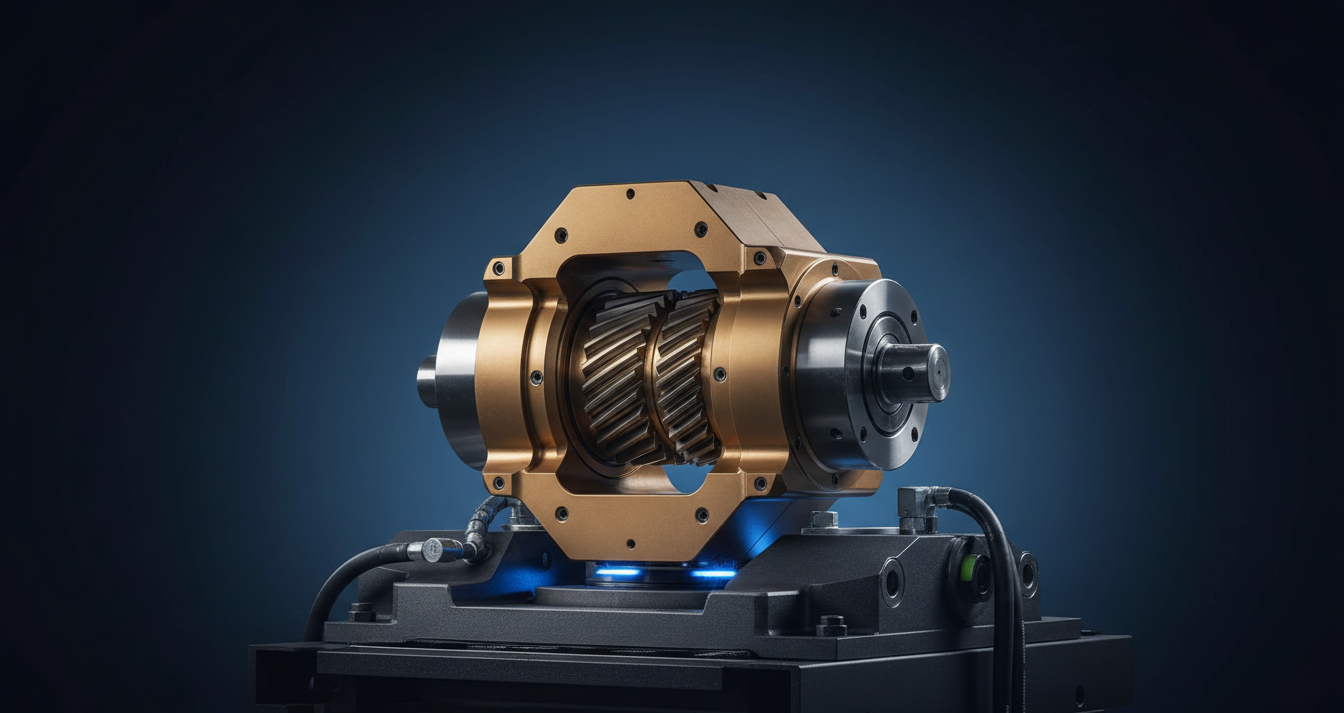
Holding Torque Explained: Static vs Dynamic — The Number That Actually Matters for AWP Safety
Static holding torque — the torque the slewing drive resists with zero motion and zero input flow — is the safety-critical parameter for aerial work platforms. At 30m working height with a 250kg basket load offset 2m from the turret centerline, the overturning moment creates approximately 4,900 Nm of slewing torque. Wind at 12.5 m/s (EN 280 in-service limit) on a 1.2m² basket at 30m adds roughly 3,300 Nm. Total peak demand: approximately 8,200 Nm.
The safety margin I specify for AWP applications is 2.5:1 on static holding torque. An 8,200 Nm peak demand requires minimum 20,500 Nm static holding torque. The IGH-2500 model at 25,000 Nm meets this with 3.0:1 factor. This margin covers basket eccentric loading (ANSI/SIA A92.20 1.33× factor), platform slope (5 degrees maximum per EN 280, adding 8.7% to overturning moment), and brake friction coefficient degradation over the service interval.
Dynamic load capacity — torque available during rotation — is typically 60-70% of static holding torque because the motor must simultaneously overcome wind load, inertial forces during start/stop, and hydraulic circuit efficiency losses. For the IGH-2500 at 25,000 Nm static, dynamic capacity is approximately 16,000-17,500 Nm — well above the 8,200 Nm peak demand with ample acceleration margin.
IGH Series Specifications: Torque Ratings, Output Speeds, and Mounting Interfaces
The IGH series spans six standard models covering the full AWP range from compact scissor lifts to 40m+ telescopic booms. Each shares the hydrostatic closed-circuit architecture with integrated multi-disc holding brake.
| Model | Static Holding Torque (Nm) | Dynamic Torque (Nm) | Max Output Speed (rpm) | Displacement (cm³/rev) | Weight (kg) | Typical AWP Application |
|---|---|---|---|---|---|---|
| IGH-800 | 8,000 | 5,200 | 8.0 | 490 | 42 | Scissor lifts to 14m |
| IGH-1500 | 15,000 | 9,800 | 6.0 | 850 | 65 | Scissor lifts 14-18m, compact booms |
| IGH-2500 | 25,000 | 16,500 | 5.0 | 1,450 | 95 | Boom lifts 18-30m |
| IGH-4000 | 40,000 | 26,000 | 4.0 | 2,400 | 140 | Boom lifts 25-35m, telescopic booms |
| IGH-6000 | 60,000 | 39,000 | 3.2 | 3,600 | 210 | Telescopic booms 30-40m |
| IGH-8500 | 85,000 | 55,000 | 2.5 | 5,100 | 310 | Articulated booms 35-45m |
Mounting interface: All IGH models use SAE standard bolt circle patterns per SAE J744. Output shaft options include splined (DIN 5480), keyed cylindrical, and integrated pinion (module 8-14). Hydraulic ports: SAE Code 61/62 split-flange, sizes #12 to #24. Visit Yining Hydraulic IGH gearbox specifications for complete dimensional drawings.
Dynamic Load Capacity: How Platform Height and Outreach Affect Slewing Motor Selection
Platform working height and lateral outreach determine slewing torque demand through a straightforward physical relationship. The overturning moment at the slewing ring equals the basket load multiplied by the horizontal distance from the basket CG to the turret rotation centerline, plus the boom structure self-weight moment. As height and outreach increase linearly, torque demand increases — but the higher the platform, the greater the wind moment arm, compounding the safety margin calculation.
Practical selection rule: calculate static overturning moment from basket load at maximum outreach, multiply by 1.33 for ANSI eccentric loading, add wind moment, then multiply the total by 2.5 for the static holding torque safety factor. Select the IGH model exceeding this requirement by at least 10%. For complete AWP specifications, see Yining Hydraulic slewing drives.
Integrated Brake System: Why the Holding Brake Is Safety-Critical
The IGH integrated multi-disc brake is spring-applied, hydraulically-released — the safest configuration for aerial work platforms. When hydraulic pressure is present, pressure overcomes the spring preload and releases the brake discs. When pressure is lost (engine stall, hose rupture, emergency stop), the springs immediately re-engage, locking the slewing drive.
This is fail-safe design — every credible failure mode results in brake engagement, not brake release. The brake pack contains 6-8 friction discs (sintered bronze on steel) alternating with steel separator plates, submerged in hydraulic oil for cooling. At 25,000 Nm holding torque, brake disc contact pressure is approximately 2.5-3.0 MPa — well within the 4.0 MPa continuous rating for sintered bronze friction material.
Factory testing verifies brake holding torque on every unit. The test protocol applies rated holding torque for 5 minutes while monitoring for angular displacement — acceptance criterion is zero measurable rotation at 0.01 degrees resolution. This is more stringent than ISO 16368, which permits 0.5 degrees drift over 5 minutes. The brake also functions as a dynamic braking element rated for 50,000 cycles at full load — sufficient for 10-15 years of typical AWP rental fleet operation. Compare with mechanical alternatives at Yining Hydraulic planetary gearboxes.
Application Sizing Guide: Matching IGH Series to Your Aerial Platform Model
Five-step selection process for matching IGH models to AWP specifications: Step 1: Determine basket load × outreach = static overturning moment. Step 2: Add wind load (0.5 × 1.225 × 12.5² × basket area × 1.2 = wind force, × platform height = wind moment). Step 3: Total demand = static + wind + slope-induced (optional). Step 4: Required holding torque = total × 2.5; required dynamic torque = total × 1.5. Step 5: Select IGH model exceeding calculated static holding torque by minimum 10%.
Example: 25m telescopic boom lift with 250kg basket at 2.5m outreach. Static moment = 250 × 9.81 × 2.5 = 6,131 Nm. Eccentric 1.33: 8,154 Nm. Wind at 12.5 m/s, 1.0m² basket, 25m height: 287 Nm. Total = 8,441 Nm. Safety factor 2.5: 21,103 Nm. Select IGH-2500 (25,000 Nm) with 18% margin. Request IGH technical datasheets for detailed selection support.
Frequently Asked Questions
Q: What is the holding torque rating for the IGH series?
IGH series holding torque ranges from 15,000 Nm to 85,000 Nm depending on model. Static holding torque is braking torque with zero input flow — the spring-applied, hydraulically-released multi-disc brake holds full rated torque with zero creep per ISO 16368 fail-safe requirements. For an AWP at 30m working height with 250kg basket load, a 25,000-35,000 Nm slewing gearbox is typically required.
Q: How does dynamic load capacity differ from holding torque in AWP slewing?
Holding torque is brake static holding capability — for safety during personnel work at height. Dynamic load capacity is torque available during rotation, accounting for wind load (12.5 m/s per EN 280), eccentric basket loading (1.33× rated load at maximum outreach), and platform slope (5 degrees). Dynamic capacity is typically 60-70% of static holding torque.
Q: What safety standards does the IGH slewing gearbox meet?
The IGH series meets ANSI/SIA A92.20 (MEWP design, calculations, and stability), ISO 16368 (mobile elevating work platforms — design and safety), and EN 280 (MEWP design calculations, stability criteria, construction). The integrated brake meets ISO 16368 Section 5.7.3 fail-safe requirements.
Q: Can the IGH series be retrofitted to older AWP slewing drives?
Yes, with key considerations: mounting bolt circle must match within 2mm, output pinion module and tooth count must match the existing slewing ring, overall height affects turret clearance, and hydraulic port size compatibility. Yining Hydraulic provides mounting interface drawings and can custom-machine adapter plates.
Q: What is the typical brake lifespan in continuous operation?
The IGH multi-disc brake is rated for 500,000 static hold cycles and 50,000 dynamic braking cycles before friction disc replacement. In typical AWP operation with 50-100 brake engagements per day, this translates to 15-20 years. Annual inspection of brake disc thickness is recommended per ISO 16368 maintenance intervals.
Conclusion
The IGH series hydrostatic slewing gearbox provides a fundamentally safer, lighter, and more reliable slewing solution for aerial work platforms compared to traditional motor-plus-gearbox systems. The dual-redundancy of hydrostatic lock plus mechanical multi-disc brake eliminates single-point failure modes, the integrated design reduces assembly weight by 80-120kg, and the fail-safe spring-applied brake ensures zero-creep holding at maximum platform extension. For AWP OEMs seeking certification-ready slewing drives meeting ISO 16368, ANSI/SIA A92.20, and EN 280, the IGH series offers a proven six-model range from 8,000 Nm to 85,000 Nm static holding torque. Contact Yining Hydraulic for complete technical proposals and mounting interface drawings within 5 business days.
External References and Standards
- ISO 16368: Mobile Elevating Work Platforms — Design Calculations, Safety Requirements, and Test Methods
- ANSI/SIA A92.20: Design, Calculations, Safety Requirements and Test Methods for MEWPs
- EN 280: Mobile Elevating Work Platforms — Design Calculations, Stability Criteria, Construction, Safety
- SAE J744: Hydraulic Motor and Pump Mounting Flanges
- ISO 3019: Hydraulic Fluid Power — Mounting Flanges for Hydraulic Pumps and Motors
- IPAF: Technical Guidance for MEWP Slewing Systems
- UK HSE: Safe Use of Mobile Elevating Work Platforms
- DIN 5480: Involute Spline Joints
The IGH hydrostatic architecture also provides superior energy efficiency. In a conventional motor-plus-gearbox system, approximately 8-12% of input power is lost through gear mesh friction and churning losses. The hydrostatic closed circuit eliminates these mechanical transmission losses, delivering 92-95% overall efficiency versus 85-88% for mechanical slewing drives. Over a 10-year equipment lifecycle operating 2,000 hours annually, this 7% efficiency gain translates to approximately 2,800 kWh of energy savings per unit. For a rental fleet of 50 boom lifts, the cumulative savings exceed $21,000 over the equipment lifecycle, justifying the 5-10% price premium for hydrostatic technology.
Temperature performance is another key differentiator. Mechanical slewing drives require separate gear oil lubrication — gear oil viscosity at -10°C can exceed 500 cSt, requiring 15-20 minutes of warm-up. The IGH hydrostatic drive uses the same hydraulic oil as the rest of the machine, sharing warm-up and filtration. At -15°C cold start, the hydrostatic drive achieves full torque capacity within 2-3 minutes versus 15-20 minutes for mechanical alternatives. For contractors operating in northern climates, this eliminates the productivity loss of extended morning warm-up procedures. Contact Yining Hydraulic for cold-start performance data and temperature-derated curves for your specific climate requirements.
From a certification standpoint, every IGH slewing drive ships with a complete documentation package: Factory Acceptance Test (FAT) report documenting static holding torque verification and dynamic performance curve, EN 10204 Type 3.1 material certificates for all primary structural components, dimensional inspection report confirming mounting interface dimensions to SAE J744 tolerances, and a conformity declaration referencing ISO 16368, EN 280, and ANSI/SIA A92.20. This documentation package means the IGH slewing drive is ready for integration into your AWP certification submission — no additional third-party testing is required for the slewing component, reducing your overall machine certification timeline by 2-4 weeks compared to drives requiring separate certifier review. For OEMs prioritizing speed-to-market in the competitive AWP sector, this pre-certification documentation is often more valuable than the unit cost saving from a lower-spec alternative. Visit IGH slewing gearbox product page for the complete specification library including CAD models and installation manuals.
Post time: May-19-2026