
- Selecting on line pull rating alone is the most common mistake — line speed, drum capacity, and duty cycle are equally critical.
- The INI winch range spans 8 series for different application profiles; the right series matters more than the line pull number.
- The IYJ-N built-in hydraulic winch uses planetary gear reduction with multiple motor displacement options for offshore and industrial programs.
- Programs that skip the duty cycle classification consistently select light-duty winches for heavy-duty applications — the structural error that costs buyers money.
- Learn about INI engineering capabilities before specifying procurement specs.
Most hydraulic winch procurement errors share the same root cause: the buyer selects on the line pull number because it is the most visible specification, and then discovers too late that the winch does not perform in the application. Line pull rating alone is approximately 20% of the selection problem — the other 80% is line speed, drum capacity, duty cycle, brake holding, motor displacement, and gear reduction matching to the application. Programs that skip this multi-variable analysis consistently buy winches that fail prematurely or that do not match the operational requirement.
The INI winch range covers 8 distinct series — Crane Hydraulic Dual Winch, Hydraulic Friction Winch, IYJ-N Series, IYJ Hydraulic Winch, IYJ-C mooring and positioning, IYM Anchor Winch, IYJP Hydraulic Capstan, and ISYJ Vehicles Winch. Each series is designed for a specific application profile, and the right series selection is the structural decision that determines whether the program meets operational requirements.
The IYJ-N built-in hydraulic winch uses planetary gear reduction with multiple motor displacement options, designed for offshore, marine, and industrial applications requiring continuous duty cycle and high line pull. INI's engineering capabilities include custom drum capacity, custom line speed tuning, and custom mounting configurations for OEM programs that need specification beyond the catalog offering.
The selection mistakes below are documented from INI's procurement support work with offshore, marine, and construction machinery buyers across Southeast Asia, the Middle East, and Europe — the structural errors that consistently cost buyers money.
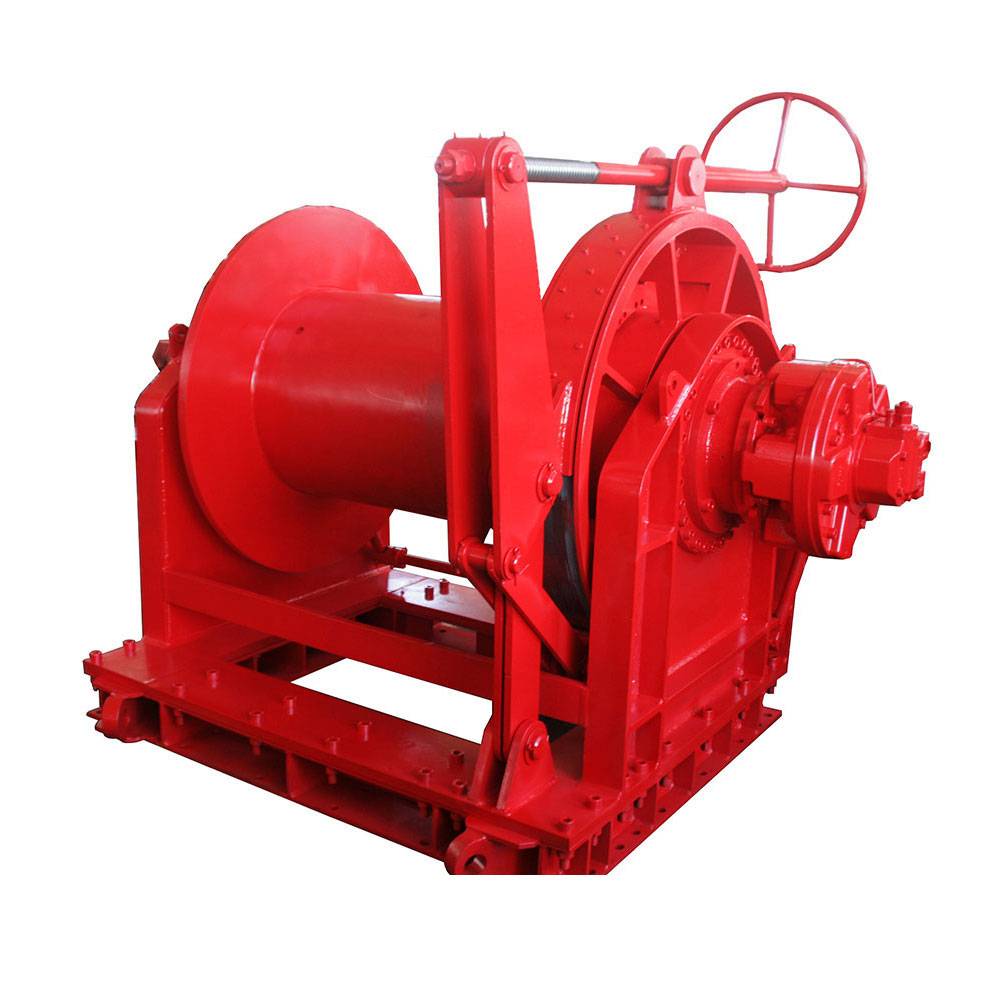
IYJ-N Series built-in hydraulic winch — planetary gear reduction with integrated brake and multiple motor displacement options. View IYJ-N Series →
The Shipyard Buyer Who Specified 30,000 lb Line Pull and Got 12,000 lb at Full Drum
A shipyard procurement manager in Southeast Asia contacted us in early 2025 after a hydraulic winch delivery failed acceptance testing. The procurement spec called for 30,000 lb line pull, and the supplier's catalog showed 30,000 lb line pull for the selected model. When the shipyard tested the winch at full drum with 30m of wire rope already on the drum, the actual measured line pull was approximately 12,000 lb — less than half the published rating. The shipyard's vessel deployment program required 25,000 lb minimum line pull, so the winch was structurally insufficient for the application.
This is the most common procurement error in hydraulic winch selection: specifying the first-layer line pull without accounting for the drum capacity that the application requires. The first-layer line pull is the maximum force the winch can pull on the outermost layer of rope on the drum, where the lever arm (drum radius) is largest and the gearbox torque advantage is maximized. As more rope is wound onto the drum, the effective drum radius decreases, and the line pull capacity decreases proportionally.
The structural fix is to specify the line pull at the drum capacity that the application requires, not the first-layer rating. For applications where the winch operates near full drum (vessel deployment, anchor retrieval, deep well operations), the full-drum line pull is the structural specification — typically 50-65% of the first-layer rating. Programs that skip this specification consistently buy winches that pass the first-layer test but fail in field operation.
The Line Speed Mistake That Costs Buyers Their Vessel Deployment Schedule
Line speed is determined by motor displacement and pump flow, and it is the specification that most procurement specs underweight. A winch rated at 10,000 lb line pull with 15 fpm line speed delivers different operational value than a winch rated at 15,000 lb line pull with 8 fpm line speed, even though the second winch has a higher line pull rating on the spec sheet. For vessel deployment programs that need to launch or recover boats within a specific tidal window, line speed is the structural specification, not line pull.
Programs that select on line pull alone without specifying line speed typically encounter one of two failure modes:
- >
- For>Line pull adequate, line speed too slow — vessel deployment takes longer than the tidal window allows, requiring expedited deployment or partial-load deployment that reduces operational efficiency.
- Line pull adequate, line speed too fast — load shock on the rope and drum, premature rope wear, and potential safety concern when the load arrives at the destination faster than the operator can control.
The structural fix is to specify both line pull and line speed at the target drum layer (typically mid-drum for typical operation). Line pull versus line speed is a trade-off determined by motor displacement: smaller motor = higher speed + lower pull; larger motor = lower speed + higher pull. Selecting the wrong balance is a structural error that costs buyers money because the winch performs the opposite of what the program needs. Hydraulic fluid power cylinder bore and rod dimensions are documented through the ISO 3320 hydraulic fluid power cylinders bore and rod dimensions standard, which provides the dimensional reference for hydraulic cylinder and motor specification validation.
Why Duty Cycle Classification Matters More Than the Catalog Specification
Duty cycle is the percentage of operating time that the winch is actively pulling load versus the total cycle time. Light-duty winches are typically rated for 20-30% duty cycle (suitable for occasional anchor retrieval); medium-duty for 40-60% duty cycle (suitable for repeated load handling); heavy-duty for 60-80% duty cycle (suitable for continuous industrial operation). Selecting a light-duty winch for a heavy-duty application causes premature brake wear, motor overheating, and gearbox failure.
| Duty Cycle | Active Pulling Time | Typical Application | Consequence of Mismatch |
|---|---|---|---|
| Light (20-30%) | 2-3 minutes per 10 minutes | Occasional anchor retrieval, recreational | Brake wear, motor overheating in heavy use |
| Medium (40-60%) | 4-6 minutes per 10 minutes | Repeated load handling, vessel deployment | Gearbox wear in continuous use |
| Heavy (60-80%) | 6-8 minutes per 10 minutes | Continuous industrial, marine commercial | Service life dramatically shortened if mismatched |
The published duty cycle is the structural specification that determines winch service life in the target application. Programs that source light-duty winches for heavy-duty applications typically encounter service life of 6-12 months instead of the expected 3-5 years. Hydraulic motors performance and testing methodology is documented through the ISO 4391 hydraulic fluid power motors performance and test methods standard. The cost saving from selecting the lighter-duty winch is quickly consumed by replacement costs and downtime.
The structural fix is to classify the target application duty cycle before selecting the winch. Programs with unpredictable peak loads (rescue, salvage) typically target heavy-duty to handle worst-case scenarios. Programs with predictable moderate loads (anchor retrieval, vessel deployment) typically target medium-duty. Programs with light occasional use can specify light-duty but should validate the actual duty cycle from operating records, not from optimistic expectations.
The Motor Displacement Selection Mistake
Motor displacement is the specification that determines the trade-off between line pull and line speed for a given pump flow. Selecting the wrong motor displacement is the procurement error that locks the program into the wrong line pull / line speed balance for the entire service life of the winch. Programs that discover the balance is wrong after delivery typically face expensive motor replacement or full winch replacement.
Three motor displacement selection rules that consistently work:
- >
- For rescue and vessel deployment programs that prioritize speed: select smaller motor displacement (typically 80-160 cc/rev) and accept the lower line pull.
- For anchor handling and heavy loadout programs that prioritize line pull: select larger motor displacement (typically 200-400 cc/rev) and accept the lower line speed.
- For mixed-use programs with both requirements: select the displacement that delivers the line pull at mid-drum that the program requires, and accept the resulting line speed at that displacement.
The IYJ-N Series built-in hydraulic winch at INI offers multiple motor displacement options for exactly this reason. Programs that consult INI's engineering team on motor displacement selection typically save 2-3 specification iterations compared to programs that select on catalog default. The motor displacement selection is a structural decision that should not be made on catalog default.
The Brake Holding Capacity Mistake
Brake holding capacity is the maximum load the winch brake can hold without slipping, typically rated at 130-150% of the first-layer line pull rating. The brake holds the load when the winch motor is not pulling (paused operation) and prevents load drift. For applications where the winch holds a suspended load for extended periods (crane operations, vessel deployment, suspended load positioning), brake holding capacity is the structural safety specification.
Programs that select winches with adequate line pull but insufficient brake holding capacity experience load drift during paused operation. For crane operations, this is a safety concern. For vessel deployment, this can damage the rope or the deployment mechanism. The structural fix is to specify brake holding capacity at 130-150% of the maximum sustained suspended load, not at the line pull rating.
For offshore and marine applications, the brake must also be rated for the marine environment (corrosion-resistant materials, sealed brake chamber). Programs that source winches with insufficient environmental protection encounter premature brake corrosion and brake failure within 12-24 months in saltwater service.
Three Procurement Mistakes That Cost the Same Buyer Money Twice
Three INI procurement support scenarios illustrate the recurring cost of common selection mistakes.
Mistake 1: Selecting on line pull without checking drum capacity. Shipyard buyer specified 30,000 lb line pull for vessel deployment, discovered 12,000 lb at full drum, ordered replacement with larger drum. Lesson: specify line pull at the target drum layer, not at first-layer.
Mistake 2: Selecting on catalog default motor displacement. Construction equipment OEM specified default motor displacement for anchor handling, discovered line speed was too slow for vessel deployment schedule. Replaced motor with smaller displacement. Lesson: validate motor displacement against the actual line speed requirement before specifying.
Mistake 3: Selecting light-duty winch for heavy-duty application. Offshore platform operator specified light-duty winch for subsea equipment handling. Winch brake failed at 8 months. Replaced with heavy-duty specification. Lesson: validate duty cycle classification against actual operating profile before specifying.
The common thread across all three scenarios: the procurement spec was written from the catalog rather than from the application analysis. Programs that run the application analysis before writing the spec save 30-50% of total cost-of-ownership over the winch service life. Hydraulic winch safety and offshore application standards are documented through the DNV offshore winch certification standards, which is the marine industry benchmark for vessel and offshore equipment certification. Programs that run the application analysis before writing the spec save 30-50% of total cost-of-ownership over the winch service life, because the right specification avoids the replacement cycle that the wrong specification triggers.
How to Avoid the Mistakes: A Procurement Spec Framework
For procurement teams specifying hydraulic winches, the specification should cover seven items before the PO is released. These are the inputs that determine whether the winch meets operational requirements in the field.
- >
- Target line pull at target drum layer — typically mid-drum for general operation, full-drum for sustained-load applications.
- Target line speed at target drum layer — typically mid-drum for general operation.
- Duty cycle classification — light, medium, or heavy based on actual operating profile.
- Motor displacement — selected to deliver the target line pull / line speed balance.
- Drum capacity — rope diameter and total rope length required for the application.
- Brake holding capacity — 130-150% of maximum sustained suspended load.
- Environmental protection — marine, offshore, industrial, or standard based on application.
The INI winch range spans 8 series to cover these specification combinations. The IYJ-N built-in hydraulic winch is the structural specification for offshore, marine, and industrial applications requiring continuous duty and high line pull, with multiple motor displacement options for the line pull / line speed trade-off. For procurement teams, the recommendation is to consult INI's engineering team before finalizing the spec, which typically saves 2-3 specification iterations.
Request Winch Specification Consultation
Tell us your application parameters: target line pull, line speed, drum capacity, duty cycle, and environmental protection. We will provide the right series specification and motor displacement selection for your program.
Frequently Asked Questions
What is the most common mistake when selecting a hydraulic winch?
The most common mistake is selecting on line pull rating alone without considering line speed, drum capacity, and duty cycle. A winch rated at 20,000 lb line pull at 0 fpm line speed (single layer, no load on the second layer) is not equivalent to a winch rated at 10,000 lb line pull at 15 fpm line speed across the full drum. Selecting the higher line pull rating because it looks better on the spec sheet is the most common procurement error, because the line pull number is only one variable in a multi-variable selection problem.
How does line speed affect hydraulic winch selection?
Line speed is determined by motor displacement and pump flow. For a given pump flow, a smaller motor displacement delivers higher line speed with lower line pull, and a larger motor displacement delivers lower line speed with higher line pull. Programs that need to lift loads quickly (rescue, vessel deployment) need higher line speed and may accept lower line pull. Programs that need to lift heavy loads (anchor handling, heavy loadout) need higher line pull and may accept lower line speed. Selecting the wrong balance is a structural error that costs buyers money because the winch performs the opposite of what the program needs. Hydraulic fluid power cylinder bore and rod dimensions are documented through the ISO 3320 hydraulic fluid power cylinders bore and rod dimensions standard, which provides the dimensional reference for hydraulic cylinder and motor specification validation.
What is the difference between first-layer line pull and full-drum line pull?
First-layer line pull is the rated maximum force the winch can pull on the outermost layer of rope on the drum, where the lever arm (drum radius) is largest and the gearbox torque advantage is maximized. Full-drum line pull is the force available on the innermost layer, where the drum radius is smallest and the gearbox torque advantage is minimized. The full-drum line pull is typically 50-65% of the first-layer rating. Programs that operate the winch near full drum consistently experience lower line pull than the published specification, which is a common source of procurement surprise.
What is the duty cycle and why does it matter for winch selection?
Duty cycle is the percentage of operating time that the winch is actively pulling load versus the total cycle time. Light-duty winches are typically rated for 20-30% duty cycle (suitable for occasional anchor retrieval), medium-duty for 40-60% duty cycle (suitable for repeated load handling), and heavy-duty for 60-80% duty cycle (suitable for continuous industrial operation). Selecting a light-duty winch for a heavy-duty application causes premature brake wear, motor overheating, and gearbox failure. The published duty cycle is the structural specification that determines winch service life in the target application.
What is the difference between a hydraulic winch and an electric winch?
Hydraulic winches draw power from a vehicle or vessel hydraulic system (PTO, dedicated pump, or auxiliary hydraulic unit), deliver consistent line pull across the full duty cycle, and have unlimited runtime as long as the hydraulic supply is running. Electric winches draw power from the vehicle battery, deliver high peak line pull but with thermal limit on duty cycle, and have limited runtime per battery charge. For marine, offshore, and industrial applications where hydraulic power is already available and continuous duty is required, hydraulic winches are the correct specification. For vehicle recovery and recreational applications where portability and battery power are the constraint, electric winches are typically specified.
How do I calculate required line pull for a winch application?
Required line pull depends on the load weight, the friction coefficient of the surface, and the slope angle. The formula is: Line Pull Required = Load Weight x (Rolling/Sliding Friction + Slope Factor). For vessel deployment on a slipway, friction is approximately 0.05-0.10 and slope factor is sin(angle) + cos(angle) x friction. For anchor retrieval from seabed, anchor weight plus chain weight plus bottom holding force. For vehicle recovery, gross vehicle weight times rolling resistance (approximately 0.04 for tires on hard surface) plus slope factor. Programs that fail to apply the friction and slope factors consistently undersize the winch.
What is brake holding capacity and why does it matter?
Brake holding capacity is the maximum load the winch brake can hold without slipping, typically rated at 130-150% of the first-layer line pull rating. The brake holds the load when the winch motor is not pulling (paused operation) and prevents load drift. For applications where the winch holds a suspended load for extended periods (crane, vessel deployment), the brake holding capacity is the structural safety specification. Programs that select a winch with adequate line pull but insufficient brake holding capacity experience load drift during paused operation, which is a safety concern.
What is the difference between planetary gear and worm gear winches?
Planetary gear winches use a planetary gearset (sun gear, planet gears, ring gear) to reduce motor speed and increase torque, with typical gear efficiency of 90-95% and high speed-to-torque ratios available. Worm gear winches use a worm and worm wheel to reduce speed and increase torque, with typical gear efficiency of 50-70% but with inherent self-locking brake characteristic. Planetary winches are typically higher performance with higher line speeds and higher efficiency. Worm gear winches are simpler and lower cost but with lower efficiency. For most hydraulic winch applications in offshore, marine, and industrial segments, planetary gear construction is the standard specification. Hydraulic winch safety standards and general technical requirements are documented through the ISO 4309 hydraulic fluid power winches general specifications reference and the EN 13000 crane safety standard family for crane application specifications.
Post time: Aug-18-2026