
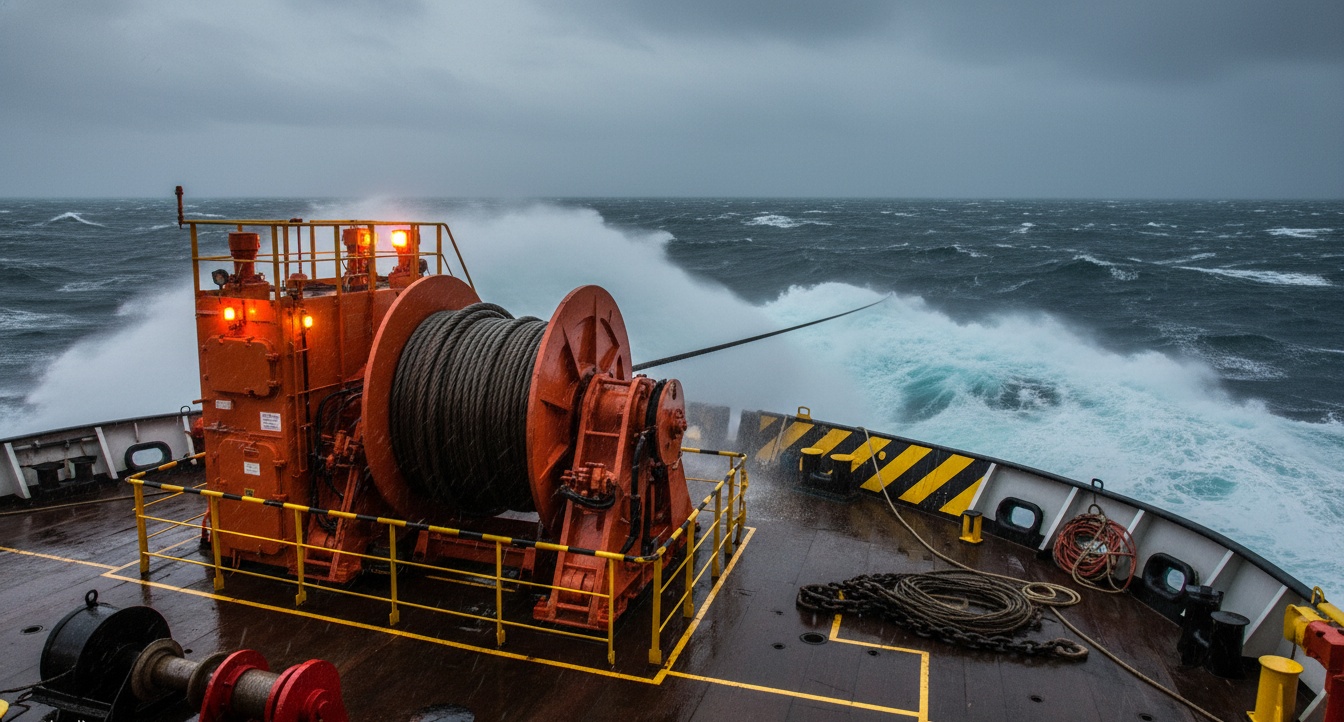
When a vessel founders at sea, every second counts. Salvage crews operate under extreme pressure—waves crashing over the deck, a listing hull threatening to slip beneath the surface, and tow lines that must be connected before the situation becomes irreversible. In these scenarios, the hydraulic winch for salvage vessel operations isn't just equipment; it's the difference between a successful recovery and a catastrophe.
A salvage winch must perform two distinct roles that seem almost contradictory: it needs to render line under controlled tension to absorb shock loads during connection, and it must recover that line with enough pulling force to move a disabled vessel hundreds of tons in heavy seas. Understanding how render and recover mode functions—and why it matters for emergency towing operations—is essential knowledge for shipyard procurement managers, OEM engineers, and marine equipment distributors evaluating hydraulic winch systems for salvage applications.
What Is Render and Recover Mode in a Salvage Winch?
The Fundamental Conflict: Slack Line vs. Maximum Pull
Traditional winches do one thing well: pull. A standard mooring winch takes in line under tension. A salvage winch must do something far more complex—it must switch between two operational modes instantly, often under full engine load and in weather that would keep most equipment offline.
Render mode (sometimes called "tensioning mode" or "controlled pay-out") allows the winch drum to rotate under load while a braking system maintains a pre-set holding force. When a salvage tug approaches a disabled vessel, the tow line is passed between the two ships. As the line comes under tension from wave action and vessel movement, the render function lets the winch "give" slightly, absorbing energy spikes that would otherwise snap the tow line or damage deck fittings. The line pays out in a controlled manner, much like a climbing rope absorbs a fall.
Recover mode is the opposite: the hydraulic system applies maximum torque to the drum, hauling in the tow line and transferring the pulling force from the salvage vessel to the tug. Once connected, the recover function takes over and begins moving the casualty.
Why Most Standard Winches Cannot Handle Salvage Operations
A standard marine winch with a simple band brake cannot render reliably under the dynamic loads encountered in emergency towing. When a wave lifts the casualty vessel and suddenly loads the tow line, the brake must slip—but slipping under load generates enormous heat, wears brake linings rapidly, and produces unpredictable jerk loads that travel through the entire tow system.
A properly configured hydraulic winch for salvage vessel operations uses a counterbalance valve or torque-limiting hydraulic motor in render mode, providing consistent, adjustable resistance without the friction-based heat and wear of a mechanical brake. This allows controlled pay-out at predictable tension levels regardless of how quickly the load changes.
Core Hydraulic System Design for Salvage Winches
Hydraulic Circuit Architecture
The hydraulic circuit is the heart of any salvage winch. INI Hydraulic designs its salvage winch systems around a variable displacement piston pump feeding a low-speed, high-torque hydraulic motor directly coupled to the winch drum. This eliminates the need for gearbox reduction in most configurations, simplifying maintenance and improving reliability in the harsh marine environment.
In render mode, the system operates with the motor in a counterbalance configuration—oil flows through the motor in the pay-out direction while the counterbalance valve maintains back-pressure proportional to the desired holding tension. The operator adjusts this tension via a proportional relief valve, typically ranging from 5% to 85% of the winch's maximum line pull rating.
In recover mode, the pump reverses flow direction, and the motor draws the drum in. Modern systems use electronic proportional controls, allowing the operator to adjust line pull from the bridge or a protected control station using a remote pendant.
Free Fall Function: When Speed Matters Most
Many salvage winch configurations include a free fall function, allowing the winch drum to release rapidly without hydraulic resistance in an emergency. This is critical when a salvage team needs to drop a recovery line quickly to a vessel in distress, or when the tow line needs to be cut and re-deployed faster than the hydraulic system can pay out under tension.
INI Hydraulic's IYJ-L Series winches incorporate an integrated free fall function with an automatic quick-connect coupling that allows the operator to switch from hydraulic render mode to free fall in a single motion. This design has proven particularly valuable in Mediterranean and Southeast Asian salvage operations where rapid deployment is frequently required.
Line Pull and Drum Capacity Specifications
A typical salvage winch for emergency towing operations must handle the following performance envelope:
- Maximum line pull: Ranging from 50 tonnes to 500 tonnes for heavy-lift salvage applications
- Drum storage capacity: Accommodating 500m to 2000m of steel wire rope or synthetic rope depending on the wire diameter
- Pay-out speed: Up to 30 meters per minute in render mode under full load
- Recovery speed: Typically 5–15 meters per minute at maximum pull, decreasing as load increases due to the hydraulic system's torque characteristics
The line pull rating is not simply a matter of motor size. The entire deck structure, sheave blocks, and fairleads must be rated to withstand the maximum potential load, which in dynamic salvage conditions can exceed the static maximum by a factor of two or more due to wave slam and dynamic amplification.
Why Render and Recover Capability Is Critical for Emergency Towing
Shock Load Absorption in Open Ocean Conditions
When two vessels are connected by a tow line in the open ocean, the load on that line is never static. A 10-meter wave passing under the casualty vessel can add hundreds of tonnes of dynamic load in a fraction of a second. Without a render function, that load spike travels directly to the tug's towing bitts and hull structure. With a properly configured render function, the winch absorbs the spike by allowing controlled line pay-out, converting the kinetic energy of the casualty's motion into drum rotation rather than structural stress.
The IMO Guidelines for Emergency Towing Systems (MSC/Circ. 1255) recognize this dynamic load management as a key requirement for salvage equipment. While the guidelines focus primarily on tow line strength and connection methods, experienced salvage masters understand that the winch's render capability is what actually protects the entire system from overload failure.
Controlled Recovery for Listing and Unstable Vessels
When a vessel has taken on water and is listing, the recovery operation must be staged carefully. The salvage winch operator starts by taking in small amounts of line, gradually righting the vessel's moment. If the winch pulls too hard too quickly, the casualty can capsize or the tow line can be ripped from the deck. A salvage winch with precise recover control allows the operator to apply exactly the right amount of force at exactly the right rate—something impossible to achieve with a simple drum brake system.
This is why shipyards and maritime authorities increasingly specify hydraulic winches with proportional recover control for salvage vessels, ocean-going tugs, and any vessel that might be called upon to assist a casualty in distress.
Choosing a Marine Hydraulic Winch Manufacturer for Salvage Applications
What Sets Salvage Winches Apart from Standard Marine Winches
Not all marine hydraulic winch manufacturers design for salvage conditions. The difference lies in several critical engineering details:
Hydraulic system redundancy: A salvage winch should have dual hydraulic circuits such that if one pump or motor fails, the winch can still operate in a limited capacity. Many commercial winches use a single hydraulic circuit with no backup.
Brake holding capacity: The fail-safe brake must hold the full maximum line pull rating with the hydraulic system de-energized. Spring-applied, hydraulically released multiple-disc brakes are the standard for salvage applications, providing positive engagement even if the hydraulic system loses pressure completely.
Corrosion protection: Salvage vessels operate in seawater spray, salt fog, and often acidic bilge environments. Hot-dip galvanizing, marine-grade stainless steel hardware, and cathodic protection systems are not optional additions—they are minimum requirements for equipment that must survive in the marine environment.
Certification and classification: Salvage equipment should be certified by a recognized classification society such as Lloyd's Register, DNV, ABS, or Bureau Veritas. The certification covers not just the winch itself but the hydraulic system, control systems, and braking performance.
The Value of Working with a Direct Manufacturer
When sourcing a hydraulic winch for salvage vessel operations, working directly with a marine hydraulic winch manufacturer offers significant advantages over purchasing through third-party distributors. Direct manufacturers can configure winch specifications to match exact vessel requirements, provide custom hydraulic circuit designs for specialized salvage scenarios, offer OEM spare parts support throughout the equipment's operational life, and provide technical documentation in the language and format required by classification surveyors.
INI Hydraulic, as a direct manufacturer, has supplied custom salvage winch configurations to shipyards across Southeast Asia, the Middle East, and Europe. This direct relationship means that procurement managers can discuss their specific operational requirements directly with the engineering team rather than selecting from a distributor's limited catalog.
Key Specifications to Request from a Salvage Winch Supplier
When requesting a quotation from a salvage winch supplier, the following specifications should be clearly defined:
| Parameter | What to Specify | Why It Matters |
|---|---|---|
| Maximum line pull | tonnes | Determines the size of casualty the winch can handle |
| Drum capacity | metres × rope diameter | Ensures sufficient wire storage for the operational area |
| Maximum working pressure | bar | Defines the hydraulic system pressure rating needed |
| Render tension range | % of max pull | Determines the controllability of pay-out under load |
| Free fall capacity | yes/no + speed | Critical for rapid deployment scenarios |
| Brake holding capacity | tonnes | Must exceed maximum line pull for safety |
| Control type | local / remote / both | Affects operator safety in heavy weather |
| Classification certification | LR / DNV / ABS / BV | Required for commercial salvage vessel compliance |
INI Hydraulic's Salvage Winch Product Lines
INI Hydraulic produces two product lines particularly suited for salvage and emergency towing applications:
The IYJ-L Series features an integrated free fall function combined with hydraulic render and recover mode. This series is designed for salvage vessels, ocean-going tugs, and multi-purpose support ships that need rapid tow line deployment capability. The compact design reduces deck mounting requirements, and the dual-circuit hydraulic system provides operational redundancy.
The IYJ-N Series offers an integrated hydraulic winch configuration with proportional render and recover control. This series emphasizes precise load management for operations requiring fine control over line tension—valuable for delicate recovery operations or for vessels operating in congested waters where sudden movements could cause collision.
Both series are available with custom hydraulic circuit configurations, allowing the buyer to specify pressure ratings, flow rates, and control system interfaces that match their existing vessel systems. INI Hydraulic's engineering team works directly with shipyard naval architects during the design phase to ensure the winch foundation, hydraulic supply lines, and control cable routing are all coordinated before fabrication begins—a service that distributors and third-party resellers typically cannot provide.
Understanding Hydraulic System Redundancy in Salvage Operations
One of the most critical yet frequently overlooked aspects of salvage winch design is hydraulic system redundancy. When a vessel is engaged in emergency towing operations, the winch is under maximum stress precisely when the vessel's other systems—including electrical generation—are likely under strain from weather conditions, damaged equipment, or emergency lighting and communication loads.
A single-circuit hydraulic system presents a catastrophic failure mode: if the hydraulic pump loses power or suffers a mechanical failure during a tow, the winch drum becomes locked or, worse, loses all holding capacity. In a dynamic ocean environment with a disabled vessel under tow, losing winch holding capacity can result in the tow line snapping, the tow connection failing, and both the salvage vessel and the casualty being placed in extreme danger.
Dual-circuit hydraulic systems address this by providing two independent pump-motor circuits that can share the load during normal operations and independently sustain the winch's render function if one circuit fails. A well-designed dual-circuit system can maintain render capability at approximately 50% of maximum line pull on a single circuit—enough to safely manage the tow until the casualty reaches sheltered waters or the faulty circuit is restored.
Tow Line Selection and Its Relationship to Winch Performance
The performance of even the best hydraulic winch for salvage vessel operations is ultimately limited by the tow line connecting the two vessels. Wire rope and synthetic rope behave very differently under the dynamic loads encountered in emergency towing, and the winch must be configured to handle the specific rope type in use.
Steel wire rope offers high strength and excellent abrasion resistance but is heavier and more difficult to handle than synthetic alternatives. It also stores more energy under tension—meaning that when a wire rope fails, it does so violently. Synthetic ropes, particularly high-modulus polyethylene or Aramid fibers, offer excellent energy absorption but are more susceptible to UV degradation and require different drum groove profiles to prevent internal heating during rapid pay-out.
A competent marine hydraulic winch manufacturer will ask about tow line specifications during the quotation process and configure the winch drum's groove pattern, flanges, and tensioning system accordingly. Buyers who specify only the maximum line pull without addressing rope compatibility risk premature rope wear, reduced drum life, and in extreme cases, rope slippage on the drum that creates a hazardous working environment.
Maintenance Considerations for Salvage Winch Systems
Salvage winches operate infrequently but must perform perfectly when called upon. A winch that sits idle for months must be ready to render and recover under full load within minutes of activation. This creates specific maintenance requirements that differ from continuously operated deck machinery.
Hydraulic fluid condition: Hydraulic fluid degrades over time, particularly in marine environments where moisture contamination is common. Annual hydraulic fluid analysis and filter replacement is essential, even when the winch has not been used.
Brake inspection: The fail-safe brake is the last line of defense if the hydraulic system fails during a tow. Disc brake pads must be inspected annually for wear, and the brake spring tension should be tested with a calibrated load cell.
Wire rope condition: Wire rope used in salvage operations should be inspected before every major operation. Look for broken strands, kinking, corrosion, and diameter reduction. Salvage wire ropes are subjected to higher cyclic loads than standard mooring operations and have shorter service lives.
Control system calibration: Electronic proportional controls and remote pendants should be calibrated annually to ensure the recover function responds accurately to operator inputs. An incorrectly calibrated winch can apply unexpected force, creating a hazardous situation during recovery operations. Calibration should be performed using calibrated test equipment and documented for classification society inspection.
Many salvage operators maintain a preventive maintenance agreement with their marine hydraulic winch manufacturer or an authorized service center, scheduling annual inspections that coincide with dry-docking periods. This approach ensures the winch is inspected, tested under load, and recertified without disrupting operational schedules.
Regulatory Framework and Classification Requirements
Commercial salvage vessels operating under flag state authority are required to meet specific equipment standards set by the International Maritime Organization and enforced by recognized classification societies. These standards cover the structural strength of deck equipment, the holding capacity of winch brakes, the performance of hydraulic control systems, and the documentation required to demonstrate compliance.
Classification society type approval is not a simple paperwork exercise—it requires the manufacturer to submit design calculations, test reports, and manufacturing quality records for review by the classification society's technical department. For a marine hydraulic winch manufacturer, obtaining type approval from multiple classification societies simultaneously is a significant investment, and the cost is reflected in the equipment price. However, vessels equipped with classification-approved winches benefit from simplified port state control inspections and clearer insurance coverage terms.
Procurement managers evaluating salvage winch suppliers should request copies of the relevant classification society type approval certificates and confirm that the specific winch model under consideration is covered by those certificates—not just a similar model in the manufacturer's catalog.
Conclusion
The hydraulic winch for salvage vessel operations is one of the most demanding pieces of equipment on any emergency towing vessel. It must switch between render and recover modes reliably, absorb extreme dynamic loads without mechanical failure, operate after extended periods of inactivity, and be supported by a manufacturer who understands the unique requirements of the maritime salvage industry.
When evaluating a marine hydraulic winch manufacturer or salvage winch supplier, look beyond the datasheet specifications. Ask about hydraulic circuit design philosophy, brake holding redundancy, classification certification coverage, and the manufacturer's track record in salvage applications. The difference between a winch that performs and one that fails is often found in these engineering details rather than in headline numbers.
INI Hydraulic's experience supplying hydraulic winches to the global salvage industry, combined with direct factory support and custom configuration capability, makes it a preferred partner for shipyards and maritime operators seeking reliable salvage equipment. To discuss your vessel's specific requirements, visit INI Hydraulic's official website.
This article is written by Mr. Leo, Technical Content Specialist & Export Sales Representative at INI Hydraulic Co., Ltd. For more technical content about hydraulic winch systems, follow INI Hydraulic on YouTube, X (Twitter), and Pinterest.
About the Author
Mr. Leo
Technical Content Specialist & Export Sales Representative, INI Hydraulic Co., Ltd.
Mr. Leo is a technical content specialist and export sales representative at INI Hydraulic Co., Ltd., one of China's leading manufacturers of hydraulic winches, slewing drives, and fluid power transmission systems. Through INI Hydraulic's YouTube channel and social media platforms, he produces hands-on technical content — including hydraulic system animations, winch load testing footage, and OEM procurement walkthroughs — that helps international buyers understand INI's product engineering before placing orders. With a background in hydraulic transmission engineering and four years supporting offshore, marine, and construction machinery buyers across Southeast Asia, the Middle East, and Europe, Leo translates complex hydraulic spec sheets into practical procurement guidance for OEM engineers, shipyard procurement managers, and industrial equipment distributors.
YouTube: https://www.youtube.com/channel/UCuyzdGdBZ6Tv-Nc9WzvYXIg
X: https://x.com/inihydraulic
Pinterest: https://www.pinterest.com/inihydraulic/
Post time: Jun-02-2026