
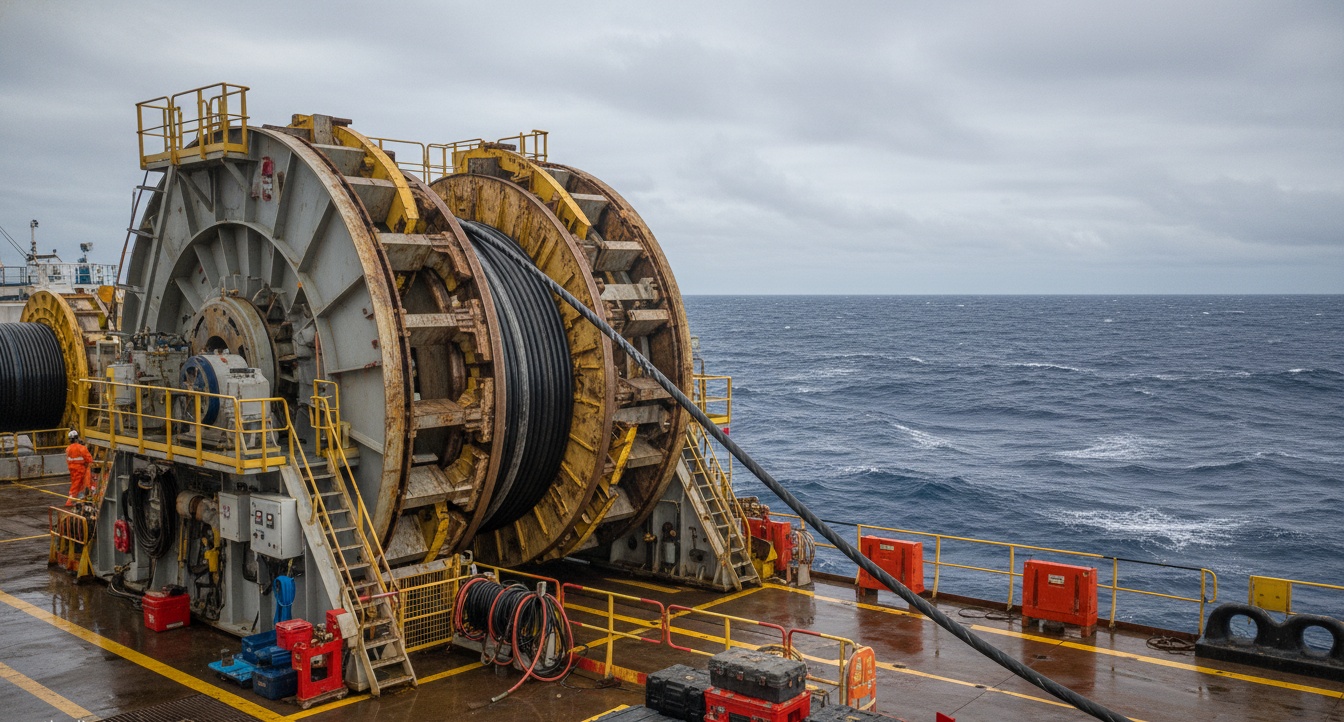
Subsea cable deployment and pipe lay operations demand precision tension control that few equipment categories can reliably deliver. A hydraulic winch for pipe layer tensioning must maintain consistent line pull during dynamic seabed conditions, handle variable rope diameters across multiple project phases, and operate reliably in the corrosive salt-water environment of offshore installation vessels.
This article covers the technical requirements for hydraulic tensioner winches used in subsea cable installation, how line pull control systems function, and how INI Hydraulic's IYJ-L series hydraulic winch with free fall function and IYJ-N series integrated hydraulic winch address the demands of offshore pipe lay and cable deployment operations.
What Is a Pipe Layer Tensioner System?
A pipe layer — also referred to as a pipelay vessel or reel-lay system — is an offshore installation vessel equipped with a specialized tensioner system that controls the tension applied to a pipeline or cable as it is lowered from the vessel to the seabed. Unlike a simple winch that pulls load, a tensioner maintains a pre-set line tension throughout the lay operation, compensating for vessel motion (heave), water depth changes, and variations in pipeline weight as more pipe is deployed.
The tensioner itself typically consists of a pair of caterpillar tracks or belt systems that grip the pipeline or cable from both sides, applying clamping force proportional to the required line tension. However, the hydraulic winch system — specifically the holdback winch — such as INI Hydraulic's IYJ-L series — at the aft end of the tensioner — is what provides the primary resistance that the tensioner controls against.
In subsea cable deployment, the same principle applies. A subsea power cable or umbilicals is fed from a rotating reel on the vessel, passes through a linear tensioner that controls the rate of deployment, and is guided to the seabed through a J-lay or S-lay ramp. The tensioner prevents the cable from being pulled too fast by the weight of the suspended section (the catenary), which could cause overbend or stress on the cable's internal structure.
The Role of Hydraulic Winches in Cable Deployment
Hydraulic winches used in subsea cable deployment serve three primary functions:
- Holdback tensioning: The winch applies a controlled resistance to the cable or pipeline as it exits the tensioner, maintaining the correct catenary shape and preventing free-fall acceleration during deployment.
- Reel spooling control: During cable retrieval or when working with flexible product (umbilicals, flexible flowlines), the winch controls the spooling speed to prevent bird-caging, crossovers, or layer irregularities on the reel.
- Emergency hold: In the event of hydraulic power loss, the winch's fail-safe brake must hold the last recorded tension without slippage, preventing the cable from dropping and potentially damaging subsea infrastructure or the cable itself.
Line Pull Control: Theory and Practice
Line pull control in hydraulic winches for cable deployment is achieved through a combination of pressure-compensated variable displacement pumps, proportional directional control valves, and load-sensing hydraulic circuits.
Load Sensing and Pressure Regulation
Modern hydraulic tensioner winches operate on a load-sensing principle: a pressure sensor monitors the hydraulic line pressure at the winch motor, and this signal is fed back to the pump's proportional control valve to adjust motor displacement and maintain the target pressure — and therefore the target line pull — regardless of variations in cable speed or suspended weight.
This is particularly important in subsea cable deployment, where the catenary load changes continuously as more cable is paid out. The suspended length of cable creates a varying gravitational load that must be constantly compensated. A well-tuned load-sensing system can maintain tension within ±5% of the setpoint across the full operational speed range.
Free Fall Function and Emergency Release
The IYJ-L series hydraulic winch with free fall function is specifically designed for applications where controlled emergency release is required. In subsea cable deployment, this means that if the tensioner system detects an overstress condition — for example, if the vessel heaves unexpectedly and the suspended cable load spikes — the free fall valve can rapidly reduce holdback pressure to prevent cable damage, then re-engage once the transient condition passes.
The free fall function also enables faster retrieval operations when needed, with the winch transitioning from tension-controlled mode to free-wheeling mode on command from the vessel's control system. This is particularly valuable when deploying cables in deep water (500m+) where the weight of the suspended catenary creates significant load variations that are difficult to manage with a standard holdback winch alone.
Key Specifications for Subsea Cable Deployment Winches
When specifying a hydraulic winch for pipe layer or subsea cable tensioning, the following parameters are critical:
Line Pull Rating
Cable deployment winches typically range from 5Te to 60Te line pull capacity, depending on the cable diameter, weight per meter, and water depth. For example:
- 35–120mm diameter power cables: 10–30Te holdback tension
- Umbilicals (100–250mm diameter): 15–50Te depending on length and weight
- Flexible flowlines (up to 400mm diameter): 30–80Te for deepwater S-lay operations
The INI Hydraulic IYJ-L series and IYJ-N series winches offer configurable line pull ratings from 5Te to 80Te, with customization available for specific project requirements.
Rope Diameter Compatibility
Subsea cable deployment typically uses steel wire rope or synthetic rope in the 20mm to 80mm diameter range. The winch drum must be grooved to match the specific rope diameter in use. Incorrect groove sizing dramatically increases rope wear and can reduce effective traction below the rated line pull.
Line Speed Control Range
Cable deployment requires precise speed control from near-zero to maximum. Typical operational speeds range from 0.5 m/min during sensitive touchdown operations to 50 m/min during normal deployment. A winch with poor low-speed controllability will struggle in the critical near-seabed phase of cable lay, where excess speed can cause dynamic cable stress.
Brake Holding Capacity
As noted above, fail-safe braking is non-negotiable. The brake must hold at least 125% of rated line pull in static conditions. For subsea cable applications, some operators specify brake holding at 150% of rated pull to account for dynamic shock loads during vessel motion.
Hydraulic System Architecture
The typical hydraulic circuit for a cable deployment tensioner winch includes:
- Main hydraulic pump: Variable displacement axial piston pump, typically 60–250 cc/rev displacement, operating at 25–35 MPa
- Proportional directional valve: Controls winch rotation direction and speed; typically a pilot-operated, electrically proportional spool valve with position feedback
- Brake valve: A pilot-operated release valve that holds the spring-applied brake engaged during normal operation and releases it when hydraulic pressure is applied
- Cross-port relief valves: Protect the motor from overpressure during overrunning load conditions — critical for descending cable loads
- Load sensing circuit: Pressure feedback from the motor circuit to the pump controller to maintain constant line pull
The IYJ-N series integrated hydraulic winch consolidates the motor, planetary reducer, and brake valve into one housing, reducing the external hydraulic circuit complexity and minimizing potential leak points. For cable deployment operations where salt-air corrosion is a constant threat, the reduced fitting count is a meaningful reliability advantage.
Offshore Environmental Considerations
Offshore installation vessels operate in one of the most demanding environments for mechanical and hydraulic equipment:
- Salt spray and marine atmosphere: Corrosion-resistant coatings and marine-grade hydraulic seals are minimum requirements. EN standards (EN ISO 12944) specify coating systems for offshore atmospheric exposure.
- Vessel motion: The winch must operate correctly under continuous pitch and roll of up to 5° in normal conditions and up to 15° in survival conditions. Winch mounting structures must be engineered to distribute dynamic loads correctly.
- Hydraulic fluid temperature: Arctic operations (North Sea, Gulf of Mexico) require heated hydraulic reservoirs and fluid that maintains viscosity at temperatures down to -20°C. Tropical operations require heat exchangers to manage fluid temperature at ambient above 40°C.
- ATEX/IECEx compliance: On vessels handling live electrical cable, the hydraulic equipment may need to meet explosive atmosphere certification requirements if in the vicinity of terminations where spark risk exists.
Application: Subsea Power Cable Installation
Offshore wind farm construction represents one of the fastest-growing applications for hydraulic tensioner winches in subsea cable deployment. A typical offshore wind export cable (220kV, 400mm outer diameter) requires:
- Holdback tension of 15–30Te during laying
- Precise speed control of 0.5–5 m/min near the seabed touchdown point
- Free fall or rapid dump capability for emergency release
- Brake holding at 1.5× normal tension to handle vessel heave conditions
The IYJ-L series hydraulic winch with free fall function is designed for these exact conditions, with an integrated free fall valve that responds to emergency signals from the vessel's dynamic positioning (DP) system or the tensioner control system.
Selecting the Right INI Hydraulic Winch for Your Operation
For subsea cable deployment and pipe lay tensioning applications, INI Hydraulic offers two primary product series:
The IYJ-L series hydraulic winch with free fall function is designed for operations requiring rapid tension release and re-engagement — including emergency cable dump scenarios, deepwater deployment where catenary loads vary significantly with depth, and retrieval operations where the winch must transition from tension-controlled to free-wheeling mode.
The IYJ-N series integrated hydraulic winch offers a compact, reduced-complexity solution for vessels with space constraints or where minimizing external hydraulic piping is a priority. The integrated motor-reducer-brake design reduces the total installed footprint, which is particularly valuable on dynamically positioned (DP) vessels where equipment positioning affects vessel stability calculations.
For either series, procurement teams should request the following specification data: maximum line pull (Te), line speed range (m/min), rope diameter range (mm), brake holding torque (kN·m), hydraulic working pressure (MPa), and free fall valve response time (ms) if applicable.
Cable Lay Vessel Configuration and Winch Sizing
Subsea cable installation vessels are specialized assets configured specifically for offshore cable and umbilical deployment. Understanding how the hydraulic tensioner winch fits into the vessel's overall cable lay system is essential for correct winch sizing and specification.
A typical cable lay vessel configuration includes:
- Rotating cable reel: The primary storage mechanism for the subsea cable, typically rated for cables up to 3,000mm diameter and 5,000–10,000Te weight capacity for offshore wind export cables.
- Linear tensioner: The primary tension control device that controls the rate of cable payout from the reel to theJ-lay or S-lay ramp. The tensioner's clamping force is set to match the desired cable tension.
- Holdback winch (the subject of this article): The hydraulic winch at the aft end of the tensioner that provides controlled resistance, preventing the cable from being pulled by its own weight faster than the tensioner can control.
- Dynamic positioning (DP) system: The vessel's computer-controlled thruster system that maintains vessel position within ±1m accuracy during cable lay operations in deep water.
The holdback winch must be sized to provide tension equal to approximately 5–15% of the total suspended cable weight in the catenary at maximum water depth. For a 220kV offshore wind export cable at 500m water depth, the suspended cable catenary creates a gravitational load that can reach 50–80Te — requiring a holdback winch rated at 10–20Te minimum line pull capacity just to maintain baseline tension during normal deployment.
Regulatory Framework and Classification Requirements
Hydraulic winches for subsea cable deployment must meet the requirements of maritime classification societies and international maritime conventions. The primary regulatory instruments include:
- SOLAS (International Convention for the Safety of Life at Sea): SOLAS Chapter II-1 requires that all deck machinery capable of lifting loads have fail-safe brakes and that the brake holding capacity be verified during sea trials. For tensioner winches, the same principle applies — the brake must hold the maximum design tension without slippage.
- Classification society rules: Lloyd's Register, DNV, ABS, and Bureau Veritas each publish rules for offshore vessel equipment. The winch design must be submitted for plan approval before construction, and the as-built winch must pass a load test at 1.25× rated line pull before delivery.
- ISO standards: ISO 7368 (Winches and Drawworks) and ISO 3828 (Deck Machinery) provide standardized definitions for winch performance parameters, test procedures, and documentation requirements. Compliance with these standards provides a common basis for comparing equipment from different manufacturers.
- ATEX/IECEx for hazardous areas: Vessels handling live electrical cables may require hydraulic equipment in the vicinity of cable termination areas to be certified for use in explosive atmospheres. This affects motor selection, junction box specifications, and cable gland selection.
INI Hydraulic's engineering team provides complete documentation packages for classification society plan approval, including general arrangement drawings, load diagrams, hydraulic schematics, finite element analysis (FEA) reports for the winch structure, and material certifications for all pressure-containing components.
Maintenance Planning and Operational Readiness
Harsh offshore environments demand rigorous maintenance planning to ensure hydraulic winch reliability during long deployment campaigns. A typical maintenance strategy for cable deployment winches includes:
- Weekly visual inspection: Check hydraulic hose condition, fitting torque, rope condition on the drum, and brake pad wear indicators. Document findings in the vessel's maintenance log.
- Monthly function tests: Test the fail-safe brake engagement at reduced load, verify the load-sensing control loop accuracy with a calibrated load cell, and inspect the drum groove condition for wear or damage.
- Six-monthly service: Replace hydraulic filter elements, check hydraulic oil condition and moisture content, inspect and adjust brake pad clearances, and verify the free fall valve response time if equipped.
- Annual overhaul: Full seal replacement on the hydraulic motor and brake caliper, inspection of planetary gear tooth condition, and recertification of the load-measuring system against traceable calibration standards.
For vessels operating in remote regions with limited technical support — such as offshore wind farms in the North Sea or oil and gas developments off West Africa — operators should specify a local service agreement with a hydraulics service provider as part of the initial procurement contract. The cost of a service agreement is typically 3–5% of the winch purchase price per year and provides access to specialist support that prevents minor issues from escalating into mission-critical failures.
Conclusion
Hydraulic winches for pipe layer tensioning and subsea cable deployment operate at the intersection of precision control engineering and heavy-duty mechanical reliability. The line pull control system must maintain tension within tight tolerances across a wide speed range while operating in a salt-water marine environment and handling the dynamic loads imposed by vessel motion.
The free fall function in the IYJ-L series specifically addresses the emergency release requirements that are inherent to deepwater cable deployment, where a stuck or overstressed cable can result in million-dollar equipment losses and significant project delays. The IYJ-N series integrated design addresses the reliability and maintenance demands of vessels operating in remote offshore locations with limited technical support infrastructure.
Procurement managers evaluating hydraulic winches for cable deployment should verify not only the rated line pull, but also the load-sensing control performance, brake holding capacity with safety margin, and the free fall valve's response time and reliability track record in comparable offshore operations.
Frequently Asked Questions
Q: What is the difference between a tensioner winch and a standard marine winch?
A: A tensioner winch must maintain a precise, pre-set line tension through variable speed conditions — it is a control device, not just a pulling device. A standard marine winch typically operates between two states: pulling or holding. A tensioner winch continuously adjusts its output to maintain the target tension regardless of whether the cable is being deployed or retrieved.
Q: Why is free fall capability important for subsea cable deployment?
A: During cable deployment in deep water, unexpected vessel heave or control system faults can cause tension spikes that exceed the cable's safe working tension. A free fall valve rapidly reduces holdback pressure, allowing the tensioner to absorb the excess load rather than the cable. Without this capability, the cable could be overstressed and damaged within seconds.
Q: How does water depth affect hydraulic winch selection for cable deployment?
A: Deeper water means longer suspended cable catenary, which increases the gravitational load on the holdback winch. A 500m water depth cable deployment requires significantly higher holdback tension than a 50m depth deployment for the same cable diameter. Additionally, deeper water means longer response times for the tension control system, requiring more aggressive free fall valve sizing and faster-responding load-sensing hydraulic circuits.
Q: What rope diameter is typically used for subsea power cable deployment?
A: Subsea power cables for offshore wind typically range from 80mm to 200mm in outer diameter (including armor and insulation). The steel wire rope used for the tensioner winch holdback typically ranges from 20mm to 60mm, depending on the winch's line pull rating and the cable's weight per meter.
Q: How often do hydraulic winches for cable deployment require maintenance?
A: Most marine hydraulic winches for offshore deployment undergo detailed inspection every 6 months and full overhaul every 3–5 years, depending on operating hours. Key maintenance items include brake pad replacement, seal renewal on the motor and brake valve, and inspection of drum grooving for wear. Winches with integrated motor-reducer designs (like the IYJ-N series) typically have longer seal life due to reduced external piping.
About the Author
Mr. Leo is a technical content specialist and export sales representative at INI Hydraulic Co., Ltd., one of China's leading manufacturers of hydraulic winches, slewing drives, and fluid power transmission systems. Through INI Hydraulic's YouTube channel and social media platforms, he produces hands-on technical content — including hydraulic system animations, winch load testing footage, and OEM procurement walkthroughs — that helps international buyers understand INI's product engineering before placing orders.
With a background in hydraulic transmission engineering and four years supporting offshore, marine, and construction machinery buyers across Southeast Asia, the Middle East, and Europe, Leo translates complex hydraulic spec sheets into practical procurement guidance for OEM engineers, shipyard procurement managers, and industrial equipment distributors.
YouTube: https://www.youtube.com/channel/UCuyzdGdBZ6Tv-Nc9WzvYXIg
Pinterest: https://www.pinterest.com/inihydraulic/
Post time: May-29-2026