
- Offshore hydraulic winch load ratings are specified at the first rope layer in kN — always verify the per-layer chart, not just the maximum rating
- Dual braking — spring-applied hydraulic-released (SAHR) brake + counterbalance valve — is mandatory for offshore mooring and lifting winches under SOLAS and ISO 19901
- INI's IYJ-N Series integrated hydraulic winch reduces installation footprint by 20–30% vs. component-built systems, with fewer hydraulic connection points vulnerable to salt-air corrosion
- Key certifications required: CCS Type Approval, CE/MED marking, ISO 19901 series — INI holds all three for IYJ-N and IYJ-ZZ series
- Marine maintenance intervals are typically 50–75% of land-based schedules; plan budget accordingly for offshore 500-hour brake inspections
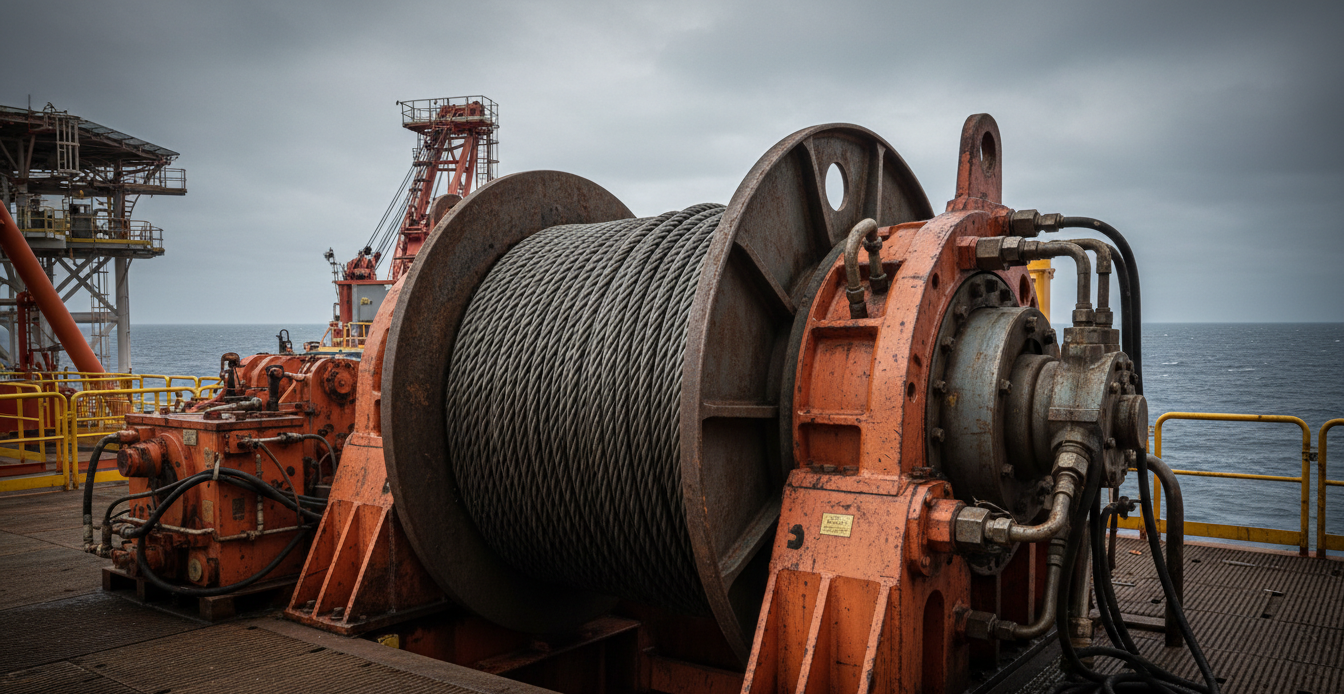
The Offshore Winch Sizing Problem: Why the First Layer Rating Determines Your Safety Margin
When I receive an inquiry from an offshore contractor who says "we need a 100kN winch," my first question back is: which layer? The line pull capacity of a drum winch changes with every layer of rope wound onto the drum — and in the offshore environment, this is not an academic distinction. A winch specified at 100kN maximum line pull on its top layer may only be rated at 60–65kN on the first layer, which is the layer at which most offshore mooring and lifting operations actually work. If the procurement specification was written against the maximum layer rating, the installed winch will be undersized for the actual working load at the first layer.
This is one of the most common hydraulic winch specification errors I encounter in offshore project reviews — and it has caused at least two well-documented load-incident investigations I have reviewed where a winch failed during a mooring operation because the specified model was selected on the wrong layer rating. The resolution is straightforward: always anchor your specification to the first-layer line pull rating, verify it against your maximum working load calculation with a minimum 3:1 design factor, and request the manufacturer's full layer chart from the RFQ stage. Any supplier who cannot provide a detailed layer-by-layer pull and torque chart for their standard product should not be on your approved vendor list for offshore applications.
Understanding Offshore Load Ratings: From Mooring Winches to Platform Cranes
The offshore hydraulic winch market covers several distinct application categories, each with different load, speed, and duty-cycle requirements. Understanding which category your project falls into is the starting point for accurate specification:
Mooring Winches: The Anchor Load Calculation
Ship and platform mooring winches typically operate at line pulls between 30kN and 300kN for commercial offshore vessels, with large cruise ships and oil tankers requiring mooring winches rated up to 500–1,000kN. The critical design parameter for mooring winches is not the continuous line pull — it is the peak braking load, which occurs when a vessel surges against its mooring lines during wind or current loading events. Mooring winch brake holding capacity is typically specified at 1.25–1.5× the maximum line pull rating, and the brake holding test is a mandatory FAT (Factory Acceptance Test) item for classification society certified units.
INI's IYJ-N Series integrated hydraulic winches in the 75–150kN range cover the majority of offshore platform support vessel and mid-sized commercial ship mooring applications, with the IYJ22.75-ND model providing a first-layer line pull of 75kN and a brake holding capacity compliant with major classification society requirements for offshore mooring service.
Personnel Transfer Hoists: The Safety Factor Imperative
Personnel transfer winches on offshore platforms — used to raise and lower workers between platform decks or between vessels and platform Jack-up legs — require a minimum 4:1 design factor on the working load limit, with dual independent braking systems as a non-negotiable safety requirement. These winches operate at lower line pulls (typically 5–30kN) but at significantly higher cycle rates than mooring winches, and the consequence of failure is categorically different. SOLAS Chapter II-1 and the NORSOK standards for Norwegian Continental Shelf operations specify the brake holding load and secondary safety device requirements in explicit detail — and classification societies will not issue type approval for personnel transfer winches without documented compliance testing against these standards.
Crane Hoists: The Duty Cycle Consideration
Platform crane winches operate on intermittent duty cycles — typically S3 25% or S4 40% per IEC 60034 — which means the hydraulic system must be sized for peak heating during the working portion of the cycle without allowing the hydraulic fluid to exceed maximum operating temperature during the resting portion. For cranes on offshore platforms operating in the Persian Gulf or West Africa tropical environments, where ambient temperatures regularly exceed 40°C, the hydraulic system's heat dissipation capacity becomes the limiting factor on sustained duty cycle performance. This is a specification detail that is frequently undersized when winches are selected by procurement officers who are evaluating based on catalog line pull and line speed data rather than the full thermal performance envelope.
Why the IYJ-N Integrated Design Matters in Offshore Environments
The IYJ-N Series integrated hydraulic winch represents a specific design philosophy: move the complexity inside the unit rather than distributing it across the hydraulic system. In a conventional winch arrangement, the hydraulic motor mounts on the winch, the brake mounts on the motor, the planetary gearbox connects motor to drum, and the entire assembly connects to the vessel's hydraulic power unit via external piping with multiple connection points. In the IYJ-N's integrated architecture, the motor, brake, gearbox, drum, and hydraulic valve block are assembled as a single factory-tested unit with internal hydraulic passages.
The practical implications for offshore operation are significant. Every external hydraulic fitting in a marine environment is a potential leak source, and every leak in a salt-air environment accelerates corrosion on adjacent fittings and structural members. Reducing the connection point count by 40–60% (typical reduction for IYJ-N vs. conventional equivalent) meaningfully reduces the leak risk profile of the installed winch. For offshore platforms where maintenance is conducted by specialized crews on a scheduled helicopter or supply vessel basis — not by a resident maintenance team — the reduction in scheduled hydraulic maintenance events translates directly into reduced operational cost and fewer unscheduled maintenance interventions.
The integrated valve block — which combines braking, counterbalance, and directional control functions in a single compact housing — also simplifies the hydraulic system troubleshooting process. When a conventional winch has a braking fault, isolating whether the problem is in the external counterbalance valve, the brake line fitting, or the internal motor brake is a multi-hour diagnostic exercise. On the IYJ-N, the valve block is a single replaceable unit — if the valve block is suspected, it is swapped as a unit and the faulty block is returned to shore for repair, minimizing platform downtime.
Dual Braking: The Non-Negotiable Safety Architecture for Offshore
I want to address the braking system question directly, because it is the most consequential specification decision for any offshore hydraulic winch — and the area where I see the most cost-driven procurement compromises that create serious safety exposure.
The SAHR Primary Brake
The primary braking system on INI's IYJ-N and IYJ-ZZ series winches is a spring-applied hydraulic-released (SAHR) multi-disc brake. The spring applies braking force when hydraulic pressure is removed — meaning the winch fails to a safe stopped state (fail-safe) if the hydraulic system loses pressure for any reason. This is the foundational safety principle for offshore winches: no single hydraulic failure mode should result in uncontrolled load descent. The SAHR brake is sized to hold the maximum rated load at a minimum 1.25× safety factor under the relevant classification society test standard.
The Counterbalance Valve: Controlling Descent, Preventing Runaway
The secondary braking element is the hydraulic counterbalance valve block, which serves two functions: it prevents the load from accelerating during controlled lowering (the load's weight trying to pull rope off the drum faster than the motor is designed to pay out), and it provides a secondary load-holding function that is independent of the SAHR brake. The counterbalance valve is a pilot-operated proportional valve — as motor pressure drops during lowering, the valve progressively closes to resist the load, and if hydraulic flow is lost, the valve closes to a dead-stop position independent of spring force. This dual-pathway failsafe is what classification societies and offshore safety regulators require for mooring and lifting winches.
The IYJ-ZZ Dual-Brake Option
For applications with the most stringent safety requirements — including personnel transfer and lifting winches on offshore accommodation platforms — the IYJ-ZZ Series adds a second independent SAHR brake on the drum shaft itself, in addition to the motor-shaft SAHR brake. The drum-shaft brake is controlled by a separate hydraulic circuit from the motor brake, meaning a failure in one brake's hydraulic circuit does not affect the other. For projects specifying NORSOK or equivalent ultra-high safety-integrity requirements, the IYJ-ZZ dual-brake configuration is the appropriate selection.
What Offshore Hydraulic Winch Procurement Requires: The Documentation Checklist
For international offshore projects, the hydraulic winch procurement package must include the following documentation — not as optional attachments but as contractually binding deliverables:
- Classification Society Type Approval Certificate: CCS Type Approval for Chinese-flagged and CCS-accepted vessels; MED CE marking for EU-flagged vessels; ABS, DNV, or equivalent for international projects — all confirming the specific winch model has been tested and certified
- Load Test Report: Factory Acceptance Test (FAT) record confirming line pull at first layer, brake holding load at 1.25× rated load, and dynamic braking test under simulated working conditions
- Hydraulic System Schematic: As-built hydraulic circuit diagram showing all components, pressure settings, and flow rates — essential for the vessel's onboard maintenance team
- Spare Parts List with Recommended Stock Levels: For a 3-year offshore operating cycle between major maintenance periods
- Corrosion Protection Specification: External coating system (typically marine epoxy + polyurethane topcoat to ISO 12944 C5-M), stainless steel hardware grade, and seal compound specifications for the specific marine environment (North Sea vs. Gulf of Mexico vs. West Africa all present different corrosion severity profiles)
- Installation and Commissioning Manual: Including shaft alignment tolerances, hydraulic pressure settings, and brake adjustment procedures — required by offshore platform safety documentation systems
Maintenance Intervals: The 50–75% Rule for Offshore Environments
The cost of not planning for accelerated offshore maintenance schedules shows up in two ways: unplanned downtime from premature component failures, and safety incident risk from degraded brake performance between scheduled inspections. Based on INI Hydraulic's field service data from active offshore installations:
- Brake pad inspection: Every 500 operating hours in marine offshore environments (vs. 750 hours typical for land-based construction equipment). Salt-air accelerates pad glazing and contamination; pads should be inspected for contamination even if visual thickness appears adequate.
- Hydraulic hose and fitting replacement: Every 2 years maximum in marine environments regardless of apparent condition. Salt-air penetrates hose outer rubber layers through microscopic cracks invisible to the naked eye, causing internal hose reinforcement corrosion that fails without warning.
- Hydraulic fluid and filter service: Every 1,000 hours or 12 months in offshore hydraulic systems — shorter than land-based intervals because salt-air ingress into the hydraulic reservoir accelerates fluid oxidation and moisture contamination.
- Corrosion inspection of structural members: Annual inspection of all external steel surfaces, winch mounting structure, and drum shaft exposed surfaces. The first sign of corrosion at a mounting bolt head or weld heat-affected zone indicates the coating system has failed locally — and where the coating has failed in one location on an offshore structure, the adjacent areas are likely to be following.
Conclusion: Safety Architecture First, Then Load Specification
The procurement sequence I recommend for offshore hydraulic winches is counterintuitive to buyers who come from land-based construction equipment purchasing backgrounds: start with the safety architecture, not the load rating. Confirm the dual braking configuration matches the project's classification society and flag state requirements. Verify the certification package completeness before discussing price. Then, and only then, size the load rating against the actual first-layer working load calculation.
The reason this sequence matters is that safety architecture violations disqualify a winch from offshore service regardless of how attractive the load rating and price are. A 30% lower price on a winch that cannot receive CCS Type Approval for the target vessel class is not a saving — it is a stranded procurement cost. INI Hydraulic's combination of IYJ-N integrated design (reduced leak points, simplified maintenance), IYJ-ZZ dual-brake configuration (independent dual SAHR brakes for ultra-safety applications), and full CCS + MED + ISO 19901 certification coverage provides the documentation completeness that offshore project procurement teams require for compliance submission.
For project-specific RFQ support — including full load calculation review, brake system recommendation, and certification package confirmation — contact INI Hydraulic's offshore applications team through the product inquiry channels.
About the Author
Mr. Leo is a technical content specialist and export sales representative at INI Hydraulic Co., Ltd., one of China's leading manufacturers of hydraulic winches, slewing drives, and fluid power transmission systems. Through INI Hydraulic's YouTube channel and social media platforms, he produces hands-on technical content — including hydraulic system animations, winch load testing footage, and OEM procurement walkthroughs — that helps international buyers understand INI's product engineering before placing orders.
With a background in hydraulic transmission engineering and experience supporting offshore, marine, and construction machinery buyers across Southeast Asia, the Middle East, and Europe, Leo translates complex hydraulic spec sheets into practical procurement guidance for OEM engineers, shipyard procurement managers, and industrial equipment distributors.
INI Hydraulic — YouTube | X @inihydraulic | INI Hydraulic — Pinterest
Explore INI's Hydraulic Winch Range:
- IYJ-N Series Integrated Hydraulic Winch — For Marine & Offshore Platforms
- IYJ Series Ordinary Hydraulic Winch — Standard Industrial Range
- IYJ22.75-ND — 75kN Mooring Winch for Offshore Vessels
Post time: May-26-2026