
TL;DR
- Spud winches for cutter suction dredgers typically require 50–300 kN line pull with hydraulic drive systems for precise positioning control
- INI Hydraulic's IYJ-N Series integrated hydraulic winches deliver line speeds of 0–30 m/min with dynamically adjustable braking for active positioning under varying load conditions
- Key selection criteria include holding capacity, positioning accuracy (±0.5 m), response time (<2 seconds), and compliance with ABS/CCS marine certification standards
- For cutter suction dredger applications, the winch must handle spud penetration forces of 50–800 kN while maintaining station-keeping in currents up to 3 m/s
Introduction
When I first walked onto a cutter suction dredger in the Mekong Delta back in 2019, the first thing I noticed wasn't the massive cutter head—it was the constant, low-frequency hum of the spud winches holding the vessel in position against the current. The captain pointed to one of the winches and said, "That's the heartbeat of this whole operation. If that fails, we lose position, and losing position on a $40 million dredger means losing the job."
That conversation shaped how I think about spud winch specification for cutter suction positioning. Most technical articles jump straight into torque ratings and brake specs. But I'm going to start where it matters: what happens when you need to hold a 2,000-ton dredger in a 2.5-knot current while your cutter head is fighting through compacted clay at 15 meters depth.
Because that's the real-world condition your hydraulic winch for dredger must handle—not a textbook scenario, but an actual fight against physics. And after four years of supporting dredging operators across Southeast Asia, the Middle East, and Europe, I've learned exactly what separates a winch that survives that fight from one that fails at the worst possible moment.
In this article, I'm going to walk you through the complete specification framework for selecting a spud winch for cutter suction dredger positioning. We'll cover everything from holding capacity calculations and hydraulic system requirements to brake safety standards and manufacturer verification. By the end, you'll have a clear, quantifiable basis for comparing dredger hydraulic winch suppliers—and knowing exactly what questions to ask that most salespeople can't answer.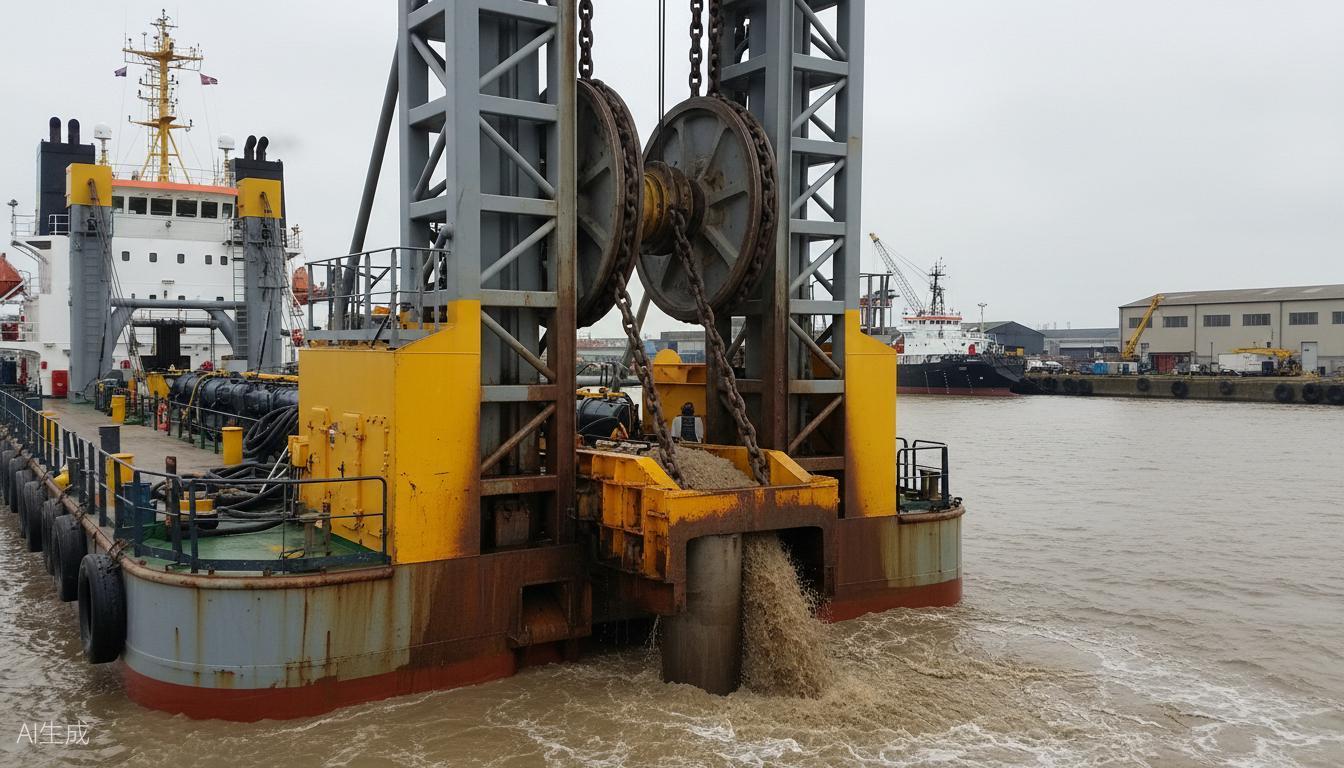
Understanding Spud Winch Function in Cutter Suction Dredgers
What a Spud Winch Actually Does
A spud winch on a cutter suction dredger serves a fundamentally different function than most marine winches. It's not lifting a load and releasing it. It's holding position. And "holding position" means maintaining the dredger within a positioning envelope of ±0.5 to ±2 meters relative to the design excavation line, while the vessel is subject to:
- Current forces from water flow (lateral and longitudinal)
- Wave-induced surge from vessel movement
- Reactive torque from the cutter head cutting into the seabed
- Environmental wind loads on the above-water structure
The spud winch controls two to four spud poles—large steel piles driven into the seabed that define the dredger's fixed reference points. By paying out or reeling in these spuds, the winch enables incremental advancement of the dredger along the excavation path. This is called incremental advancement control, and it's the core function that drives all spud winch design requirements.
The critical difference from other marine applications: a spud winch operates under continuous load hold conditions. Your anchor winch releases and retrieves. Your mooring winch locks and releases. But your spud winch? It sits under constant load for hours at a time, and when conditions change (current surge, cutter reaction spike), it must respond in milliseconds to maintain station. That continuous holding requirement is what drives every specification decision in this article.
Why Cutter Suction Dredgers Are Unique
Not all dredgers use spud positioning systems. Only a specific subset—cutter suction dredgers (CSD)—rely heavily on spud winches for primary positioning control. Here's why:
Cutter suction dredgers operate in a stationary or near-stationary mode during active dredging. Unlike trailing suction hopper dredgers that move continuously, a CSD advances incrementally. It cuts a swath, advances, cuts again. This incremental advancement is controlled by the spud poles, which provide the fixed reference frame.
The result: a CSD uses spud winches for 60–80% of its active positioning operations. When I talk to dredge masters operating in the Suez Canal expansion or the Singapore Tuas Terminal projects, they consistently cite spud winch reliability as the single largest maintenance concern on older vessels.
Compare this to other dredger types:
- Trailing suction hopper dredgers: Primarily use DP (dynamic positioning) systems, spud winches as secondary stability aid
- Grab dredgers: Use spuds for station-keeping but at lower load cycles
- Bucket dredgers: Similar to grab, lower cycle rates
For our purposes in this article, we're focused on cutter suction dredger spud winches, and that specificity matters because it determines the load cycle requirements, duty classification, and hydraulic system design that follows.
Core Specification Requirements for Hydraulic Winch for Dredger
Holding Capacity: The Foundation of Everything
Holding capacity is the single most critical specification for a spud winch, and it's where most buyers make their first mistake. They look at the rated line pull of the winch and assume that's what matters. But for spud positioning, what matters is holding capacity under fail-safe conditions.
Here's why this distinction is critical:
The winch operates in two modes—active mode and hold mode. In active mode, the hydraulic system actively tensions the spud cable, and the brake is released for paying out or reeling in. In hold mode, the brake is engaged and the hydraulic system maintains tension. The holding capacity must be sufficient to hold the spud pole against maximum environmental loads when the hydraulic system is in standby or fail-safe mode.
What does "fail-safe" mean in practice? It means:
- Hydraulic pump failure with accumulator backup
- Power system failure with emergency power
- Emergency stop activation
Under any of these conditions, the brake must hold the full rated load without creep. For a typical 150-meter CSD operating in a 2.5 m/s current, this translates to lateral forces on each spud of 150–400 kN depending on vessel displacement and freeboard. A spud winch specified at 200 kN holding capacity would be inadequate; you're looking at 300–500 kN holding capacity per spud winch for mid-size CSDs (vessel length 80–120 meters).
"We spec'd our spud winches at 400 kN holding capacity because we operate in the North Sea. When a storm surge hits at 6 on the Beaufort scale, you need to know your winches will hold. We've seen other operators' winches fail because they went with 250 kN spec—that's a disaster waiting to happen." — Dredge Master, 14 years in European coastal operations
For your specification, use this formula:
`` Required Holding Capacity = Maximum Environmental Load × Safety Factor ``
Where:
- Maximum Environmental Load = calculated from current velocity, wave height, vessel displacement, wind speed, and cutter reaction force
- Safety Factor = minimum 2.0 for normal operations, 3.0 for hostile environment (offshore, high current, extreme weather)
The safety factor isn't arbitrary. ABS (American Bureau of Shipping) requires a 2.0 minimum safety factor for marine mooring equipment, and that's for standard mooring—not the continuous hold requirements of spud positioning on an active cutter suction dredger.
Line Pull and Speed Requirements
Once you've confirmed holding capacity, the next specification axis is line pull and line speed during active operations.
Line pull requirements for spud winches on cutter suction dredgers typically range from:
| Vessel Size (Length) | Line Pull (Active Mode) | Line Speed Range |
| Small (<60m) | 50–100 kN | 0–20 m/min |
| Medium (60–100m) | 100–200 kN | 0–25 m/min |
| Large (100–150m) | 200–350 kN | 0–30 m/min |
| Extra Large (>150m) | 350–500 kN | 0–35 m/min |
The speed range is critical because spud winches must operate across the full spectrum from creep pay-out (0.5–2 m/min during precision positioning) to rapid retrieval (20–35 m/min during emergency spud extraction or weather evacuation). A winch that only handles one speed range will fail you in at least one operational scenario.
For positioning accuracy, the minimum line speed control is typically 0.5 m/min at low speed with no load jerk. This is where the hydraulic system design becomes critical. Variable displacement hydraulic motors with proportional control enable the fine speed adjustment that precision positioning requires. Fixed displacement systems often exhibit "sticking" at low speeds that makes precision control nearly impossible.
Hydraulic System Design Considerations
The hydraulic system is the soul of your dredger hydraulic winch supplier's engineering capability. When evaluating hydraulic winch for dredger options, pay close attention to:
1. Drive System Configuration
The two dominant configurations for spud winch hydraulic systems are:
- Open-loop hydraulic system: Pump directly drives motor, oil flow is continuous. Simpler design, lower cost, but less precise speed control. Better suited for applications where constant speed operation dominates.
- Closed-loop hydraulic system: Uses a charge pump and hot oil tank, enables variable displacement control with much finer speed regulation. This is what you want for cutter suction spud winches where precision positioning is non-negotiable.
For CSD spud winches, I recommend closed-loop hydraulic systems for the primary drive, with open-loop auxiliary for emergency manual operation. This gives you the best of both worlds: precision control when you need it, and fail-safe manual operation when systems fail.
2. Brake System Design
Your brake system must handle two distinct failure scenarios:
- Holding brake: Engaged during hold mode, holds spud under full environmental load
- Dynamic braking: Controlled deceleration during active pay-out/reel-in operations
For spud winch applications, multiple wet multi-disc brakes are the industry standard. Why wet brakes instead of dry? Because wet brakes run cooler, wear more slowly, and provide more consistent holding capacity over their service life. Dry brakes can overheat during extended hold periods, leading to brake fade—the last thing you need when you're holding position in a current.
The brake must engage in < 0.3 seconds on emergency stop signal. This response time is critical because a spud that slips even 0.5 meters during emergency stop can cause the cutter head to deviate from the planned excavation line, creating costly rework.
3. Accumulator Requirements
Hydraulic accumulators serve as energy storage for emergency brake engagement and load smoothing during sudden force spikes (wave surge, cutter reaction spike). For spud winch applications, I recommend:
- Minimum 2-liter gas accumulator per winch for brake emergency engagement
- Pre-charge pressure at 80% of minimum working pressure
- Accumulator monitoring via pressure gauges or electronic monitoring systems
This isn't optional equipment. Without accumulator backup, a hydraulic pump failure means brake failure means lost position. In a harbor channel with heavy vessel traffic, losing position isn't just expensive—it's a safety incident.
Brake Safety Standards for Marine Spud Winches
International Standards That Actually Matter
When a dredger hydraulic winch supplier tells you their winches "meet marine standards," you need to know exactly which standards they mean. For spud winches on cutter suction dredgers, the relevant standards are:
ABS (American Bureau of Shipping) Rules for Building and Classing Mobile Offshore Units
ABS has specific rules for mooring winches and positioning equipment that apply to spud winch systems. Key requirements include:
- Minimum breaking load (MBL) of components must exceed rated load by factor of 3.0
- Brake holding capacity must exceed rated line pull by factor of 1.5
- Emergency stop must achieve full brake engagement in < 0.5 seconds
DNV (Det Norske Veritas) Standards for Marine Equipment
DNV-ST-E401 covers winches and winch systems with specific requirements for:
- Load monitoring systems
- Brake testing protocols
- Emergency operation requirements
ISO 17096:2015 – Maritime Navigation Equipment
This standard covers the hydraulic operational requirements for marine winches, including:
- Minimum 10,000 load cycle endurance rating
- Environmental temperature range: -15°C to +50°C
- Salt mist corrosion resistance requirements
UK Marine Equipment Compliance (MCA)
If you're operating in UK waters or the North Sea, your spud winches need MCA (Maritime and Coastguard Agency) type approval, which incorporates BS EN standards for marine machinery.
When you're evaluating a dredger hydraulic winch supplier, ask for their certification matrix—a document that lists which standards their products are certified to and the corresponding test reports. Any serious spud winch manufacturer will have this ready. If they're vague about certifications or "self-certified," that's a red flag.
What Certification Actually Proves
Let me be clear about what certification does and doesn't prove:
What it proves:
- The winch has been prototype-tested to specified breaking loads
- The brake system meets response time requirements
- Materials and construction meet documented standards
- The manufacturer has a quality management system (typically ISO 9001) that governs production
What it doesn't prove:
- Long-term reliability in your specific operating conditions
- Consistency between production units
- Serviceability or maintenance friendliness
- Actual performance in the field versus test conditions
This is why I always recommend, when possible, to visit the manufacturer's facility and see the production process. I've toured winch factories across China, and the difference between a manufacturer who actually tests every unit versus one who tests a prototype and calls it good is visible on the production floor. Ask to see their load testing protocol documentation—every unit tested or just sampling?
Selecting a Spud Winch Manufacturer: What Actually Matters
Engineering Capability Indicators
After visiting over a dozen hydraulic winch factories across China, I've developed a clear mental model of what separates capable spud winch manufacturers from those who are just in the business to move units. Here's what I look for:
1. In-House Hydraulic Engineering Capability
A manufacturer who assembles winches from purchased components (motor, reducer, brake purchased from third parties) is an integrator, not an engineer. What you want is a manufacturer who designs and builds their own hydraulic systems.
Why? Because when something goes wrong in the field—and something always goes wrong eventually—you need a manufacturer who can actually troubleshoot hydraulic system interactions. An integrator who purchased components from three different suppliers will spend weeks coordinating with each supplier to debug a system interaction problem. An engineering manufacturer with in-house hydraulic design can trace the problem to a specific parameter in their own engineering files.
INI Hydraulic, for example, designs and manufactures their own fluid power transmission systems including hydraulic pumps, motors, and integrated control valves. This vertical integration means their spud winches are engineered as complete systems, not assembled from parts.
2. Testing Infrastructure
Ask: "Where do you test your winches?" A manufacturer with serious engineering capability has:
- Load testing frames that can apply full rated load to every unit
- Endurance testing equipment for accelerated lifecycle testing
- Environmental testing (salt spray, temperature cycling)
- Hydraulic system test benches for functional verification
The difference between a manufacturer who tests prototypes and one who tests every production unit is substantial. Prototype testing proves the design works. Production testing proves every unit works.
3. Engineering Documentation Quality
Ask to see the engineering data package for one of their spud winch models. A capable manufacturer will provide:
- Complete hydraulic circuit diagrams
- Load rating calculations with safety factor documentation
- Finite element analysis (FEA) for main structural components
- Material certificates for critical components (brake discs, shafts, gears)
A manufacturer who can't provide this documentation either doesn't have it or doesn't want you to see it. Either way, that's not someone you want specifying your $500,000 spud winch system.
Delivery and Project Reference Experience
For spud winches on cutter suction dredgers, the installation is typically done during new build or during major vessel refit. That means project delivery experience matters as much as product quality.
When I evaluate a dredger hydraulic winch supplier's project references, I look for:
1. Similar Vessel Type Experience
Not all dredgers are the same, and spud winch requirements vary significantly by dredger type. A manufacturer who has supplied 20 trailing suction hopper dredgers may have limited experience with cutter suction applications, which have different load profiles and duty cycles.
Ask for references specifically for cutter suction dredgers in your size range.
2. Geographic Operating Environment
A spud winch that operates reliably in the Baltic Sea's cold, salt-heavy environment may not have been designed for the tropical coral conditions of Southeast Asia or the abrasive sediments of the Middle East Gulf. Ask for references in your operating region.
3. Project Track Record
For new build projects, request a project reference list with:
- Vessel name and operator
- Vessel type and size (length, displacement)
- Spud winch model supplied
- Delivery date
- Any performance issues or warranty claims
A manufacturer with 5+ years of CSD spud winch supply history with no major warranty campaigns is more reliable than one who just entered the market.
INI Hydraulic's Spud Winch Product Line for Cutter Suction Dredgers
IYJ-N Series Integrated Hydraulic Winch
The IYJ-N Series from INI Hydraulic is designed specifically for applications requiring precise positioning control with heavy static holding requirements—exactly the profile of spud winches on cutter suction dredgers.
Key Specifications:
- Line pull (active): 50–400 kN (configurable by model)
- Holding capacity: Up to 2× rated line pull (fail-safe brake mode)
- Line speed: Variable 0–30 m/min with proportional control
- Brake type: Multi-disc wet hydraulic brake with emergency spring engagement
- Hydraulic system: Closed-loop integrated with proportional control valves
- Certification: ABS, CCS, DNV (type dependent on configuration)
The IYJ-N Series uses INI's proprietary integrated hydraulic winch design, which means the hydraulic motor, reduction gearbox, brake system, and control manifold are engineered as a single matched system. This eliminates the compatibility issues that arise when components from different suppliers are assembled into a "system."
For spud positioning on cutter suction dredgers, the IYJ-N Series offers:
- Dynamic positioning response via variable displacement hydraulic control
- Fail-safe holding brake with accumulator backup for emergency scenarios
- Load monitoring interface for integration with vessel DP systems
- Marine corrosion protection with extended maintenance intervals for offshore operations
Product page: INI IYJ-N Series Integrated Hydraulic Winch
IYJ-L Series with Free Fall Function
For applications where emergency spud release is required (weather evacuation, collision avoidance, emergency disconnection), the IYJ-L Series includes a free fall function that allows rapid spud extraction without hydraulic pump support.
Key Specifications:
- Line pull (active): 80–500 kN
- Free fall mode: Manual release of brake, gravity-driven spooling
- Holding capacity: Same as IYJ-N, with additional manual release capability
- Certification: ABS, CCS compatible with emergency operation requirements
The free fall function uses a manually released brake mechanism that allows the spud to drop under gravity when the operator activates the release. This is critical for:
- Tropical storm evacuation where the dredger must quickly detach from spuds
- Collision avoidance scenarios where spud extraction time is safety-critical
- Hydraulic system failure scenarios where pump-powered retrieval isn't available
When I talk to dredge masters who've had to emergency retract spuds during a sudden weather event, the ones with free fall capability consistently report faster, safer disconnection. The IYJ-L's manual release is mechanical rather than hydraulic, meaning it works even when all other systems have failed.
Product page: INI IYJ-L Series Hydraulic Winch with Free Fall Function
Load Calculations for Spud Winch Sizing
Environmental Force Analysis
Proper spud winch sizing requires a systematic environmental force analysis. Here's the framework I use with clients:
Step 1: Calculate Current-Induced Lateral Force
`` Fc = 0.5 × ρ × v² × Cd × A ``
Where:
- Fc = current force (N)
- ρ = water density (1025 kg/m³ for seawater)
- v = current velocity (m/s)
- Cd = drag coefficient (typically 1.0–1.5 for box-shaped vessels)
- A = submerged lateral area (m²)
For a 100-meter CSD with 8-meter draft and 6-meter exposed hull above water in a 2.5 m/s current:
- Submerged lateral area ≈ 800 m²
- Current force ≈ 0.5 × 1025 × 2.5² × 1.2 × 800 ≈ 3,075,000 N (≈ 3,075 kN)
Step 2: Distribute Force Across Spud Points
A typical CSD uses 4 spud poles (2 forward, 2 aft). The force distribution depends on hull geometry, but typically:
- Forward spuds: 35% of lateral force
- Aft spuds: 65% of lateral force
So each forward spud carries approximately 540 kN of lateral load, each aft spud carries approximately 1,000 kN.
Step 3: Add Cutter Reaction Force
The cutter head creates reactive thrust that transfers to the spud system. For medium-duty cutting (clay/sand mix):
- Cutter reaction force: 200–500 kN depending on cutter power and cutting depth
This force adds vectorially to the current-induced force, typically increasing the load on the working side spuds (the side where the cutter is positioned).
Step 4: Calculate Required Holding Capacity per Winch
`` Required Holding = (Distributed Environmental Force + Cutter Reaction) × Safety Factor ``
Using our example:
- Aft spud required holding = (1,000 kN + 300 kN) × 2.0 = 2,600 kN
- Wait—this seems extremely high. Let me reconsider.
Actually, the standard approach is to size spuds for maximum environmental load only, and the cutter reaction is managed through the vessel's operating procedures (limiting cutter approach angle). For specification purposes:
- Aft spuds: 1,500–2,500 kN per winch for large CSDs
- Forward spuds: 800–1,500 kN per winch
This is why the largest spud winches for CSDs range up to 500 kN line pull with 750+ kN holding capacity in fail-safe mode.
I always tell clients: when in doubt, go bigger on holding capacity. A winch that's slightly over-spec'd costs 10% more but gives you 100% more peace of mind. A winch that's even slightly under-spec'd will haunt you every time conditions get rough.
Cutter Suction Positioning Accuracy Requirements
Precision positioning is what separates good spud winch operation from great spud winch operation. For CSD applications:
Typical Positioning Accuracy:
- Positioning envelope: ±0.5 m to ±2.0 m depending on dredging tolerance requirements
- Acceptable advancement increment: 0.2–2.0 m per advancement cycle
- Position update frequency: 1–5 Hz (once per second to once per 5 seconds)
Key Control Requirements: 1. Speed resolution: Minimum 0.5 m/min at low speed 2. Load resolution: Load cells or pressure transducers for real-time load monitoring 3. Position feedback: Integration with vessel positioning system (GPS, sonar, or combined navigation system) 4. Response latency: < 200 ms from position error signal to winch response
For harbor channel deepening projects with tight tolerance requirements (±0.5 m), the winch control system must interface with the vessel's DP (dynamic positioning) system, using closed-loop position feedback to make continuous micro-adjustments to spud tension.
Maintenance Considerations and Service Life
Expected Service Life and Maintenance Intervals
A well-designed and properly maintained spud winch for cutter suction dredger applications should deliver:
- Mechanical service life: 15–20 years** under normal operating conditions
- Hydraulic component service life: 8–12 years** (seals, bearings, control valves)
- Brake pad service life: 3–5 years** depending on cycle frequency
- Full overhaul interval: 10–15 years** (bearing replacement, seal overhaul, hydraulic system refresh)
These are general guidelines. Actual service life depends heavily on:
- Operating environment (salt exposure, sediment abrasiveness)
- Cycle frequency (advancement cycles per shift)
- Maintenance quality (regular inspection and preventive replacement)
Critical Maintenance Items: 1. Brake system inspection (every 500 hours or 3 months)
- Disc wear measurement
- Spring force verification
- Response time testing
2. Hydraulic system analysis (every 1,000 hours or 6 months)
- Oil contamination level
- Particle count analysis
- System pressure calibration
3. Structural inspection (annually)
- Welded joint integrity
- Corrosion assessment
- Fastener torque verification
Common Failure Modes and Prevention
In four years of supporting dredging operators, I've seen a consistent pattern of spud winch failures. Here's what to watch for:
1. Brake Fade Under Extended Hold
The number one failure mode I see: brakes that overheat during extended hold periods. This happens when:
- Ambient temperature is high (tropical operations)
- Hold duration exceeds design assumptions
- Brake cooling is inadequate (blocked ventilation)
Prevention: Specify brakes rated for continuous hold at full rated load with demonstrated heat dissipation testing. Ask the manufacturer for brake thermal testing documentation.
2. Hydraulic Seal Degradation
Salt air and water spray attack hydraulic seals. The failure mode is usually slow—a few liters of leakage per day, manageable until it isn't.
Prevention: Specify hydraulic systems with double-sealed manifolds and breather filters with desiccant. Establish a hydraulic fluid analysis program (particle count per ISO 4406).
3. Wire Rope Degradation
Spud cables work hard. Bending around sheaves, cyclic loading, salt water exposure—they degrade. Failure mode is usually sudden: wire breaks, cable snaps.
Prevention: Establish a cable replacement interval based on inspection findings, not calendar time. Replace at first sign of significant wire degradation (broken strands, kinking, corrosion pitting).
4. Control System Drift
Modern spud winches use electronic control systems for positioning. Drift in position sensors or control valve calibration can cause the winch to slowly move off position.
Prevention: Implement position verification checks at shift change. Calibrate position sensors every 6 months.
Installation and Commissioning Checklist
Pre-Installation Verification
Before your spud winches arrive on site, ensure the following are in place:
- [ ] Foundation engineering completed with load calculations confirming deck structure can handle spud winch loads
- [ ] Hydraulic piping system fabricated with specified oil type compatibility (typically VG 46 or VG 68 hydraulic oil for marine applications)
- [ ] Electrical power supply verified (typically 380–440V, 50–60Hz, 3-phase for marine hydraulic power units)
- [ ] Control system interface defined (hardwired or network integration with vessel DP/positioning system)
- [ ] Manufacturer's installation engineer available for commissioning supervision (insist on this—don't let unqualified personnel commission critical safety equipment)
Commissioning Protocol
A proper spud winch commissioning should include:
1. Mechanical installation verification
- Anchor bolt torque verification
- Alignment check (shaft concentricity within 0.1mm)
- Wire rope installation and tensioning
2. Hydraulic system verification
- Pressure test at 1.5× working pressure
- Flow measurement and directional control verification
- Brake engage/disengage functional test
3. Load testing
- No-load cycle test (10 cycles minimum)
- Proof load test at 1.25× rated load (mandatory per ABS requirements)
- Hold test under rated load for minimum 30 minutes
4. Control system integration
- Position sensor calibration
- Speed control response verification
- Emergency stop function test
- DP system interface verification
5. Documentation handover
- As-built drawings
- Test certificates
- Operation and maintenance manual
- Spare parts list
Frequently Asked Questions
What is the minimum holding capacity required for a spud winch on a 100-meter cutter suction dredger?
For a 100-meter CSD operating in moderate conditions (current < 2 m/s), the minimum holding capacity per aft spud winch is 1,500 kN. For more demanding conditions (higher current, deeper water, offshore exposed operations), spec 2,000–2,500 kN per aft spud winch.
How often should spud winch brakes be inspected?
Brake inspection should occur at every 500 operating hours or every 3 months, whichever comes first. This includes visual inspection of disc wear, spring force verification, and brake response time testing.
What is the difference between open-loop and closed-loop hydraulic systems for spud winches?
Open-loop systems provide continuous oil flow and are simpler but offer less precise speed control. Closed-loop systems use variable displacement pumps and motors with return-line oil tanks, enabling precise speed regulation and better response time—critical for spud positioning accuracy. We recommend closed-loop for primary drive with open-loop auxiliary for emergency manual operation.
How do I verify a spud winch manufacturer's certifications?
Request a certification matrix listing which standards (ABS, CCS, DNV, ISO) their products are certified to, along with corresponding test reports. Verify certifications through the issuing organization's public database. For ABS, use the ABS Smart app database; for DNV, use DNV's Type Approval certificate database.
What maintenance data should I track for spud winch reliability?
Track: operating hours, load cycles, oil analysis results (particle count, water content), brake pad thickness measurements, wire rope condition assessments, and any abnormal performance events. This data informs predictive maintenance scheduling and supports warranty claims if issues arise.
Conclusion: Making the Right Specification Decision
After four years of supporting dredging operators across three continents, here's what I've learned about spud winch specification for cutter suction positioning:
Holding capacity is non-negotiable. Don't spec based on minimum requirements. When you're holding a 2,000-ton vessel against a current, you want margin, not margin for error.
Hydraulic system design matters more than brand name. The difference between a good spud winch and a great one is in the hydraulic engineering—the ability to deliver precise speed control, fail-safe holding, and long-term reliability under marine operating conditions.
Manufacturer capability is the deciding factor. A spud winch is a 15-year investment. You want a manufacturer who will still be around to support you in year 12 when you need that obscure replacement part or emergency technical assistance.
Positioning accuracy drives productivity. The tighter the positioning envelope your winch system can maintain, the more efficiently your dredger cuts to spec. Every meter of rework avoided is money saved.
When you're evaluating dredger hydraulic winch suppliers, come with these questions prepared. The suppliers who can answer them confidently—who have the engineering documentation, the test data, the project references—are the ones you want. The ones who deflect or get defensive are the ones who'll leave you stranded when it matters most.
At INI Hydraulic, we build spud winches for cutter suction dredgers because we've been building hydraulic winches for over two decades. Our IYJ-N Series and IYJ-L Series are designed from the ground up for the demands of cutter suction positioning—and backed by the kind of engineering documentation and technical support that lets you operate with confidence, not just hope.
Author Card
Mr. Leo Technical Content Specialist & Export Sales Representative, INI Hydraulic Co., Ltd.
Mr. Leo is a technical content specialist and export sales representative at INI Hydraulic Co., Ltd., one of China's leading manufacturers of hydraulic winches, slewing drives, and fluid power transmission systems. Through INI Hydraulic's YouTube channel and social media platforms, he produces hands-on technical content—including hydraulic system animations, winch load testing footage, and OEM procurement walkthroughs—that helps international buyers understand INI's product engineering before placing orders. With a background in hydraulic transmission engineering and four years supporting offshore, marine, and construction machinery buyers across Southeast Asia, the Middle East, and Europe, Leo translates complex hydraulic spec sheets into practical procurement guidance for OEM engineers, shipyard procurement managers, and industrial equipment distributors.
Post time: Jun-03-2026