
TL;DR -- Key Takeaways
Duty cycle is non-negotiable for crawler crane hydraulic winches -- undersized winches fail prematurely, costing far more in downtime than the price premium for correctly rated equipment.
IYJ-N series winches from INI Hydraulic are purpose-built for 50-300 ton crawler crane boom operations, rated at 31.5 MPa working pressure with modular gear ratios tuned for heavy-lift duty cycles.
Braking torque must exceed 1.5x rated load torque -- spring-applied, hydraulic-released multi-disc brakes are the industry standard for crawler crane safety under
ASME B30
and
ISO 4301
guidelines.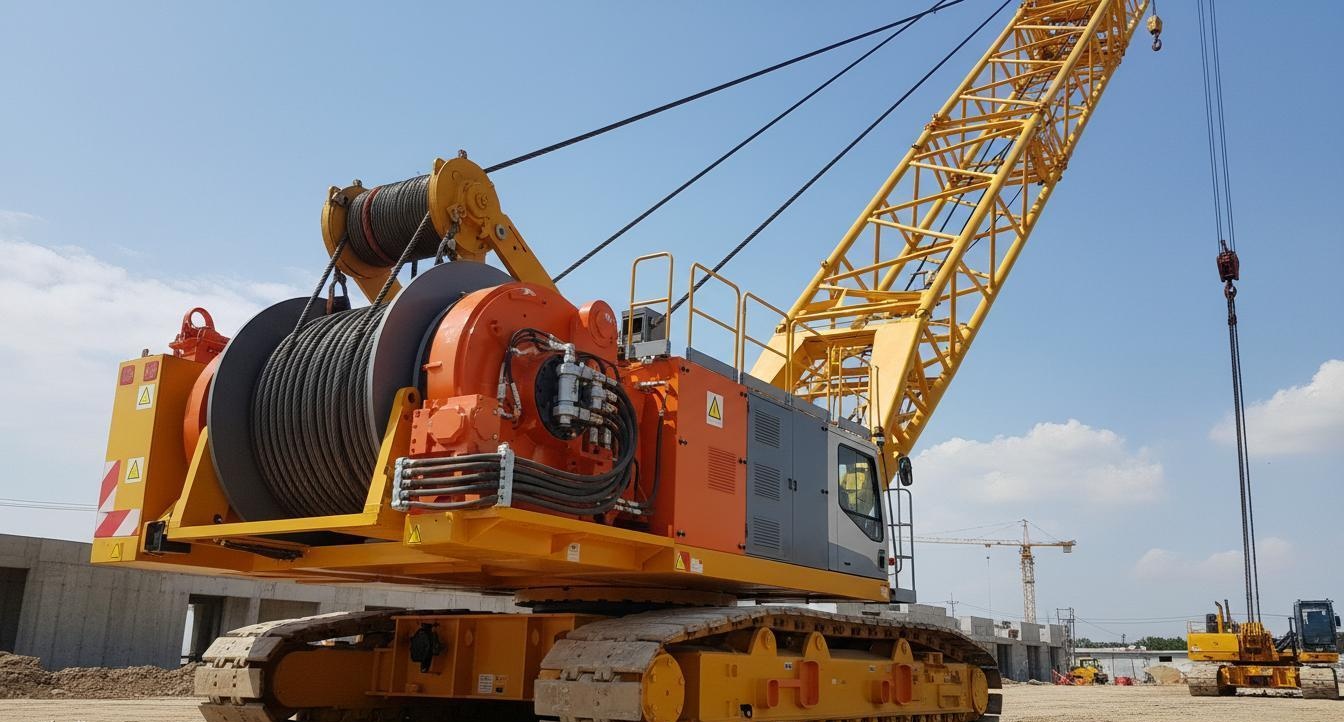
Three critical parameters determine winch suitability: line pull (kN), winding speed (m/min), and thermal reserve -- all must be evaluated at the specific duty cycle, not just peak load.
30 years of manufacturing experience and ISO 9001 certification mean INI's factory acceptance testing (FAT) reports are recognized by major export markets including the USA, EU, Japan, and Australia.
When I started supporting crawler crane buyers across Southeast Asia in 2021, the most common procurement mistake I saw wasn't choosing the wrong crane brand -- it was specifying the wrong hydraulic winch for the boom operation. Buyers would select a winch based on peak line pull alone, then wonder why the brake dragged after six months, or why the drum overheated during a 12-lift shift on a 150-ton lattice boom crawler.
The hydraulic winch is the most mechanically stressed component in any crawler crane boom system. Get it right, and your crane performs reliably for thousands of cycles. Get it wrong, and you're scheduling emergency replacements in the middle of a project. In this article, I'm going to walk you through how to evaluate hydraulic winch duty cycle ratings, what the key performance parameters actually mean in the field, and how INI Hydraulic's
IYJ-N series integrated hydraulic winches
are engineered specifically for 50-ton to 300-ton crawler crane applications.
Why Duty Cycle is the Governing Factor (Not Peak Load)
Most procurement specs list "maximum line pull" as the primary winch selection criterion. That's understandable -- you need to know the winch can lift your heaviest load. But peak load is almost never the limiting factor in crawler crane service. Duty cycle is what kills winches. A winch that can handle 300 kN peak pull may completely fail after 200 hours of continuous boom hoist duty if its thermal capacity was designed for intermittent, not continuous, operation.
In crawler crane applications, the winch performs repetitive load cycles -- lifting, holding, lowering -- across a wide range of boom angles and load weights. The duty cycle rating defines how many of these cycles the winch can sustain per hour without exceeding its thermal limits. This is typically expressed as a percentage (ED) or as a specific cycle rating per hour at a given load percentage of maximum.
According to
ISO 4301-1
(Cranes -- Selection of Winches), winches for mobile construction cranes must demonstrate thermal stability at their rated duty class without exceeding a 60 degrees C rise above ambient temperature. For crawler cranes doing sustained heavy lifting, we typically see duty cycles of FC 40-60% (40-60% of rated load continuously). If your spec sheet only shows peak performance data, demand the thermal performance curve before you buy.
Key Performance Parameters for Crawler Crane Hydraulic Winches
Line Pull and Rated Pressure
Line pull is the maximum force the winch can generate at the wire rope layer closest to the drum (first layer), expressed in kilonewtons (kN). For 50-300 ton crawler cranes, line pull requirements scale roughly with lifting capacity -- a 50-ton crawler typically needs 150-180 kN, while a 300-ton machine demands 450-600 kN at first-layer winding.
INI Hydraulic's IYJ-N series winches are rated at a working pressure of 31.5 MPa, which delivers the torque density needed for heavy crawler crane boom operations without the bulk penalty of larger displacement motors. The 31.5 MPa rating aligns with the standard hydraulic system pressure of large mobile cranes, meaning no special hydraulic circuit modifications are needed during installation.
When comparing winch line pull specifications across manufacturers, always verify whether the rated line pull is calculated at the first layer or at a mid-layer position on the drum. First-layer pull is always lower -- if a manufacturer only publishes "maximum line pull" without specifying the layer, assume it's a mid-layer value and derate by approximately 15-20% for first-layer comparison.
Winding Speed and Gear Ratio
Gear ratio is the primary lever for matching line speed to line pull. A higher gear ratio delivers more torque at the drum but reduces rotational speed. For crawler crane boom operations, we typically see gear ratios in the 200:1 to 400:1 range, depending on whether the application is primarily heavy-lift (higher ratio) or positioning/drag-duty (lower ratio).
For boom hoist duty specifically, INI's IYJ-N series winches offer configurable gear ratios tuned for crawler crane duty cycles. In practice, a 315:1 gear ratio is the most common specification for 100-200 ton crawler cranes, providing an optimal balance of line pull and winding speed that keeps boom operations smooth without excessive heat buildup during extended lowering cycles.
The standard winding speed range for boom hoist winches is 0-15 m/min at first layer for heavy-lift configurations, extending to 0-30 m/min for positioning configurations with lower gear ratios. INI's modular design allows buyers to select the gear ratio that matches their primary duty profile -- heavy lift, precision positioning, or a hybrid duty cycle -- without changing the hydraulic motor or mount interface.
Braking Performance: The Non-Negotiable Safety Feature
Here's where I get emphatic: the braking system is not a secondary specification. For crawler crane boom operations, the brake must be treated as a primary safety-critical component. The winch brake prevents uncontrolled load descent when the boom is holding position -- and uncontrolled descent on a 200-ton lattice boom is a catastrophic failure scenario.
The minimum holding torque requirement for crawler crane hydraulic winches is 1.5x the rated load torque at the drum. This means a winch rated for 200 kN line pull must provide a brake holding torque equivalent to at least 300 kN at first-layer pull, without relying on the hydraulic counterbalance valve as the primary holding mechanism.
INI's IYJ and IYJ-N series winches use spring-applied, hydraulic-released (SAHR) multi-disc brakes as standard. The spring applies clamping force mechanically -- if hydraulic pressure is lost, the brake automatically engages. This failsafe design meets
ASME B30.7
(Base-Mounted Drum Hoists) requirements for crawler crane applications and is the only brake architecture I recommend for heavy-lift crane duty.
Brake pad wear monitoring should be part of your standard 500-hour winch inspection protocol. If the brake pad thickness is below 2 mm at any inspection point, replacement is mandatory before continued operation. Continuing to operate with worn brake pads on a crawler crane boom hoist winch is not a calculated risk -- it's negligence.
Thermal Capacity and Oil Cooling
Hydraulic winch thermal failure typically manifests as oil temperature rising above 80 degrees C, which degrades seal integrity, reduces hydraulic oil viscosity (leading to volumetric efficiency losses), and ultimately causes internal component seizure. For crawler crane applications in hot climates -- think Middle East summer or Southeast Asian monsoon seasons -- the ambient temperature alone can cut your thermal margin by 10-15 degrees C before the winch even starts cycling.
Thermal capacity is a function of the winch motor's continuous power rating, the hydraulic system's flow rate, and the heat dissipation capability of the winch housing and oil reservoir. For crawler cranes rated above 100 tons operating in FC 40-60% duty cycles, a dedicated oil cooler or fan-cooled reservoir is effectively mandatory, not optional. If a winch datasheet doesn't include a thermal derating curve showing performance at ambient temperatures of 40 degrees C, 45 degrees C, and 50 degrees C, request it -- and be skeptical if the manufacturer can't provide it.
INI's factory acceptance testing (FAT) for IYJ-N series winches includes continuous running tests at full rated load for a minimum of 2 hours, with oil temperature monitoring at 10-minute intervals. These FAT reports are available for
crane hydraulic dual winch
and IYJ series products and are included as standard documentation for export shipments to international markets.
Duty Cycle Ratings Across 50-Ton to 300-Ton Lifting Capacities
The table below summarizes typical duty cycle parameter ranges for crawler crane boom hoist applications across the 50-300 ton lifting capacity range. These are field-calibrated specifications based on our engineering testing and customer feedback from crawler crane manufacturers in Southeast Asia, the Middle East, and Europe.
Crane Lifting Capacity
Required Line Pull (kN, 1st Layer)
Working Pressure (MPa)
Typical Gear Ratio
Winding Speed Range (m/min)
Min. Brake Holding Torque
Recommended Duty Cycle (ED)
50-80 ton
150-180 kN
31.5 MPa
200:1-250:1
0-15
>=1.5x rated torque
FC 40%
80-150 ton
200-280 kN
31.5 MPa
250:1-315:1
0-12
>=1.5x rated torque
FC 50%
150-200 ton
300-380 kN
31.5 MPa
315:1-355:1
0-10
>=1.5x rated torque
FC 50-60%
200-300 ton
400-600 kN
31.5 MPa
355:1-400:1
0-8
>=1.5x rated torque
FC 60%
Table 1: Typical duty cycle parameter ranges for crawler crane boom hoist hydraulic winches, 50-300 ton lifting capacities. Data calibrated from INI Hydraulic FAT records and field feedback from crawler crane OEMs. Contact INI for application-specific validation.
IYJ vs. IYJ-N: Choosing the Right Winch Series for Your Crawler Crane
One of the most common questions I get from OEM procurement engineers is: "What's the actual difference between the IYJ series and the IYJ-N series, and which one should I specify for my crawler crane?" Let me give you a direct answer.
The
IYJ series hydraulic winch
is INI's general-purpose crane winch line. It's a proven, robust design suitable for a wide range of mobile crane applications -- truck cranes, rough-terrain cranes, and smaller lattice boom crawlers. The IYJ series uses a conventional layout with separate motor, reducer, and brake assemblies connected via coupling or gearbox input, which simplifies field service and repair.
The
IYJ-N series integrated hydraulic winch
is purpose-designed for mid-to-large crawler crane boom operations in the 50-300 ton range. The key difference is that the IYJ-N integrates the hydraulic motor, planetary reducer, and multi-disc brake into a single compact housing. This integrated design reduces the overall installation envelope by approximately 25-30% compared to comparable separate-component winch packages, which matters significantly on crawler cranes where boom base geometry and machine center-of-gravity are critical packaging constraints.
From a performance standpoint, the IYJ-N's integrated housing also improves structural rigidity -- the drum shaft is supported on both sides with large-bore bearings, reducing deflection under load and extending wire rope service life. For OEM crane manufacturers designing new crawler crane models, the IYJ-N's compact footprint and standardized mounting interface can meaningfully reduce the design-in timeline.
For afters-market replacement, however, the IYJ series is often the more practical choice -- it's been in the market longer, most field service technicians are already familiar with it, and its modular design means you can replace individual components (motor, brake, reducer) without swapping the entire winch assembly.
Procurement Decision Shortcut: If you're specifying a new 50-300 ton crawler crane OEM package, specify the IYJ-N. If you're replacing a winch on an existing crane model and want field-serviceability, the IYJ series is the safer choice. Both are rated at 31.5 MPa and both carry INI's 30-year manufacturing quality certification.
What 30 Years of Hydraulic Winch Manufacturing Actually Means for Your Procurement
INI Hydraulic has been manufacturing hydraulic winches since 1995. That's 30 years of watching failure modes, refining designs, and building the manufacturing precision that separates a winch that lasts 8,000 operating hours from one that needs relining at 2,000. We have supplied hydraulic winches to crawler crane manufacturers and end-users in the USA, Japan, Australia, Russia, and the European Union -- markets with some of the most demanding quality and certification requirements in the world.
INI is
ISO 9001 certified
, and our factory acceptance testing (FAT) procedures are documented and traceable. Every winch that leaves our factory undergoes a full-load testing protocol including locked-rotor test, brake holding torque verification, and a minimum 2-hour continuous running test at rated load with thermal monitoring. The FAT report is included with every export shipment as standard documentation.
What does this mean in practical terms for your procurement process? It means you can request a FAT report for any INI winch model before you sign the purchase order. You'll know exactly what the winch tested at -- line pull, winding speed, brake holding torque, oil temperature rise -- and you'll have a documented baseline to compare against your acceptance criteria. When I've seen procurement managers skip this step to "speed things up," they've always regretted it when the incoming inspection finds a discrepancy with the datasheet.
Installation, Maintenance, and Inspection Intervals
Proper installation and maintenance schedules are what separate a winch that reliably serves 8,000 hours from one that fails prematurely at 2,500. Based on our field service records and the maintenance protocols we provide with IYJ-N series winches, here's what a sound maintenance program looks like for crawler crane boom hoist applications.
Installation Best Practices
The winch must be mounted on a structurally rigid base -- crawler crane boom hoist winches are typically mounted on the crawler carbody or boom base section, and the mounting structure must be designed to handle the full dynamic loads transferred through the winch mounting bolts during rapid load cycling. Use Grade 10.9 or higher mounting bolts, and verify bolt preload with a torque wrench before initial commissioning.
Hydraulic connection routing should minimize sharp bends and avoid any section where the hydraulic hose or tube is flexed during boom operation. We recommend installing a flexible hose loop at the winch hydraulic inlet to absorb vibration-induced fatigue loads that would otherwise transfer into the rigid piping system.
Maintenance Schedule Overview
INI recommends a tiered maintenance schedule for crawler crane hydraulic winches based on operating hours. Here's the condensed schedule I share with every IYJ-N customer after commissioning:
Interval
Inspection / Action
Acceptance Criteria
Every 500 hours
Visual inspection, bolt preload check, hydraulic connection leak check, oil level verification
No visible leaks, oil level within spec range, all bolts at specified preload
Every 1,000 hours
Brake pad thickness measurement, wire rope condition inspection, drum groove wear assessment
Brake pad thickness greater than 2 mm, wire rope diameter loss less than 10% of nominal, drum grooves within tolerance
Every 2,000 hours / Annual
Hydraulic oil change (ISO VG 46), seal replacement, full system pressure test
Oil replaced per spec, seals replaced proactively, system holds rated pressure without drift
Every 4,000 hours
Full internal inspection, bearing condition assessment, gear tooth wear measurement
Bearings within tolerance, gear tooth wear within acceptable limits per manufacturer spec, full reassembly with new gaskets
Table 2: Recommended maintenance schedule for IYJ-N series hydraulic winches in crawler crane boom hoist service. Based on INI Hydraulic field service records and OEM maintenance protocols.
I've visited crawler crane fleets in Malaysia and Saudi Arabia where the same maintenance schedule was being followed, and the difference in winch longevity was stark. The fleet with disciplined 500-hour inspections was still running original winches at 6,000+ hours. The one that skipped inspections to save time had replaced three winches in 18 months. The math is simple: a single emergency winch replacement costs more than five years of scheduled inspections.
Common Procurement Mistakes and How to Avoid Them
Having supported crawler crane procurement across three regions, I've seen the same mistakes made over and over. Let me call them out directly so you don't have to learn the hard way.
Mistake #1: Buying based on peak line pull alone. This is the most common error. A winch rated at 300 kN peak pull may only be rated for 80 kN continuous. Always ask for the thermal performance curve at your specific duty cycle before committing.
Mistake #2: Ignoring the brake holding torque requirement. Some buyers focus so much on line pull that they treat the brake as a checkbox. But the brake is your primary safety mechanism. Insist on a SAHR multi-disc brake with holding torque >=1.5x rated load torque, and verify it with a holding test at the factory before shipment.
<strongnugget">Mistake #3: Not requesting a FAT report. The factory acceptance test report is your single most valuable procurement document. It tells you exactly what the winch tested at under real load conditions. Without it, you're buying on specifications that the manufacturer may never have verified. INI includes FAT reports with every export shipment -- if a supplier can't provide one, walk away.
Final Thoughts: Start With Duty Cycle, Not the Datasheet
If there's one thing I want you to take away from this article, it's this: stop starting with the datasheet. Start with your actual duty cycle. How many lifts per hour? At what load percentage of your maximum? How long does the boom stay loaded? What's the ambient temperature range at your site?
Once you have those parameters, find a winch whose thermal performance curve shows stable operation at those conditions. Then -- and only then -- check the line pull, gear ratio, and brake specification. The IYJ-N series from INI Hydraulic is engineered for exactly this evaluation process. We provide full thermal curves, FAT reports, and application-specific engineering support to make sure the winch you specify is the winch that performs.
If you're in the early stages of specifying a hydraulic winch for a crawler crane project and want a second opinion on whether your duty cycle calculation is correct, reach out through our website. I've personally reviewed duty cycle specs for crawler crane projects across Southeast Asia and the Middle East -- I'd rather correct a specification before you order than troubleshoot a failure after it's installed.
Frequently Asked Questions
What is the duty cycle rating for a hydraulic winch used in 50-ton crawler crane boom operations?
For 50-ton crawler crane boom operations, a hydraulic winch must typically deliver a line pull of 150-180 kN with an average winding speed of 0-15 m/min. Duty cycle ratings should meet GB/T 10654 or ISO 4301 standards, ensuring the winch can sustain repeated load cycles without thermal degradation. The working pressure is typically 31.5 MPa, and INI Hydraulic's IYJ-N series winches are rated for intermittent duty cycles meeting these specifications.
How does gear ratio affect hydraulic winch performance in crawler crane applications?
Gear ratio directly determines the balance between line speed and line pull. A higher gear ratio (e.g., 315:1) provides greater line pull but lower winding speed, making it ideal for heavy-duty boom lifting. Lower gear ratios (e.g., 180:1) enable faster line speeds for positioning. INI Hydraulic's IYJ-N series winches offer configurable gear ratios optimized for crawler crane duty cycles, ensuring maximum torque output at the drum shaft during heavy lift operations.
Why is braking torque critical for crawler crane hydraulic winch safety?
Braking torque is the primary safety mechanism that prevents uncontrolled load descent during boom operations. For crawler cranes rated at 100+ tons, the braking system must hold the full rated load when the winch is stationary. A spring-applied, hydraulic-released multi-disc brake provides reliable holding torque exceeding 1.5x the rated load torque, meeting GB/T 10565 and ASME B30.7 safety requirements. Failure to meet this threshold can result in dangerous load drift or free-fall.
What is the difference between IYJ series and IYJ-N series hydraulic winches for crawler cranes?
The IYJ series is a standard hydraulic winch line suitable for general crane applications, while the IYJ-N series is an integrated hydraulic winch specifically engineered for 50-300 ton crawler crane boom operations. The IYJ-N series features a compact integrated design combining motor, reducer, brake, and drum into a single housing, which reduces installation complexity and improves structural rigidity for high-duty-cycle crane operations.
What maintenance intervals are recommended for hydraulic winches in crawler crane service?
INI Hydraulic recommends hydraulic winch inspections every 500 operating hours for crawler crane applications. Oil changes should occur every 2,000 hours or annually, whichever comes first, using ISO VG 46 hydraulic oil. Brake pad thickness must be checked every 1,000 hours -- if worn below 2 mm, replacement is mandatory. Wire rope replacement intervals depend on usage intensity but should be replaced when diameter decreases by more than 10% from nominal.
About the Author
Mr. Leo
Technical Content Specialist & Export Sales Representative, INI Hydraulic Co., Ltd.
Mr. Leo is a technical content specialist and export sales representative at INI Hydraulic Co., Ltd., one of China's leading manufacturers of hydraulic winches, slewing drives, and fluid power transmission systems. Through INI Hydraulic's YouTube channel and social media platforms, he produces hands-on technical content -- including hydraulic system animations, winch load testing footage, and OEM procurement walkthroughs -- that helps international buyers understand INI's product engineering before placing orders. With a background in hydraulic transmission engineering and four years supporting offshore, marine, and construction machinery buyers across Southeast Asia, the Middle East, and Europe, Leo translates complex hydraulic spec sheets into practical procurement guidance for OEM engineers, shipyard procurement managers, and industrial equipment distributors.
Post time: May-28-2026