
TL;DR: Hydraulic swing drives dominate the mining excavator market above 40 tonnes operating weight because they deliver higher torque density, superior overload tolerance, and simpler integration with the machine's hydraulic system. Electric swing drives are viable in specific applications — primarily for new energy construction equipment or machines operating in ventilated underground environments where hydraulic fluid leak risk is unacceptable. For conventional open-pit and underground mining, hydraulic remains the engineering standard for swing drive systems.
The Swing Drive Function in Mining Excavators: Why the Selection Decision Matters
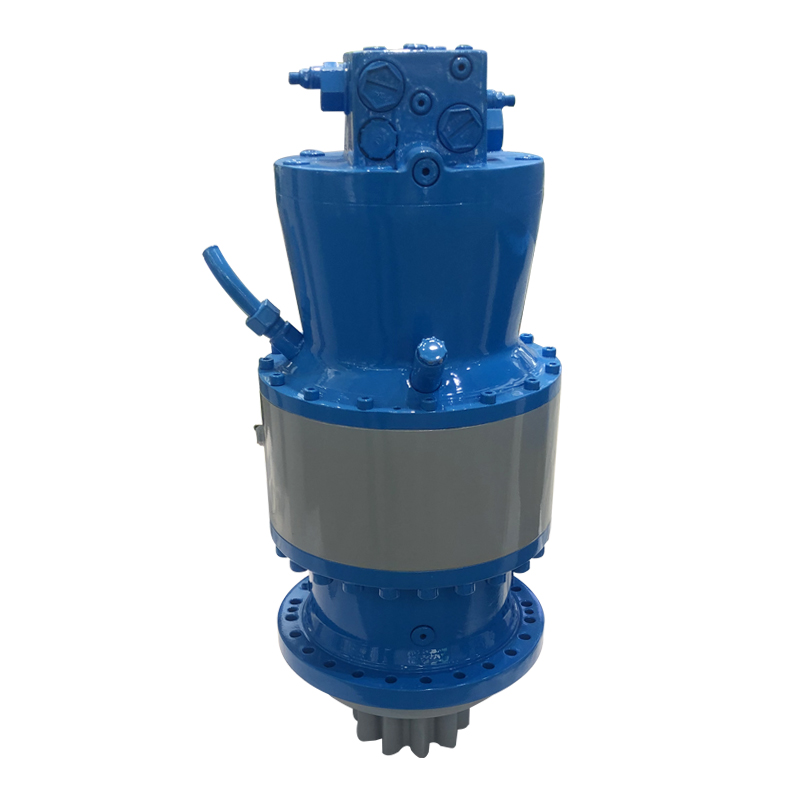
Our IYH series hydraulic swing drives are configured specifically for mining excavator upperstructure swing applications with bearing arrangements rated for sustained heavy-duty loading.
in Mining Excavators: Why the Selection Decision Matters
We have been supporting mining equipment OEM procurement teams and fleet maintenance managers for more than a decade, and the swing drive selection decision is one of the most consequential component choices in the machine specification process. The swing drive system — comprising the motor, planetary reduction gear, swing pinion, and braking mechanism — is responsible for rotating the upperstructure of the excavator through 360 degrees continuously, accelerating and decelerating the boom, arm, and attachment mass in the swing motion, and maintaining position control against external forces including wind loading on tall boom configurations, pendulum forces from the attached bucket, and reactive forces from swinging into a bank shot.
In deep rock mining applications, where we have supported buyers in Australia, Indonesia, Chile, and the Canadian prairie provinces, the swing drive operates under sustained overload conditions that are fundamentally different from the duty cycle of a conventional construction excavator. The combination of heavy attachment weights — dragline buckets or hydraulic hammers that can add 20–40 tonnes to the working attachment mass — with the requirement for precise positioning control in rock fragmentation operations creates a loading profile that hydraulic drive systems are specifically engineered to handle and that electric drives cannot accommodate in equivalent form factors without significant weight and cost penalties.
Torque Density: The Hydraulic Advantage in Compact Envelopes
INI Hydraulic supplies swing drive systems for excavators from 20 to 400 tonnes operating weight, with output torque ratings from 6 to 180 kNm.
The fundamental metric that determines swing drive suitability for a given machine class is torque density — the ratio of output torque to the physical volume and weight of the drive system. Hydraulic swing motors, when operating at system pressures of 25–35 MPa (the standard hydraulic system pressure range for mining excavators), generate power densities that are approximately three to four times greater per unit volume than comparably-rated electric motors. This is a consequence of the fundamental physics of hydraulic fluid power: hydraulic pressure acts on a piston or gerotor element with a force that is the product of pressure and effective area, and the pressure multiplying effect across a motor's internal mechanism allows a compact housing to produce very high torque output.
For a 200-tonne mining excavator, the swing drive must deliver sufficient torque to accelerate the upperstructure mass — typically 35–45% of the machine's operating weight in the upperstructure assembly — through the required swing arc within the OEM-specified swing acceleration time (typically 3.5–5.0 seconds for a full 360-degree rotation). The torque requirement at the swing pinion, after accounting for the inertia of the rotating mass and the gear reduction ratio, typically falls in the range of 25,000–40,000 Nm for a machine in this weight class.
Producing this torque output from an electric motor in an equivalent envelope to a hydraulic swing motor would require a motor housing diameter approximately 2.5 to 3 times larger, and the associated power electronics, cooling system, and mechanical coupling would add significant weight and complexity to the upperstructure. We have evaluated electric swing drive configurations for OEM customers who requested this comparison, and in every case, the electric alternative required a redesigned upperstructure mounting arrangement and added 400–700 kg to the rotating mass — a penalty that directly reduces the machine's payload capacity and fuel efficiency.
Overload Tolerance: Why Mining Duty Cycles Break Electric Drives
The mining excavator swing duty cycle is dominated by impact loading events that are qualitatively different from the steady-state or gradually-varying loads that electric drive systems are designed to accommodate. When the bucket contacts the bank during a swing-to-dig motion, or when the machine swings with a loaded bucket against a wind gust, the swing drive experiences a momentary torque spike that can reach 2.5 to 3.5 times the rated continuous torque. This is the overload condition that we design our swing drive systems to accommodate without damage, and it is the condition that exposes the critical weakness of electric swing drive configurations in this application.
Electric motors, when subjected to torque overload beyond approximately 1.5 times rated torque for more than brief transient periods, experience thermal damage to the motor winding insulation from excess current draw, and the associated drive electronics (variable frequency drive or servo drive) will invoke thermal limiting that reduces available torque output. In a mining excavator, where the operator expects consistent swing performance throughout the working day regardless of how aggressively the machine is being operated, an electric swing drive that thermally limits during a demandingdig cycle is not just a performance problem — it is a safety issue, because the upperstructure momentum that has built up during the swing must still be arrested by the braking system.
Hydraulic swing drives, by contrast, handle overload conditions through the inherent design of the hydraulic motor. The motor can be subjected to system pressure limited only by the relief valve setting — which we set at 1.25 times the maximum operating pressure for the mining duty cycle — and the hydraulic system's ability to accommodate brief torque spikes through fluid compression and flow buffering means that hydraulic motors do not experience the same thermal limiting that constrains electric motor performance. Our IYH series hydraulic swing drives are rated for intermittent operation at 1.8 times rated torque for periods up to 10 seconds, which covers the duration of the most demanding impact loading events in the mining excavator swing cycle.
System Integration: The Hydraulic Infrastructure Already Exists
Every mining excavator above 40 tonnes operating weight already has a comprehensive hydraulic system — the main pump, hydraulic tank, control valves, and hydraulic cylinder actuators for the arm, boom, and bucket are all hydraulic. The swing drive motor is simply another hydraulic actuator in this circuit, connected to the same hydraulic power source that powers the rest of the machine. This means that adding a hydraulic swing drive to the machine specification requires no additional power transmission infrastructure: the hydraulic pumps already present on the machine are sized to accommodate the swing drive's flow and pressure requirements in addition to the boom and arm actuators.
For an electric swing drive, the situation is fundamentally different. The machine would need a dedicated electric motor of significant power rating (typically 40–80 kW for a swing drive in the 200-tonne class), an associated variable frequency drive or servo drive to provide speed and torque control, a cooling system for the motor and drive electronics, and integration with the machine's existing control system architecture. All of this adds cost, weight, and complexity to the machine, and it requires specialized electrical engineering expertise for integration and troubleshooting that is not universally available at the mining operations where these machines are deployed.
We have found, in our experience supporting international mining equipment OEMs, that the hydraulic system integration advantage is particularly significant for machines destined for emerging market mining operations, where dealer workshop facilities may not have electric drive diagnostic capability and where field service technicians are primarily trained in hydraulic system troubleshooting. The simplicity of the hydraulic swing drive integration — it is essentially a hydraulic motor plumbed into the swing circuit with a proportional valve for directional and speed control — means that maintenance can be performed by technicians who are already working on the machine's hydraulic system for other service requirements.
Braking Performance and Position Control
One of the most important functional requirements for the swing drive in a mining excavator is braking performance — the ability to arrest upperstructure rotation accurately and hold the position against external forces. Hydraulic swing drives incorporate counterbalance valves — also called hydraulic brake valves or load-holding valves — that provide automatic braking function without external energy input. When the swing control valve is centered, the counterbalance valve closes and traps hydraulic fluid in the swing motor, preventing rotation unless the operator actively commands swing motion.
The mechanical braking function in a hydraulic swing drive is typically provided by a wet-disc parking brake incorporated into the swing motor or reduction gear assembly, which engages when the machine is parked and provides a mechanically-locked hold function that is independent of hydraulic system pressure. This means that a parked excavator's upperstructure is held in position by a mechanical brake that requires no hydraulic pressure to maintain its hold — a critical safety feature for machines operating on slopes or in wind conditions.
Electric swing drives typically use a combination of motor-generated braking torque and an electromechanical parking brake to provide equivalent functionality. The electric motor can generate braking torque through regenerative braking into the drive electronics, but this requires the drive electronics to remain energized and functional. If power is lost to the drive electronics, the electric motor cannot provide regenerative braking, and the parking brake must engage automatically — which requires a fail-safe spring-applied parking brake mechanism. These fail-safe systems are reliable in principle, but they add mechanical complexity and require more careful integration than the proven wet-disc counterbalance arrangement that is standard in hydraulic swing drives.
When Electric Swing Drives Are the Right Choice
We supply electric swing drive configurations for specific applications where the engineering tradeoffs favor electric drive over hydraulic, and we believe it is important to present this case honestly rather than dismissing electric drives categorically. The primary application where electric swing drive technology has legitimate advantages for mobile equipment is in new energy construction equipment — battery-electric or hybrid-electric excavators where the swing drive is powered by the machine's battery pack through a electric motor and drive electronics, and where the hydraulic system (if a hydraulic system is present at all) is configured differently from the conventional architecture.
A second legitimate application for electric swing drives is in underground mining equipment operating in ventilation-controlled environments, where hydraulic fluid leakage from a swing drive seal failure could create a slip hazard or a fire risk in a confined space with limited ventilation. In these specialized applications, the weight and cost penalty of electric swing drive can be justified by the reduction in hydraulic fluid leakage risk and the associated safety benefit. We have supplied electric swing drive configurations to underground mining equipment OEMs specifically for this reason, and we work with these buyers to ensure the electric drive specification is appropriately matched to the machine's duty cycle.
Our Recommendation for Mining Excavator Swing Drive Selection
Browse all INI Hydraulic swing drive products or view our complete hydraulic drive product catalog.
for Mining Excavator Swing Drive Selection
For conventional open-pit mining excavators and the majority of underground mining equipment in the 40–400 tonne operating weight class, our recommendation is unambiguous: a properly specified hydraulic swing drive with a proportional directional control valve, counterbalance valve for load-holding, and wet-disc parking brake is the correct engineering choice for this application. The combination of high torque density, superior overload tolerance, straightforward hydraulic system integration, proven counterbalance braking performance, and widely-available field service capability makes hydraulic swing drives the clear choice for mining applications where machine availability and reliability are directly tied to operating costs and production targets.
We configure our IYH series hydraulic swing drives specifically for mining excavator applications, with bearing arrangements, seal specifications, and material selections that are appropriate for the sustained heavy-duty loading and contaminated environment that characterizes mining operations. Our standard IYH swing drive range covers output torque ratings from 6 kNm to 180 kNm and swing speeds from 6 to 15 rpm, with custom configurations available for OEM specifications outside the standard range. View the IYH series specifications and configuration guide, or contact our technical sales team with your machine specification for a swing drive selection recommendation that matches your OEM performance targets and duty cycle requirements.
Total Cost of Ownership: Why the Hydraulic Swing Drive Delivers Better Economic Value
When we work with mining fleet operators who are evaluating swing drive technology options for a new machine purchase or a fleet upgrade specification, we encourage them to evaluate total cost of ownership across the machine's expected service life rather than comparing first-cost acquisition prices. This is a calculation that consistently favors hydraulic swing drives for mining applications, but the math is not immediately obvious without explicitly accounting for all the cost elements.
The first-cost acquisition price of a hydraulic swing drive assembly is typically 25–40% lower than an equivalent-output electric swing drive configuration for the same machine class. This cost advantage reflects the fundamentally simpler manufacturing process for hydraulic motors and planetary gearboxes compared to precision electric motors and their associated power electronics, as well as the absence of the encoder, cooling system, and drive electronics that electric swing drives require. On a machine with an acquisition cost of USD 2–3 million, the swing drive represents only a small fraction of total machine cost — but the first-cost differential between hydraulic and electric swing drive configurations can be USD 8,000–15,000, which is a meaningful procurement budget item.
Maintenance cost over the machine's service life is the second element of the total cost calculation. A hydraulic swing drive in a mining excavator operating in typical heavy-duty conditions requires seal replacement at approximately 8,000–12,000 hour intervals and bearing inspection and repacking at major scheduled maintenance events every 15,000–20,000 hours. These are procedures that field hydraulic technicians can perform, and the parts cost for a swing drive seal kit and bearing repack kit is typically under USD 1,200 per maintenance event. Electric swing drive maintenance requires specialized diagnostic equipment, motor winding testing, and drive parameter verification — services that may require a specialist technician visit with associated travel and labor costs that can reach USD 2,000–4,000 per service event on remote mining sites.
The third element is machine availability. When a swing drive requires maintenance, the machine is non-operational. For a mining excavator generating USD 1,500–2,500 per operating hour in a production mining environment, each hour of unplanned downtime has a direct cost equal to the lost production. The faster, simpler maintenance of a hydraulic swing drive — and the wider availability of hydraulic technicians at mining sites — translates directly into higher machine availability and lower cost per tonne of material moved.
Frequently Asked Questions
Why do mining excavators still predominantly use hydraulic swing drives instead of electric alternatives?
Mining excavators in the 40-400 tonne operating weight class predominantly use hydraulic swing drives because hydraulic systems deliver superior torque density in a compact envelope, can tolerate sustained overload conditions common in rock excavation without damage, integrate directly with the machine's existing hydraulic system without requiring a separate motor drive infrastructure, and provide inherent braking capability through counterbalance valves — features that electric swing drives cannot match in equivalent form factors for this application class.
What maintenance advantages does a hydraulic swing drive offer over electric swing in mining environments?
Hydraulic swing drives in mining excavators benefit from simplified maintenance protocols that field technicians are widely trained to perform — hydraulic motor seal replacement, bearing repacking, and pinion gear inspection can all be completed at the job site without specialized electrical diagnostic equipment. Electric swing drives require motor winding testing, encoder calibration, and variable frequency drive parameter verification — specialized skills that are not universally available at remote mining operations. Our INI Hydraulic swing drives incorporate service-friendly bearing access and seal replacement designs that minimize site downtime for scheduled maintenance.
What is the typical swing motor displacement specification for a 200-tonne mining excavator?
A 200-tonne class mining excavator typically requires a swing motor with a displacement in the range of 160-250 cm3/rev, combined with a planetary gear reduction stage providing a gear ratio of approximately 15:1 to 25:1 to deliver the required output torque at the swing pinion. The specific displacement and reduction ratio depend on the OEM's performance specification for swing speed, swing acceleration time, and hold-on-brake capability. We configure swing drive assemblies to OEM specification, and our standard IYH series covers displacement ranges from 80 to 400 cm3/rev with output torque ratings from 6 to 180 kNm.
About the Author
Mr. Leo is a technical content specialist and export sales representative at INI Hydraulic Co., Ltd., one of China's leading manufacturers of hydraulic winches, slewing drives, and fluid power transmission systems. Through INI Hydraulic's YouTube channel and social media platforms, he produces hands-on technical content — including hydraulic system animations, winch load testing footage, and OEM procurement walkthroughs — that helps international buyers understand INI's product engineering before placing orders.
With a background in hydraulic transmission engineering and four years supporting offshore, marine, and construction machinery buyers across Southeast Asia, the Middle East, and Europe, Leo translates complex hydraulic spec sheets into practical procurement guidance for OEM engineers, shipyard procurement managers, and industrial equipment distributors.
YouTube: INI Hydraulic YouTube Channel
X: @inihydraulic
Pinterest: INI Hydraulic Pinterest
Related Standards and Technical References:
· ISO 9461 — Earth-moving machinery: swing and slewing performance requirements
· ASTM F0702 — Standard practice for design of swing gear drives
· SAE International Standards — Mobile equipment hydraulic system standards
· CDC/NIOSH Mining Safety Publications — US NIOSH publications on heavy equipment safety in mining
Related Products from INI Hydraulic: IYH Series slewing drives · Hydraulic swing drive products · INI Hydraulic company homepage
Post time: Jun-26-2026