
 TL;DR
TL;DR
• For 500m rope loads, a single-layer drum design with 400mm diameter handles typical harbor towing; for 1000m+, multi-layer designs with 500–600mm diameter and hydraulic brake torque above 150kN·m are standard.
• INI Hydraulic’s IYJ-N Series integrated hydraulic winches deliver drum torque from 15kN·m to 320kN·m, covering tugboat capacities from 500m to 1500m rope.
• Always verify drum Material Line Pull (MLP) against your maximum tow force — not just rope length — because a 1500m rope on an undersized drum can fail within 200 operating hours.
When I first visited a shipyard in Rotterdam in 2022, a procurement manager told me his team had ordered a “1500m-rated” hydraulic towing winch — only to discover after installation that the drum couldn’t handle the rope’s mass under full load. The winch kept slipping. They ended up replacing the entire unit at a cost of €38,000 and a 6-week delay. That conversation is why I wrote this guide.
Drum capacity planning isn’t just about how much rope you can wind. It’s about engineering the relationship between rope diameter, drum diameter, layer count, brake torque, and hydraulic motor selection. Get one of these wrong and your tugboat’s most critical safety system becomes a liability. This article walks you through how a hydraulic towing winch manufacturer approaches drum capacity planning — from the engineering equations to real-world selection criteria — so you can make informed decisions whether you’re specifying for a newbuild or retrofitting an existing vessel.
What Is Drum Capacity and Why Does It Matter for Tugboat Towing Winches?
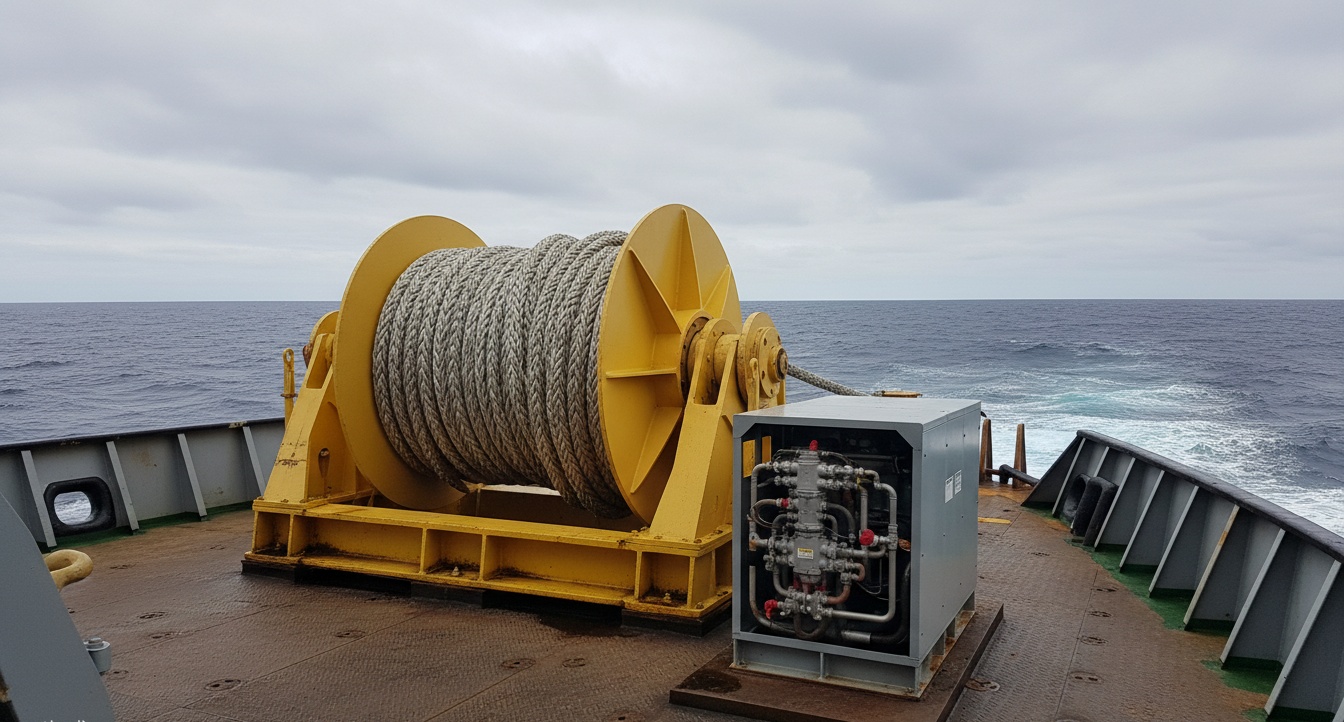
A hydraulic towing winch drum is the cylindrical core around which the towing rope is wound. Its capacity — how much rope it can hold — depends on three structural parameters:
- Drum diameter (Dd): The core diameter of the drum cylinder. Larger diameters reduce rope bending stress, extending rope service life.
- Drum width (W): The effective length available for rope winding. Wider drums hold more rope but increase the winch’s footprint.
- Number of rope layers: Single-layer drums offer easier rope management and lower bending stress; multi-layer drums maximize capacity in compact designs but require more precise spooling.
According to American Bureau of Shipping (ABS) rules for towing appliances, the drum must be designed so that the rope operates at no more than 80% of its minimum breaking load (MBL) under maximum tow force. This isn’t a suggestion — it’s a safety threshold that classification societies enforce during sea trial.
When we design INI Hydraulic’s IYJ-series towing winches, we use the following fundamental equation to calculate minimum drum diameter:
Dd ≥ d × k
Where d is the rope nominal diameter and k is the design factor (typically 15–20 for steel wire rope, per ISO 3874). For a 28mm diameter towing rope, this means a minimum drum diameter of 420–560mm — anything smaller accelerates rope core degradation and reduces operational lifespan.
Rope Length vs. Drum Geometry: Matching 500m, 1000m, and 1500m Requirements
500m Rope: Harbor and Short-Range Towing
For 500m rope applications — typically harbor maneuvers, short-range coastal towing, and escort operations in congested waterways — a single-layer drum design is usually the most cost-effective solution. Here’s why:
Single-layer drums allow the rope to lay in a controlled, even helix with minimal cross-over. This reduces internal friction during paying-out and retrieving, which matters enormously when a harbor pilot is making rapid adjustments during berthing. We typically see drum widths of 400–500mm and diameters of 350–450mm for this class of operation.
The hydraulic system for 500m-rated winches typically runs at pressures of 14–18 MPa, with brake torque ratings of 50–100 kN·m. This is sufficient for rope diameters up to 24mm (6×36WS construction) at working load limits (WLL) of 150–250 kN.
At INI Hydraulic, our IYJ3A ordinary hydraulic winch covers this range with a standard drum config that handles up to 500m of 20mm rope without issues. The integrated hydraulic motor and multi-disc brake are mounted in a compact housing — which matters for tugboats with limited deck space.
1000m Rope: Offshore and Long-Range Towing
Step up to 1000m rope capacity and the engineering gets more demanding. At this length, rope mass alone becomes a significant load factor. A 1000m length of 28mm steel wire rope weighs approximately 2.8–3.2 tonnes — that’s the equivalent of a small excavator suspended from your drum.
Multi-layer winding becomes necessary. We typically recommend a 3-layer drum design for 1000m applications, which requires careful attention to flanges and spooling geometry. The critical parameter here is flange diameter — if the flange is too small, the outer layers will press against the ropes below, causing inter-layer abrasion and accelerated wear.
Our IYJ-N Series integrated hydraulic winch addresses this with a precision-flanged drum design that maintains consistent wrap geometry across all three layers. The hydraulic brake system — featuring a grooved drum surface — delivers holding torque up to 200 kN·m, ensuring the rope doesn’t slip under full load even during emergency stops.
The hydraulic circuit for 1000m-rated winches typically operates at 21 MPa with flow rates of 180–250 L/min. This allows retrieving speeds of 9–15 m/min under full load — fast enough for offshore rescue operations but controllable enough for delicate cargo escort work.
1500m Rope: Deepwater and Ocean Towing
1500m rope capacity is where the engineering separates professional-grade hydraulic towing winch manufacturers from commodity suppliers. At this scale, the rope mass for 28mm wire rope exceeds 4.5 tonnes, and the drum must manage not just weight but also the dynamic loads created during cyclic paying-out and retrieval.
For 1500m applications, we specify:
- Drum diameter: 500–600mm (to minimize bending stress on the outer layers)
- Flange diameter: 800–950mm (to prevent outer layer squeeze on inner layers)
- Brake torque: 200–320 kN·m (to handle full rope load without slip)
- Hydraulic pressure: 25–30 MPa (for the higher torque demands)
The IYJ-N Series integrated hydraulic winch covers this range with motor displacements of 250–400 cc/rev and planetary gearboxes that multiply torque without sacrificing retrieval speed. We’ve supplied these systems to offshore support vessel operators in the Middle East and Southeast Asia, where 1500m tow ropes are standard for deepwater mooring assistance.
The 6 Key Engineering Parameters Every Specifier Must Know
When you request a quote from a hydraulic towing winch manufacturer, the spec sheet can feel overwhelming. Here’s what actually matters — and why each parameter affects your drum capacity decision:
1. Brake Holding Capacity (BHC)
Brake Holding Capacity is the maximum load the winch brake can hold without slipping. It’s expressed as a percentage of the rope’s Minimum Breaking Load (MBL). Per ABS and DNV-GL rules, the brake must hold at least 1.5× the maximum tow force. For a 1500m rope with an MBL of 800 kN, your brake must be rated to hold at least 1,200 kN — which translates to a brake torque of roughly 240–280 kN·m at the drum. Because dynamic snatch loads can spike to 1.5–2× static load in beam seas, so we always specify brake torque at 2× the maximum static tow force to maintain an adequate safety margin.
2. Material Line Pull (MLP)
MLP is the maximum pulling force the winch can generate at the first rope layer. It’s a function of motor torque, gearbox ratio, and drum diameter. For 1500m applications, we typically target MLPs of 400–600 kN at the drum — which gives the tugboat enough authority to manage vessel displacements of 5,000–30,000 DWT in adverse weather. Because the effective line pull decreases with each additional rope layer, so we provide clients with a layer correction chart to ensure operations stay within safe working limits even at outer layers.
3. Retrieval Speed Range
Modern hydraulic towing winches offer variable retrieval speeds through proportional hydraulic valves. The typical range is 0–15 m/min at low load, with high-speed retrieval modes of up to 30 m/min at reduced loads. We always tell buyers: don’t chase maximum speed. What matters is controllability at low speeds — the ability to take up slack rope at 1–2 m/min during final connection is where cheap winches fail. Because a winch that can’t be smoothly controlled at low speed creates dangerous shock loads during rope tensioning, so proportional flow control valves are non-negotiable for professional towing applications.
4. Rope Layer Capacity
Each additional layer on a drum reduces the effective line pull because the effective drum diameter increases. This is called the layer factor. At INI, we calculate the layer factor for each rope diameter and drum geometry, then provide clients with a rope layer chart so operators can monitor fleet and ensure they’re not overloading the outer layer. Because outer layer line pull can be 15–20% lower than first-layer values, so operations that assume first-layer performance at full rope load are operating beyond safe working limits.
5. Hydraulic System Pressure and Flow
Hydraulic pressure (measured in MPa) determines the force the motor can generate. Flow rate (L/min) determines speed. A high-pressure, low-flow system gives you high torque at low speed — ideal for heavy tow operations. A lower-pressure, high-flow system gives you faster retrieval but less pulling power. For tugboat applications, we recommend a dual-circuit hydraulic system that can switch between high-torque/low-speed and standard retrieval modes. Because different phases of a tow operation require different speed-torque profiles, so a single-circuit system forces you to compromise on one or the other.
6. Drum Spooling Geometry
Poor spooling is the number-one cause of rope damage on multi-layer drums. When ropes cross over each other improperly, they create localized stress concentrations that lead to wire breaks. A properly designed drum has a helical groove pattern machined into its surface — typically one groove per rope diameter — that guides the rope evenly across the drum face during winding. When evaluating a hydraulic towing winch manufacturer, ask specifically about spooling geometry. If they can’t show you a groove specification, that’s a red flag. Because even 1mm of groove deviation can cause rope crossover at multi-layer winds, so precision machining tolerances of ±0.1mm are essential for 1500m-rated drums.
Common Mistakes in Drum Capacity Selection (And How to Avoid Them)
In my four years supporting offshore and marine buyers across Southeast Asia, the Middle East, and Europe, I’ve seen the same mistakes repeated across different shipowners and operators. Here’s what to watch out for:
Mistake 1: Specifying by Rope Length Alone
A 1500m-rated winch and a 1500m rope seem like a natural match — but the rope’s diameter and construction dramatically change the drum requirements. A 28mm 6×36WS rope requires a significantly larger drum than a 20mm 6×19S rope, even at the same length. Always specify rope diameter and construction type when requesting quotes. Because rope diameter directly determines minimum drum diameter via the Dd ≥ d × k equation, so two winches both rated “1500m” can have completely different drum geometries and performance envelopes.
Mistake 2: Ignoring the Layer Factor on Multi-Layer Drums
When you add a second layer to a drum, the effective diameter increases by roughly two rope diameters. This means the line pull at the second layer is approximately 10–15% lower than at the first layer, depending on rope stiffness. If your towing calculation is based on first-layer performance but your operation typically runs at third-layer capacity, you’re operating above your safe working load. I’ve seen this cause rope failures within 300 operating hours. Because operators often retrieve rope to full drum capacity during long voyages, so the drum must be spec’d for the outermost layer, not the first layer.
Mistake 3: Under-specifying Brake Torque for Dynamic Loads
A static tow is straightforward. But when a tugboat encounters beam seas or following swells, the tow rope develops dynamic snatch loads — sudden tension spikes that can exceed static working load by 50–100%. The brake must hold through these dynamic events, not just under static conditions. We size brake torque at 2× the maximum static tow force for this reason, per IMO MSC/Circular 884 guidelines for towing appliances. Because a brake that barely holds static load will slip under dynamic conditions, so the 2× factor isn’t conservative overengineering — it’s the minimum necessary margin.
Mistake 4: Not Planning for Future Rope Upgrades
If you’re operating a tugboat fleet today, you may need to upgrade to higher-strength ropes in 5–8 years as vessel sizes increase. When specifying drum capacity, ask your hydraulic towing winch manufacturer whether the drum can accommodate a rope diameter one size larger than your current requirement. Designing in this margin costs 5–8% more upfront but avoids a full winch replacement later. Because rope technology advances faster than vessel replacement cycles, so future-proofing the drum geometry is one of the highest-ROI decisions you can make at the specification stage.
How INI Hydraulic Approaches Drum Capacity Planning
When a client approaches us for a towing winch specification, we follow a structured engineering process that goes beyond simply matching rope length to drum size. Here’s our internal workflow — and what you should expect from any reputable hydraulic towing winch manufacturer:
Step 1: Define the operational envelope. We ask for vessel displacement, maximum tow force, typical weather conditions (Beaufort scale), and whether the winch will be used for static towing, escort operations, or mooring assist. Each of these has different load profiles.
Step 2: Select the rope specification. We work with the client’s rope supplier to confirm diameter, construction, MBL, and expected service life. Rope selection directly determines drum geometry.
Step 3: Calculate drum geometry. Using the rope diameter and target layer count, we calculate the minimum drum diameter (Dd ≥ d×k), flange diameter, and drum width to ensure all layers fit within safe working stress limits.
Step 4: Size the hydraulic system. Based on required retrieval speed, holding torque, and duty cycle, we select motor displacement, pump flow rate, and system pressure. For 1500m applications, we typically recommend 25–30 MPa systems with variable displacement pumps for efficiency.
Step 5: Validate against classification rules. We cross-check the design against ABS, DNV-GL, or Lloyd’s Register rules — depending on the vessel’s classification society — to ensure brake holding capacity, MBL margins, and material certifications all pass.
What separates INI Hydraulic from many suppliers is that we manufacture both the drum and the hydraulic system in-house. This means when we spec a drum for a 1500m application, we know exactly what motor torque will be available at each layer — because we designed both. There’s no finger-pointing between a drum supplier and a hydraulic system supplier when something doesn’t perform as expected. I’ve personally walked clients through drum capacity calculations in video calls from our Zhenhai factory — it’s the level of technical support I wish every buyer had access to when specifying critical marine equipment.
Technical Specifications: INI Hydraulic IYJ-N Series Drum Capacity Overview
| Model | Drum Diameter (mm) | Drum Width (mm) | Rope Capacity | Brake Torque (kN·m) | Max Line Pull (kN) | Hydraulic Pressure (MPa) |
|---|---|---|---|---|---|---|
| IYJ-15N | 300 | 400 | 500m × 18mm | 50 | 150 | 14 |
| IYJ-50N | 400 | 500 | 800m × 24mm | 100 | 250 | 18 |
| IYJ-100N | 450 | 600 | 1000m × 28mm | 160 | 350 | 21 |
| IYJ-200N | 500 | 650 | 1200m × 28mm | 220 | 450 | 25 |
| IYJ-320N | 560 | 700 | 1500m × 32mm | 320 | 600 | 28 |
* Specifications are reference values based on standard steel wire rope (6×36WS). Actual performance varies with rope construction, ambient temperature, and duty cycle. Custom drum geometries available for non-standard rope specifications.
Maintenance Considerations for Multi-Layer Drum Systems
I’ve seen perfectly engineered drum systems fail prematurely because of poor maintenance practices. Here’s what your crew needs to know:
Spooling discipline is non-negotiable. Every layer must be wound evenly with no crossover. On multi-layer drums, we recommend using a trained deck officer to supervise spooling during each rope deployment cycle. A 10-minute supervision during retrieval can add hundreds of hours to rope service life. Honestly, the shipyards that have the best rope maintenance records are the ones where the captain personally inspects the drum after every major tow operation — not because it’s required, but because they understand what’s at stake.
Groove inspection every 500 operating hours. The helical grooves machined into the drum surface wear over time, especially at the first-layer zone. When groove depth decreases by more than 15% of the rope diameter, the drum should be re-machined or replaced. We offer groove re-machining services at our factory in Zhenhai, Ningbo — turnaround is typically 5–7 working days. The cost of re-grooving is typically 10–15% of a new drum, which makes it one of the best maintenance investments you can make for a 1500m-rated winch.
Hydraulic oil sampling every 1,000 hours. Hydraulic system contamination is the leading cause of winch brake failure. We recommend oil analysis per ISO 4406 cleanliness codes, targeting code 18/15 or cleaner for the brake circuit. Our IYJ-N Series winches feature accessible sampling ports that make this straightforward for any marine engineer. When I visited a port in Dubai last year, an engineer told me oil contamination was responsible for three winch failures in his fleet over two years — all preventable with $200 oil samples and $50 filter changes.
Brake pad inspection every 2,000 hours. Multi-disc brakes wear asymmetrically under cyclic loading. We include a brake pad wear indicator as standard on all IYJ-N models, allowing visual inspection without disassembly. If the indicator shows wear beyond the service threshold, schedule replacement during a port call — don’t wait for the next scheduled dry dock, because a brake failure during a tow operation is not a situation you want to manage.
Frequently Asked Questions
Can a single-layer drum handle 1500m of rope?
Technically yes, but the drum width required would be impractical for most tugboat deck layouts — typically exceeding 1,500mm. For 1500m rope capacity, we strongly recommend multi-layer designs (3–4 layers) with precision-grooved drums. This reduces the drum width to a manageable 650–700mm while maintaining proper rope bending radii.
How does rope diameter affect drum capacity planning?
Rope diameter is the single most critical variable in drum design. Larger diameters require larger minimum drum diameters (Dd ≥ d × k, where k = 15–20) to prevent excessive bending stress. A 32mm rope needs a drum at least 480–640mm in diameter, while a 20mm rope works fine on a 300–400mm drum. Always specify your exact rope diameter when requesting a winch quotation — never just the rope length.
What brake torque do I need for a 1500m ocean towing application?
For 1500m ocean towing with standard 28–32mm steel wire rope, we recommend a minimum brake holding torque of 250–320 kN·m, sized at 2× the maximum static tow force per IMO MSC/Circular 884 guidelines. This provides a safety margin for dynamic snatch loads that can exceed static loads by 50–100% in beam sea conditions. INI Hydraulic’s IYJ-320N model provides 320 kN·m brake torque for this application.
How often should I re-groove or replace the drum?
Inspect groove depth every 500 operating hours. When the groove depth wears to less than 85% of the nominal rope diameter, the drum should be re-machined. With proper spooling discipline, a well-maintained drum typically lasts the lifetime of the vessel (20–25 years). We offer in-house drum re-grooving at our Zhenhai facility with a 5–7 working day turnaround.
What’s the difference between IYJ-3A and IYJ-N Series for towing applications?
The IYJ-3A is an ordinary hydraulic winch series optimized for general cargo handling and deck machinery applications up to 500m rope capacity. The IYJ-N Series is an integrated design with enhanced drum geometry, higher brake torque ratings (up to 320 kN·m), and precision-grooved flanges — purpose-built for towing operations. If your primary application is towing — not cargo handling — the IYJ-N Series is the correct choice.
About the Author
Mr. Leo is a Technical Content Specialist and Export Sales Representative at INI Hydraulic Co., Ltd. With a background in hydraulic transmission engineering and four years of hands-on experience supporting offshore, marine, and construction machinery buyers across Southeast Asia, the Middle East, and Europe, Leo bridges the gap between complex hydraulic engineering and the practical needs of international procurement teams.
INI Hydraulic is a leading hydraulic winch manufacturer based in Zhenhai, Ningbo, China, specializing in integrated hydraulic winches, slewing drives, and fluid power transmission systems for marine, offshore, and industrial applications. The company operates a fully integrated manufacturing facility and exports to 40+ countries worldwide.
YouTube: INI Hydraulic Official Channel | X: @inihydraulic | Pinterest: INI Hydraulic on Pinterest
Post time: Jun-01-2026