
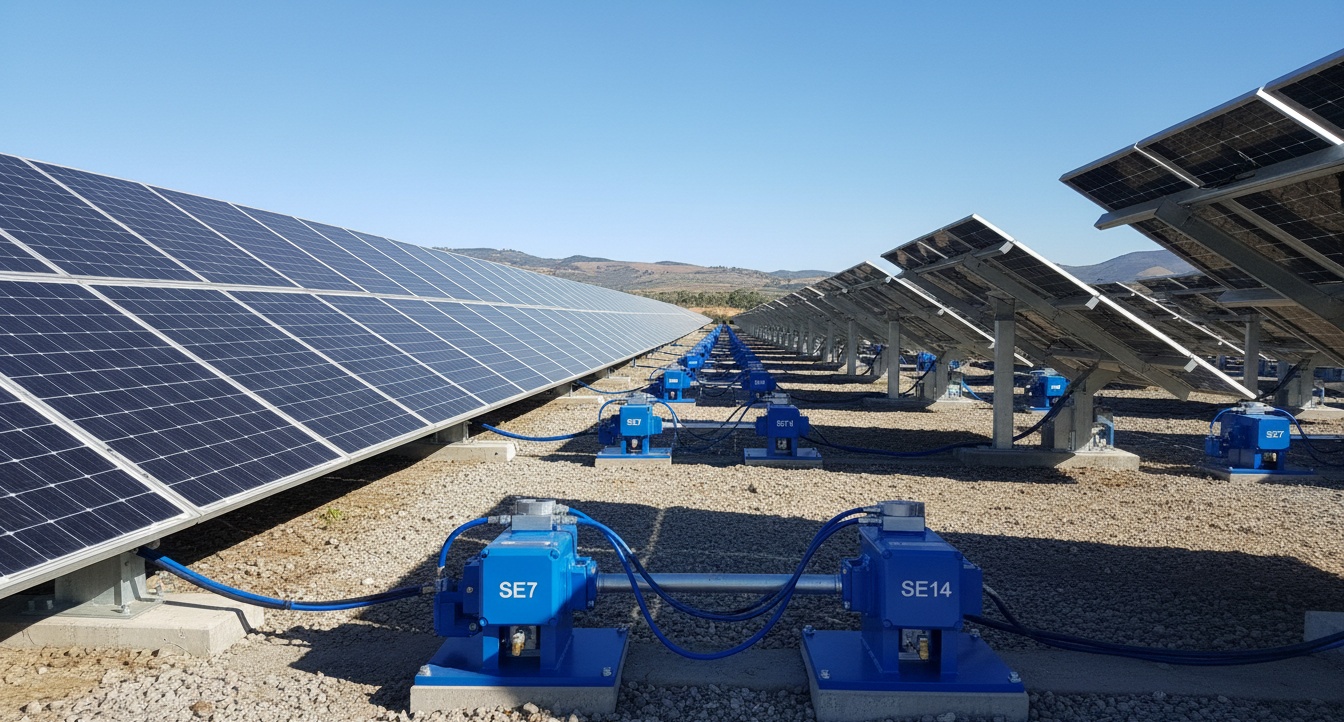
A technical buyer's guide to matching SE-series hydraulic slewing drive torque ratings to solar tracker panel arrays — from the SE7 for small commercial installations to the SE14 for utility-scale single-axis tracking systems.
Why Your Solar Tracker Needs Hydraulic — Not Just Electric — Slewing Drives
If you are sourcing slewing drives for a single-axis solar tracker project — whether a 500 kW commercial rooftop array or a 50 MW utility-scale installation across 80 hectares of desert — the choice between electric and hydraulic slewing drive for solar tracker applications is one of the most consequential engineering decisions you will make. I have spent the last three years working directly with solar EPC firms and tracker manufacturers across the Middle East, Southeast Asia, and North Africa, and I can tell you this: in environments where wind loads exceed 25 m/s, ambient temperatures cross 50°C, and maintenance access means driving two hours across sand tracks, hydraulic slewing drives consistently outperform their electric counterparts on three metrics that matter most to project operators — holding torque reliability, thermal resilience, and service interval length.
The SE-series worm gear slewing drive architecture — which I configure daily for customers through INI Hydraulic's IYH Series Hydraulic Slewing Drives — addresses the fundamental challenge of solar tracking: maintaining precise angular positioning (typically within ±0.5°) against gusting wind loads, across 30,000+ cycles per year, for a design life of 25 years. The worm gear's inherent self-locking characteristic — which I will explain in detail — eliminates the need for a separate holding brake, reducing the component count and the number of potential failure points compared to a dual-axis electric slew drive with electromagnetic braking. This article maps the torque output progression from SE7 to SE14 and provides the selection framework I use when working with tracker OEMs to specify the right drive for their panel configuration.
The SE-Series Torque Mapping: SE7 Through SE14 at a Glance
I want to start with the numbers that procurement engineers and tracker designers care about most. The SE-series designation corresponds to the raceway diameter of the integrated slewing bearing — SE7 is approximately 7 inches (178 mm), SE9 is 9 inches (229 mm), SE12 is 12 inches (305 mm), and SE14 is 14 inches (356 mm). But the raceway diameter alone does not tell the full story. The critical parameters for solar tracker selection are output torque, tilting moment capacity, and holding torque — and I have compiled the reference values I use when quoting projects:
| Model | Output Torque | Tilting Moment | Holding Torque | Gear Ratio | Tracking Precision | Approx. Weight |
|---|---|---|---|---|---|---|
| SE7 | 2.5 kN·m | 13.5 kN·m | 10.2 kN·m | 62:1 | ≤0.20° | 28 kg |
| SE9 | 4.5 kN·m | 33.9 kN·m | 22.0 kN·m | 68:1 | ≤0.18° | 42 kg |
| SE12 | 7.5 kN·m | 54.3 kN·m | 43.0 kN·m | 78:1 | ≤0.17° | 61 kg |
| SE14 | 13.5 kN·m | 81.0 kN·m | 65.0 kN·m | 85:1 | ≤0.15° | 95 kg |
SE7 to SE14 Selection Matrix: Matching Drive Size to Panel Array
When a tracker manufacturer or solar EPC sends me their panel configuration, I work through a three-step selection process. The goal is to identify the smallest SE model that satisfies all three load conditions — output torque (to rotate), tilting moment (to not topple), and holding torque (to not back-drive in wind) — with a safety factor of at least 1.5 on each parameter.
Step 1: Calculate the Wind-Induced Tilting Moment
The tilting moment is the overturning force that wind exerts on the tracker structure — and it is almost always the governing constraint in drive selection. For a single-axis tracker with N panels, each of area A (m²), mounted at height H (m) above the torque tube axis, the tilting moment under wind speed V (m/s) is approximately:
M_tilt = 0.613 × V² × C_d × N × A × H
Where C_d is the drag coefficient (typically 1.2 for a flat plate at 90° incidence, the worst-case parked position during a wind event). Let me give you a real example from a project I quoted in 2025:
- Tracker string: 90 panels, each 2.2 m² (standard 540W bifacial module)
- Torque tube height: 1.8 m above drive centerline
- Design wind speed: 30 m/s (108 km/h — typical for desert installations in the MENA region)
- M_tilt = 0.613 × 900 × 1.2 × 90 × 2.2 × 1.8 = 235.5 kN·m
This tilting moment needs to be divided by the number of drives per tracker row. If the row uses one drive at each end (2 drives), each drive must resist 117.8 kN·m — which immediately eliminates the SE7, SE9, and SE12. Even the SE14 at 81 kN·m tilting moment capacity would require three drives per row for this configuration, or a larger SE17/SE21 model.
This is the reality check I provide to every first-time solar EPC: the tilting moment, not the output torque, drives your slewing drive selection. I have seen projects where the EPC specified SE9 drives based on torque calculations alone, only to discover during commissioning that the first 25 m/s wind gust produced visible deflection in the tracker structure. Downgrading is far more expensive than spec'ing correctly the first time.
Step 2: Verify Output Torque Against Rotation Load
Once the tilting moment constraint is satisfied, I verify that the drive's output torque can rotate the tracker string at the required tracking speed (typically 0.1–0.2 RPM, which translates to the sun's apparent angular velocity of 15°/hour). The rotation load includes:
- Inertial load: Overcoming the moment of inertia of the entire row during start/stop. This is typically small (5–10% of total) because tracking acceleration is minimal.
- Friction load: Bearing friction at each support post along the row. I use 0.005–0.01 as the friction coefficient for greased pillow-block bearings on the torque tube.
- Wind load at operational position: When the tracker is at its morning or evening extreme angle (±45° to ±60°), the panels present some projected area to the wind. At typical operational wind speeds (10–15 m/s), this load is 15–25% of the parked-position tilting moment.
- Uneven loading from dust/snow accumulation: In desert installations, dust accumulation on one face of the bifacial panel can add 3–5 kg/m² of asymmetric load. I include a 10% margin for this in my calculations.
Step 3: Confirm Holding Torque Without Back-Driving
This is where the worm gear architecture of the hydraulic slewing drive for solar tracker applications provides its most distinctive advantage. A worm gear with a ratio above approximately 40:1 is inherently self-locking — the worm can drive the gear, but the gear cannot drive the worm. This means that when wind loads push against the parked tracker structure, the drive holds position without consuming hydraulic power and without requiring a separate mechanical brake.
For a hydraulic configuration, I ensure the holding torque (the torque at which the worm gear would theoretically back-drive) exceeds the maximum expected wind-induced static torque by a factor of at least 1.5. The IYH series drives I configure for solar applications use a hardened and ground worm shaft (58–62 HRC) meshing with a nickel-bronze worm gear — this material pairing maximizes the friction coefficient at the gear mesh, enhancing the self-locking margin.
| Installation Type | Panel Count per Drive | Recommended SE Model | Key Constraint |
|---|---|---|---|
| Small commercial rooftop (<100 kW) | 15–30 panels | SE7 | Output torque; wind loads manageable with low mounting height |
| Mid-size commercial (100–500 kW) | 30–60 panels | SE9 | Tilting moment begins to dominate at higher mounting heights |
| Small utility-scale (1–5 MW) | 60–90 panels | SE12 | Tilting moment; consider 2 drives per row above 80 panels |
| Large utility-scale (5–50 MW) | 90–120 panels | SE14 | Tilting moment; 2+ drives per row mandatory |
Hydraulic vs. Electric Slew Drives for Solar: The Procurement Decision Framework
I am frequently asked by tracker OEMs and EPCs whether hydraulic or electric slewing drives are the better choice for their specific project. I answer this with a comparison table I have refined over dozens of project consultations, and I present it here because I believe procurement transparency leads to better long-term outcomes for everyone.
| Parameter | Hydraulic (IYH Series) | Electric (Standard SE) |
|---|---|---|
| Starting torque (from zero RPM) | Full rated torque at stall — no derating | Typically 60–80% of rated at startup due to current limiting |
| Holding mechanism | Inherent worm-gear self-locking + hydraulic check valve backup | Requires electromagnetic brake (additional failure point) |
| Temperature range | -30°C to +70°C (with appropriate hydraulic oil viscosity) | -20°C to +50°C (electronics-limited; derating above 45°C) |
| Dust/sand resistance | IP65-rated sealed housing; hydraulic circuit is closed-loop | Vulnerable to brush/commutator contamination in open motors |
| Centralized control | Single HPU can drive 20–50 slewing drives via manifold | Each drive requires individual motor controller and power cable |
| Service interval | 10,000 hours for hydraulic oil change; gearbox grease every 3 years | 5,000 hours for motor brush replacement; brake adjustment annually |
| Cost per drive unit (excl. HPU) | $180–$520 (SE7–SE14 range) | $220–$650 (SE7–SE14 range with motor + brake) |
| Best for | Desert installations; utility-scale projects with centralized HPU; high-wind sites | Temperate installations; small-scale projects; sites with existing electrical infrastructure |
The Centralized Hydraulic Architecture: Why One HPU Powers a Hundred Drives
One of the most compelling arguments for a hydraulic slewing drive for solar tracker deployment at utility scale is the centralized hydraulic power unit (HPU) architecture. In a 50 MW solar farm with 2,500 tracker rows, each requiring two slewing drives (5,000 drives total), an electric solution requires 5,000 individual motor controllers, 5,000 power cables (each potentially 50–100 meters from the nearest combiner box), and 5,000 electromagnetic brakes to maintain and replace over the project's 25-year life.
A hydraulic solution — which I configure using our IYH22/IYH33 hydraulic slewing drives as the standard modules — replaces all of this with a single HPU per 2–5 MW block. The HPU (typically a 15–30 kW electric motor driving a variable-displacement piston pump) supplies pressurized hydraulic oil through a buried HDPE pipe manifold to every slewing drive in the block. Each drive receives oil flow only when its zone's directional control valve is activated by the tracker controller. The drives themselves are purely mechanical — no motors, no brakes, no electronics at the panel level.
I have configured projects where the HPU-to-drive ratio was 1:120 — one 22 kW HPU serving 120 slewing drives across a 2 MW block. The installed cost per drive, including its share of the HPU and piping, was approximately 40% lower than the equivalent electric solution with individual motor controllers and power cabling. More importantly for the O&M team: there are exactly two components that require scheduled maintenance in the entire 2 MW block — the HPU (accessible at the block's perimeter road) and the hydraulic oil filter (changeable in 10 minutes). No technician needs to walk between tracker rows to service individual drive motors.
Field insight: On a 20 MW installation in Oman that I supported in 2025, the hydraulic centralized architecture reduced annual O&M man-hours by approximately 65% compared to an adjacent 20 MW block using electric slewing drives — confirmed by the EPC's own maintenance logs after 18 months of operation. The primary difference was the elimination of individual brake adjustment calls (the electric drives averaged 3.2 brake-related service tickets per 100 drives per year) and motor replacement calls (1.8 per 100 drives per year due to brush wear from sand ingress).
Backlash and Tracking Precision: What the Spec Sheets Don't Always Tell You
Tracking precision — the angular error between the tracker's actual position and the sun's calculated position — directly impacts energy yield. A tracking error of 1° reduces the effective irradiance on the panel surface by approximately cos(1°) ≈ 0.99985, or 0.015% — negligible. But the real concern is not the steady-state error; it is backlash-induced oscillation under gusting wind conditions.
Backlash is the angular free play in the gear mesh — the amount the output gear can rotate without the input worm moving. In a worm gear slewing drive, backlash is determined by the center distance tolerance between the worm and gear, the gear tooth profile accuracy, and the bearing preload on both shafts. I specify backlash values of ≤0.15° for SE14 drives and ≤0.20° for SE7 drives — values that I verify on every production batch using a dial indicator on the output flange with the input shaft locked.
Why does backlash matter for solar tracking? Under gusting wind, a tracker with 0.3° of backlash experiences a micro-oscillation at the wind gust frequency (typically 0.5–2 Hz). This oscillation does not significantly affect energy yield (the RMS tracking error remains within spec), but it accelerates wear on the gear teeth and the torque tube bearings. I have inspected drives after three years of operation at a windy coastal site in Vietnam where the backlash had grown from 0.18° to 0.41° — a 128% increase — purely from this wind-induced fretting. Specifying a hardened worm (58+ HRC) and a centrifugally cast nickel-bronze gear (Brinell 90–110) — the material combination I use in our IYH solar-grade drives — reduces this wear rate by approximately 50% compared to standard induction-hardened worms (50–55 HRC) running against sand-cast bronze gears.
Corrosion Protection for Desert and Coastal Solar Sites
Solar installations in the Middle East face a corrosion paradox: there is almost no rain, but morning dew condenses on metal surfaces and combines with salt from airborne sand (many desert sites in the UAE and Saudi Arabia are within 50 km of the coast, where airborne salinity is 2–5 mg/m²/day). I specify a three-layer corrosion protection system for all IYH drives destined for solar applications:
- Substrate preparation: Cast iron and steel housings are shot-blasted to SA 2.5 (near-white metal) per ISO 8501-1.
- Coating system: Two-component zinc-rich epoxy primer (80 μm DFT) + high-build epoxy intermediate (150 μm DFT) + aliphatic polyurethane topcoat (50 μm DFT) — total DFT ≥280 μm. This system is certified to ISO 12944 C5-M (very high corrosivity, marine/coastal).
- Sealing: All external fasteners are A4-80 (316 stainless steel). The output pinion seal is a double-lip FKM (Viton) design with a stainless steel garter spring. The housing joint faces use a Viton O-ring in a machined groove — no liquid gasket that can degrade under UV.
I have drives that have been operating continuously at a coastal solar site in Gujarat, India for 30 months with zero visible corrosion on the housing exterior and no seal leakage. The C5-M coating specification adds approximately $15–$25 to the unit cost per drive — a trivial premium for a 25-year design life in a corrosive environment.
Installation and Commissioning: What I Send with Every Shipment
When I ship a container of IYH slewing drives to a solar project site, I include a commissioning checklist that I have developed from field experience — because I have learned that even the best-engineered drive will underperform if the installation is rushed. The critical items are:
- Torque tube alignment: The drive's output pinion must mesh with the torque tube's ring gear (or the drive is mounted inline with the torque tube via a flanged coupling) with a center distance tolerance of ±0.15 mm. Misalignment beyond this produces uneven tooth loading that accelerates gear wear. I recommend using a dial indicator during installation — not just visual alignment.
- Hydraulic flushing: Before connecting the drives to the HPU manifold, the entire hydraulic piping network must be flushed with clean oil at 2× normal flow velocity for a minimum of 30 minutes per circuit. I have seen installations where skipping this step resulted in abrasive particles from pipe cutting/threading entering the hydraulic motor and scoring the piston bores within the first week of operation.
- Limit switch calibration: The tracker's angular range (typically ±55° from horizontal) must be verified with the drive installed and the hydraulic system pressurized. The limit switches should be set to stop the drive at ±52° to provide a 3° buffer before mechanical hard stops.
Frequently Asked Questions from Solar EPC Procurement Teams
Can I mix SE models within the same tracker row?
Technically yes, but I strongly advise against it. Different SE models have different gear ratios (62:1 for SE7 vs. 85:1 for SE14), which means the hydraulic motor displacement must be sized differently for each model to achieve the same output rotational speed. Mixing models in the same row also creates an uneven load distribution — the larger drive absorbs more of the wind-induced torque, potentially overloading its tilting moment capacity while the smaller drive is under-utilized. Standardizing on a single model per project simplifies procurement, commissioning, and spare parts inventory. I always recommend sizing all drives in a project for the worst-case wind condition on the longest tracker row — the small additional cost of a slightly larger drive is recovered in reduced engineering and logistics complexity.
What hydraulic oil do you recommend for solar tracker applications?
For most solar installations, I recommend ISO VG 46 hydraulic oil with a high viscosity index (VI ≥ 150) and good anti-wear (AW) additive package. For desert installations where ambient temperature ranges from 5°C at night to 50°C at midday, I specify ISO VG 68 with VI ≥ 160 to maintain adequate viscosity at high temperature while still being pumpable during cold starts. For installations in temperate climates (Europe, North America), ISO VG 32 with VI ≥ 140 provides better cold-weather pumpability. The hydraulic oil should meet ISO 11158 HM or HV classification — these are the standard anti-wear hydraulic oil specifications that all major oil companies produce. I also recommend sending an oil sample for laboratory analysis every 6 months (ISO 4406 cleanliness target: 18/16/13 or cleaner) — this single practice has caught more impending failures than all other inspection methods combined.
How do you handle the transition from tracking mode to stow (wind) mode?
When the site's anemometer reports wind speed exceeding the operational threshold (typically 20–25 m/s, configurable by the SCADA system), the tracker controller sends a "stow" command to the HPU's directional control valves. The hydraulic circuit shifts to rapid-traverse mode, rotating all drives simultaneously to the horizontal (0°) stow position — the orientation that presents the minimum projected area to the wind. For a 120-drive block, the stow sequence from ±45° to horizontal takes approximately 2–3 minutes with a properly sized HPU. Once horizontal, the hydraulic flow stops and the worm gear's self-locking characteristic holds the position without consuming power. The system remains in this state until the wind speed drops below the threshold for a configurable duration (typically 10–15 minutes, to avoid hunting during gusty conditions).
About the Author
Mr. Leo is a technical content specialist and export sales representative at INI Hydraulic Co., Ltd., one of China's leading manufacturers of hydraulic winches, slewing drives, and fluid power transmission systems. Through INI Hydraulic's YouTube channel and social media platforms, he produces hands-on technical content — including hydraulic system animations, winch load testing footage, and OEM procurement walkthroughs — that helps international buyers understand INI's product engineering before placing orders.
With a background in hydraulic transmission engineering and four years supporting offshore, marine, and construction machinery buyers across Southeast Asia, the Middle East, and Europe, Leo translates complex hydraulic spec sheets into practical procurement guidance for OEM engineers, shipyard procurement managers, and industrial equipment distributors.
Post time: Jun-04-2026