
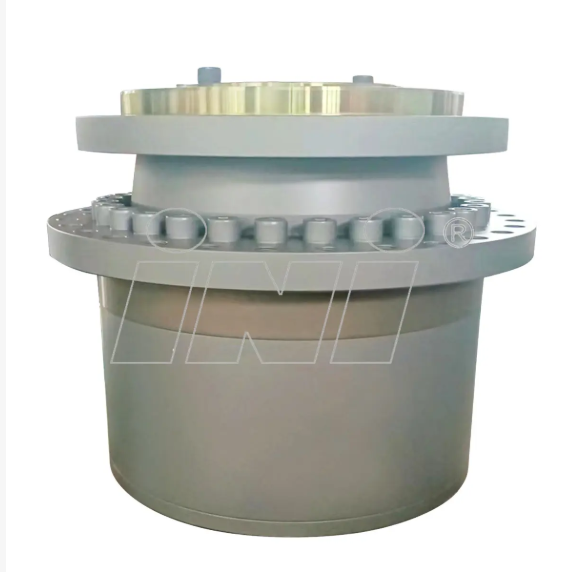
1. Hydraulic Planetary Gearbox: How It Works and Where It Excels
The integration of the hydraulic motor with the planetary gear stage within a single housing provides significant advantages for marine installations. Space on offshore platforms, ship decks, and port equipment is at a premium. A hydraulic planetary gearbox can deliver the same torque as a much larger direct-drive motor in a package that is 40–60% smaller and lighter.
Additionally, the contained hydraulic system provides natural protection against the corrosive effects of saltwater spray. Sealed shaft seals, marine-grade paint systems, and optional stainless steel fasteners ensure that the gearbox can withstand the harsh operating conditions typical of port and offshore environments without compromising performance or service life.
Hydraulic planetary gearboxes are available in multiple design configurations to match specific marine applications. The most common arrangement is the coaxial planetary gear stage, where the sun gear drives multiple planet gears that rotate within a fixed ring gear. This design distributes the load across multiple gear meshes, reducing tooth stress and extending gear life compared to parallel-axis gear arrangements.
For port machinery applications, hydraulic planetary gearboxes are typically paired with axial piston motors capable of operating at pressures up to 35 MPa. This combination delivers the high starting torque essential for crane hoisting and winch operations. The gear reduction ratio can be tailored to match specific line pull and line speed requirements, with ratios ranging from 3:1 for high-speed applications to 100:1 for heavy lifting operations requiring maximum torque output.
A hydraulic planetary gearbox combines a planetary gear reduction stage with a hydraulic motor (typically axial piston or radial piston type) integrated into a single housing. The compact coaxial design allows high torque output in a small footprint — a critical advantage in space-constrained marine and offshore installations.
Key advantages for marine applications:
• High torque density: Planetary gear stages distribute load across multiple planet gears, achieving torque capacities of 50,000 Nm and above in compact packages.
• Integrated braking: Most hydraulic planetary gearboxes include spring-applied, hydraulically released (SAHR) brakes, eliminating the need for external brake systems.
• Controlled acceleration: Hydraulic fluid provides natural damping, reducing shock loads during start-stop cycles.
INI Hydraulic’s planetary gearbox range (IGC-I, IE, and IGC-J series) is engineered specifically for port and offshore applications, with corrosion-resistant coatings and sealing options for marine environments.
2. Direct Drive Systems: Simplicity and Efficiency for Constant-Speed Applications
Direct drive systems couple the prime mover (typically an electric motor or diesel engine) directly to the driven load, often through a flexible coupling or a simple gear couple. No intermediate gear reduction is required — the motor runs at the load speed.
Key advantages for marine applications:
• Higher efficiency at nominal speed: Direct drive eliminates gear mesh losses, achieving 95–98% efficiency vs. 85–93% for hydraulic planetary gearboxes.
• Lower initial cost: Fewer components translate to a simpler system with lower upfront investment.
• Easier maintenance: A direct drive system has fewer rotating components and no hydraulic fluid to monitor or replace.
Direct drive is generally preferred for constant-speed, steady-load applications such as bilge pumps, ventilation fans, and light-duty conveyor systems.
3. Side-by-Side Comparison for Port and Offshore Applications
| Parameter | Hydraulic Planetary Gearbox | Direct Drive |
|---|---|---|
| Torque Density | High (compact coaxial design) | Moderate (requires larger motor) |
| Efficiency (nominal) | 85–93% | 95–98% |
| Speed Control | Excellent (variable via flow control) | Limited (fixed or VFD only) |
| Shock Load Protection | Inherent (hydraulic damping) | Requires external coupling |
| Space Requirement | Compact | Larger for same torque |
| Maintenance Interval | 1,000–2,000 hours | 3,000–5,000 hours |
| Saltwater Corrosion Protection | Available (marine coating) | Available (motor-specific) |
4. Selecting the Right Transmission for Specific Port Machinery
4.2 Shipboard Deck Equipment and Anchor Handling
Shipboard hydraulic systems power a wide variety of deck equipment, including anchor windlasses, capstans, mooring winches, hose-handling cranes, and provision cranes. Each application has unique transmission requirements. Anchor windlasses require high torque at very low speed for initial anchor break-out, followed by moderate torque at higher speed for anchor retrieval. Mooring winches require precise speed control for maintaining tension against tidal movements without over-tensioning the mooring lines.
Hydraulic planetary gearboxes equipped with variable-displacement motors can provide the wide speed-torque envelope required for these diverse applications. The same basic gearbox platform, with different motor displacement settings and control valving, can be configured for anchor handling, mooring, and general cargo handling applications — reducing the spare parts inventory required onboard.
4.1 Harbor Crane and Ship-to-Shore Applications
Ship-to-shore (STS) container cranes represent one of the most demanding transmission applications in port operations. A typical STS crane requires hoisting speeds of 60–120 m/min with load capacities of 40–80 tonnes under the spreader. The transmission must deliver consistent torque across a wide speed range, provide precise positioning capability for container stacking, and operate reliably in a saltwater environment with minimal maintenance access.
Hydraulic planetary gearboxes are the preferred transmission choice for STS crane hoist drives because they meet all of these requirements within a compact package that can be integrated directly into the crane trolley structure. The variable-speed capability of the hydraulic motor allows the crane operator to smoothly transition from high-speed hoisting to slow-speed positioning without mechanical gear shifting, improving both cycle time and safety.
For rubber-tired gantry (RTG) cranes, portal cranes, and ship-to-shore cranes that require frequent start-stop cycles and precise positioning, the hydraulic planetary gearbox is the standard choice. Its ability to deliver controlled acceleration and integrated braking significantly reduces cycle times.
For constant-speed port applications such as conveyor drives, ventilation systems, and lighting towers, direct drive offers better energy efficiency and lower maintenance requirements over the equipment’s service life.
For offshore applications like anchor winches, mooring winches, and pipe-laying tensioners, the hydraulic planetary gearbox dominates due to its high torque density, compact footprint, and built-in overload protection.
5. Total Cost of Ownership: What Marine Buyers Should Calculate
When comparing transmission options, marine buyers must look beyond the initial purchase price. A hydraulic planetary gearbox may carry a 20–40% higher upfront cost than a comparable direct drive, but offers lower total cost of ownership in high-cycle, high-torque applications because:
• Longer service life under shock loads reduces replacement frequency.
• Integrated braking eliminates separate brake system costs.
• Hydraulic damping reduces wear on connected components (shafts, couplings, bearings).
For port operators and offshore contractors, the INI Hydraulic planetary gearbox range provides engineered solutions with certified marine-grade protection.
6. Why Marine Engineers Worldwide Specify Chinese Hydraulic Planetary Gearboxes
Chinese manufacturers have invested heavily in hydraulic component technology over the past decade. INI Hydraulic, based in Ningbo, Zhejiang Province, produces hydraulic planetary gearboxes that meet or exceed international standards, with CE, ISO 9001, and marine classification society certifications available.
For marine buyers, sourcing from China offers: competitive factory-direct pricing (30–50% below European equivalents), shorter lead times for custom configurations, and OEM/ODM flexibility for branded integration.
To discuss your specific marine transmission requirements, contact the INI Hydraulic engineering team for a technical consultation.
For marine buyers evaluating transmission options for new-build or retrofit projects, the most effective approach is to specify the duty cycle in detail and allow the transmission manufacturer to recommend the optimal configuration. The hydraulic planetary gearbox offers the best solution for the majority of port and offshore machinery applications due to its torque density, integrated braking, and shock load protection. However, for constant-speed, steady-load applications, direct drive may offer lower total cost of ownership.
To discuss your specific port or offshore transmission requirements, contact INI Hydraulic’s engineering team for a technical consultation and customized solution proposal.
8. Procurement Checklist for Marine Buyers
When specifying hydraulic planetary gearboxes or direct drive systems for port and offshore applications, the following checklist ensures complete and accurate procurement:
1. Duty Cycle Specification: Provide detailed duty cycle data including peak torque, continuous torque, operating speed range, number of start-stop cycles per hour, and annual operating hours.
2. Environmental Requirements: Specify saltwater exposure level, ambient temperature range, IP protection rating required (IP56 minimum for deck-mounted equipment), and any specific corrosion protection standards.
3. Certification Requirements: Identify the required classification society (CCS, DNV, ABS, BV, or Lloyd’s) and certification scope (type approval, design appraisal, or survey during manufacture).
4. Integration Requirements: Specify mounting configuration, shaft connection type, control interface protocol, and any space constraints affecting installation.
5. Documentation Requirements: Require a technical data sheet, dimensional drawing, wiring diagram, test certificate, and material certificates for major components.
Providing this information during the quotation stage reduces the risk of specification gaps that can lead to change orders and delivery delays. Contact INI Hydraulic for application-specific transmission recommendations.
Procurement Checklist for International Buyers
When developing a sourcing strategy for this product category, international buyers should follow a structured evaluation process. Start by defining the technical specifications that match your target market requirements, including dimensional tolerances, material grades, surface finish requirements, and certification standards. The initial specification document serves as the foundation for supplier communication and quotation comparison.
The supplier qualification process should include: (1) review of the manufacturer’s quality management system certification (ISO 9001:2015 minimum), (2) verification of product-specific certifications applicable to your target market, (3) review of customer references and export track record to your region, (4) evaluation of communication responsiveness and technical support capability, and (5) sample request and inspection for dimensional and material verification.
Cost negotiation should consider the total cost of ownership, not just the unit price. Factor in: shipping costs (sea freight or air freight), import duties and taxes in the destination country, certification and testing costs, quality inspection costs, and spare parts and after-sales support costs. A supplier with a higher unit price but better quality consistency and on-time delivery performance may offer lower total cost of ownership than a cheaper alternative with higher defect rates and delivery variability.
Establish a quality agreement that defines: (1) acceptable quality level (AQL) for critical, major, and minor defects, (2) inspection and testing requirements for each production batch, (3) sampling plan and frequency, (4) non-conformance handling procedures and corrective action timelines, and (5) warranty terms and conditions. A written quality agreement aligned with ISO 9001 principles reduces the risk of quality disputes during production and delivery.
For buyers new to sourcing from China, consider starting with a trial order of 10–20% of the annual projected volume. A trial order provides practical experience with the supplier’s communication, production, and logistics processes without exposing the buyer to excessive inventory risk. Use the trial order to establish working relationships and identify any process improvements needed before scaling to full-volume production orders.
Regional Port Equipment Standards and Marine Classification Requirements
International buyers sourcing from China must consider the specific regulatory and market requirements of their target region. Each major market has distinct standards, certification requirements, and compliance expectations that affect product specification and supplier qualification processes.
The North American market (United States and Canada) requires compliance with specific safety standards administered by UL, CSA, and ANSI. Products sold in this market must carry certification marks from Nationally Recognized Testing Laboratories (NRTLs) such as UL, Intertek (ETL), or CSA. The certification process involves product testing, factory inspection, and follow-up inspection services to verify ongoing compliance.
The European market operates under CE marking requirements, covering applicable EU directives and standards for each product category. The manufacturer or importer must issue a Declaration of Conformity and maintain technical documentation demonstrating compliance. Notified Body involvement is required for certain product categories and higher risk classifications.
The Asia-Pacific market presents a fragmented regulatory landscape with country-specific requirements. China requires CCC (China Compulsory Certification) for certain products, Japan requires PSE marking for electrical products, Korea requires KC certification, and Australia requires RCM marking for electrical and EMC compliance.
For buyers sourcing from Chinese manufacturers, working with a supplier experienced in multiple market certifications provides significant advantages. A manufacturer that has already navigated the certification processes for major markets can apply that experience to new product development, reducing certification lead times and avoiding common compliance pitfalls. Request documentation of the supplier’s existing certifications for similar products as evidence of their compliance capability.
Beyond regulatory compliance, regional market requirements also include: (1) packaging and labeling requirements specific to each market, (2) documentation requirements for customs clearance and market surveillance, (3) language requirements for user manuals and safety instructions, and (4) after-sales service and spare parts availability requirements. Factor all of these elements into your sourcing strategy and supplier selection criteria.
Marine transmission technology continues to evolve, with digital control systems enabling more precise monitoring of gearbox performance parameters such as oil temperature, vibration signature, and torque output. These smart monitoring capabilities are increasingly specified for critical offshore applications where unscheduled downtime carries prohibitive costs. INI Hydraulic’s planetary gearbox range can be equipped with condition monitoring sensors for integration with vessel maintenance management systems.
Frequently Asked Questions
Which is better for marine winch applications: planetary gearbox or direct drive?
Hydraulic planetary gearboxes are almost universally preferred for marine winch applications due to their high torque density, integrated braking, and controlled acceleration. Direct drive is rarely specified for heavy-duty winch applications.
What maintenance does a hydraulic planetary gearbox require?
Routine maintenance includes checking hydraulic oil level and condition every 500 hours, changing oil filters every 1,000 hours, and inspecting seals and coatings during annual dry-dock maintenance.
Can direct drive systems handle shock loads in offshore applications?
Direct drive systems can handle moderate shock loads with flexible couplings, but they lack the inherent damping of hydraulic systems. For severe shock load conditions, hydraulic planetary gearboxes are the more robust choice.
What certification should I look for in marine planetary gearboxes?
Look for ISO 9001 quality management, CE marking, and classification society certification (DNV, ABS, BV, CCS, or Lloyd’s) appropriate for your vessel type and operating region.
How long does a hydraulic planetary gearbox typically last?
With proper maintenance, a hydraulic planetary gearbox in marine service can last 10–15 years. Offshore applications with continuous high-load cycles may require major overhaul at 8–12 years.
What is the lead time for custom hydraulic planetary gearboxes from Chinese manufacturers?
Standard lead times range from 30–60 days for existing designs. Custom-engineered solutions typically require 60–90 days, including design review, prototyping, and type testing.
Post time: Jul-09-2026