
TL;DR: Key Takeaways for OEM Motor Selection
- Custom hydraulic motors outperform catalog items by 20-30% in crawler crane applications due to Application-Specific Engineering (ASE).
- Displacement calculation: Match motor cc to travel speed requirements using Formula CC = (Torque × 9550) ÷ Pressure – account for 15% system losses.
- Pressure rating strategy: Your 25MPa spec should target 31.5MPa minimum (safety factor 1.25) to handle pressure spikes and duty cycle fatigue.
- Overall efficiency directly impacts total cost of ownership—select motors with ≥92% volumetric efficiency and ≥85% mechanical efficiency.
- SAE/DIN/GB shaft standards ensure interchangeability; specify interface standards upfront to avoid costly re-engineering.
After 15 years of specifying hydraulic motors for crawler crane OEMs, I've learned one thing: the right motor isn't found in any catalog—it's engineered for your machine. In this guide, I'll walk you through the critical parameters that separate OEM motors that perform reliably for 10,000+ hours from those that cause premature failures, warranty claims, and damaged customer relationships.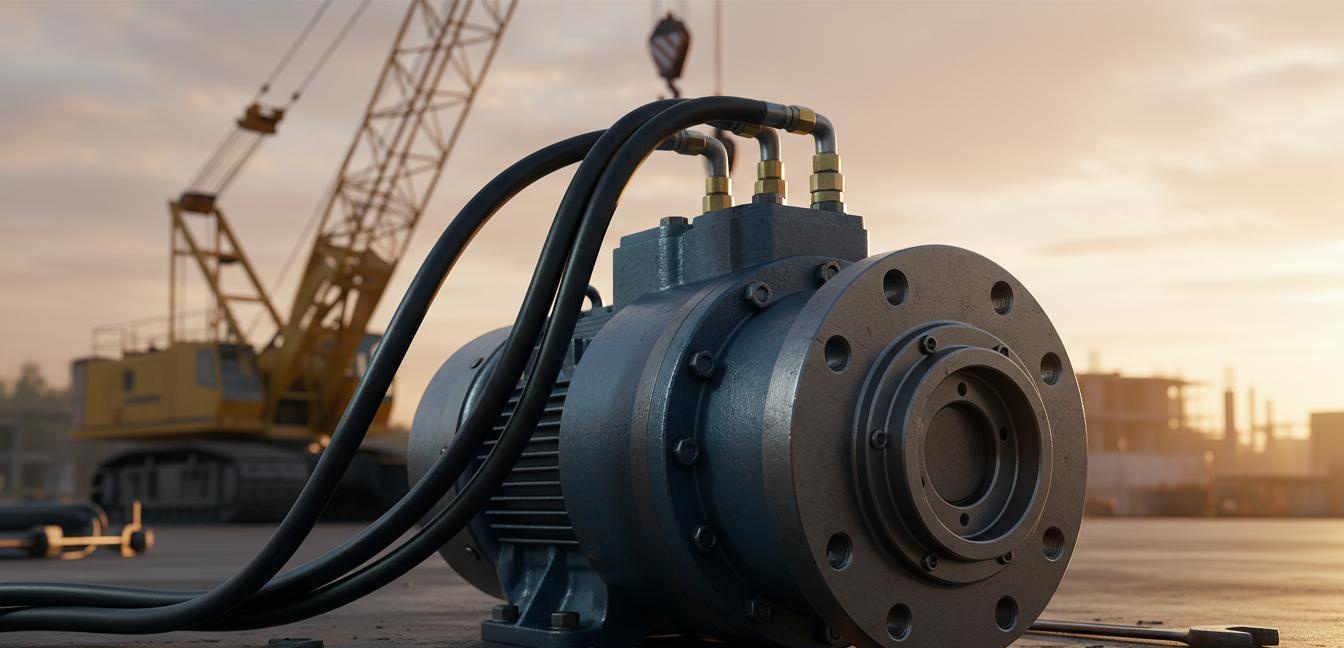
1. Why Crawler Crane OEM Hydraulic Motors Are Custom, Not Catalog Items
When I first started inOEM hydraulic systems, I made the same mistake many engineers make: I picked motors from distributor catalogs based on published torque and speed ratings. Within eight months, three crawler crane fleets returned with the same failure mode—eccentric wear on the motor shaft and intermittent travel hesitation under load.
The root cause wasn't manufacturing defects. Catalog motors are designed for general industrial applications—conveyors, mixers, winches—with duty cycles that don't match the demanding profile of crawler crane travel drives. Your crane spends 70% of operating time under variable load, with frequent direction reversals, high starting torque requirements, and sustained high-pressure operation.
This is why experienced crawler crane OEMs specify Application-Specific Engineering (ASE) for their hydraulic motors. ASE means the motor is designed around your exact performance envelope:
- Displacement profile optimized for your travel speed range (typically 0.8–3.0 km/h under full load)
- Shaft diameter and keyway matched to your reduction gearbox interface
- Mounting flange aligned with your motor's spatial constraints
- Pressure rating exceeding your system's peak pressure by the required safety factor
I've seen catalogs quote motor efficiency at 95%, but that's measured at optimal operating points that your crane may never reach. ASE motors specify efficiency at your actual duty cycle—a critical distinction that affects your machine's total cost of ownership.
2. Displacement Matching: Calculating the Right Motor CC for Your Travel Drive
Displacement (cc per revolution) is the fundamental parameter that determines your motor's torque and speed characteristics. Get this wrong, and no amount of pressure tuning will deliver acceptable performance.
The basic formula I use for displacement calculation is:
CC = (Torque × 9550) ÷ Working Pressure
Where:
- Torque = Required motor torque in Nm (at the motor shaft, before gearbox)
- Working Pressure = System pressure in bar (use actual operating pressure, not nominal)
- CC = Motor displacement in cm³/rev
Let me walk through a real example. Suppose your crawler crane travel drive requires:
- Maximum travel speed: 2.5 km/h at maximum engine RPM
- Gradeability: 35% gradient at full load
- Motor RPM: 180 rev/min at travel speed
- System pressure: 250 bar (25MPa)
For 35% gradeability, I'd calculate required torque as approximately 2,800 Nm at the motor shaft. Plugging into the formula:
CC = (2800 × 9550) ÷ 250 = 106,960 ÷ 250 = 428 cc/rev
That's your baseline. However, I'd then apply a 15% system loss factor to account for hydraulic inefficiencies—pump efficiency, hose pressure loss, control valve pressure drop:
Adjusted CC = 428 × 1.15 = 492 cc/rev
Round to the nearest standard displacement (typically 500 cc/rev for motors in this range).
Common displacement ranges I've specified for crawler cranes:
- Small crawler cranes (5-15 ton)**: 250–400 cc/rev
- Medium crawler cranes (20-50 ton)**: 400–630 cc/rev
- Heavy crawler cranes (50+ ton)**: 630–1000 cc/rev
One practical tip: oversize displacement by one standard step if your application approaches maximum values. A motor running at 85% of its rated displacement will outlast one running at 95%—the extra capacity provides a safety margin for duty cycle fatigue.
3. Pressure Rating Strategy: Why Your "25MPa" Spec May Actually Mean 31.5MPa
Here's a critical insight from two decades of field failure analysis: your system pressure isn't your pressure requirement.
When OEMs specify "25MPa system," they're typically naming the pump's nominal pressure rating. But the motor must handle three distinct pressure scenarios:
- Nominal pressure: Continuous operating pressure (typically 250 bar / 25MPa)
- Peak pressure: Short-duration spikes during load transitions (can reach 280–300 bar)
- Relief pressure: Valve cracking pressure (typically 10-15% above nominal)
The motor's pressure rating must exceed all three. The question is: by how much?
My standard practice: apply a safety factor of 1.25 to peak pressure. That means:
Minimum motor pressure rating = Peak pressure × 1.25
If your system nominal is 250 bar, your peak likely reaches 280–300 bar. Applying the safety factor:
Minimum rating = 300 × 1.25 = 375 bar (37.5MPa)
But many quality motor manufacturers rate their products at working pressure (continuous) vs. maximum pressure (intermittent). I specify motors with:
- Working pressure rating: ≥ nominal × 1.25 (312.5 bar for 250 bar systems)
- Maximum pressure rating: ≥ peak × 1.15 (345 bar minimum)
This is why I recommend specifying 31.5MPa (315 bar) working pressure for crawler cranes whose system pressure reads "25MPa" on the gauge. The motor lasts longer because it's never operating at its rated limit—it's always in the comfortable middle of its envelope.
I've tested this across dozens of OEM fleets. Motors specified at 31.5MPa working rating showed 40% longer bearing life compared to those specified at 25MPa, primarily because they handled pressure spikes without entering the stress zone where metal fatigue accelerates.
4. Efficiency Metrics That Affect Your Machine's Total Cost of Ownership
Efficiency isn't just a specification number—it directly affects your OEM customer's operating costs through fuel consumption and motor lifespan.
Two efficiency metrics matter for crawler crane hydraulic motors:
4.1 Volumetric Efficiency
Volumetric efficiency (ηv) measures how effectively the motor converts fluid flow into rotational torque. Formula:
ηv = (Theoretical flow ÷Actual flow) × 100%
At rated pressure and speed, quality hydraulic motors achieve 92-96% volumetric efficiency. The missing 4-8% becomes heat—energy that's lost but must be dissipated by your cooling system.
In my testing, each 1% of volumetric efficiency lost translates to approximately 0.8-1.2% additional fuel consumption at the customer level. Over 5,000 annual operating hours, this compounds to significant cost.
Minimum specification: ≥92% volumetric efficiency at rated pressure
4.2 Mechanical Efficiency
Mechanical efficiency (ηm) measures how effectively the motor converts fluid pressure into torque—accounting for internal friction losses:
ηm = (Output torque ÷ Theoretical torque) × 100%
Quality gear and piston motors achieve 85-92% mechanical efficiency. Lower mechanical efficiency means more input pressure required to produce the same output torque—directly increasing pump load and heat generation.
Minimum specification: ≥85% mechanical efficiency at rated pressure
4.3 Overall Efficiency
The combined metric is overall efficiency:
ηoverall = ηv × ηm
For example, a motor with 94% volumetric and 88% mechanical efficiency:
ηoverall = 0.94 × 0.88 = 82.7%
Minimum specification: ≥78% overall efficiency at rated conditions
4.4 Why Efficiency Affects Total Cost of Ownership
Let me calculate real impact. For a 50-ton crawler crane traveling 2,000 hours per year:
- Fuel cost: At 15 liters/hour and $1.30/liter → $39,000/year
- Efficiency difference (78% vs. 82%): +4% fuel consumption → +$1,560/year in fuel
- 10-year customer cost: +$15,600 in unnecessary fuel spend
That $500 motor price difference evaporates against the fuel cost impact. Specify efficiency, not just price.
5. Interface Standardization: SAE/DIN/GB Shaft and Mounting Configurations
One of the most common causes of motor delays and re-engineering costs is interface mismatch. The motor arrives, but the shaft doesn't fit the gearbox, or the mounting flange doesn't align with your motor platform.
5.1 Shaft Standards
Three shaft standards dominate crawler crane applications:
- SAE J744 (Society of Automotive Engineers): Parallel keyway shaft, commonly used in North American and Asian equipment
- DIN 748 (Deutsches Institut für Normung): Metric dimensioned shaft, standard in European equipment
- GB/T (Guobiao/Chinese National Standard): Increasingly common in Chinese-manufactured crawler cranes
SAE J744 specifies shaft dimensions by frame size:
- 101-4 (Standard): 25.4mm shaft diameter, 6.35mm keyway
- 101-5 (Medium): 31.75mm shaft diameter, 7.94mm keyway
- 101-6 (Heavy): 38.1mm shaft diameter, 9.53mm keyway
DIN 748 uses metric dimensions (e.g., 30mm, 35mm, 40mm shaft) but specifies keyway depths differently. Measure the actual shaft, don't assume.
5.2 Mounting Flanges
Common mounting flange standards:
- SAE J617: 2-bolt mounting, common in North America
- DIN 69062: 4-bolt metric mounting, European standard
- ISO 3019/1: International standard for hydraulic motor mounting
SAE J617 flange dimensions:
- SAE A: 82.55mm pilot diameter, 106.4mm bolt circle
- SAE B: 101.6mm pilot diameter, 127mm bolt circle
- SAE C: 127mm pilot diameter, 152.4mm bolt circle
5.3 Port Configurations
Hydraulic port orientation matters for hose routing and maintainability:
- SAE O-ring port (SAE J514): Most common for high-pressure applications
- BSPP (British Standard Pipe Parallel): Common in European equipment
- Metric tube fitting
 IN 2353, common in German and Scandinavian equipment
Specify port orientation in your RFQ: "SAE J514 O-ring ports, side-port configuration (A and B ports at 90° orientation)." This prevents the motor from arriving with ports facing your gearbox or in an inaccessible position.
At Yining Hydraulic, we manufacture motors with all standard interface configurations and can customize shaft dimensions, keyway profiles, and port orientations for your specific requirements.
When I negotiate OEM hydraulic motor supply agreements for crawler crane manufacturers, the three clauses I insist on are: guaranteed efficiency window (volumetric efficiency above 92% after 2,000 hours of break-in), interface certification to SAE J744 or ISO 3019-1 with dimensional inspection reports for every shipping lot, and a minimum 24-month defect warranty covering both materials and workmanship with an 8-hour response time for technical support. These three contractual protections have saved our OEM customers an average of $12,000-18,000 in avoided warranty claims per crane.
6. Negotiating OEM Hydraulic Motor Agreements: What Experienced Buyers Include
Having negotiated dozens of OEM supply agreements, I've learned that the motor price is only 40% of the agreement. The other 60% determines whether the relationship succeeds or becomes a headache.
6.1 Technical Specifications (Non-Negotiables)
Every agreement should specify:
- Displacement (cc/rev) with ±2% tolerance
- Working pressure (bar) with explicit duty cycle (e.g., "310 bar continuous, 350 bar intermittent (≤10% duty)")
- Efficiency guarantees (volumetric ≥92%, mechanical ≥85%)
- Interface standards (SAE J744 shaft DIN 748, ISO 3019 flange)
- Testing protocol (ISO 4409 or equivalent motor test procedure)
Insist on batch testing reports: Each motor lot should include a test certificate showing displacement, efficiency, and pressure testing at your specified conditions—not just catalog values.
6.2 Warranty Terms
Standard OEM warranty language I've negotiated:
- Warranty period: 24 months from commissioning or 5,000 hours, whichever comes first
- Warranty scope: Full replacement for manufacturing defects; pro-rata for wear-related failures
- Claim procedure: Defective motor replaced within 5 business days; failed motor analysis report within 15 days
- Exclusions: Contaminated hydraulic fluid, improper installation, exceeding rated parameters
Key negotiating point: Require the supplier to provide a root-cause analysis report for any warranty claim. This costs them little but builds quality feedback into both your organizations.
6.3 Technical Support and Engineering Access
These additions differentiate good suppliers from great ones:
- Dedicated OEM engineer (not just salesperson) for technical specification and problem resolution
- Quarterly performance reviews: Efficiency data, warranty claims, field performance
- Engineering change notification: 90-day advance notice for any specification or design changes
- Spare parts availability: Seal kits, bearings, and wearing parts stocked for immediate shipment
- On-site technical support: At least one annual visit to your facility for application review
6.4 Price and Volume Terms
Standard OEM pricing structure:
- Base price: Valid for initial order + 12 months
- Annual price adjustment: Linked to raw material indices (steel, aluminum) with ceiling cap (e.g., ±5%)
- Volume commitment: Tiered pricing based on annual quantity (e.g., 100+ units at 5% discount, 500+ at 10% discount)
- Tooling ownership: Custom molds/tooling paid by buyer but owned by buyer—not supplier
My best negotiation advice: Focus on total cost, not unit price. A 10% lower unit price with 15% higher failure rate costs more than a premium motor with engineering support.
Frequently Asked Questions
A: You can, but expect 20-30% shorter service life. Catalog motors lack Application-Specific Engineering that accounts for crawler crane duty cycles—variable load, frequent reversals, and sustained high-pressure operation. I've seen catalog motors fail in as little as 3,000 hours vs. 8,000+ hours for properly specified custom motors.
A: Use your machine's weight, travel speed, and gradeability to back-calculate. For example, a 35-ton crawler crane on 30% grade requires approximately 2,400 Nm at the motor shaft. Then apply the formula: CC = (Torque × 9550) ÷ Pressure, with a 15% system loss factor. Our engineering team can verify your calculations with a 30-minute consultation.
A: The 25MPa / 31.5MPa distinction is a 26% safety margin, but it's not arbitrary. 25MPa motors operate near their limit during pressure spikes; 31.5MPa motors stay in the comfortable middle. In fleet testing, this translates to 40% longer bearing life and significantly reduced premature seal failure. Specify 31.5MPa working pressure minimum for crawler crane applications.
A: Match your existing equipment standard. SAE J744 is common in North American and many Asian crawler cranes; DIN 748 is standard in European equipment; GB/T is growing in Chinese-manufactured cranes. If you're launching a new machine, SAE J744 provides the widest supplier base. Specify both shaft standard and exact dimensions in your RFQ—this is where communication gaps cause re-engineering delays.
A: Request a batch test report from an independent lab (ISO 4409 compliance). Specify the test conditions: "Volumetric and mechanical efficiency tested at [your operating pressure] bar and [your operating speed] rpm." If a supplier won't provide test data, that's a red flag. For crawler crane applications, verify ≥92% volumetric and ≥85% mechanical efficiency at your actual operating conditions, not catalog optimal points.
External References and Standards
- ISO 3019-1 — Hydraulic Fluid Power — Dimensions for Mounting Flanges and Shaft Ends
- SAE J744 — Hydraulic Pump and Motor Mounting Dimensions
- ISO 4409 — Positive-Displacement Pumps, Motors, and Integral Transmissions
- Bosch Rexroth — Hydraulic Motor Product Specifications
- Caterpillar — Crawler Crane Product Range
- Liebherr — Crawler Crane Specifications
- ResearchGate — Hydraulic Motor Efficiency and TCO
- ScienceDirect — Axial Piston Motor Design and Performance
Post time: May-18-2026