
TL;DR
1. Multi-point lifting with standard winches requires perfect synchronization — any mismatch causes load redistribution and potential overloading at individual lift points. Friction winches solve this through calibrated slip, allowing controlled load sharing. 2. Friction winches cost 15-25% more than standard winches but eliminate the need for complex synchronization systems and reduce rigging time by 40-60% on four-point lifts. 3. The controlled slip mechanism works by adjusting spring preload on the friction disc pack — slip torque typically set at 110-125% of the per-point working load.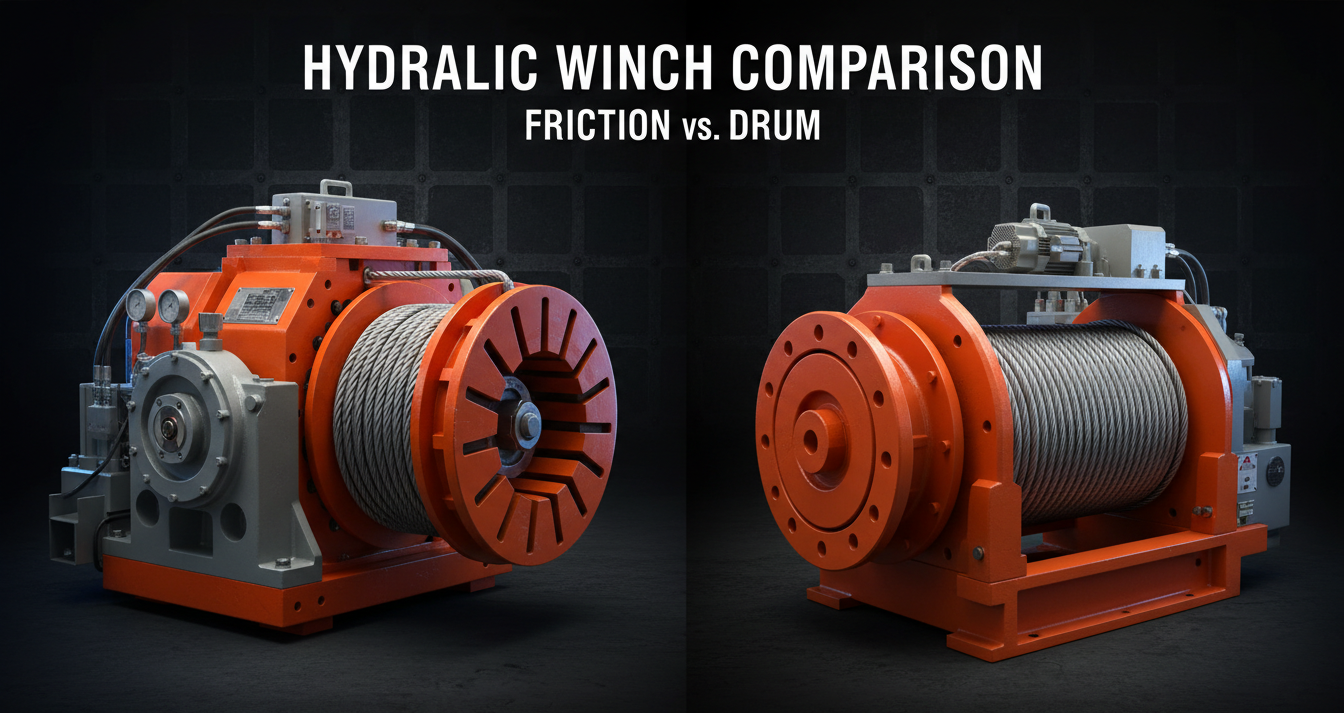
The Multi-Point Lifting Problem: Why Standard Winches Cannot Always Work in Sync
In multi-point lifting, the fundamental challenge is rarely the total load — it is load distribution. When four hydraulic winches lift a 200-tonne steel bridge section, each winch theoretically carries 50 tonnes. But in practice, I have seen load distribution vary from 35 to 75 tonnes across lift points within the same lift operation. Why? Hydraulic system pressure compensated differences,吊绳 lengths vary by 10-30cm due to manufacturing tolerances, and the load CG never sits perfectly centered over the lifting arrangement.
The consequences of load imbalance are not trivial. A 40% overload on a single lift point can fracture a synthetic sling, buckle a spreader beam, or cause a cascade failure across the entire rigging system. In one incident I investigated, a 180-tonne pedestal lift ended with a 72-tonne imbalance — one winch carried 108 tonnes while another held only 48 tonnes. The root cause: 0.8mm difference in hose length between two hydraulic circuits caused a 3-second timing offset during the initial take-up phase.
Standard winches have no mechanism to accommodate imbalance — they are designed for either fully locked or fully free operation. When you command a standard hydraulic winch to lift, it either pays out wire rope or holds tension. There is no intermediate state. This binary operation works fine for single-point lifts or perfectly synchronized four-point systems, but it assumes every component in the rigging train behaves identically. That assumption breaks down in real-world conditions.
How Hydraulic Friction Winches Work: The Controlled Slip Mechanism Explained
A friction winch is not a different type of winch — it is a standard winch with a calibrated friction clutch between the hydraulic motor and the drum. When the motor applies torque, the friction disc pack transmits that torque to the drum up to a pre-set slip threshold. Above that threshold, the discs slip relative to each other, allowing the drum to rotate at reduced torque while maintaining tension. Below the threshold, the winch behaves like a standard winch — locked and immovable.
The slip torque setting is adjusted by changing spring preload on the friction disc stack. More preload = higher slip torque = harder to slip. Less preload = lower slip torque = easier to slip. Typical factory settings calibrate slip torque to 110-125% of the winch's rated working load (WLL). For a 10-tonne WLL winch, slip is typically set at 11-12.5 tonnes. When the lifted load reaches this threshold, the friction discs begin to slip, holding the load at constant tension rather than allowing overload.
This is the key insight: the friction winch acts as a mechanical load limiter. In a four-point lift with four friction winches all set to slip at 12.5 tonnes, if one corner load tries to exceed 12.5 tonnes, that winch slips while the others continue lifting. The load redistributes to the three remaining points, bringing the overloaded point back within safe capacity. The lift continues smoothly without any electronic load monitoring or synchronization control. Visit Yining Hydraulic friction winch specifications for detailed selection.
Controlled Slip vs Full Lock: When Each Configuration Is the Right Choice
Controlled slip and full lock serve different lift scenarios — using the wrong configuration creates unnecessary risk.
| Scenario | Recommended Configuration | Reason |
|---|---|---|
| Single-point lift | Full lock (standard winch) | No load sharing needed, full control |
| Two-point symmetric lift | Full lock | Common center, easy synchronization |
| Four-point asymmetric lift | Controlled slip | Load CG offset inevitable |
| Lift with unknown/uneven CG | Controlled slip | Self-balancing load distribution |
| Multi-stage lift (twin | Full lock | Positive hold between stages |
| Lift through restricted opening | Controlled slip | Fine tension control required |
| Paired lift with equalizing beam | Full lock | Beam handles distribution |
| Paired lift without equalizing beam | Controlled slip | Winches self-compensate |
Rule of thumb: any lift where the load center of gravity is not guaranteed to be centered over all lift points requires controlled slip. This includes almost all multi-point lifts of irregular structures, equipment assemblies, and engineered components where the CG falls outside the geometric centroid of the lift points.
Full lock configurations remain correct for single-point lifts, perfectly symmetric two-point lifts, and lifts using certified equalizing spreader beams. The beam distributes load equalization mechanically — the winches themselves do not need to perform that function. However, adding a friction winch to a beam-assisted lift provides backup protection if the beam fails, making it the conservative choice for critical lifts.
Load Balancing Calculations: How to Determine Correct Friction Setting Per Lift Point
The friction setting calculation follows a straightforward but critical logic chain.
Step 1: Calculate individual point capacity. Total load divided by number of lift points gives the baseline per-point load. With a 200-tonne load on four points, each point carries 50 tonnes baseline.
Step 2: Apply imbalance factor. For lifts with uncertain CG, apply an imbalance factor of 1.25 to 1.40. This accounts for CG offset, rigging asymmetry, and hydraulic timing differences. 50 tonnes × 1.40 = 70 tonnes maximum expected per point.
Step 3: Set slip torque above maximum expected, below rated working load. Slip torque must be above maximum expected per-point load (70 tonnes) but below the winch rated working load. For a 10-tonne WLL winch, rated capacity is 10 tonnes — but we cannot set slip above rated capacity. Use a winch with WLL at least 1.25× the maximum expected load. 70 × 1.25 = 87.5 tonnes. Select a winching system rated for at least 90 tonnes working load.
Simplified formula: Slip torque = (Total load / N points) × Imbalance factor × 1.10. The 1.10 multiplier ensures slip engages before any point reaches its working load limit.
Practical example: 320-tonne bridge section, six-point lift, CG offset approximately 0.5m from center. Baseline per point: 320 ÷ 6 = 53.3 tonnes. Apply 1.35 imbalance factor: 72 tonnes. Slip setting = 72 × 1.10 = 79.2 tonnes. Each of six friction winches should be set to slip at approximately 80 tonnes, using winches rated for minimum 100 tonnes WLL. See Yining Hydraulic IYJ series winches for capacity ratings.
Friction Disc Wear and Maintenance: The Interval Most Buyers Forget
Friction disc wear is the most overlooked maintenance item on friction winches — and the consequence of neglect is catastrophic. As friction discs wear, the slip torque capacity decreases. New discs at 3mm thickness slip at rated capacity. At 2mm disc thickness, slip torque drops approximately 15-20%. At 1mm, it drops 30-40%. A winch set to slip at 80 tonnes when new may slip at only 55 tonnes after 18 months of heavy use. The winch now provides less overload protection than intended.
The disc wear inspection interval is every 500 operating hours or 6 months, whichever comes first. This applies to any winch used in controlled slip mode. The inspection measures disc thickness at five points around the disc circumference using a micrometer. Acceptance criterion: minimum 2.0mm residual thickness for sintered bronze discs. If any measurement falls below 2.0mm, replace the entire disc set as a matched set — never replace individual discs.
In my 15 years, I have seen exactly one friction winch failure caused by wear neglect. A dredging company in Southeast Asia ran a friction winch for 22 months without disc inspection. The 15-tonne slip setting had degraded to approximately 9.5 tonnes. During a routine 12-tonne lift, the winch slipped well below the intended threshold, dumping the load onto three other winches. One experienced shock loading but held. The fourth winch drum brake was unable to arrest the sudden load transfer and the wire rope snapped. No injuries, but USD 180,000 in equipment damage. The post-incident inspection found disc thickness at 0.8mm. That company now budgets for quarterly disc inspections.
Friction Winch Selection Checklist: Match Specification to Your Lifting Scenario
Use this six-point checklist before specifying a friction winch for multi-point lifting:
- Total load and number of lift points. Calculate baseline per-point load = Total load ÷ N points. This is your starting number.
- Load CG uncertainty. Will the CG be centered or offset? For uncertain CG, apply 1.35× imbalance factor.
- Winch working load rating. Select winch WLL at least 1.25× (baseline × imbalance factor).
- Slip torque setting. Set slip at approximately 1.10× (baseline × imbalance factor). Factory calibration required.
- Disc material and thickness. Specify sintered bronze for durability, minimum 3mm new thickness.
- Inspection schedule. Plan 500-hour or 6-month intervals. Budget for disc replacement at approximately 2,000 hours.
Common specification errors: Specifying slip torque too close to WLL (no safety margin), selecting disc material for marine salt spray without adequate corrosion protection, and forgetting to recalibrate slip after disc replacement. All three have caused lift incidents in my experience.
Yining Hydraulic offers friction winches with factory-calibrated slip settings and optional digital slip torque readout for verification. The IYJ friction winch series covers capacities from 5 tonnes to 50 tonnes WLL, with matching disc sets available for replacement. Contact Yining Hydraulic for application-specific selection support and customized slip torque calibration.
Frequently Asked Questions
Q: What is the difference between a friction winch and a standard winch?
A friction winch has a calibrated friction disc clutch between the hydraulic motor and drum. When torque exceeds the slip threshold, the discs slip, holding constant tension. A standard winch is either fully locked or fully free — no intermediate state. This makes friction winches essential for multi-point lifts where load distribution cannot be guaranteed.
Q: How do I set the slip torque on a friction winch?
Slip torque is factory-set by adjusting spring preload on the friction disc stack. The setting equals approximately 110-125% of the per-point working load. For a four-point lift of 200 tonnes (50 tonnes per point), set slip at 55-62.5 tonnes per winch. Factory calibration is required — field adjustment is not recommended.
Q: Can friction winches be used for single-point lifts?
Yes, but it is usually unnecessary cost. For single-point lifts, a standard winch with full lock provides simpler control. Friction winches add value when load distribution cannot be guaranteed — in multi-point lifts with uncertain CG offset.
Q: How often should friction discs be inspected?
Every 500 operating hours or 6 months, whichever comes first. Minimum acceptable disc thickness is 2.0mm for sintered bronze. Replace disc sets as a matched set — never individual discs.
Q: What happens if the slip setting is too low?
If slip is set below the actual per-point load, the winch will slip continuously during the lift, preventing the load from being raised. The lift stalls. Increase slip torque setting to continue. This is a commissioning error, not a mechanical failure.
Q: What happens if the slip setting is too high?
If slip is set above the winch WLL, the winch will not slip at all — it becomes a standard winch. This defeats the purpose of the friction mechanism and can lead to overload. Slip must always be set below winch WLL.
Conclusion
Friction winches solve a fundamental problem in multi-point lifting: load distribution cannot be guaranteed through hydraulic synchronization alone. The controlled slip mechanism acts as a mechanical load limiter, automatically redistributing load when any single point approaches its capacity threshold. For lifts with uncertain CG — which is most real-world lifts — friction winches provide self-correcting load balance without complex electronic monitoring. The 15-25% cost premium pays for itself in eliminated synchronization equipment, reduced rigging time, and inherent overload protection. Specifying friction winches for four-point and six-point lifts is now standard practice for responsible lifting coordinators. Remember: the slip setting must be factory-calibrated to 110-125% of per-point working load, inspected every 500 hours, and reset after every disc replacement.
External References and Standards
- ISO 8681: General Purpose Wire Rope Winches — Safety Requirements for Fixed Lifting Devices
- ISO 19901: Petroleum and Natural Gas Industries — Specific Requirements for Offshore Structures
- OSHA 1926.251: Rigging Equipment — Safe Practice for Wiring for Rigging
- DNV-RP-E301: Recommended Practice for Design and Installation of Offshore Lifting Operations
- API 2C: Specification for Offshore Pedestal Cranes
- ISO 12480: Mobile Cranes — Safe Use — Part 1: General Requirements
- EN 13155: Cranes — Safety — Loose Equipment
- ASME B30 Series: Cranes and Rigging Standards
- NIOSH: Preventing Injuries from Slings, Chains, and Hooks
For detailed specifications on controlled-slip lifting solutions, visit Yining Hydraulic friction winch series and standard hydraulic winch product range. For multi-point lifting system design support, contact Yining Hydraulic application engineers with your project requirements including number of lift points, load per point, and lifting height.
Post time: May-19-2026