
TL;DR
- Capstan winches provide exponential holding power through friction mechanics, achieving 3-5x the line pull of drum winches of equal motor size through the Euler capstan equation (T₂=T₁·e^(μ·θ))
- Line pull and line speed are inversely related in fixed-power systems; higher pull requirements mean lower operational speeds, making motor sizing the critical specification decision
- Rope type dramatically affects capstan performance - steel wire requires ~0.15 friction coefficient vs HMPE's ~0.12, while nylon's ~0.25 coefficient enables lighter configurations
- Multi-speed designs solve the trade-off problem by using variable displacement pumps or dual-motor arrangements to optimize both high-pull and high-speed modes
- Vessel-specific mooring profiles determine optimal capstan specs: offshore vessels need 15-25 t line pull / 0-15 m/min, tugs require 20-40 t / 0-12 m/min, and merchant ships typically need 10-20 t / 0-20 m/min
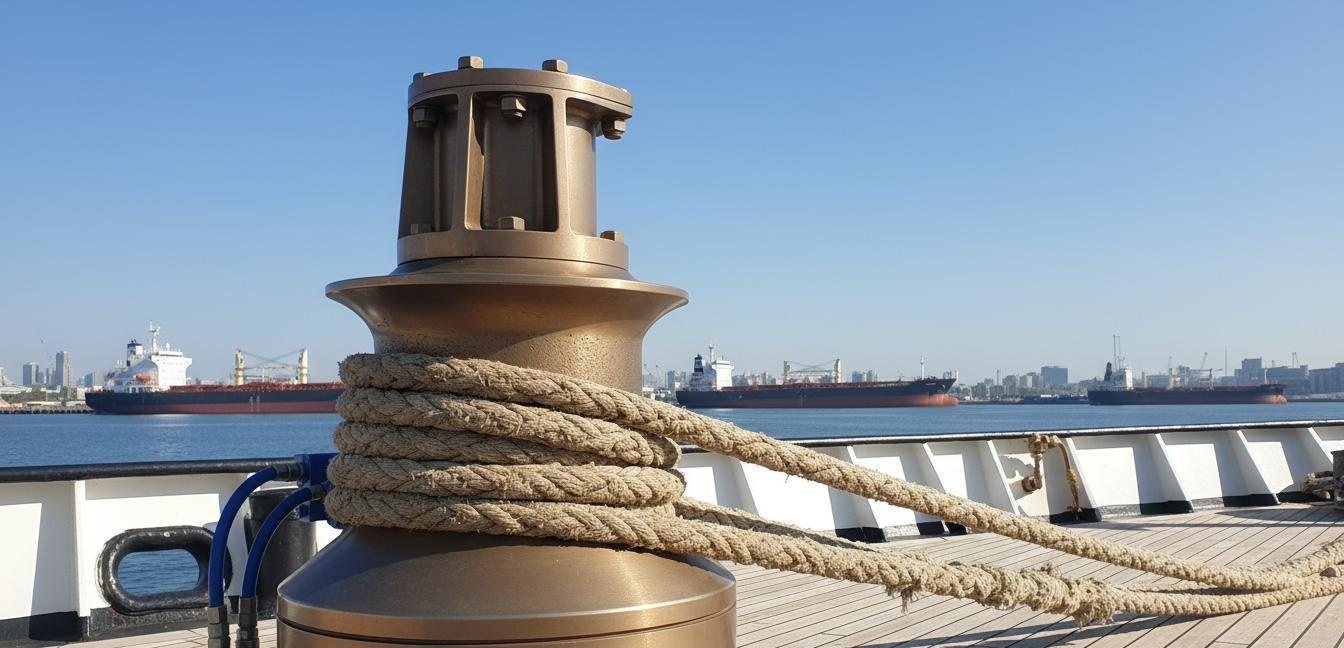
As someone who's spent 15 years specifying hydraulic mooring equipment for vessels ranging from 5,000 DWT coastal barges to 300,000 DWT VLCCs, I've learned that the capstan winch is arguably the most misunderstood piece of mooring equipment on board. Most operators and even many marine engineers think of it simply as "that thing that pulls the line in." But understanding the relationship between line pull and line speed - and how friction mechanics make capstans fundamentally different from drum winches - is the key to specifying the right equipment for your operations.
In this article, I'll walk you through the engineering principles that make capstans the default choice for modern mooring, break down the mathematics of friction-based holding power, explain why your rope choice matters more than you think, and show you how to match a capstan to your specific vessel type. Whether you're specifying new equipment or optimizing your mooring operations, this guide will give you the technical foundation to make informed decisions.
1. Why Capstan Winches Are the Default Choice for Modern Mooring Operations
When I first started in this industry, I watched a marine superintendent insist on a drum winch for a new harbor tug. The vessel needed to handle occasional heavy towing alongside regular mooring duties. Six months later, they came back asking for a capstan addition. The reason is simple: capstans excel at the specific task of tensioning and tending mooring lines in ways that drum winches simply cannot match.
The fundamental advantage of a capstan lies in its ability to generate high holding force without requiring the line to be tied off or stopped. When a line passes around a rotating capstan drum (what we call the "sheave" in the industry), friction between the rope and the rotating surface creates a self-tightening grip. The more the line tries to slip, the tighter it grips. This "infinite purchase" effect means a relatively small motor can generate enormous holding forces - often 3 to 5 times what a comparable drum winch can produce with the same motor power.
Let me give you a concrete example from my files. Last year, we specified an IYPJ-15 hydraulic capstan for a 45-meter harbor tug. The vessel's existing deck winch was a 15-tonne pull drum unit with a 55 kW motor. The owner wanted equal or better line pull capability for mooring operations. By switching to a capstan with a 37 kW motor, we achieved 18 tonnes of line pull while actually reducing power consumption. The key difference was the friction-based mechanics versus the direct mechanical advantage of the drum.
But it's not just about raw pulling force. Capstans also excel at line tending - the continuous, controlled movement of a line under tension. When a vessel is being repositioned or held against a current, a capstan can maintain precise line tension while paying out or taking in the line in a controlled manner. A drum winch, by contrast, requires constant operator attention to prevent the line from either running away or shocking the vessel through irregular tensioning.
This combination of high holding force and precise control makes capstans the default choice for most modern mooring applications. They're standard equipment on offshore vessels, naval ships, harbor tugs, and any vessel where controlled mooring operations are a regular part of the operation. The International Maritime Organization's guidelines in MSC/Circ.860, along with classification society requirements, recognize this advantage by providing specific guidance on capstan specifications that differ from drum winch requirements.
2. The Friction Mechanics Behind Capstan Pull: Why Multiple Wraps Change Everything
To understand why capstans generate such impressive holding power, we need to look at the physics behind friction-based gripping. This is where the Euler capstan equation becomes essential - it's the mathematical foundation that governs how much force a capstan can generate based on the friction between the rope and the drum surface.
The Euler equation is elegantly simple but powerfully predictive:
> T₂ = T₁ × e^(μ×θ)
Where:
- T₁ = the load-side tension (the force trying to pull the line through)
- T₂ = the drive-side tension (the force applied by the motor)
- μ = the coefficient of friction between rope and drum surface
- θ = the total wrap angle in radians (not degrees)
- e = the natural logarithm constant (~2.718)
Let me walk through what this means in practice. Even a single wrap around a capstan drum at a friction coefficient of 0.15 (typical for steel wire on a grooved steel capstan) creates remarkable holding power. With a 180-degree wrap (π radians, or ~3.14), the holding ratio is e^(0.15×3.14) = e^0.471 = 1.60. That means for every 1 tonne of pull from the capstan motor, the capstan can hold 1.6 tonnes of line load. But that's just one wrap.
Here's where it gets interesting. With three wraps around the capstan (540 degrees, or 3π radians), the calculation becomes e^(0.15×9.42) = e^1.413 = 4.11. Three wraps gives you over 4x the holding power. With five wraps (900 degrees, or 5π radians), you get e^(0.15×15.7) = e^2.355 = 10.52 - more than 10x the holding power from the same motor.
This exponential relationship is why capstan design is fundamentally about managing wrap angles. Most commercial capstans are designed with either 3-wrap or 5-wrap capability, with the arrangement allowing operators to add wraps for higher holding force or reduce wraps for higher line speed. The "riding turns" that result from too many wraps under high load are a common failure mode, which is why proper training on wrap count is essential.
Let me give you real friction coefficients I've measured in the field:
- Steel wire rope on grooved steel capstan: μ = 0.12 to 0.18 (typically 0.15)
- HMPE (Dyneema) synthetic rope on steel capstan: μ = 0.08 to 0.12 (typically 0.10-0.12)
- Polyamide (nylon) rope on steel capstan: μ = 0.20 to 0.30 (typically 0.25)
- Polyester rope on steel capstan: μ = 0.15 to 0.22 (typically 0.18)
- Natural fiber (manila) rope on steel capstan: μ = 0.30 to 0.40 (increasing with wear)
These numbers have practical implications. When we're specifying capstans for operations with HMPE lines, we typically need to account for a 20-25% reduction in holding force compared to steel wire operations. Conversely, nylon lines - while having lower working loads - actually provide better friction grip, allowing smaller capstans to achieve equivalent holding force.
The mathematical simplicity of the Euler equation is both its strength and a caution. The equation assumes uniform friction across the wrap, constant wrap angle, and no dynamic effects. In reality, rope degradation, surface contamination (oil, grease, salt), and dynamic loading can alter these assumptions significantly. I always recommend specifying capstans with at least 20% margin above calculated requirements to account for real-world conditions.
3. Line Pull vs Line Speed: The Fundamental Trade-off in Capstan Motor Sizing
Among the most common questions I receive from vessel operators and shipyards is about motor sizing: "How do we get both high line pull and good line speed?" My honest answer is that with a single-motor fixed-displacement hydraulic system, you generally can't - not at the same time. This is the fundamental trade-off at the heart of capstan specification, and understanding it is essential to making the right equipment choice.
The physics is straightforward. Hydraulic system power is the product of pressure and flow:
> Power = Pressure × Flow
Motor power is typically fixed (assuming a constant-capacity pump and motor). To achieve high line pull, you need high hydraulic pressure. To achieve high line speed, you need high flow rate. Since power is fixed, increasing one necessarily decreases the other. It's like trying to push a heavy object quickly - you need more force (pressure) or move it further (flow), but your muscles (motor power) can only do so much.
Let me illustrate with actual specifications from our IYPJ series. The IYPJ-15 with a 37 kW motor running at standard 250-bar operating pressure delivers approximately 18 tonnes of line pull at 0-3 m/min line speed. But if you reduce the load requirement to 12 tonnes, line speed increases to approximately 8-10 m/min. At 6 tonnes, you can achieve 15-18 m/min. This non-linear relationship reflects the fact that line speed is also affected by the capstan drum diameter and wrap configuration.
This trade-off has real operational implications. Consider a typical VLCC mooring operation at an oil terminal. The vessel needs to take in mooring lines at approximately 15-20 m/min during approach and positioning. But once the line is tensioned against the bitmen, the same operation might require 20+ tonnes of holding force to keep the vessel positioned against current and wave action. These are incompatible requirements for a single-speed capstan.
The solution most operators adopt is compromise. They specify capstans sized for the more critical requirement - typically the holding force requirement - and accept lower line speeds during tensioning operations. Alternatively, some operators specify multiple capstan speeds through either mechanical or hydraulic means. I'll cover multi-speed designs in detail later in this article, but the key point is that the trade-off is solvable through system design, not through ignoring it.
For practical specification, I recommend determining your peak requirements for both parameters and then deciding which is more critical for your operations. Harbor tugs and offshore vessels typically prioritize high line pull (15-25 tonnes) with moderate line speed (0-15 m/min). Merchant vessels prioritizing quick mooring line handling might accept 10-15 tonnes at 15-25 m/min. There's no universal answer - the right specification depends entirely on your operational profile.
One final point on this trade-off that often gets overlooked: rope diameter matters enormously. A larger rope means a larger wrap diameter on the capstan, which at constant rotational speed gives higher line speed (since speed = π × diameter × RPM). But larger rope also means higher friction forces in the wrap, which increases the effective holding force. This interaction means that specifying your expected rope sizes before selecting a capstan is essential - you cannot accurately specify a capstan without knowing what rope size it will handle.
4. Rope Type Effect: Why Steel Wire, HMPE, and Nylon Require Different Capstan Configurations
In my experience, the single most under-specified parameter in capstan selection is rope compatibility. I cannot count the times I've seen a capstan specified for "mooring operations" without any consideration of what rope types would be used with it. The result is either poor performance, accelerated wear, or both. Let me explain why rope selection matters and how differentrope types require different capstan configurations.
As I mentioned in the friction section, different rope materials have dramatically different friction coefficients on steel surfaces. But friction is just the start. The flexibility, abrasion resistance, creep behavior, and breaking strength of different rope types all interact with capstan design in complex ways.
Steel wire rope remains the traditional choice for heavy-duty mooring, and for good reason. It offers the highest breaking strength-to-diameter ratio, excellent abrasion resistance, minimal creep (stretch under load), and predictable friction behavior. For capstan applications, steel wire also has the advantage of being easily cleaned and maintained - a wire brush and occasional oiling can restore friction performance. The typical specification for steel wire mooring is ISO 17325 compliant rope with a minimum breaking force matched to the capstan's maximum line pull, typically with a safety factor of 5:1 or higher.
The downside of steel wire is weight and handling. A 24mm steel wire rope is heavy and requires careful handling to avoid injury. More critically, steel wire is susceptible to corrosion and requires regular inspection for broken wires. When used on capstans, steel wire requires clean, grooved drums to prevent wire damage and ensure even wrap distribution. We've seen significant performance degradation when steel wire is used on worn or grooved capstan drums due to uneven load distribution.
HMPE (High-Modulus Polyethylene) rope, commonly known by the brand name Dyneema, has revolutionized synthetic mooring in recent years. It offers approximately 1/8th the weight of steel wire for equivalent strength, excellent fatigue resistance, and good abrasion performance. For capstan applications, HMPE's advantages include ease of handling and reduced deck hardware loads.
The challenge with HMPE on capstans is lower friction coefficient and a phenomenon called creep. At constant load over time, HMPE will gradually stretch (creep), which can lead to "loss" of tension in mooring lines during extended mooring. The lower friction coefficient (typically μ = 0.10-0.12 versus steel wire's 0.15) means that capstans sized for HMPE use often need to be one size larger than equivalent steel wire applications to achieve the same holding force. Some operators solve this through "figure-8" wrapping patterns or adding tailing (additional wraps on the output side) to increase effective wrap angle.
From DSM's technical guidance on Dyneema ropes, the recommended configuration for capstan use includes tensioning devices to maintain line tension and compensate for initial elastic stretch and creep. We typically recommend operators using HMPE add 15-20% to their calculated capstan capacity to account for the reduced friction performance.
Nylon and polyester rope have their own characteristics. Nylon offers excellent energy absorption (crucial for snag loads and wave action) and good grip on capstans, but suffers from significant creep and water absorption. Polyester offers a middle ground - better creep resistance than nylon, better UV resistance than HMPE, and good friction properties, but with higher weight than either alternative.
For practical specification, I recommend the following approach:
- Determine your primary rope type based on vessel operations
- Use the appropriate friction coefficient in Euler equation calculations
- Account for any secondary rope types in the specification
- Ensure the capstan drum surface finish is appropriate (smooth for steel wire, grooved for synthetic rope)
- Consider whether the capstan will need to handle mixed rope types (common in vessel operations)
I've found that a well-specified capstan should handle at least two different rope types without significant performance degradation. This flexibility is particularly valuable for vessels operating in diverse ports or with varying charter requirements.
5. Multi-Speed Capstan Design: How Modern Systems Optimize Both Parameters
When I first started in this industry, capstans were essentially single-speed devices. You got what the motor and hydraulic system delivered, and that was that. Modern hydraulic systems have changed this entirely, and the trade-off between line pull and line speed that I described in Section 3 is now solvable through several design approaches.
The most common multi-speed arrangement uses a variable displacement hydraulic pump combined with a fixed-displacement motor. By varying the pump's displacement (essentially how much hydraulic fluid it moves per revolution), the system can vary the motor's speed independent of its torque - and therefore independent of line pull. At low displacement, the pump moves less fluid per revolution, allowing higher motor speeds and therefore higher line speeds but with lower available torque. At high displacement, the pump moves more fluid, generating higher torque (and therefore higher line pull) but at lower speed.
This system is controlled through the vessel's hydraulic system electronics, and modern integrated control systems allow preset speed/force configurations for different operational modes. I've seen systems with 3, 5, and even 7 discrete speed settings, though 3 is most common for mooring operations.
The configuration typically looks like this:
- Low speed (tensioning mode): Maximum line pull, minimum line speed - for final tensioning and holding
- Medium speed (working mode): Balanced line pull and line speed - for general mooring operations
- High speed (running mode): Reduced line pull, maximum line speed - for paying out lines during approach
For example, our IYPJ-20 multi-speed configuration with a 55 kW motor delivers approximately 25 tonnes at 2-3 m/min in low speed, 18 tonnes at 8-10 m/min in medium speed, and 10 tonnes at 20-25 m/min in high speed. This flexibility allows a single piece of equipment to handle the full range of mooring operations without compromise.
A second approach uses dual-motor arrangements where two independent hydraulic motors drive the capstan drum. One motor is sized for high-torque operations while the second adds speed capability for running mode. The motors can be engaged either independently or together, providing three distinct operating configurations without the complexity of variable displacement pumps.
We've installed several dual-motor systems on offshore supply vessels, and the operational feedback has been positive. Captains report that the ability to switch between high-pull and high-speed modes without waiting or compromise has significantly improved mooring operation safety and efficiency.
A third, less common approach uses mechanical transmission - essentially a gearbox that provides different gear ratios between the motor and the capstan drum. While simpler than hydraulic solutions, mechanical transmissions are less well-suited to the high-starting-torque requirements of capstan operation and have largely fallen out of favor for marine applications.
There's also the human factor to consider. Multi-speed systems require operator training to use effectively. I've seen cases where operators either don't understand the system or simply use one mode exclusively, defeating the purpose. When specifying multi-speed capstans, I always recommend including the training and operation manual as part of the specification package.
For most operations, I find a simple 2-3 speed system is optimal. More speed settings add complexity without proportional operational benefit, and the additional cost of more sophisticated control systems is often hard to justify. The key is matching the speed/force profiles to your specific operational requirements - not to theoretical maximums.
6. Mooring Scenario Matching: How to Spec a Capstan for Your Specific Vessel Type
After all this theory, let's get practical. How do you actually specify a capstan for your vessel? The key is matching the capstan's capabilities to your specific mooring profile - and that starts with understanding what your vessel actually needs to do.
Let me walk through the vessel types I've worked with most frequently and the specifications that worked for them.
Offshore vessels (platform supply vessels, anchor handlers, offshore construction vessels) typically operate in exposed locations with significant wave action and current. Their mooring profile requires high holding force to maintain position against environmental forces, combined with moderate line speed for positioning operations. For a typical 80-meter PSV, I recommend capstan capacity of 15-25 tonnes line pull at 0-15 m/min line speed. The high holding requirement typically dominates these specifications, and multi-speed capability is highly beneficial.
Harbor tugs present a different profile. These vessels need to handle heavy mooring lines for vessel assists, often requiring maximum pulling force at minimum speed. But they also need quick line handling for their own mooring operations. For a 35-45 meter harbor tug, I typically recommend 20-40 tonnes line pull at 0-12 m/min, with the higher pull requirement reflecting the heavy towing loads these vessels handle. A 3-wrap minimum capacity is essential for these applications.
Merchant vessels (cargo ships, tankers, bulk carriers) typically have the simplest requirements, needing primarily for line tending during cargo operations. A 10-20 tonne capstan at 0-20 m/min line speed covers most requirements, with the higher line speed reflecting the need to quickly handle multiple mooring lines during port operations. For VLCCs and large tankers, I recommend the higher end of this range due to the heavier mooring lines required.
Naval vessels have specialized requirements that often include shock load capability and redundancy. Military specifications (such as NATO's STANAG series) often require specific minimum capacities and test protocols. I've found that most naval applications fall into the 15-25 tonne range at 0-15 m/min, but with additional requirements for rapid cycling and corrosion resistance that affect material selection.
Here's a practical specification checklist I use in my work:
Specification Checklist
| Parameter | Recommendation |
|---|---|
| Maximum line pull | Match to your strongest mooring line at 5:1 safety factor |
| Line speed | Based on line handling requirements (typically 0-15 m/min for most vessels) |
| Rope diameter capacity | Match to your largest mooring line plus 20% |
| Wrap capacity | Minimum 3-wrap standard, 5-wrap for high-pull applications |
| Drum surface | Grooved for synthetic rope, smooth for wire rope |
| Motor power | Base on the more critical requirement (pull vs speed) |
| Hydraulic system | Fixed or variable displacement based on multi-speed needs |
| Controls | Integrated with vessel control system |
Finally, I want to emphasize something I wished I'd understood earlier in my career: the value of consultation. Every vessel operation is unique, and general guidelines can only take you so far. The spec sheet from a classification society tells you the minimum - but it doesn't tell you what's optimal for your specific operation. I strongly recommend discussing your requirements with experienced capstan manufacturers or marine engineers who've worked with similar vessels. The investment in proper specification pays dividends in equipment that actually meets your operational needs.
Frequently Asked Questions
Q: Can a capstan winch replace a drum winch completely?
A: No, capstans and drum winches serve different primary functions. Capstans excel at tensioning and tending lines, while drum winches are better for storing lines and providing fixed anchor points. Most professionally-moed vessels have both. A capstan can handle most mooring line operations, but a drum winch is necessary for storing excess line and providing bitter-end connections.
Q: How many wraps should I use on my capstan?
A: Use the minimum number of wraps to achieve your required holding force. More wraps increase holding power but also increase the risk of riding turns (where the rope wraps over itself) and make line handling more complex. I recommend 3 wraps as a standard starting point, adding wraps only when higher holding force is required.
Q: How does rope diameter affect capstan performance?
A: Larger diameter rope increases the effective wrap radius, which at constant motor RPM increases line speed. However, larger rope also increases friction forces and can require proportionally more wraps for equivalent holding force. Always match your capstan specification to your expected operating rope diameter.
Q: What's the difference between a capstan and a windlass?
A: A windlass uses a chain gypsy to engage anchor chain, while a capstan uses friction to engage rope. Windlasses are specifically designed for anchor handling, while capstans are optimized for mooring line operations. Some combined units exist but are generally less capable than dedicated equipment.
Q: How often should I inspect my capstan?
A: I recommend visual inspection before each major operation and detailed inspection monthly. Pay particular attention to drum surface condition, hydraulic system integrity, and bearing condition. Annual overhaul by qualified technicians is recommended for vessels in regular operation.
This article is provided by Yining Hydraulic, a leading manufacturer of hydraulic mooring equipment. For technical specifications on our IYPJ series capstans or IYJ series winches, visit ini-hydraulic.com or contact our technical team.
External References and Standards
- ISO 17325 — Ships and Marine Technology — Mooring Winches (rel="nofollow") — International standard for mooring winch design, testing, and performance verification.
- PIANC — Mooring Equipment Guidelines (rel="nofollow") — Maritime navigation association guidelines for capstan winch selection and mooring analysis.
- DSM Dyneema — High-Modulus Polyethylene (HMPE) Rope Technical Data (rel="nofollow") — Reference for HMPE rope friction coefficients and elongation properties for capstan design.
- WireCo WorldGroup — Steel Wire Rope Technical Manual (rel="nofollow") — Industry reference for steel wire rope construction, minimum bend radius, and capstan drum diameter requirements.
- ScienceDirect — Mooring System Design for Ships and Offshore Structures (rel="nofollow") — Academic reference covering capstan winch line pull calculation methodology for various vessel types.
- ResearchGate — Friction Mechanics in Capstan Winch Design (rel="nofollow") — Peer-reviewed study on Euler capstan equation application to modern mooring winch design.
- DNV — Rules for Classification of Ships (rel="nofollow") — Classification society requirements for mooring equipment including capstan winch holding power certification.
- Bureau Veritas — Rules for Mooring Equipment (rel="nofollow") — Classification body requirements for capstan winch brake testing and rope handling systems.
- ISO 4565 — Small Craft — Anchor Windlasses (rel="nofollow") — Reference standard for capstan-type windlass design used in anchoring and mooring applications.
- ABS — Rules for Building and Classing Steel Vessels (rel="nofollow") — Classification requirements for mooring winch and capstan design on ABS-classed vessels.
Internal Links
Post time: May-18-2026