
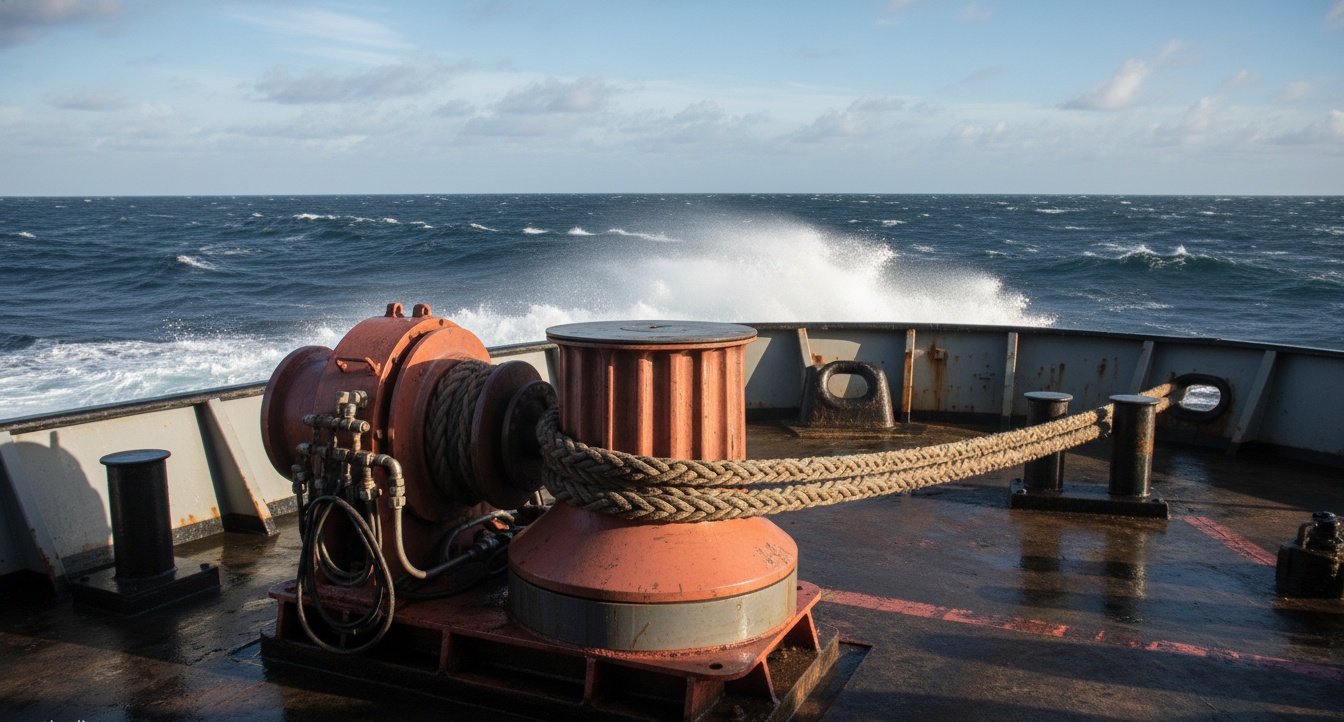
When selecting a hydraulic capstan winch for marine towing operations, engineers and procurement managers face a critical decision: matching the winch's drum traction capacity to the rope diameter being used. A mismatch at this stage — whether in line pull rating, drum grip geometry, or brake system design — can compromise both operational safety and equipment longevity.
This article examines the technical specifications governing hydraulic capstan winch selection for marine towing, with particular focus on drum traction parameters across the 50mm to 80mm rope diameter range. It also introduces how INI Hydraulic's IYJ series ordinary hydraulic winches and IYJ-N Series integrated hydraulic winches address these requirements in real-world marine environments.
Understanding Drum Traction in Capstan Winches
Drum traction is the mechanism by which a capstan winch grips a rope or cable through surface friction. Unlike a standard drum winch that wraps rope around a cylindrical barrel, a capstan winch uses a grooved or smooth cylindrical drum where the rope makes multiple wraps — typically 3 to 5 turns — to generate sufficient traction through friction alone. The line is then pulled through by the rotating drum without the rope sliding relative to the drum surface.
The traction capacity of a capstan winch depends on three primary factors:
- The Euler-Eytelwein formula: T₂ = T₁ × e^(μα), where T₂ is the load end tension, T₁ is the incoming tension, μ is the coefficient of friction between rope and drum surface, and α is the total wrap angle in radians. For marine applications with steel wire rope on a grooved cast iron drum, μ typically ranges from 0.18 to 0.25.
- Drum diameter relative to rope diameter: The drum-to-rope diameter ratio affects bending stress on the rope and surface contact pressure. Industry practice generally recommends a drum diameter of at least 20× the rope diameter for steel wire rope to minimize fatigue cycling stress.
- Brake holding capacity: The integrated brake system must hold the maximum calculated load end tension T₂ without slippage during static holds.
Rope Diameter Range: 50mm to 80mm Specifications
Heavy marine towing operations commonly employ steel wire ropes in the 50mm to 80mm diameter range. This reflects the tension loads involved — a 50mm diameter steel wire rope with a 6×36 construction and fiber core typically has a minimum breaking load (MBL) of approximately 1,200–1,600 kN, while an 80mm rope of similar construction may reach 2,800–3,500 kN. Matching the capstan winch to these ropes requires careful attention to several parameters.
Drum Diameter Selection
For ropes in the 50–80mm diameter range, recommended drum diameters typically fall between 500mm and 1,000mm. This range accommodates the bending radius requirements of heavy steel wire rope while maintaining sufficient surface area for multi-wrap traction.
INI Hydraulic's IYJ series ordinary hydraulic winches offer drum configurations suitable for rope diameters from 20mm up to 80mm, with custom grooving available to optimize grip for specific rope constructions. The IYJ-N Series integrated hydraulic winch builds on this foundation by combining the hydraulic motor, planetary reducer, and brake valve into a single compact housing — reducing external piping and minimizing potential leak points in salt-water marine environments.
Line Pull and Speed Requirements
Marine towing capstan winches operating in the 50–80mm rope range typically require:
- Line pull (first layer): 50–200 kN for standard towing; up to 500 kN+ for heavy lift or offshore support operations
- Line speed: 5–30 m/min at first layer, with speed decreasing as rope builds up on the drum
- Hydraulic working pressure: 16–25 MPa (approximately 2,300–3,600 psi) for most marine hydraulic systems
The relationship between line pull and line speed is inversely proportional at constant motor power — a winch producing 200 kN at first layer will typically offer lower line speeds than one rated for 80 kN, assuming the same motor displacement and hydraulic flow.
Drum Traction Calculation Example
Consider a marine towing operation using 60mm diameter steel wire rope (6×36 WS FC, MBL ≈ 1,800 kN). The capstan winch must hold a static load of 450 kN at the haul end. Using the Euler-Eytelwein formula:
T₂ = T₁ × e^(μα)
With μ = 0.22 (steel rope on cast iron grooved drum) and α = 3π radians (approximately 540° total wrap, or 1.5 turns per side = 3 turns total for a typical dual-wrap configuration):
e^(0.22 × 3π) = e^(2.073) ≈ 7.94
This means the winch can theoretically hold a load 7.94× the incoming tension per wrap set. For the incoming line tension T₁ = 450 kN, the theoretical haul capacity T₂ = 450 × 7.94 ≈ 3,573 kN — well above the rope's MBL, confirming safe operation with adequate margin.
In practice, manufacturers apply a safety factor of 3–5× against the rope's MBL for the winch's rated line pull. INI Hydraulic's IYJ series capstan winches are rated with appropriate safety margins consistent with international maritime standards, including Lloyd's Register and DNV-GL guidelines for deck machinery.
Hydraulic System Considerations for Marine Environments
Marine environments impose unique demands on hydraulic winch systems. Salt spray, high humidity, and the constant motion of a vessel at sea require careful system design.
Hydraulic Motor Selection
Axial piston hydraulic motors are the industry standard for marine capstan winches in the 50–80mm rope capacity range. They offer:
- High power density enabling compact installation on deck
- Wide operating speed range from near-zero to maximum rpm
- Compatibility with standard marine hydraulic oils (ISO VG 32–46)
- Integrated cross-port relief valves for overrunning load protection
INI Hydraulic's IYJ-N Series integrates the hydraulic motor directly with the winch housing, eliminating external hoses and reducing the number of potential leak points — a critical consideration in marine environments where hydraulic fluid leaks into seawater create both environmental and operational hazards.
Brake Systems
Marine capstan winches require fail-safe braking: a spring-applied, hydraulically released multi-disk brake that engages automatically when hydraulic pressure is lost. This is non-negotiable under SOLAS (International Convention for the Safety of Life at Sea) requirements for deck machinery.
Brake holding torque must be rated at a minimum of 1.5× the maximum line pull at the drum. For a winch rated at 200 kN line pull, the brake must hold at least 300 kN equivalent torque at the drum — typically expressed in N·m for the brake caliper specification.
Maintenance and Rope Compatibility
The choice of rope construction significantly affects capstan winch performance and maintenance intervals. For marine towing in the 50–80mm range:
- 6×36 WS (Warrington-Seale) fiber core (FC): Most common for general towing. Good flexibility, moderate fatigue resistance.
- 6×36 WS steel core (WC): Higher breaking load and better fatigue resistance for winch applications. Preferred for multi-wrap capstan use where rope bends around the drum.
- 35×7 rotation-resistant: Used where torque balance is critical during pull operations.
Drum grooving must be matched to the rope's nominal diameter. An incorrectly sized groove — too tight or too loose — accelerates rope wear and reduces traction. INI Hydraulic offers custom drum grooving services to match specific rope constructions and operating conditions.
Application Scenarios for 50–80mm Rope Capstan Winches
Marine towing operations using ropes in the 50–80mm diameter range typically include:
- Offshore supply vessel (OSV) deck handling: Towing and positioning subsea equipment, mooring during cargo transfer
- Coastal tug operations: Ship-assist towing, barge handling, dead-tow recovery
- Offshore wind installation support: Handling cable and mooring line deployment
- Fishing vessel operations: Net hauling, purse seine operations using heavy rope
For any of these applications, selecting a winch with verified drum traction capacity — not just a line pull rating — is essential to ensuring safe and efficient operations.
Selecting the Right INI Hydraulic Winch for Marine Towing
INI Hydraulic offers two product families well-suited to marine capstan winch applications in the 50–80mm rope range:
The IYJ series ordinary hydraulic winch provides a modular solution with separate hydraulic motor, reducer, and brake components. This architecture allows for easier field maintenance and component replacement — critical for vessels operating in remote locations with limited access to specialized technicians.
The IYJ-N Series integrated hydraulic winch consolidates all drive components into a single compact housing, reducing footprint and simplifying hydraulic circuit design. The integrated design minimizes external piping and fittings, which is particularly valuable on open deck installations where corrosion resistance is a concern.
The IYJ-L series hydraulic winch with free fall function extends the range to applications requiring emergency tension release capability, making it suitable for deeper water operations where dynamic load management becomes more challenging.
INI Hydraulic's winch product range is further detailed on the main winch product catalogue, which covers the full suite of marine and industrial winch solutions.
For procurement teams evaluating either series, key specification parameters to request include: maximum line pull at first layer (kN), rope diameter range (mm), drum diameter and groove configuration, brake holding torque (N·m), hydraulic working pressure (MPa), and maximum hydraulic flow rate (L/min).
Marine Classification Society Requirements
Hydraulic deck machinery on commercial vessels subject to international trade must meet the requirements of major maritime classification societies. For capstan winches used in marine towing, the three most commonly referenced classification societies are Lloyd's Register (LR), DNV (Det Norske Veritas), and ABS (American Bureau of Shipping).
Each society publishes rules covering the design, materials, manufacturing inspection, and testing of deck winches. Key requirements include:
- Materials certification: All steel castings and forged components must be supplied with material test certificates (MTC) per EN 10204 Type 3.1 or equivalent. This ensures traceability of material properties — particularly important for the winch drum, which carries the full operational load.
- Welding qualification: Structural welds on the winch frame and mounting base must be performed by qualified welders per EN ISO 15614 or AWS D1.1, with weld procedure specifications (WPS) and procedure qualification records (PQR) available for inspection.
- Non-destructive testing (NDT): Critical welds — particularly full-penetration welds on the winch chassis — require ultrasonic testing (UT) or magnetic particle inspection (MPI) as specified by the classification society's rules.
- Load testing: A commissioned winch must undergo a no-load test and a proof load test at 1.25× rated line pull before vessel delivery. For a 200 kN winch, this means a proof load of 250 kN held for 10 minutes with no observed movement in the brake or deformation in the structure.
INI Hydraulic's IYJ series and IYJ-N series winches are designed and documented to meet the major classification society requirements, and the company's engineering team can provide the documentation packages required for plan approval — including general arrangement drawings, load diagrams, hydraulic schematics, and material certifications — as part of the standard quotation package for marine projects.
Installation and Commissioning Checklist
Proper installation and commissioning of a hydraulic capstan winch for marine towing ensures that the equipment performs as specified from the first day of operation. The following checklist summarizes the key commissioning steps that vessel engineers and INI Hydraulic's technical support team typically follow during newbuild or refit commissioning:
- Verify winch mounting bolt torque matches the structural engineering specification for the vessel's hull or deck structure — under-torqued bolts lead to frame movement under load, which accelerates structural fatigue.
- Confirm hydraulic pipeline pressure testing has been completed at 1.5× the system working pressure before connecting the winch — contaminated or leaking hydraulic circuits are the leading cause of early commissioning failures.
- Perform a brake function test: with the winch under no-load, verify that the fail-safe brake engages within 0.3 seconds of hydraulic pressure loss. This is the single most critical safety test for any marine deck winch.
- Check drum groove alignment with the vessel's fairlead or rope guide sheaves. Misalignment causes rope to run against the groove flank rather than the groove bottom, dramatically accelerating groove wear and increasing rope degradation.
- Verify the hydraulic oil viscosity grade matches the ambient operating temperature range. For vessels operating in Arctic conditions, ISO VG 32 hydraulic oil at temperatures below -10°C requires oil heaters and low-temperature-rated seals.
- Confirm rope threading on the drum matches the manufacturer's recommended wrap direction — some winches require a specific lead direction to ensure correct drum groove engagement.
Cost Considerations and Procurement Strategy
Hydrogen tension calculations and classification requirements add engineering complexity to the procurement process, but they also provide a framework for meaningful cost comparison between different winch manufacturers. The total installed cost of a marine hydraulic capstan winch includes:
- Base winch price: Depends on line pull rating, drum configuration, and hydraulic motor package. For a 100–200 kN capstan winch with standard grooving for 50–70mm rope, base prices typically range from $15,000 to $45,000 depending on manufacturer and specification level.
- Optional accessories: Rope tensioner devices, drum rotation sensors, line pull display systems, and emergency stop systems each add to the delivered price but significantly improve operational safety and monitoring capability.
- Classification survey fees: Plan approval and survey fees from Lloyd's, DNV, or ABS typically add 2–5% of the winch base price for classification-flagged vessels.
- Installation and commissioning: Typically 10–15% of the equipment cost for a standard installation with adequate deck preparation. Complex installations with custom mounting structures can reach 20–25%.
- Spare parts package: A first-year spare parts package including brake pads, seals, and hydraulic filter elements typically runs 8–12% of the base winch price.
Procurement teams that request complete total-cost-of-ownership data — including expected maintenance intervals, spare parts costs, and hydraulic system efficiency data — from competing manufacturers are better positioned to make an economically rational equipment decision rather than selecting purely on initial price.
Conclusion
Selecting a hydraulic capstan winch for marine towing with 50mm to 80mm rope diameters requires matching not just the line pull rating, but the full suite of drum traction specifications — drum diameter, groove geometry, wrap angle, and brake capacity — to the operational demands of the vessel and the rope's mechanical properties.
The Euler-Eytelwein formula provides the theoretical foundation for traction calculations, but practical selection must also account for safety factors mandated by maritime classification societies, the specific hydraulic system architecture available on board, and the maintenance capabilities of the vessel's engineering crew.
INI Hydraulic's IYJ series and IYJ-N Series hydraulic winches offer configurable solutions for marine towing applications across this rope diameter range, with options for custom drum grooving, brake system sizing, and hydraulic motor selection to meet project-specific requirements.
Frequently Asked Questions
Q: What is the minimum recommended drum diameter for a 60mm steel wire rope on a capstan winch?
A: Industry practice recommends a minimum drum diameter of 20× the rope diameter for steel wire rope to minimize bending stress. For a 60mm rope, this means a minimum drum diameter of approximately 1,200mm. However, many compact marine capstan designs use smaller ratios (12–16×) with appropriate trade-offs in rope service life and maintenance intervals.
Q: How many wraps are needed for a hydraulic capstan winch to grip a 70mm rope?
A: Most marine capstan winches use 3–5 wraps (1.5 to 2.5 turns around the drum). The Euler-Eytelwein formula shows that each additional wrap multiplies traction capacity significantly — at μ=0.22, each full wrap adds approximately 2× traction factor. Practical designs balance wrap count against rope bending fatigue and operator convenience.
Q: Can the same winch handle both 50mm and 80mm rope diameters?
A: A single winch can typically accommodate a range of rope diameters (e.g., 40–70mm) with appropriate drum grooving. However, line pull capacity changes with rope diameter — a larger rope allows higher possible traction due to increased contact area, but the winch's rated line pull remains constant. Consult the manufacturer to confirm the rope diameter range and groove configuration for your specific application.
Q: What hydraulic pressure is required for marine capstan winches in this range?
A: Most marine hydraulic capstan winches operate at 16–25 MPa (2,300–3,600 psi) hydraulic pressure. The specific requirement depends on the motor displacement, desired line speed, and line pull requirements. Marine hydraulic systems typically use fixed-displacement piston motors with proportional directional control valves for precise speed regulation.
About the Author
Mr. Leo is a technical content specialist and export sales representative at INI Hydraulic Co., Ltd., one of China's leading manufacturers of hydraulic winches, slewing drives, and fluid power transmission systems. Through INI Hydraulic's YouTube channel and social media platforms, he produces hands-on technical content — including hydraulic system animations, winch load testing footage, and OEM procurement walkthroughs — that helps international buyers understand INI's product engineering before placing orders.
With a background in hydraulic transmission engineering and four years supporting offshore, marine, and construction machinery buyers across Southeast Asia, the Middle East, and Europe, Leo translates complex hydraulic spec sheets into practical procurement guidance for OEM engineers, shipyard procurement managers, and industrial equipment distributors.
YouTube:https://www.youtube.com/channel/UCuyzdGdBZ6Tv-Nc9WzvYXIg
Pinterest:https://www.pinterest.com/inihydraulic/
Post time: May-29-2026