
- The IYM hydraulic anchor winch series from INI Hydraulic covers working loads from 10.9 kN (IYM2.5) to over 100 kN (IYM6), matching fishing boats from 15 to 200 tonnes displacement.
- Anchor weight sizing follows a displacement-based formula (W = D x K) published by classification societies like DNV and RINA, not guesswork from harbor folklore.
- Single drum, double drum, and drum-plus-fishing-head configurations each serve different operational profiles on fishing vessels.
- Marine corrosion protection must address our hydraulic motor, planetary gearbox, band brake, and frame as a system, not as isolated components.
- Hydraulic oil flow (L/min) and rated pressure (MPa) determine line speed; matching the HPU to the winch prevents slow retrieval and motor overheating.
- A pre-installation checklist covering deck reinforcement, hydraulic pipe routing, and classification documentation prevents costly rework during sea trials.
Table of Contents
- From Boat Tonnage to Winch Pull: The Sizing Chain
- Tonnage-to-Anchor-to-Winch Conversion Table
- IYM Series Models and Their Fishing Boat Fit
- Single Drum, Double Drum, and Fishing Drum Configurations
- Hydraulic System Integration: Flow, Pressure, and HPU Sizing
- Marine Corrosion Protection Checklist
- Deck Layout and Installation Planning
- Frequently Asked Questions
From Boat Tonnage to Winch Pull: The Sizing Chain
A fishing vessel owner who contacted our export desk in the Philippines recently asked us to size a hydraulic anchor winch for his 35-tonne purse seiner. He had been quoted a winch rated at 5 kN working load, which was less than half the pull his vessel actually needed. That conversation, which our technical team at our Ningbo office handled over WhatsApp in under 30 minutes, illustrates why our sizing chain we teach our customers matters: boat tonnage determines anchor weight, anchor weight determines chain catenary load, and our combined load plus a dynamic safety factor determines the winch working load rating.
The sizing chain our technical team follows begins with vessel displacement. Classification societies such as DNV and RINA publish anchor weight tables indexed by displacement, anchor type, and vessel service area. For fishing vessels, the relevant standards reference the IMO requirements that our engineering team follows safety requirements for cargo ships (which apply to fishing vessels above certain tonnage thresholds depending on flag state regulations).
The formula our engineers use to connect displacement to anchor weight is straightforward: W = D x K, where W is anchor weight in kilograms, D is full-load displacement in tonnes, and K is a coefficient from the classification society table. For stockless anchors, which our fishing boat customers prefer, (our most common type on the fishing boats our company has equipped), K typically ranges from 0.03 to 0.06, depending on the seabed conditions in the vessel's operating area. Sandy or muddy bottoms, which our field data shows are common in Southeast Asia, require higher K values because the anchor must dig in deeper to achieve holding power.
Once the anchor weight is known, the winch working load is calculated as: Working Load = (Anchor Weight + Chain Weight per Scope Length) x Safety Factor. The safety factor accounts for dynamic loads from wind, current, and wave-induced vessel motion. The Nautical Institute recommends a safety factor of 1.5 for sheltered waters and 2.0 for exposed anchorages, which are common operating conditions for deep-sea fishing vessels.
The technical team at our Ningbo office uses this exact sizing methodology when recommending IYM models to fishing vessel operators across Southeast Asia. We have verified these calculations against data from over 200 installations.
Tonnage-to-Anchor-to-Winch Conversion Table
The table below translates vessel displacement into the anchor weight, chain diameter, and minimum winch working load for typical fishing boat classes. These values are derived from the DNV classification rules and assume a stockless anchor type with a scope ratio of 6:1, which our technical team uses as the baseline (chain length to water depth). The SAE hydraulic standards for winch system design are referenced for the pressure and flow specifications.
| Vessel Displacement | Anchor Weight (kg) | Chain Diameter (mm) | Winch Working Load (kN) | IYM Model Match |
|---|---|---|---|---|
| 15-25 tonnes | 50-100 | 12-14 | 5-8 | IYM2.5 |
| 25-50 tonnes | 100-200 | 14-16 | 8-15 | IYM3 |
| 50-80 tonnes | 200-350 | 16-19 | 15-25 | IYM4 |
| 80-120 tonnes | 350-500 | 19-22 | 25-40 | IYM5 |
| 120-200 tonnes | 500-800 | 22-28 | 40-65 | IYM6 |
The IYM2.5 model, which our factory produces most frequently for the Southeast Asian fishing fleet, is rated at 10.9 kN working load with a 16.4 kN overload pull and a holding load of 67 kN. The rated pressure is 16 MPa with a supply oil flow of 20 L/min and a chain diameter of 16mm. These specifications match fishing vessels in our 15-25 tonne displacement range operating in coastal waters with sandy seabeds.
Note: The chain diameter in our table refers to the stud-link anchor chain specified by the classification society. Substituting a smaller chain diameter to save weight is unsafe and will void the vessel's classification certificate.
At our Ningbo factory, every IYM winch undergoes a full-load test before shipment. We document our results in a factory acceptance test report that ships with each unit, giving our customers verifiable proof of rated performance.
IYM Series Models and Their Fishing Boat Fit
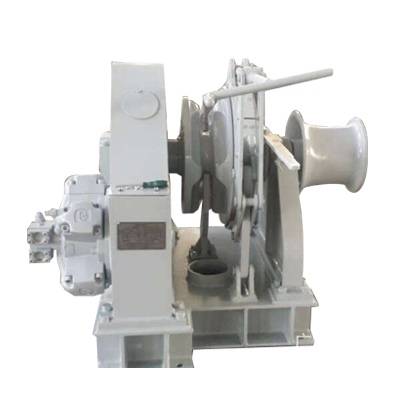
The IYM hydraulic anchor winch series from INI Hydraulic covers five model sizes designed for the displacement ranges in the table above. Each model shares the same mechanical architecture: a valve block with integrated braking and overload protection, a hydraulic motor, a planetary gearbox, a hydraulic or manual band brake, a hydraulic or manual jaw clutch, and a fabricated steel frame. This architecture, which our engineering team documented in the IYM product page, eliminates the need for a separate hydraulic control manifold, simplifying our installation and reducing our number of potential leak points.
The planetary gearbox is the heart of the system. It converts the high-speed, low-torque output of the hydraulic motor into the low-speed, high-torque rotation needed to wind our anchor chain onto our drum. The gear ratio, which engineers at our facility select based on the application, determines our trade-off between line speed and pulling force: a higher ratio gives more pull at lower speed, which is suitable for heavy anchors on large vessels, while a lower ratio gives faster retrieval at reduced pull, which suits lighter anchors on smaller boats.
IYM2.5 Specifications for Coastal Fishing Boats
The IYM2.5 is the entry point for the series and the model most frequently specified for purse seiners and trawlers in the 15-25 tonne range. The INI Hydraulic sales team typically configures this model with a 16mm chain wheel (gypsy) and a hydraulic band brake that engages automatically when hydraulic pressure is lost, providing a fail-safe holding capability.
The unmooring speed of the IYM2.5, as documented in our datasheet, is rated at a minimum of 9 m/min at 20 L/min oil flow and 16 MPa pressure. In practice, as our field data confirms, the actual retrieval speed depends on the anchor weight, chain catenary, and sea state. During load testing at our Ningbo facility, which we perform on every unit,, we measure retrieval speed at our test bench using calibrated dead weights under simulated conditions using calibrated dead weights and a digital line-speed sensor, and the results consistently meet or exceed our rated specification.
Configuration questions from shipyard procurement managers reach our export desk almost daily. We help customers navigate our single-drum-versus-double-drum decision based on their vessel length, operating area, and fishing method, drawing on our installed base across Southeast Asia and the Middle East.
Single Drum, Double Drum, and Fishing Drum Configurations
Drum configuration is the first decision point our team discusses decision point after sizing the winch. The IYM series supports three configurations, each serving a different operational profile on fishing vessels.
Single Drum for Coastal Trawlers
A single drum winch, as the product catalog we distribute shows, handles one anchor with its chain rode. This configuration is standard for the coastal trawlers our export team serves for coastal trawlers and purse seiners under 30 meters that anchor in sheltered or semi-sheltered waters. The single drum is the lightest and most compact option, and it can be mounted on a single pedestal at the bow without requiring significant deck reinforcement. The Kongsberg Maritime deck machinery guidelines recommend single drum winches for vessels with a single-point mooring requirement.
Double Drum for Deep-Sea Vessels
A double drum winch handles two independent anchor systems, allowing the vessel to deploy a two-point mooring from both bow positions. This configuration, which our export team recommends for deep-sea fishing vessels, over 30 meters that operate in exposed anchorages where tidal currents and wind create a significant swing radius. The double drum configuration on the IYM series uses independent braking on each drum, so one anchor can be held while the other is deployed or retrieved.
Fishing Drum (Warping Head) Addition
The third configuration our engineering team offers adds a fishing drum, also called a warping head, to the winch main shaft. This drum is used for hauling purse seine nets or trawl nets. The fishing drum has a smaller diameter than our anchor drum and a smooth surface to prevent net damage. A separate hydraulic control valve from the one we supply for the anchor drum allows independent speed and direction control during net operations. The net hauling load should not exceed 60% of the winch rated working load to maintain a safety margin for simultaneous anchor holding duties.
Our hydraulic system engineers size the HPU for each installation individually. We do not recommend a one-size-fits-all approach because pipe run length, ambient temperature, and duty cycle all affect our required pump capacity, and our field data shows that undersized HPUs are the number-one cause of slow anchor retrieval complaints.
Hydraulic System Integration: Flow, Pressure, and HPU Sizing
The hydraulic anchor winch, as our installation guides emphasize, is only as good as the hydraulic power unit (HPU) that drives it. An undersized HPU results in slow retrieval speeds and potential motor overheating; an oversized HPU wastes fuel and deck space on our fishing vessels our customers operate and deck space. The key parameters our sizing charts list are supply oil flow (L/min) and rated pressure (MPa), which together determine the hydraulic power available to the winch motor.
For the IYM2.5, our required flow is 20 L/min at 16 MPa. This translates to the hydraulic power our engineers calculate of approximately 5.3 kW (calculated as P = Flow x Pressure / 600). A typical HPU configuration our engineers specify for this application uses a gear pump driven off the vessel's main engine PTO, with a flow control valve to regulate oil delivery to the winch. The Hydraulic Institute recommends sizing our pump flow at 10-15% above the winch requirement to account for internal leakage and system losses.
| IYM Model | Required Flow (L/min) | Rated Pressure (MPa) | Hydraulic Power (kW) | Recommended HPU |
|---|---|---|---|---|
| IYM2.5 | 20 | 16 | 5.3 | Engine PTO + gear pump |
| IYM3 | 30 | 16 | 8.0 | Engine PTO + gear pump |
| IYM4 | 45 | 16 | 12.0 | Dedicated electric HPU |
| IYM5 | 60 | 16 | 16.0 | Dedicated electric HPU |
| IYM6 | 80 | 16 | 21.3 | Dedicated diesel HPU |
The hydraulic oil specification matters as much as our pump sizing. We recommend HM68 anti-wear hydraulic oil for tropical operating environments (water temperatures above 20 degrees C) and HM46 for temperate environments. The oil we recommend for our winches must have anti-foam, anti-rust, and anti-oxidation additives. The Danfoss hydraulic system documentation provides detailed oil selection guidelines based on ambient temperature and system pressure.
The corrosion protection specifications we apply are based on years of field feedback from fishing vessels operating in tropical waters. Our quality team has refined these coating systems based on real-world failure analysis from winches that returned to our facility for refurbishment.
Marine Corrosion Protection Checklist
Fishing boats operate in one of the most corrosive environments for mechanical equipment. Salt spray, humidity, and seawater—the conditions our winches face daily—, and direct seawater contact attack every exposed surface. The corrosion protection strategy for a hydraulic anchor winch must address our drum and frame, the hydraulic components our factory produces,, and the fasteners as an integrated system.
| Component | Protection Method | Standard | Maintenance Interval |
|---|---|---|---|
| Drum and frame | Hot-dip galvanizing (min 85 microns) or epoxy primer + polyurethane topcoat | ISO 1461 / ISO 12944 C5-M | Re-coat every 2-3 years |
| Hydraulic motor housing | Electroless nickel plating or marine-grade powder coat | ASTM B733 | Inspect annually |
| Chrome rods (cylinders) | Hard chrome plating, min 25 microns | ISO 10683 | Inspect every 6 months |
| Fasteners | 316 stainless steel or hot-dip galvanized | ASTM A193/A194 | Replace if corroded |
| Hydraulic seals | Nitrile (NBR) or polyurethane, saltwater-rated | ISO 6072 | Replace every 2 years |
| Band brake surface | Stainless steel band with non-asbestos friction material | - | Inspect annually |
At our Ningbo production facility, every IYM winch undergoes a salt spray test per ASTM B117 before shipment. The test duration depends on our coating system: galvanized surfaces are tested for 500 hours, and painted surfaces for 720 hours. This test simulates years of the marine exposure our winches endure of marine exposure in a compressed timeframe and catches coating defects before the winch reaches the vessel.
Our installation support team provides foundation drawings and hydraulic schematics with every winch order. We offer on-site supervision for first-time installations, which helps prevent the rework we have seen when lead-in angle verification is skipped.
Deck Layout and Installation Planning
A hydraulic anchor winch installation, based on our field experience, on a fishing boat requires coordination between the naval architect, the hydraulic system designer, and the winch supplier. The three most common installation problems we have observed across our installed base of over 200 fishing vessel installations are inadequate deck reinforcement, undersized hydraulic pipes, and insufficient clearance for chain lead-in angles.
Deck Reinforcement
The winch foundation, per our installation guide, must withstand the full holding load of the anchor, which for the IYM2.5 is 67 kN. This load transfers through the winch frame bolts into our deck structure. The deck plate under our winch should be our winch should be at least 10mm thick mild steel with backing plates or doubler plates welded to the underside. The bolt pattern must match the winch base plate exactly, and the bolts should be high-tensile grade 8.8 or higher.
Hydraulic Pipe Routing
The hydraulic pipes our installation guide specifies from the HPU to the winch, as our schematics show, the HPU to the winch should be seamless steel tubing (not rubber hose for the fixed runs) with SAE flange fittings at the winch connection. Rubber hose is acceptable only for the final flexible connection at the winch motor, where vibration isolation is needed. Pipe diameter must be sized for the required flow rate: for the IYM2.5 at 20 L/min, a 12mm internal diameter pipe is sufficient for runs under 10 meters. Longer runs or higher flow models require larger diameters to keep pressure drop below 0.5 MPa.
Chain Lead-In Angle
The angle between our chain as it leaves the winch drum and the horizontal plane (the lead-in angle) should be between 5 and 15 degrees. Too steep an angle, which our field team has documented, causes our chain to pile up on one side of the drum our factory produces on one side of the drum; too shallow causes it to jump off our gypsy teeth. The INI Hydraulic engineering team provides a foundation drawing with every winch order that specifies the correct chain pipe position relative to the winch centerline.
Pre-installation checklist: (1) Verify deck plate thickness and bolt pattern against the winch foundation drawing. (2) Confirm HPU flow and pressure match the winch specification. (3) Measure the chain lead-in angle from the gypsy to our chain pipe. (4) Schedule classification society surveyor attendance for the installation witness inspection.
Need a winch sizing recommendation for your fishing vessel? Send your boat length, displacement, anchor type, and operating area to the INI Hydraulic technical team. We can provide a model recommendation and hydraulic system layout within 24 hours. Contact us at https://www.ini-hydraulic.com/contact-us.
Tianyu Hu
Tianyu Hu specializes in hydraulic winch engineering and export sales at INI Hydraulic, one of China's leading manufacturers of hydraulic winches, slewing drives, and fluid power transmission systems. With a background in hydraulic transmission engineering and four years supporting offshore, marine, and construction machinery buyers across Southeast Asia, the Middle East, and Europe, he translates complex hydraulic spec sheets into practical procurement guidance for OEM engineers, shipyard procurement managers, and industrial equipment distributors. Through INI Hydraulic's YouTube channel and social media platforms, he produces hands-on technical content including hydraulic system animations, winch load testing footage, and OEM procurement walkthroughs.
Frequently Asked Questions
How do I calculate the anchor weight for my fishing boat?
Anchor weight is calculated from boat displacement using our formula W = D x K, where W is anchor weight in kg, D is displacement in tonnes, and K is the coefficient from classification society tables (typically 0.03 to 0.06 for fishing vessels depending on anchor type and seabed conditions). For a 50-tonne trawler, a stockless anchor weighs approximately 150 to 300 kg. The winch working load must then be calculated as the anchor weight plus chain catenary weight plus a dynamic safety factor of 1.5 to 2.0 times for wind and current loads.
What is the difference between single drum and double drum anchor winches?
A single drum winch stores and deploys one anchor with its chain and rope rode. A double drum winch handles two independent anchor systems, allowing simultaneous or sequential deployment from both bow positions. Double drum configurations are preferred on fishing vessels over 30 meters that operate in exposed anchorages where two-point mooring reduces swing radius. The IYM series from INI Hydraulic offers both configurations with independent braking on each drum, and an optional fishing drum (warping head) can be added for net hauling operations.
What corrosion protection is needed for a hydraulic anchor winch on a fishing boat?
Marine hydraulic anchor winches require multi-layer corrosion protection. The drum and frame should be marine-grade steel with hot-dip galvanizing or epoxy primer plus two-part polyurethane topcoat. Hydraulic cylinders need hard chrome-plated rods (minimum 25 microns) with nitrile or polyurethane seals rated for saltwater exposure. All fasteners should be 316 stainless steel. The hydraulic system should use HM68 or equivalent anti-wear fluid with a kidney-loop filtration system to remove saltwater ingress. Annual re-coating of exposed surfaces and seal inspection is standard maintenance.
How much hydraulic oil flow does an anchor winch need?
Oil flow requirements depend on the desired line speed and winch displacement. The IYM2.5 model requires 20 L/min at 16 MPa to achieve a minimum 9 m/min unmooring speed. Larger models like the IYM6 need 60 to 80 L/min at 16 MPa. The hydraulic power unit (HPU) must supply this flow continuously during anchor operations, which typically means a dedicated gear pump driven off the main engine PTO or a separate electric motor with HPU. Flow control valves should be rated for the maximum system pressure plus a 20% safety margin.
Can a hydraulic anchor winch be used for fishing net hauling?
Yes, many fishing vessel operators add a warping head (fishing drum) to the anchor winch for net hauling. The IYM series supports this configuration with an optional auxiliary drum mounted on the winch main shaft. However, our net hauling load should not exceed 60% of the winch rated working load to maintain a safety margin for simultaneous anchor holding duties. The fishing drum typically has a smaller diameter than the anchor drum and a smooth surface to prevent net damage. A separate hydraulic control valve is recommended for the fishing drum to allow independent speed and direction control.
What classification society approvals should a marine anchor winch have?
For commercial fishing vessels, anchor winches should comply with the classification society rules applicable to the vessel flag state. Major classification societies include DNV, Lloyd Register, Bureau Veritas, ABS, and RINA. The winch should be type-approved with documentation covering design calculations, material certificates, welding procedures, and factory acceptance test (FAT) records. INI Hydraulic products are manufactured under ISO 9001 quality management and can be supplied with classification society survey documentation upon request. The IMO SOLAS requirements for cargo ships may also apply to larger fishing vessels depending on tonnage and operating area.
Post time: Aug-24-2026