
TL;DR
1. Dredging hydraulic power = Q × H × ρ × g / (η × 3,600,000) kW — a 500m³/h system at 25m head with 1,200 kg/m³ slurry density requires approximately 52 kW at the pump shaft, plus 20% for auxiliary drives. 2. Pipeline velocity is the critical design constraint — 3.5-5.5 m/s for sand, 2.5-3.5 m/s for clay — go too slow and solids settle, go too fast and hose wear accelerates 4-5×. 3. Open loop for cutter and winch drives, closed loop for dredge pump drive — matching circuit architecture to duty cycle saves 5-8% fuel and eliminates unnecessary cooling requirements for continuous pump operation.
Why Dredging Hydraulic Systems Are Among the Most Demanding Industrial Applications
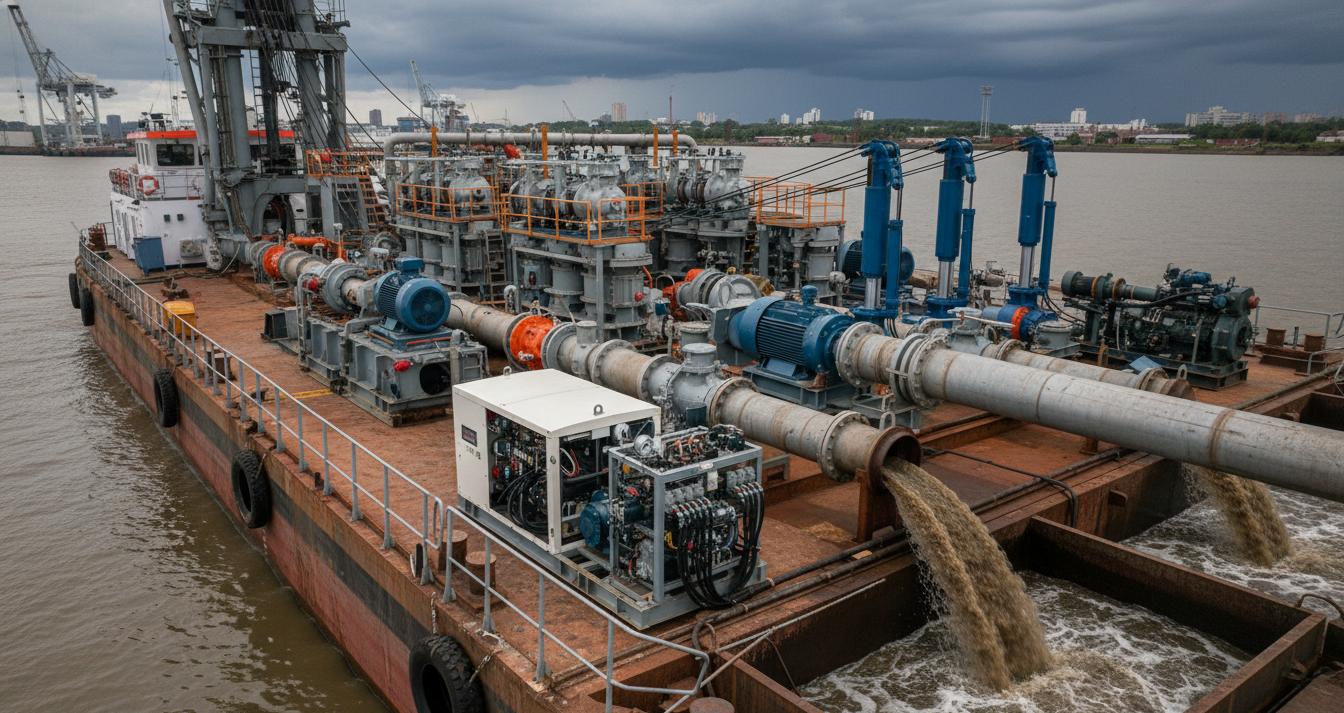
Dredging hydraulic systems face a unique combination of continuous high-power operation, abrasive slurry exposure, and multi-drive coordination that surpasses nearly every other industrial hydraulic application. A single trailing suction hopper dredger (TSHD) typically requires 500-2,000 kW of hydraulic power distributed across the dredge pump drive, cutter or draghead drive, swing winches, spud carriage cylinders, and jet water pump. All of these must operate simultaneously in a saltwater environment with 24/7 duty cycles lasting 2-4 weeks continuous.
In my 15 years specifying hydraulic systems for dredging projects — from 120m³/h maintenance dredgers operating in Chinese inland waterways to 1,000m³/h capital dredging systems deployed in Southeast Asian port expansion projects — I have identified three characteristics that make dredging uniquely demanding. First, abrasion. Slurry with 15-30% solids concentration at 4.5 m/s acts like liquid sandpaper on every pump internal surface. Standard hydraulic pumps without hardened wear plates and ceramic-coated pistons last 800-1,200 hours in sand service before efficiency drops below 85%. Second, heat rejection. A 500 kW dredge pump drive operating at 82% hydraulic efficiency rejects 90 kW of heat continuously — requiring oil cooler capacity of 35-45 kW (the remainder dissipates through piping and reservoir) and reservoir volume of at least 3× pump flow rate to maintain dwell time for air release and cooling.
Third, multi-drive coordination. The dredge pump, cutter, and swing winches must operate simultaneously while maintaining precise speed relationships. If the swing winch speed drops 10% while the cutter maintains full power, the cutter teeth engage too deeply, stalling the cutter motor and creating a 15-30 minute recovery operation. This requires load-sensing proportional control on all drives, not simple fixed-displacement pump-and-valve arrangements. See Yining Hydraulic dredging systems for multi-drive coordinated configurations.
Capacity Selection Logic: From 120m³/h Maintenance to 1000m³/h Capital Dredging
Dredging capacity directly determines total hydraulic power, pipeline diameter, and system architecture. The capacity ranges follow a rough power-of-two progression because each doubling of flow rate requires approximately 3× the hydraulic power (due to the cubic relationship between pipeline velocity and friction loss).
| Capacity Range | Typical Application | Pipeline Diameter | Total Hydraulic Power | Dredge Pump Displacement | System Architecture |
|---|---|---|---|---|---|
| 120-300m³/h | Maintenance, small rivers | DN150-200 (6-8 inch) | 150-350 kW | 160-400 cm³/rev | Single pump, open loop |
| 300-600m³/h | Medium port, canal | DN200-300 (8-12 inch) | 350-750 kW | 400-800 cm³/rev | Dual pump, split open/closed |
| 600-1000m³/h | Capital, port expansion | DN300-400 (12-16 inch) | 750-1,500 kW | 800-1,600 cm³/rev | Multi-pump, closed loop |
The capacity dictation rule I use: maintenance dredging (removing 0.5-1.5m accumulated silt from maintained channels) needs 120-300m³/h — a single diesel engine powering one main pump and two auxiliary pumps through a splitter gearbox. Medium capital dredging (creating new channels or deepening existing ports by 2-5m) requires 300-600m³/h — twin engines, one dedicated to the dredge pump, the second powering cutter and winch hydraulics. Large capital dredging (port basin creation, land reclamation) demands 600-1,000m³/h+ — a multi-engine distributed hydraulic system with dedicated pumps per function and redundant cooling circuits.
For complete dredging system designs, see Yining Hydraulic pump range for pressure-compensated and load-sensing options.
Pump Pressure and Flow Calculation: The Hydraulic Power Formula Driving System Sizing
The fundamental dredging hydraulic power equation is P = (Q × H × ρ × g) / (η_total × 3,600,000) where Q is flow rate in m³/h, H is total dynamic head in meters, ρ is slurry density (typically 1,100-1,300 kg/m³ depending on solids concentration), g is 9.81 m/s², and η_total is the combined efficiency of hydraulic pump (0.88-0.92) × mechanical transmission (0.95-0.97) × dredge pump impeller (0.75-0.85).
Total dynamic head (H) has four components: static lift (vertical distance from water surface to discharge point), friction loss in pipeline (Darcy-Weisbach: h_f = f × L/D × v²/2g where f ≈ 0.015-0.025 for slurry), velocity head (v²/2g, typically negligible at 0.3-0.6m), and discharge pressure (typically 1-3m to overcome discharge pipe exit energy). For a 500m pipeline of DN200 at 4.5 m/s with 1.2 SG slurry: h_f ≈ 0.018 × 500/0.2 × 4.5²/(2×9.81) ≈ 46.5m. With 5m static lift + 46.5m friction + 2m discharge = 53.5m total head.
Real-world example — 500m³/h medium sand dredging: Q=500m³/h, H=53.5m, ρ=1,200 kg/m³, η_total=0.82 (hydraulic) × 0.96 (mechanical) × 0.80 (dredge pump) = 0.63. P = (500 × 53.5 × 1200 × 9.81) / (0.63 × 3,600,000) = 315.4 × 10^6 / 2.268 × 10^6 ≈ 139 kW at the diesel engine output shaft. Add 30 kW for cutter drive, 15 kW for swing winches, 10 kW for jet pump, 5 kW for controls and lighting = approximately 199 kW total installed power. Select a 250 kW diesel engine for 25% duty margin.
Cutter Drive Hydraulic System: Motor Power for Different Soil Resistances
Cutter drive hydraulic motor sizing depends primarily on soil type and cutter head diameter. The empirical cutter power formula I use after 15 years of dredging projects is: P_cutter = k_c × D² × v_swing × S_u, where k_c is the soil coefficient (0.02-0.04 for loose sand, 0.04-0.06 for silt/clay, 0.06-0.10 for stiff clay, 0.10-0.20 for weak rock, 0.20-0.35+ for competent rock), D is cutter diameter in meters, v_swing is swing speed in m/s, and S_u is undrained shear strength in kPa (or equivalent for non-cohesive soils).
| Soil Type | k_c Coefficient | S_u (kPa) | Power for 2.0m Cutter (kW) | Recommended Motor Displacement (cm³/rev) |
|---|---|---|---|---|
| Loose sand | 0.025 | 10 | 1.0 | 40 |
| Medium sand | 0.030 | 25 | 4.5 | 100 |
| Silt | 0.045 | 50 | 13.5 | 250 |
| Stiff clay | 0.065 | 150 | 29.3 | 500 |
| Weak rock | 0.150 | 500 | 225 | 3,500 |
The motor must also handle stall torque — when the cutter hits an unexpectedly hard layer and momentarily stops rotating. I specify cutter motors with 2.0-2.5× rated torque stall capability and a cross-port relief valve set at 110% of maximum continuous pressure. This allows the cutter to stall safely without mechanical damage, after which the operator reverses rotation briefly and re-engages. Yining Hydraulic piston motors provide the high stall torque characteristics required for dredging cutter drives.
Hose and Pipeline Sizing: Avoiding Pressure Losses That Kill Production Rate
Pipeline diameter is the single most consequential decision in dredging hydraulic system design because it affects both the system pressure (and therefore fuel consumption) and the production rate (through slurry velocity). An undersized pipeline costs fuel — 10% too small diameter increases friction loss by approximately 46% (head loss ∝ 1/D^5). An oversized pipeline increases capital cost and requires higher velocity to prevent solids settling.
The critical velocity for slurry transport is the minimum flow velocity that keeps solids in suspension. For sand particles (d50 = 0.2mm), critical velocity V_crit ≈ 3.5-4.0 m/s. For silt (d50 = 0.02mm), V_crit ≈ 2.5-3.0 m/s. Below V_crit, solids begin settling at the pipe bottom, progressively reducing the effective cross-section until the pipeline plugs — a condition requiring reverse pumping to clear, costing 2-6 hours of lost production.
Pipeline friction loss calculation for a 500m DN200 pipeline at 4.5 m/s: ΔP = f × (L/D) × (ρ×v²/2). With f=0.018 (slurry friction factor, 15-20% higher than water due to solids interaction), L=500m, D=0.2m, ρ=1,200 kg/m³, v=4.5 m/s: ΔP = 0.018 × 2,500 × (1,200×20.25/2) = 45 × 12,150 = 546,750 Pa ≈ 5.5 bar friction loss. Add 2 bar for static lift (5m at 1.2 SG) and 1 bar for fittings/valves = 8.5 bar discharge pressure at the pump. This is the number that determines dredge pump drive power and hydraulic motor selection. Visit Yining Hydraulic dredging system configurations for pre-calculated pipeline loss tables.
System Configuration: Open Loop vs Closed Loop for Dredging
The fundamental architectural decision in dredging hydraulic system design is open loop versus closed loop — and the correct answer varies by function.
Open loop (pump draws from reservoir, fluid returns for cooling): Preferred for cutter drives because the cutter operates intermittently (engaged 40-60% of cycle time during swing, free-running during repositioning), allowing the reservoir to buffer thermal load. Also preferred for swing winches using directional control valves for forward/reverse and speed modulation. Open loop advantages: simpler filtration (full-flow return filter catches wear particles before they reach the pump), easier cooling (return fluid passes through heat exchanger), and lower cost (standard directional valves).
Closed loop (sealed pump-motor circuit with charge pump): Preferred for dredge pump drives operating continuously at the design point for 4-12 hours per shift. Closed loop advantages: 5-8% better efficiency (no directional valve losses), compact reservoir (only 1.5× circuit volume versus 3× for open loop), and precise speed control via pump swashplate angle rather than valve throttling. The efficiency difference is significant: at 500 kW continuous operation, 7% efficiency gain = 35 kW less heat rejected = approximately 15 liters/hour less diesel consumption = approximately $4.50/hour fuel savings at industrial diesel prices.
My standard configuration for 300-600m³/h dredgers: Closed loop for dredge pump drive (single variable-displacement axial piston pump, 250-500 cm³/rev, 350 bar continuous), open loop for cutter drive (fixed-displacement pump with proportional directional control, 150 bar max), open loop for swing winches (load-sensing variable pump, 220 bar), and a dedicated gear pump for jet water and auxiliary functions. Yining Hydraulic pump catalog provides open and closed loop configurations for all capacity ranges.
Case Reference: Typical 500m³/h Trailing Suction Hopper Dredger Configuration
A 500m³/h TSHD represents the most common dredging system configuration and serves as a useful reference for hydraulic system specification. Based on a project I completed for a Southeast Asian port operator in 2024, here is the actual system configuration:
Power source: Single 650 kW diesel engine at 1,800 rpm driving a splitter gearbox with three PTO pads. Dredge pump drive (closed loop): 450 kW variable-displacement axial piston pump (500 cm³/rev at 350 bar) driving a fixed-displacement hydraulic motor (2,500 cm³/rev, 280 bar continuous) direct-coupled to the dredge pump impeller shaft. Pump speed 0-350 rpm, slurry production 450-550m³/h in medium sand at 45m total head. Cutter drive (open loop): 55 kW variable-displacement pump (160 cm³/rev, 250 bar) driving a 500 cm³/rev piston motor through a 3.5:1 planetary gearbox. Cutter speed 0-35 rpm at 15,000 Nm peak torque. Swing winches (open loop, load-sensing): 75 kW variable pump feeding two 315 cm³/rev motors with fail-safe multi-disc brakes, producing 80 kN line pull at 0-25 m/min.
Cooling: Shell-and-tube heat exchanger rated 120 kW heat rejection, seawater-cooled, with duplex strainers for continuous operation without shutdown for cleaning. Reservoir: 2,500 liters with 60-micron full-flow return filtration and 10-micron kidney loop polishing circuit. Control system: CANbus J1939 networked controllers with operator touchscreen displaying pump pressures, motor speeds, temperatures, and production rate calculated from flow meter and density meter inputs. Contact Yining Hydraulic for complete system proposals customized to your dredging project specifications.
Frequently Asked Questions
Q: How do I calculate hydraulic pump requirements for a 500m³/h dredging system?
Use P = (Q × H × ρ × g) / (η × 3,600,000) where Q=500m³/h, H=total head (m), ρ=1,200 kg/m³, η=0.75-0.82 total efficiency. For 25m head: P≈52.4 kW at pump shaft. Add 20% for auxiliary drives.
Q: What hose diameter is required for high-capacity dredging slurry transfer?
For 500m³/h: D=√(4Q/πv)=√(4×0.139/(π×4.5))≈0.198m → DN200 at 4.4 m/s. For 1000m³/h: DN300 at 3.9 m/s minimum.
Q: What hydraulic motor power is needed for cutter drive in stiff clay conditions?
For 2.0m cutter in 150 kPa clay at 0.3 m/s: P≈9.0 kW cutting power. With motor eff 0.88 and gearbox 0.92: approximately 11.1 kW at motor shaft. De-rate by 15% for sand, 40% for rock.
Q: What is the difference between open and closed hydraulic circuits in dredging?
Open: pump draws from reservoir, fluid returns for cooling — preferred for cutter and winches. Closed: sealed pump-motor loop with charge pump — preferred for continuous dredge pump drive, 5-8% better efficiency.
Q: How does soil type affect hydraulic system design for dredging equipment?
Soil type affects pump power (1× sand, 1.8× clay, 2.5×+ rock), wear protection thickness, cutter power (0.02-0.35 coefficient range), pipeline velocity requirements, and solids concentration capability.
Conclusion
Specifying a hydraulic system for dredging operations is fundamentally an exercise in matching capacity to soil conditions while maintaining pipeline velocity above the critical settling threshold. The system architecture — open loop for intermittent drives, closed loop for continuous drives — determines both fuel efficiency and maintenance intervals. For a 500m³/h system, expect approximately 200 kW total installed hydraulic power, DN200 pipeline, and a multi-drive configuration with dedicated closed-loop dredge pump drive. Yining Hydraulic provides complete hydraulic system proposals including pump sizing, pipeline loss calculations, cooling system design, and control architecture within 10 business days — contact our application engineering team with your target production rate, soil conditions, and discharge distance for a customized specification.
External References and Standards
- PIANC: Dredging and Port Construction Guidelines — International dredging engineering standards and best practices.
- ISO 15119: Dredging Equipment Safety Requirements — Safety standard for dredging hydraulic system design.
- ASTM D5069: Standard Test Method for Dredge Soil Classification — Soil testing standard for dredging power calculations.
- ISO 4413: Hydraulic Fluid Power — General Rules for System Design — Primary hydraulic system design standard.
- IADC: International Association of Dredging Companies — Technical Publications — Industry reference for dredging system design and operational data.
- USACE EM 1110-2-5025: Dredging and Dredged Material Management — US Army Corps dredging engineering manual with hydraulic power tables.
- CIRIA C683: The Rock Manual — Dredging and Marine Construction — European reference for dredging soil classification and power requirements.
- DNV-ST-N001: Marine Operations and Marine Warranty — Offshore dredging project certification standard.
Post time: May-19-2026