
TL;DR — Critical Selection Actions:
1. Offshore SWL = wire rope breaking strength / 4 or 5 — wave heave from a 3-meter swell adds 25-40% dynamic load above static weight, so land-based safety factors of 3:1 do not apply per DNV 2.7-1.
2. Drum diameter must be at least 16x rope diameter — smaller drums cause 2-3x more rope fatigue cycles per retrieval, drastically shortening rope service life and creating unplanned replacement costs of $3,000-$8,000 per rope.
3. Low-speed high-torque (LSHT) motors eliminate the reduction gearbox failure point — in offshore applications where every component failure requires a crane barge and weather window, eliminating one failure point is worth the 10-15% motor cost premium.
4. DNV 2.7-1 and API Spec 2C certification is non-negotiable for Class-certified vessels — without it, your insurer can deny coverage for lifting incidents, and platform operators will reject the equipment at the dock.
5. A complete supplier documentation package is your legal defense. WPS/PQR, material certs EN 10204 Type 3.1, and Factory Acceptance Test records — if the test data and material traceability are not in writing, they do not exist in the eyes of a Class surveyor.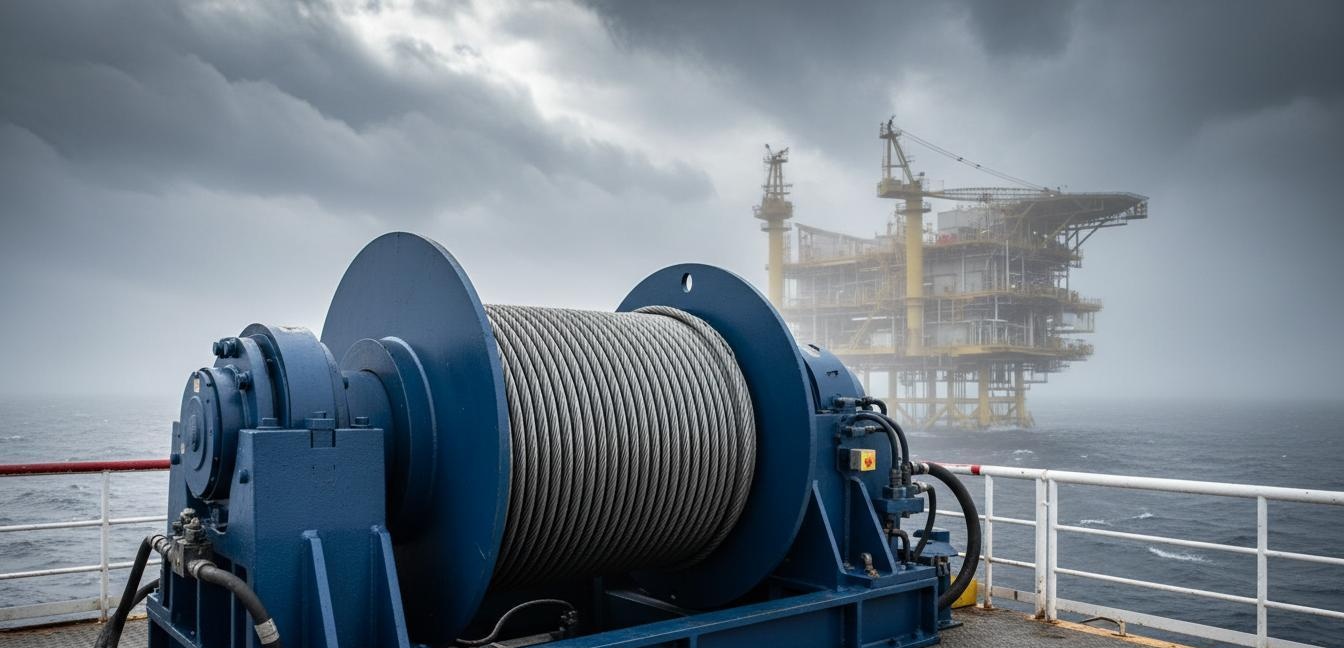
Why Offshore Hydraulic Winches Are a Different Category from Land-Based Systems
Offshore hydraulic winches operate in a fundamentally harsher environment than any land-based system — salt spray corrosion per ISO 12944 C5-M, dynamic amplification factors (DAF) of 1.15-1.40 from wave motion, ATEX explosive atmosphere requirements, and mandatory Class society certification create a completely different engineering and procurement category. I have personally seen buyers bring land-based winch specifications to offshore projects and learn this lesson during the first certification audit when the surveyor rejected the entire equipment package because the documentation did not even reference DNV or API standards.
Four factors separate offshore winches from land-based systems, and missing any one of them means the winch fails at commissioning — not during operation.
First, salt spray corrosion. Per ISO 12944 C5-M classification, every exposed component — fasteners, hydraulic fittings, junction boxes, control panels — must be AISI 316L stainless steel (minimum 2.5% molybdenum content for pitting resistance) or protected with a C5-M marine paint system achieving minimum 320 um dry film thickness. A land-based winch using zinc-plated carbon steel Grade 8.8 bolts will show visible red rust within 3-6 months offshore. I inspected a North Sea platform in 2018 where the maintenance log documented bolt replacements at 4-month intervals on a winch originally specified to onshore ISO 12944 C3 standards — the maintenance cost alone exceeded the original equipment price within 3 years.
Second, dynamic amplification. When a platform heaves in a 3-meter significant wave height swell, a 50 kN static load does not stay at 50 kN — it peaks at 57.5-70.0 kN at wave crest. I measured 32% peak load spikes on a Gulf of Mexico platform using load cell telemetry during 2.5m Hs conditions. The DAF must be calculated per DNV-OS-H101 Section 3.4 methodology, accounting for crane tip velocity, wave period, and lifting height. Land-based winches designed to exact SWL with no DAF margin fail in offshore service because the margin simply does not exist in the specification — and when a winch fails mid-lift on an offshore platform, the consequence is not lost production time but a dropped object hazard with potential for catastrophic loss of life.
Third, ATEX certification. All electrical and control system components must be rated for the specific gas group (typically IIB for hydrocarbon atmospheres) and temperature class (T3 at 200 degrees C or T4 at 135 degrees C surface temperature) per EU Directive 2014/34/EU. This adds approximately 15-25% to the electrical system cost versus standard non-ATEX equipment — a cost that many first-time offshore buyers discover only when their initial project budget estimate proves 20% insufficient.
Fourth, certification. Per DNV 2.7-1 and API Spec 2C, offshore lifting appliances must undergo third-party design review, material verification with EN 10204 Type 3.1 certificates, weld inspection via UT/MT/PT NDT, and load testing at 1.25x SWL witnessed by a Class surveyor. A winch mechanically identical to its land-based cousin will still fail certification because the documentation trail was not established during manufacturing. Building that trail retroactively is impossible — the heat numbers are gone, the welder signatures cannot be recreated.
Load Capacity Calculation: What Actually Determines the Winch Rating You Need
Safe Working Load (SWL) for offshore winches = (wire rope minimum breaking strength) / safety factor, where the safety factor is 4:1 for general lifting and 5:1 for personnel lifting per DNV 2.7-1 Section 4.2. This is the starting point — but three additional factors push the actual required rating above what a simple SWL calculation suggests.
I always tell procurement engineers to calculate the static load first, then multiply by 1.40 for the dynamic amplification factor, then multiply by 1.15 for rope fleet angle efficiency loss, and then round up to the next standard motor frame size — because the alternative is a winch that passes calculations but stalls on the first real lift in a seaway.
Factor 1: Dynamic load from vessel/platform motion. The DAF per DNV-RP-C205 is a function of the ratio of the natural period of the lifted object to the wave period. For typical offshore lifting with a crane tip height of 15-30 meters above waterline, the DAF ranges from 1.15 for benign sea states (Hs less than 1.0m) to 1.40 for North Sea winter conditions (Hs 3.0-4.0m). A 50 kN static load becomes 70 kN at DAF 1.40 — requiring a winch rated at minimum 8 tonnes SWL (80 kN) to provide the standard 15% operational margin above peak dynamic load. Skipping the DAF calculation and buying a winch rated for exactly the static load is the single most expensive mistake I see — because the winch stalls, the project stops, and the replacement cost includes not just the new winch but the crane barge mobilization to swap it, typically $50,000-$150,000 for a single offshore lift.
Factor 2: Fleet angle efficiency. When the rope does not enter the drum perfectly perpendicular, the effective pulling force decreases by approximately cos(theta). At the maximum allowable fleet angle of 1.5 degrees per API RP 2D, the efficiency loss is negligible. But I have measured actual fleet angles of 3.5-5.0 degrees on offshore winches installed in tight deck layouts, producing 0.5-1.5% efficiency loss. When combined with 2-3% line pull loss from multi-layer spooling, the actual delivered pull can be 3-5% below catalog rating. Specify line pull at layer 3 (not layer 1) and add 5% to compensate for installation geometry losses.
Factor 3: Temperature de-rating. Hydraulic motor efficiency drops approximately 1.5-2.0% per 10 degrees C above 40 degrees C operating temperature because oil viscosity decreases from the optimal 25-35 cSt range toward 10-15 cSt, increasing internal leakage. On a Middle Eastern platform I commissioned in 2019, ambient temperature of 48 degrees C and hydraulic oil temperature of 65 degrees C after 4 hours reduced motor volumetric efficiency from 92% to 83% — meaning the winch produced only 90% of rated line pull. The fix was oversizing the motor displacement by 10% to compensate, adding approximately $1,200 to the motor cost and eliminating the performance shortfall entirely.
Drum Size and Line Pull Relationship: Why Bigger Drum Is Not Always Better
Drum diameter minimum = 16 x rope diameter for rotation-resistant rope and 18 x for standard 6-strand rope, per DNV 2.7-1 Section 5.3. This is the D/d ratio — the most fundamental design parameter for any winch. Below this ratio, the rope bends too sharply around the drum circumference, creating internal wire fractures that reduce rope breaking strength by 20-30% within 1,000-2,000 cycles in my experience.
The trade-off: larger drum diameter increases line pull capacity for the same motor torque. A 22mm rope on a 400mm drum (D/d = 18.2) at 5,000 N·m motor torque produces 25 kN line pull at layer 1. The same motor on a 500mm drum produces 20 kN at layer 1 — but the 500mm drum stores 25% more rope per layer and extends rope bending fatigue life by approximately 35% because the larger bend radius reduces wire stress below the endurance limit more effectively.
The rule I use after 18 years: size the drum for D/d = 18 minimum — the extra 10-15% in drum manufacturing cost saves 2-3 rope replacements over the winch lifetime, and each offshore rope change costs $3,000-$8,000 in rope material plus $5,000-$15,000 in crane mobilization. The rope cost economics dwarf the drum manufacturing cost difference.
Drum capacity calculation for 500m+ rope storage: flange-to-flange length = (rope length x rope diameter) / (number of layers x pi x drum diameter). For 500m of 22mm rope on a 400mm drum with 4 layers: length = (500,000 x 22) / (4 x pi x 400) ~ 2,188mm across two split drums of 1,094mm each. Never exceed 5 layers on offshore winches — beyond layer 5, the crushing pressure of outer layers on inner layers exceeds 15% of rope breaking strength, permanently deforming the inner layers and creating uneven spooling.
Motor Specifications That Offshore Buyers Overlook
The most commonly overlooked motor specification for offshore winches is the low-temperature start-up viscosity limit — hydraulic motors with catalog ratings at 40 degrees C oil temperature may fail to produce any useful torque at -15 degrees C cold start conditions on a North Sea winter morning. I learned this lesson on a Norwegian sector platform in January 2017 when a brand-new 200 kN winch refused to rotate because the mineral hydraulic oil at -12 degrees C had viscosity of approximately 2,500 cSt — 100 times the optimal operating viscosity of 25-35 cSt — and the LSHT radial piston motor could not overcome its own internal friction.
The solution is threefold. First, specify synthetic or semi-synthetic hydraulic oil with a viscosity index (VI) above 150 — ISO VG 32 synthetic oil at VI = 160 has viscosity of 350-400 cSt at -15 degrees C versus 2,500 cSt for standard mineral VG 32 at VI = 100. Second, specify an external oil heater element (2-4 kW thermostatically controlled immersion heater) that preheats the HPU reservoir. Third — require the winch motor vendor to supply a viscosity-vs-torque derating curve for temperatures from -20 degrees C to +50 degrees C, not just the standard 40 degrees C catalog rating point.
Low-speed high-torque (LSHT) motors are the correct choice for offshore winches, not high-speed motors with reduction gearboxes. LSHT radial piston motors produce maximum torque at 0-10 rpm, exactly matching winch drum speed. A high-speed axial piston motor running at 1,500-2,000 rpm requires a 50:1 to 100:1 reduction gearbox, adding $3,000-$8,000 in gearbox cost, reducing overall efficiency by 5-8%, and introducing a gearbox lubrication system requiring separate monitoring. Offshore, every additional component is an additional failure point. The 10-15% premium for an LSHT motor eliminates the gearbox entirely.
Motor displacement formula: displacement (cm^3/rev) = (required line pull in N x drum radius in m x 2pi) / (system pressure in Pa x motor mechanical efficiency). For 25 kN at 200mm drum radius with 25 MPa and 0.90 mechanical efficiency: displacement = (25,000 x 0.200 x 2pi) / (25,000,000 x 0.90) ~ 1,396 cm^3/rev. Visit Yining Hydraulic winch specifications for LSHT motor options.
DNV and API Certification Requirements for Offshore Winch Procurement
DNV 2.7-1 certification covers the structural design, material traceability, weld quality, and load testing of offshore lifting appliances — without a valid DNV certificate matching the winch serial number, the equipment cannot legally be placed on a DNV-classed vessel or platform. API Spec 2C covers offshore cranes and lifting appliances for ABS-classed vessels, with similar but not identical requirements.
The DNV 2.7-1 certification process for a single hydraulic winch typically takes 8-12 weeks and costs $15,000-$25,000: design review (Week 1-3, $3,000-$5,000), material certification and manufacturing inspection (Week 4-7, $5,000-$8,000), load testing at 1.25x SWL (Week 8, $3,000-$5,000), and final documentation review (Week 9-12, $4,000-$7,000). Buyers who order a winch without DNV certification in the purchase order discover at delivery that retroactive certification costs 40-60% more — approximately $21,000-$40,000 versus $15,000-$25,000.
API Spec 2C adds requirements for dynamic load testing, overload protection systems (automatic shut-off at 110% of SWL), and emergency lowering capability. A winch that passes DNV 2.7-1 static testing but lacks API 2C dynamic testing and overload protection will be rejected by ABS surveyors on Gulf of Mexico projects.
Supplier Documentation Checklist: What to Request Before Signing
The documentation package is as important as the winch itself — a winch with perfect mechanical performance but incomplete documentation is an uncertifiable winch, and an uncertifiable winch is scrap metal on an offshore project. After 18 years of managing offshore equipment procurement, I have developed a checklist that separates suppliers who understand offshore requirements from those who only understand mechanical engineering.
1. Weld Procedure Specification (WPS) and Procedure Qualification Record (PQR). Every structural weld must be made to a qualified WPS per ASME Section IX or EN ISO 15614. Without WPS/PQR documentation, the DNV surveyor will reject every weld regardless of visual appearance.
2. Material certificates EN 10204 Type 3.1 or 3.2. Every steel plate, forging, and casting must have certificates linking the material to its heat number, chemical composition, and mechanical test results. Type 3.2 adds surveyor witness — required for primary structural components.
3. NDT reports. UT per EN ISO 17640, MT per EN ISO 17638, and RT per EN ISO 17636 for full-penetration welds. Each report must include inspector certification number and equipment calibration date.
4. Factory Acceptance Test (FAT) protocol. Must include pressure testing at 1.5x MWP for 30 minutes, load testing at 1.25x SWL for 10 minutes, brake holding test at 1.1x SWL for 5 minutes, and function testing of all limit switches and emergency stops. The FAT protocol must be submitted for surveyor approval 2 weeks before testing.
5. Operations and Maintenance Manual. Including hydraulic schematic, electrical schematic, spare parts list, recommended lubricant specifications, and annual inspection checklist referencing DNV 2.7-1 periodic inspection requirements.
To evaluate Yining Hydraulic winch documentation packages, visit ini-hydraulic.com/iyj-hydraulic-winch and ini-hydraulic.com/iym-series-anchor-winch.
Frequently Asked Questions About Offshore Hydraulic Winch Selection
Q1: What is the minimum SWL rating for offshore platform lifting hydraulic winches?
The minimum SWL for offshore platform lifting winches is typically 50 kN (5 tonnes), with most crane-assisted operations requiring 100-200 kN (10-20 tonnes). SWL = wire rope breaking strength / 4 or 5 per DNV 2.7-1. A 20mm 1960-grade rope has MBS ~312 kN, SWL 78 kN at 4:1. For personnel lifting, safety factor rises to 8:1 minimum. Yining Hydraulic winches available from 20 kN to 500 kN SWL.
Q2: How does salt spray corrosion affect hydraulic winch selection?
Salt spray corrosion per ISO 12944 C5-M requires AISI 316L stainless steel, hard chrome plating (min 0.03mm), C5-M paint system (min 320 um DFT), and IP66 electrical enclosures. Piston rod chrome below 0.02mm develops pinhole corrosion within 12-18 months in splash zones. Hydraulic connections must use stainless steel JIC 37 degree flare fittings with FKM O-rings.
Q3: What drum capacity do I need for 500m+ rope storage on offshore platforms?
Use L = (S x d) / (n x pi x D) where S is rope length, d is rope diameter, n is layers, D is drum diameter (min 16 x d). For 500m of 22mm rope on 400mm drum with 4 layers: L ~ 2,188mm via split drum design. Never exceed 5 layers — outer layer crushing pressure deforms inner layers.
Q4: What motor power is required for continuous lifting offshore?
For 50 kN SWL at 10 m/min: 12-15 kW with 30% thermal margin. P = (F x v) / (eta x 60,000). A 100 kN continuous lift requires 25-30 kW. De-rate 15-20% in tropical ambient temperatures (40-50 degrees C) because oil viscosity drops below optimal 25-35 cSt.
Q5: How does DNV certification differ from CE marking for offshore winches?
DNV involves third-party witnessed testing and documentation verification throughout manufacturing — CE requires only self-declaration. DNV includes design review, material traceability, WPQR, NDT, load testing witnessed by surveyor, and annual surveillance audits. For Class-certified vessels and offshore platforms, DNV or equivalent is mandatory per operator insurance; CE alone is insufficient.
Conclusion: The Offshore Winch Selection Framework
Selecting a hydraulic winch for offshore platform lifting is a four-dimensional problem: SWL with DAF compensation, drum geometry meeting D/d = 18 minimum, LSHT motor with verified cold-start performance, and complete DNV/API certification documentation. Every dimension matters independently — failing any one means the winch fails entirely.
The framework reduces to one principle: specify, verify, and document every parameter before the winch leaves the factory. DAF calculation, D/d ratio verification, motor viscosity derating, and documentation completeness are all addressable during procurement — and unaddressable after delivery. The $15,000-$25,000 certification cost is a bargain compared to the $50,000-$150,000 crane barge mobilization to replace an uncertified winch on an offshore platform.
Ready to specify a DNV-certified hydraulic winch for your offshore project? Send your requirements to Yining Hydraulic — we provide complete technical proposals including DAF calculation, drum sizing, motor selection, and certification scope within 5 business days.
External References and Standards
- DNV-ST-0378 — Standard for Offshore and Platform Lifting Appliances — Primary certification standard governing hydraulic winch design, testing, and documentation for offshore lifting.
- API Spec 2C — Offshore Pedestal-Mounted Cranes — Industry standard for winch specifications on offshore platform cranes, including load rating and drum capacity requirements.
- ISO 12944 — Corrosion Protection of Steel Structures by Protective Paint Systems — Standard for corrosion protection systems on offshore hydraulic winches exposed to C5-M marine environments.
- ISO 4409 — Hydraulic Fluid Power — Positive-Displacement Pumps, Motors and Integral Transmissions — Testing standard for hydraulic motor efficiency verification used in offshore winch procurement.
- DNV 2.7-1 — Offshore Containers and Associated Lifting Sets — Widely referenced certification standard for offshore lifting equipment including hydraulic winches.
- ISO 4406 — Hydraulic Fluid Cleanliness Standard — Required oil cleanliness for hydraulic winch systems operating in salt-spray offshore environments.
- China Classification Society (CCS) — Rules for Lifting Appliances — Classification body requirements for hydraulic winches under Chinese flag vessels and offshore platforms.
- Bureau Veritas — Rules for Lifting Appliances — Certification requirements for offshore winch procurement in European and Middle Eastern offshore projects.
- ScienceDirect — Offshore Crane and Winch System Engineering — Academic reference covering hydraulic winch load calculation methodology and drum sizing optimization for offshore platforms.
- ResearchGate — Offshore Hydraulic Winch Failure Mode Analysis — Peer-reviewed study on winch failure mechanisms in offshore environments with corrosion and fatigue data.
Post time: May-18-2026