
 TL;DR
TL;DR
- Typical total range: 8-16 weeks.
- Fast projects need frozen specs early.
- Sea freight adds 30-55 days.
- Testing and documents prevent delays.
- Air freight suits urgent small units.
For a custom hydraulic power unit manufactured in China and shipped to Europe, a realistic end-to-end lead time is usually 8 to 16 weeks after technical specifications, payment terms, and drawing approval are confirmed. A simple repeat-order hydraulic power unit can sometimes be completed and shipped in 6 to 9 weeks, while a new engineered package for marine, offshore, mining, deck machinery, or heavy industrial equipment can take 12 to 20 weeks if it requires imported components, classification review, special coatings, factory acceptance testing, or tight documentation for European import clearance.
The fastest timeline is not created by asking the factory to “rush”; it is created by removing decision gaps before production starts. The buyer-controlled variables are motor voltage and frequency, pump flow and pressure, tank capacity, valve brand preference, PLC or sensor requirements, surface treatment, applicable standards, Incoterms, customs documents, and whether the unit must travel by sea, rail, truck, or air. At INI Hydraulic, custom engineering is a normal part of the work: the company designs and manufactures hydraulic systems, winches, motors, pumps, transmissions, and planetary gearboxes for industrial machinery, ship and deck machinery, offshore equipment, mining, metallurgy, and construction machinery applications. For buyers comparing suppliers, the correct question is not only “How many days?” but “Which milestone is the likely bottleneck, and what can we freeze today?”
If you are sourcing a project around hydraulic stations and hydraulic power units, use the timeline below as a planning model rather than a delivery promise. It shows scenario-based ranges because logistics, component availability, port congestion, vessel schedules, customs inspection, holidays, and engineering revisions can move the schedule in either direction.
What is the usual production and shipping timeline?
A practical China-to-Europe custom hydraulic power unit schedule has five phases: technical confirmation, engineering, procurement, fabrication and assembly, testing, and international logistics. For most European B2B buyers, the total calendar time falls between 8 and 16 weeks, but the spread is wide because “custom” can mean anything from changing a tank size to designing a complete hydraulic control package around a new machine.
| Phase | Typical range | What can extend it | Buyer action to reduce risk |
|---|---|---|---|
| RFQ and technical clarification | 3-10 working days | Missing duty cycle, fluid type, voltage, port size, ambient temperature, or control logic | Send a complete data sheet and application description in the first inquiry |
| Engineering drawing and approval | 1-3 weeks | Multiple design revisions, unclear installation envelope, or late changes to valve brand | Freeze interface dimensions and approve drawings by one decision owner |
| Component procurement | 2-6 weeks | Imported motors, special pumps, proportional valves, ATEX-related components, or marine certificates | Approve equivalent components before purchase order release |
| Fabrication, assembly, and wiring | 2-5 weeks | Large tanks, stainless steel, special paint, tight pipe routing, PLC panel integration | Release final drawing and inspection plan before cutting or machining starts |
| Factory testing and documentation | 3-10 working days | Witness FAT, extra pressure-hold cycles, noise test, documentation translation, or rework | Agree test criteria, acceptance forms, and document list before production |
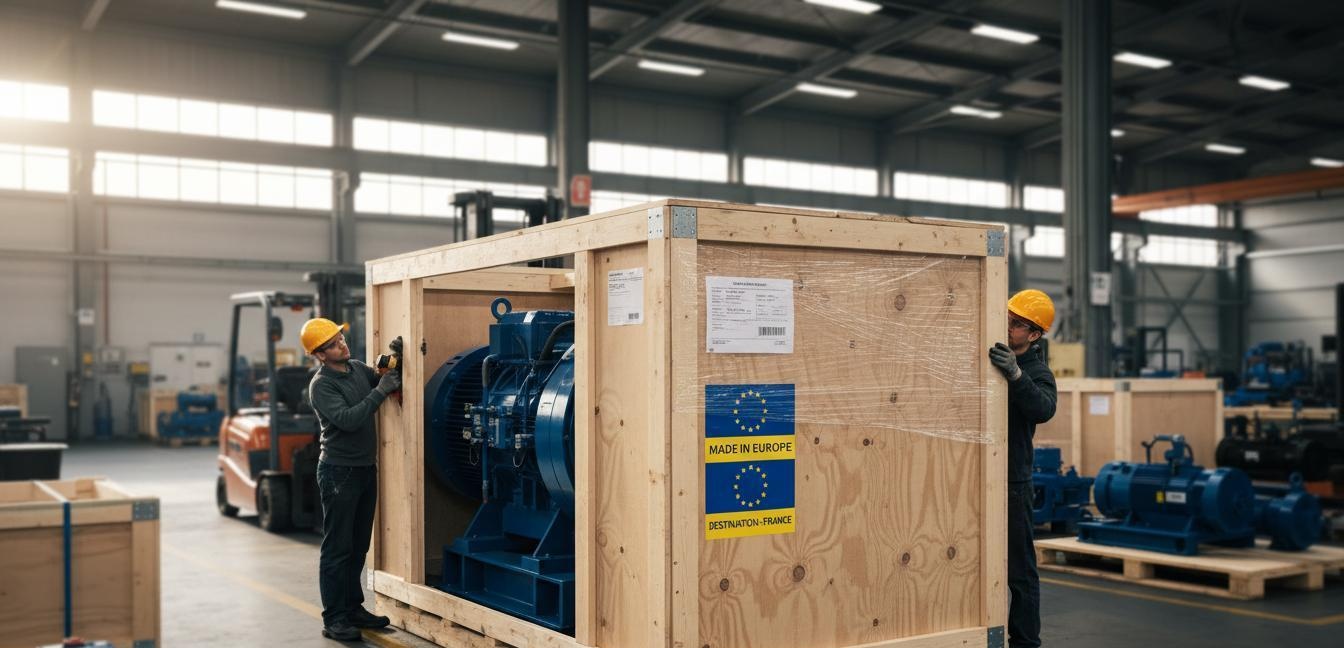
| Export packing and inland transport in China | 3-7 working days | Oversized crate, dangerous goods questions about oil, fumigation, or port cut-off timing | Confirm Incoterms, HS code discussion, packing method, and oil-draining policy early |
| Sea freight to Europe plus import handling | 30-55 days | Vessel blank sailings, transshipment, customs inspection, or missing EORI/importer data | Book forwarder space early and pre-check customs documents |
For planning, separate factory lead time from logistics lead time. A buyer may hear “45 days production” and assume the machine can be installed two months later. That is risky. Forty-five days of factory work plus sea freight, customs clearance, inland European trucking, and site receiving can become 11 to 14 weeks in practice. We prefer to show the project as a milestone chart because it prevents the common mistake of counting only manufacturing days.
There is also a hidden scheduling issue: engineering does not always begin on the day of the first email. It begins when the supplier has enough information to design safely. A hydraulic power unit is a compact system combining reservoir, pump, electric motor, manifold, valves, filters, cooling, sensors, piping, electrical control, and safety interfaces. If the buyer cannot confirm pressure, flow, duty cycle, ambient temperature, fluid viscosity, and electrical supply, the design team has to make assumptions. Assumptions save time today and often cost time later.
Why do custom hydraulic power units have such different lead times?
Lead time varies because a hydraulic power unit is not one component; it is an engineered package where every change can affect heat balance, noise, pressure stability, service access, documentation, and logistics. A change from 18.5 kW to 30 kW does not simply enlarge the motor. It can change oil tank volume, pump displacement, coupling, cooler size, electrical cabinet layout, lifting points, crate dimensions, and test procedure.
The largest time drivers are engineering novelty, component availability, testing depth, and shipping route. A repeat design with stocked pumps and standard valves moves quickly. A first-time design using proportional control, stainless steel tank, low-temperature seals, classification-related documents, or customer-nominated European components moves more slowly. In real procurement work, the slowest item is sometimes not the factory. It may be a branded valve, explosion-protection accessory, servo component, marine approval document, or customer-side drawing approval.
Because engineering changes multiply downstream, a late specification change can cost more time than a busy workshop. If a buyer changes the manifold logic after machining, the unit may need a new manifold, new piping, updated drawing, revised test plan, and renewed electrical check. That is why a disciplined supplier asks many questions before accepting the final schedule. It can feel slow at the beginning. I would rather lose two days in clarification than lose two weeks in rework.
According to ISO 4413:2010, hydraulic fluid power systems require general rules and safety requirements for systems and their components. In practical sourcing terms, this means pressure, control, leakage, cleanliness, and safety details should be treated as design inputs, not afterthoughts. A buyer who sends only “need 25 MPa and 60 L/min” is not giving enough information for a reliable custom build.
For European projects, compliance and import documentation add another layer. The European Commission CE marking guidance explains that CE marking indicates a product has been assessed to meet high safety, health, and environmental protection requirements where applicable. Not every hydraulic power unit is handled in exactly the same regulatory category, and final responsibility depends on the machine integration and market role, but buyers should still ask for declarations, manuals, electrical information, and risk-related documents early. Do not leave this to the week of shipment.
How should European buyers plan the schedule by project type?
A low-complexity custom hydraulic power unit can often be planned at 6 to 10 weeks end-to-end with fast approval and air or expedited freight, while a medium-complexity sea-freight project is better planned at 10 to 16 weeks. High-complexity systems should be treated as engineered equipment projects rather than catalog purchases.
Low-complexity repeat or near-standard unit: 6-10 weeks
A low-complexity unit usually has standard voltage, a conventional pump-motor set, ordinary carbon steel tank, standard filtration, no unusual control logic, and no special classification requirement. If components are available and the buyer approves drawings quickly, production may take 3 to 5 weeks. Air freight can reduce logistics to about 1 to 2 weeks, depending on airport routing and customs handling, but air freight costs more than sea freight because of weight and volume. Air freight is faster than sea freight because it removes port sailing cycles and ocean transit, but it can cost several times more per kilogram for heavy hydraulic equipment.
Medium-complexity new project: 10-16 weeks
This is the most common case for European industrial buyers. The unit may need a custom reservoir, cooler, manifold, sensors, pressure test, electrical control box, painted enclosure, or customer-specific interface dimensions. Engineering and procurement may take 3 to 7 weeks before assembly is complete. Sea freight then adds roughly 30 to 55 days including export, ocean transit, import processing, and inland movement. For a medium-complexity sea-freight order, 12 weeks is an optimistic plan and 16 weeks is a safer planning window.
High-complexity package: 14-24 weeks
A high-complexity package may include marine use, offshore duty, cold climate operation, stainless steel, redundant pumps, proportional valves, PLC control, remote monitoring, noise limits, customer-witnessed FAT, or third-party inspection. It may also need coordination with the main machine builder in Europe. The difficult part is not only building the unit; it is aligning design reviews, test criteria, certificates, export packing, and installation documentation. When the unit is safety-critical or integrated into a larger machine, schedule a design freeze milestone and an FAT readiness milestone before committing to the installation date.
INI Hydraulic’s export background is relevant here because the company has supplied hydraulic products to markets including Germany, the Netherlands, the United States, Australia, Russia, Turkey, Singapore, Japan, South Korea, Malaysia, Vietnam, India, and Iran. Its product range covers hydraulic systems, motors, pumps, winches, transmission drives, slewing drives, and planetary gearboxes. That does not eliminate schedule risk, but it gives buyers a broader engineering base when the hydraulic power unit must interact with winch, deck machinery, construction machinery, or mining equipment.
What information should a buyer send to get a reliable lead time?
The quickest way to get an accurate lead time is to send a complete technical package with operating data, interface requirements, compliance expectations, and logistics preferences in the first RFQ. A vague RFQ produces a vague delivery estimate. A precise RFQ lets the supplier identify long-lead parts within the first engineering review.
Send the required pressure in MPa or bar, rated and peak flow in L/min, motor power in kW, voltage and frequency such as 400 V / 50 Hz or 690 V / 50 Hz, duty cycle in minutes per hour, oil type and viscosity grade, tank volume in L, ambient temperature in °C, working environment, cleanliness target, noise limit in dB(A) if any, port standards, paint requirement, installation envelope, lifting and service access needs, control mode, sensor list, and preferred component brands. If the unit connects to a winch, press, deck crane, test rig, mining machine, or metallurgical line, explain the load cycle. Hydraulic design is about behavior over time, not only maximum pressure.
Because heat generation depends on duty cycle, a supplier cannot size the reservoir and cooler responsibly from pressure and flow alone. A 30 kW unit running 10 minutes per hour is a different thermal problem from a 30 kW unit running 50 minutes per hour. If the duty cycle is unknown, the supplier may oversize the tank and cooler for safety, which increases cost, weight, and shipping volume. Or worse, the supplier may undersize cooling and create a commissioning problem in Europe.
For documentation, request a commercial invoice, packing list, bill of lading or air waybill, certificate of origin if needed, test report, product manual, hydraulic schematic, electrical schematic if included, spare parts list, material or coating notes where relevant, and declaration documents appropriate to the final use. The European Commission Union Customs Code describes the EU framework for customs rules and procedures and its move toward electronic customs processes. In buyer language, that means incomplete documents can create real delays even after the goods physically arrive.
What does a good factory milestone plan look like?
A good milestone plan names the decision owner, output document, and acceptance rule for each stage. Without that structure, both sides may think the project is progressing while one critical approval is sitting in an inbox.
- RFQ freeze: buyer confirms pressure, flow, voltage, duty cycle, environment, quantity, target destination, and preferred Incoterms.
- Concept confirmation: supplier confirms basic hydraulic circuit, major components, approximate size, estimated mass, and scenario lead time.
- Drawing approval: buyer approves tank outline, port positions, lifting points, electrical cabinet location, service clearance, and interface dimensions.
- Procurement release: supplier orders long-lead components after commercial confirmation and approved substitutions.
- Fabrication start: reservoir, frame, manifold, pipework, and panel layout enter production according to released drawings.
- Assembly completion: pump, motor, filters, valves, gauges, sensors, hoses, piping, and wiring are installed.
- FAT readiness: pressure test, leakage inspection, functional test, oil cleanliness check if specified, and documentation package are prepared.
- Packing release: buyer or inspector accepts the test record, photos, nameplate, packing method, and shipment documents.
We like this structure because it keeps engineering, purchasing, production, quality, export, and the customer’s project team looking at the same clock. Because each milestone has a named output, schedule risk becomes visible before it becomes a late shipment. That visibility matters for European OEMs that must coordinate installation crews, site shutdowns, vessel docking windows, or customer acceptance dates.
How long does shipping from China to Europe add?
Shipping from China to Europe usually adds about 30 to 55 days by sea after export packing, while air freight can reduce transit and handling to roughly 5 to 14 days for suitable cargo. These are planning ranges, not guarantees. Actual performance depends on origin port, destination port, vessel schedule, transshipment, season, customs inspection, local trucking, and whether the crate is standard cargo or oversized cargo.
Hydraulic power units are often heavy and sometimes bulky. Sea freight is usually the economical choice for medium and large units, especially if the order includes multiple crates, spare parts, or related hydraulic equipment. Air freight is useful when a shutdown cost is higher than the freight premium, when the unit is compact, or when the buyer needs a prototype for testing. Rail freight from China to Europe can sometimes sit between sea and air in time and cost, but availability and route reliability vary by period and destination.
According to the European Commission’s maritime transport information, more than 80% of world merchandise trade by volume is carried by sea. That scale is why ocean freight is cost-effective, but it also explains why buyers should not treat a vessel ETD or ETA as a fixed installation date. Ports, carriers, customs, and inland hauliers all affect the final arrival at the factory gate.
Discuss whether the unit will be shipped with oil drained or with preservation oil, and confirm how ports and airlines treat any fluid residue. Wooden packing may need to follow ISPM 15 treatment requirements for international movement. Ask for crate dimensions and gross weight early because freight quotes and booking decisions depend on chargeable volume and lifting method. A crate that misses the container planning limit by 50 mm can change the freight solution, so packing design is part of lead-time control.
Europe import and logistics checklist before shipment
The import checklist should be completed before the hydraulic power unit leaves the factory, not after the vessel sails. Many delays that look like “customs problems” are actually preventable document or classification gaps.
- Confirm the importer of record and EORI number for EU customs processes.
- Agree Incoterms such as EXW, FOB, CIF, DAP, or DDP with a forwarder who understands industrial equipment.
- Review the HS code discussion with the customs broker; the final classification should be made by the responsible importer or broker.
- Prepare invoice, packing list, bill of lading or air waybill, and certificate of origin if requested.
- Confirm whether CE-related documents, declaration documents, manuals, or risk information are needed for the final machine integration.
- Request hydraulic and electrical schematics, test report, spare parts list, and installation notes in English.
- Check crate size, gross weight, lifting points, center of gravity notes, and unloading equipment at the European site.
- Confirm oil status, preservation method, desiccant, anti-rust protection, and storage conditions during transport.
- Align delivery window with port handling, customs inspection possibility, and inland truck availability.
The European import side is where buyers can gain or lose a full week without touching the product. If the consignee is wrong, the EORI number is missing, the broker does not have technical description, or the documents show inconsistent weights, the shipment can wait. The factory may have finished on time, but the project still feels late. I am worried whenever a buyer says, “We will handle customs later.” Later is usually too late.
How can buyers accelerate the schedule without increasing quality risk?
The safest acceleration method is parallel preparation: freeze technical requirements, pre-approve alternative components, book logistics early, and define FAT criteria before assembly starts. Unsafe acceleration means skipping tests, accepting unclear drawings, or shipping with incomplete documents. That often creates a bigger delay during commissioning.
First, use a one-page specification freeze sheet. It should list pressure, flow, motor, tank, valve brand, control mode, coating, ports, documents, tests, and destination. Once frozen, any change needs a schedule-impact note. This may sound formal, but it is the simplest way to stop small requests from becoming hidden redesigns.
Second, agree equivalent component rules. If the nominated pump or valve has a 6-week supplier lead time, ask whether an approved equivalent is acceptable. A nominated European component may cost 15% to 40% more than a Chinese or globally stocked equivalent because of brand policy, import channel, and availability, but it may reduce approval risk for conservative OEMs. There is no universal best answer. The right choice depends on the buyer’s service network, spare parts policy, and end-customer preference.
Third, split shipment only when it truly helps. For example, a compact control valve kit or urgent spare sensor may fly ahead while the heavy reservoir travels by sea. But splitting shipments creates extra paperwork and coordination. Use it for commissioning-critical items, not as a habit.
Fourth, hold a remote pre-FAT review. Ask for photos, video, pressure readings, leakage inspection notes, nameplate details, and packing photos before the final FAT date. A remote review can catch labeling, port orientation, manual, or wiring issues early. It does not replace formal testing, but it reduces surprises.
Fifth, make payment, inspection, and document workflows match the schedule. A project can lose five working days because a bank payment, third-party inspection booking, or internal approval is slower than production. Because factory capacity is scheduled in slots, missing a payment or approval cut-off can push the project behind other orders even if the hardware is ready.
What timeline should you use for internal planning?
For internal planning, use three dates: target ex-works date, target port arrival date, and conservative site-ready date. The site-ready date should include customs clearance, inland transport, unloading, inspection, and a small buffer for document questions. If installation crews or production shutdowns depend on the unit, do not plan them against the earliest possible arrival.
Here is a practical model. For a medium-complexity hydraulic power unit with sea freight to Europe, plan 2 weeks for RFQ and drawing approval, 5 weeks for procurement and production, 1 week for FAT and packing, 6 weeks for sea freight and import handling, and 1 week for inland delivery and receiving. That totals 15 weeks. If everything goes smoothly, it may arrive earlier. If one long-lead valve or customs inspection appears, the plan still survives.
For an urgent small unit, plan 1 week for specification freeze, 3 to 4 weeks for production if components are available, 1 week for testing and packing, and 1 to 2 weeks for air logistics and import handling. That totals 6 to 8 weeks. This is possible only when the design is simple, the buyer approves quickly, and the freight budget supports air shipment.
For a high-complexity unit, do not hide the risk. Plan 4 to 6 weeks for engineering and procurement alignment, 6 to 10 weeks for production and test, and 6 to 8 weeks for sea logistics and import handling. That totals 16 to 24 weeks. When the equipment is mission-critical, a longer honest plan is cheaper than a short optimistic plan that fails during commissioning.
FAQ
Can a custom hydraulic power unit be manufactured in China in less than 30 days?
Yes, but only for simple or repeat designs with available components and fast drawing approval. A new engineered unit with custom tank, special valves, electrical control, or detailed FAT normally needs more than 30 calendar days before shipment.
Does sea freight or production usually take longer?
For medium projects, production and sea logistics can be similar in duration. Production may take 4 to 8 weeks, while sea freight plus import handling can add 30 to 55 days. Buyers should track both clocks separately.
Can I reduce lead time by accepting supplier-standard components?
Often yes, if the supplier-standard components meet the pressure, flow, safety, service, and documentation requirements. Pre-approved equivalents can avoid waiting for a nominated brand. However, European OEMs should consider spare parts availability and customer acceptance before changing brands.
What documents should I request before the unit ships to Europe?
Request invoice, packing list, transport document, test report, hydraulic schematic, manual, spare parts list, and applicable declaration or compliance documents. Ask your customs broker and machine safety team what they need before the goods leave China.
Is air freight a good option for hydraulic power units?
Air freight is useful for urgent compact units or critical spares, but it is expensive for heavy reservoirs and large frames. It can reduce logistics time to roughly 5 to 14 days, but crate dimensions, weight, oil residue, and airport handling must be checked early.
When should I book a freight forwarder?
Engage the forwarder when the order is released, not when production is finished. Early booking allows crate planning, HS code discussion, document review, and port schedule alignment before the FAT is complete.
What is the biggest buyer-controlled cause of delay?
The biggest buyer-controlled delay is late technical change after drawing approval. Changing voltage, tank size, port position, valve brand, or control logic after procurement or fabrication can restart engineering and add days or weeks.
Conclusion: plan by milestones, not by hope
A custom hydraulic power unit from China to Europe should normally be planned at 8 to 16 weeks, with 10 to 16 weeks being the safest working range for many sea-freight industrial projects. Faster schedules are possible when the design is simple, components are available, decisions are centralized, and air freight is justified. Longer schedules are normal when the unit is complex, safety-critical, documentation-heavy, or dependent on long-lead imported components.
The best acceleration strategy is boring but powerful: send complete technical data, freeze the drawing, approve equivalents, define the FAT, prepare customs documents, and book logistics early. If you are evaluating a hydraulic station or custom hydraulic power unit for European equipment, start with the application data and ask the supplier to map the bottleneck. That conversation will tell you more than a single promised delivery date.
Need a project-specific schedule? Share pressure, flow, duty cycle, voltage, environment, destination country, and target installation date with INI Hydraulic’s export team through the hydraulic stations product page. The response should be treated as a scenario estimate until drawings, components, testing, and logistics are confirmed.
Post time: May-18-2026