
When I first visited a major Korean shipyard's mooring analysis office, I was struck by the wall of calculation sheets pinned around the engineer's workstation — each one mapping a different combination of vessel displacement, tidal range, windage area, and mooring line geometry. That level of rigor is exactly why Korean LNG terminals maintain one of the safest berthing records in the world. Sizing a hydraulic mooring winch for an LNG carrier berth is not a matter of picking a catalog number. It demands a systematic engineering process that translates berth geometry, vessel characteristics, and regulatory mandates into a precise set of hydraulic winch specifications.
In this article, I want to walk you through how Korean shipyards and terminal operators approach that process — from the initial load analysis to the final hydraulic system integration. I will also explain why INI Hydraulic structures its custom winch engineering workflow the way it does, and how that approach dovetails with the expectations of classification societies like the Korean Register of Shipping (KR) and the American Bureau of Shipping (ABS).
The Berthing Context That Drives Every Sizing Decision
Korean LNG import terminals — at locations like Tongyeong, Pyeongtaek, and the massive Yeosu complex — handle some of the largest conventional LNG carriers afloat today, ranging from 125,000 to 180,000 cubic meters in capacity. The moment a vessel of that size approaches a berth, the mooring system must absorb a complex cocktail of environmental and operational forces. Wind loads on the exposed hull surface can exceed several hundred kilonewtons under typhoon conditions. Tidal currents in Korea's coastal waters generate persistent lateral forces. Ship motions during cargo transfer — caused by thermal expansion of the hull, small wave oscillations, and even the sloshing of LNG in partially filled tanks — translate into dynamic line load variations that the mooring winch must accommodate without triggering an emergency release.
This is precisely why Korean terminal specifications and Society of Naval Architects and Marine Engineers (SNAME) guidelines demand a comprehensive mooring analysis before any winch procurement begins. The analysis considers the full-loaded displacement of the design vessel, the mooring arrangement plan showing line lead angles, and the environmental design criteria for the specific berth location. Only after these inputs are quantified can an engineer arrive at the line pull and brake holding force requirements that drive hydraulic mooring winch selection.
Classifying the Load: How Classification Societies Set the Baseline
The Korean Register of Shipping (KR) and ABS Rules for Building and Classing Vessels both publish specific requirements for mooring equipment used at LNG terminals. These rules do not prescribe a single line pull number — instead, they provide a framework that the terminal operator's engineering team must populate with berth-specific data. The IGF Code, which governs LNG carrier maritime safety standards, adds further constraints related to the behavior of LNG as cargo and the consequences of a mooring failure in a gas-handling environment.
In practice, this means the winch brake holding capacity must be rated at a minimum of 1.5 times the maximum working line load, with many Korean terminal operators specifying a 2.0 safety factor for breast mooring lines. For a typical 150,000 cbm LNG carrier with a loaded displacement approaching 100,000 tonnes, this translates into individual winch line pulls that can reach 200–250 kN per unit, distributed across multiple mooring points along the breasting dolphins and trestle approach. When I discuss these specifications with our engineering team at INI Hydraulic, we run the hydraulic motor sizing calculations against the brake holding torque requirement first, then verify that the reduction gearbox and drum shaft can handle the resulting bending moments without excessive deflection.
Displacement and Line Pull: The Core of the Engineering Calculation
The starting point for any mooring winch sizing exercise is the vessel's maximum displacement at the berth. Korean shipyards typically design for the worst-case loaded condition — the vessel at full cargo capacity, maximum draft, and maximum windage area. From that displacement figure, the mooring engineer calculates the environmental forces using empirical formulas from OCIMF's "Prediction of Wind and Current Loads on VLCCs" or equivalent standards recognized by the Maritime Safety Authority of Korea.
Those environmental forces are then distributed across the mooring lines in the approved mooring plan, taking into account the lead angles and scope of each line. A breast mooring line, for instance, carries a much higher proportion of the total lateral force than a spring line at a shallow lead angle. This distribution is what determines the design line pull for the hydraulic mooring winch serving each mooring point. The winch must not only hold that load statically — it must also be capable of paying out and taking in the line smoothly during the vessel's approach and departure sequence, without introducing shock loads that could damage the line or the winch brake system.
At INI Hydraulic, we have standardized around a range of hydraulic motor displacements that cover the 80–400 kN line pull envelope commonly encountered in Korean LNG terminal projects. Our design team selects the motor displacement, pressure rating, and gearbox ratio as an integrated system, rather than picking an "off-the-shelf" motor and hoping the application fits. This is why I consistently recommend that buyers share the full mooring analysis report with us during the enquiry stage — the more data we receive, the more precisely we can size the hydraulic circuit and avoid the costly problem of a winch that is either underpowered or grotesquely over-engineered.
Brake Holding Capacity and Its Role in Berthing Safety
While line pull determines the winch's working capacity, brake holding capacity is the safety anchor of the entire mooring system. In the context of a Korean LNG berth, the brake holding capacity represents the maximum load the winch brake can sustain without slipping, and it is almost always specified at a multiple of the working line pull. I have seen terminal specifications requiring brake holding capacities of 1.8×, 2.0×, and even 2.5× the working load for breast mooring winches on exposed berths with significant wave action.
The hydraulic circuit design directly affects brake holding performance. INI Hydraulic's mooring winches employ a dual-circuit braking system: a spring-applied, hydraulically released multi-disc service brake for normal operation, and a failsafe emergency brake that engages automatically upon hydraulic pressure loss. Both circuits are independently rated, which satisfies the redundancy requirements of ISO 3821 for hydraulic fluid power systems and the classification society rules covering mooring winches on gas carriers. During load testing at our factory in Ningbo, we verify each winch's brake holding capacity at 125% of its rated holding force, using a calibrated hydraulic puller that simulates the full design load condition.
The Hydraulic Circuit: Matching Motor, Pump, and Valve Package
Once the mechanical sizing is confirmed, the hydraulic system design becomes the next critical engineering challenge. A well-designed hydraulic mooring winch circuit must deliver smooth variable-speed control across the full range of line pay-out and retrieval speeds while maintaining sufficient line tension during the hold phase. For Korean LNG terminals, the operational profile typically involves long periods of tension-hold during cargo transfer, punctuated by brief moments of active line adjustment during berthing and departure.
INI Hydraulic's standard mooring winch circuit uses a variable-displacement axial piston motor driving through a planetary gearbox to the winch drum. The pump station — which may serve multiple winches at a single berth — is designed with load-sensing pressure compensation so that each winch receives the flow it demands without causing system-wide pressure drops. The proportional directional control valve governing each winch is sized for the full motor flow at maximum speed, ensuring that the valve never operates in a choked-flow regime that would generate excessive heat in the hydraulic fluid.
One detail that I find many buyers underestimate is the importance of hose and fitting pressure ratings in the winch's hydraulic circuit. The working pressure in a 250 kN mooring winch circuit can reach 25–28 MPa during a heavy pull, and the pressure spikes during brake engagement can push peaks significantly higher. All INI Hydraulic winches use hose assemblies rated to at least 35 MPa working pressure with a 4:1 safety factor, and every fitting is rated to the same standard. This is not optional — it is a baseline requirement for any winch intended for Korean classification society approval.
The Mooring Analysis Report: Your Most Important Procurement Document
If there is one piece of advice I can offer to any procurement manager or project engineer evaluating hydraulic mooring winches for a Korean LNG berth, it is this: commission and share the mooring analysis report before you issue an enquiry. This document is the Rosetta Stone of winch sizing. It contains the design vessel parameters, the environmental load criteria, the mooring arrangement plan with line lead angles, the calculated line loads for each mooring point, and the required brake holding capacity. Without it, any winch supplier is essentially guessing — and a guessed spec can lead to a winch that is dangerous if undersized or economically ruinous if overbuilt.
I have worked with terminal operators in Busan and Geoje who arrived at our engineering review meeting with a mooring analysis report that was three centimetres thick. Those projects produced the smoothest procurement cycles I have experienced, because the engineering teams on both sides were speaking the same technical language from day one. The supplier understood exactly what the berth demanded, and the buyer had confidence that the winch being quoted was not a warmed-over catalog unit but a purpose-engineered piece of equipment.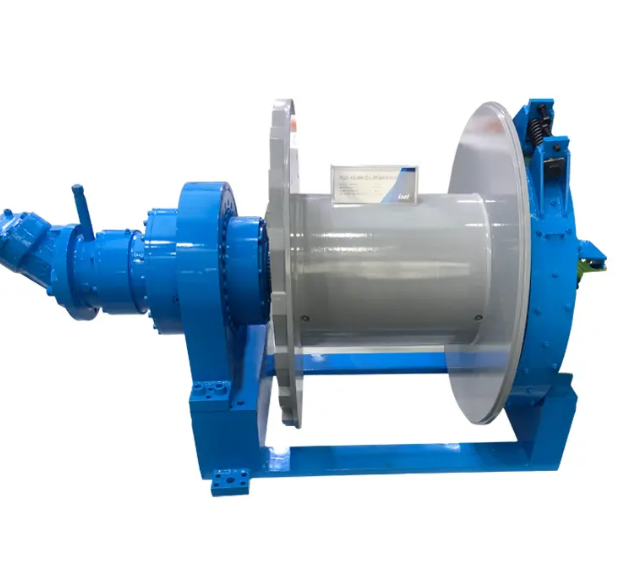
Berth Geometry and Winch Layout: Why Location Within the Terminal Matters
Beyond the load calculations, Korean shipyards and terminal designers must contend with the physical layout of the berth structure. Breasting mooring dolphins typically protrude from the quay wall at a fixed distance, which determines the lead angle of the mooring line from the winch fairlead to the bitts on the vessel's deck. A steep lead angle — common on compact berths with limited trestle length — concentrates more load on the winch brake and less on the dolphins' mooring hooks. A shallow lead angle distributes load more evenly but requires longer mooring lines, which introduces greater elasticity into the system.
INI Hydraulic's engineering team models each berth's lead geometry during the proposal stage using the mooring plan provided by the terminal operator. We pay particular attention to the fleet angle at the winch drum — if the mooring line enters the drum at an angle greater than 1.5 degrees from the drum axis, the line will tend to stack unevenly on the drum flanges, leading to accelerated wear on both the line and the drum surface. We address this by specifying an adjustable fairlead sheave assembly that can be positioned to optimize the fleet angle regardless of the berth's structural constraints.
Meeting Korean Classification Society Requirements, Control Integration, and Supplier Qualification
The Korean Register of Shipping (KR) conducts plan review and construction survey for most mooring equipment installed at Korean-flagged vessels and Korean-port terminals. To obtain KR type approval or a shop test certificate, the winch supplier must provide design calculations, material test certificates, hydraulic circuit diagrams, brake test records, and load test results from the factory. ABS Rules for Building and Classing Vessels apply when the terminal or the mooring system is being built under ABS survey, which is common for projects with international financing.
At INI Hydraulic, we maintain a documentation package for each custom mooring winch project that is formatted to satisfy both KR and ABS submission requirements. This includes a fatigue analysis of the winch frame under cyclic loading, a brake thermal rise calculation for the worst-case sustained hold scenario, and a full weld map for the structural steel housing. Our quality system is certified to ISO 9001, and we welcome third-party inspection by KR, ABS, Lloyd's Register, or any other IACS-classification society nominated by the buyer. I believe this transparency at the engineering stage is one of the key reasons why INI Hydraulic has built a strong track record in Korean LNG terminal projects over the past several years.
Modern Korean LNG terminals are highly automated environments where the berth management system coordinates mooring operations alongside cargo handling, bunkering, and safety monitoring. The hydraulic mooring winch at each mooring point must therefore be integrated into this broader control architecture. INI Hydraulic winches are available with a choice of industrial communication protocols — Profibus DP, Modbus TCP, and CANopen — that allow the berth operator's distributed control system to query winch status, set tension setpoints, and trigger emergency functions remotely.
During cargo transfer operations, the mooring winch typically operates in tension-hold mode, maintaining a pre-set line tension that compensates for the vessel's thermal expansion and tidal variation without triggering unnecessary brake engagement cycles. The load cell feedback loop on each winch provides real-time tension data to the control room, giving the operator a complete situational picture of the mooring system without needing to send personnel onto the mooring deck. For berths equipped with mooring line tension monitoring (MLTM) systems, this data integration is essential — and it is a feature that many buyers who come from the container ship or dry bulk sector underestimate when first specifying equipment for an LNG terminal.
I have seen the consequences of improperly sized mooring winches at terminals in other regions — equipment purchased on a lowest-price basis without a proper mooring analysis, then found inadequate when the terminal operator encountered its first major storm event. The failure modes range from premature brake pad wear (caused by a winch that is too small for the load and cycles its brake too frequently) to structural distortion of the winch frame (caused by a gearbox not sized for the sustained holding load). In the most extreme cases, the winch brake was unable to hold the vessel at the berth during a typhoon, requiring emergency tug attendance and a vessel evacuation that cost the terminal operator several hundred thousand dollars in emergency response charges. This is precisely why I recommend that buyers look beyond the datasheet line pull number and examine the supplier's hydraulic engineering capability, quality system documentation, and track record with classification society approvals when evaluating winch suppliers for a Korean LNG project.
INI Hydraulic has manufactured hydraulic winches for over two decades, and our Ningbo facility includes a dedicated load test bed capable of applying full-rated line pull to winches up to 500 kN capacity. Every winch undergoes a minimum two-hour load acceptance test before dispatch, during which we measure drum temperature rise, verify brake holding force, and confirm the performance of the proportional control valve across the full speed range. We also source hydraulic motors from established manufacturers like Rexroth and Parker, and design our winch gearboxes using standardized planetary stages that can be rebuilt in the field without returning the winch to the factory. This matters in a Korean terminal environment where scheduled maintenance windows are tight and unplanned downtime carries significant operational cost. We maintain an inventory of replacement brake pads, seal kits, and hydraulic hose assemblies that can be dispatched within 48 hours to any Korean port, backed by our regional technical support network.
Why does INI Hydraulic supply fully custom hydraulic mooring winches instead of catalog-only models?
Every LNG berth carries unique tidal conditions, vessel tonnage profiles, and regulatory requirements. INI Hydraulic designs each mooring winch from the ground up, matching displacement, line pull, brake holding capacity, and drum layout to the specific berth envelope. This approach eliminates the mismatch between off-the-shelf specs and real operational demands, which is why shipyards across Southeast Asia, the Middle East, and Europe specify INI Hydraulic winches for their most demanding LNG carrier berths.
What brake holding capacity should a hydraulic mooring winch deliver for a typical Korean LNG carrier berth?
Korean classification society standards and terminal operator specifications typically require a brake holding capacity of at least 1.5 to 2 times the maximum working load. For a 150,000–180,000 cbm LNG carrier, this translates to line pulls in the 150–250 kN range per winch, with multiple winches distributed along the breasting mooring dolphins. The exact figure depends on the vessel's displacement at loaded condition, the mooring arrangement geometry, and whether the berth experiences significant wind, current, or tidal surge loads.
How does INI Hydraulic integrate its hydraulic mooring winches with existing shipyard control and monitoring systems?
INI Hydraulic's mooring winches communicate with shipyard DCS and berth management systems via Profibus, Modbus TCP, or CANopen protocols depending on the terminal operator's infrastructure. Each winch unit carries an integrated tension feedback loop using load-cell sensing, enabling automatic tension-hold mode during cargo transfer operations. We also provide an optional HMI panel at each mooring station with real-time line tension display, alarm history logging, and manual override capability for emergency release scenarios.
About the Author
Mr. Leo is a technical content specialist and export sales representative at INI Hydraulic Co., Ltd., one of China's leading manufacturers of hydraulic winches, slewing drives, and fluid power transmission systems. Through INI Hydraulic's YouTube channel and social media platforms, he produces hands-on technical content — including hydraulic system animations, winch load testing footage, and OEM procurement walkthroughs — that helps international buyers understand INI's product engineering before placing orders.
With a background in hydraulic transmission engineering and four years supporting offshore, marine, and construction machinery buyers across Southeast Asia, the Middle East, and Europe, Leo translates complex hydraulic spec sheets into practical procurement guidance for OEM engineers, shipyard procurement managers, and industrial equipment distributors.
Getting the sizing right on a hydraulic mooring winch for a Korean LNG berth is not a one-step procurement decision — it is a multi-stage engineering process that starts with the mooring analysis and ends with the on-site load acceptance test. Korean shipyards and terminal operators have refined this process over decades of LNG terminal construction, and the result is a set of moored vessels that hold safely through cargo transfer operations in conditions that would challenge equipment designed to looser standards.
INI Hydraulic's role in this process is to be the engineering partner who takes the mooring analysis report and transforms it into a winch that performs reliably at the rated load for the design life of the berth. If you are currently evaluating hydraulic mooring winches for a new or existing LNG terminal project, I encourage you to reach out to our technical team and share your mooring analysis. We will provide a detailed technical proposal that addresses every load case, every classification society requirement, and every integration concern — because that is what the engineering process demands, and that is what INI Hydraulic has built its reputation on delivering.
Related Products: Hydraulic Winch | Hydraulic Slewing Drive | Hydraulic Motor
Post time: Jul-02-2026