
TL;DR
- A hydraulic planetary gearbox is usually the safer choice for high-torque, reversing, shock-loaded mining conveyors.
- A worm gearbox is usually better for lower-power conveyors where self-locking behavior and low initial cost matter more than efficiency.
- Planetary gearing commonly offers about 90% to 97% efficiency per reducer, while worm gearing often operates around 50% to 90% depending on ratio, lead angle, lubrication, and speed.
- Choose by conveyor duty cycle, starts per hour, brake philosophy, heat rejection, service access, and five-year total cost of ownership.
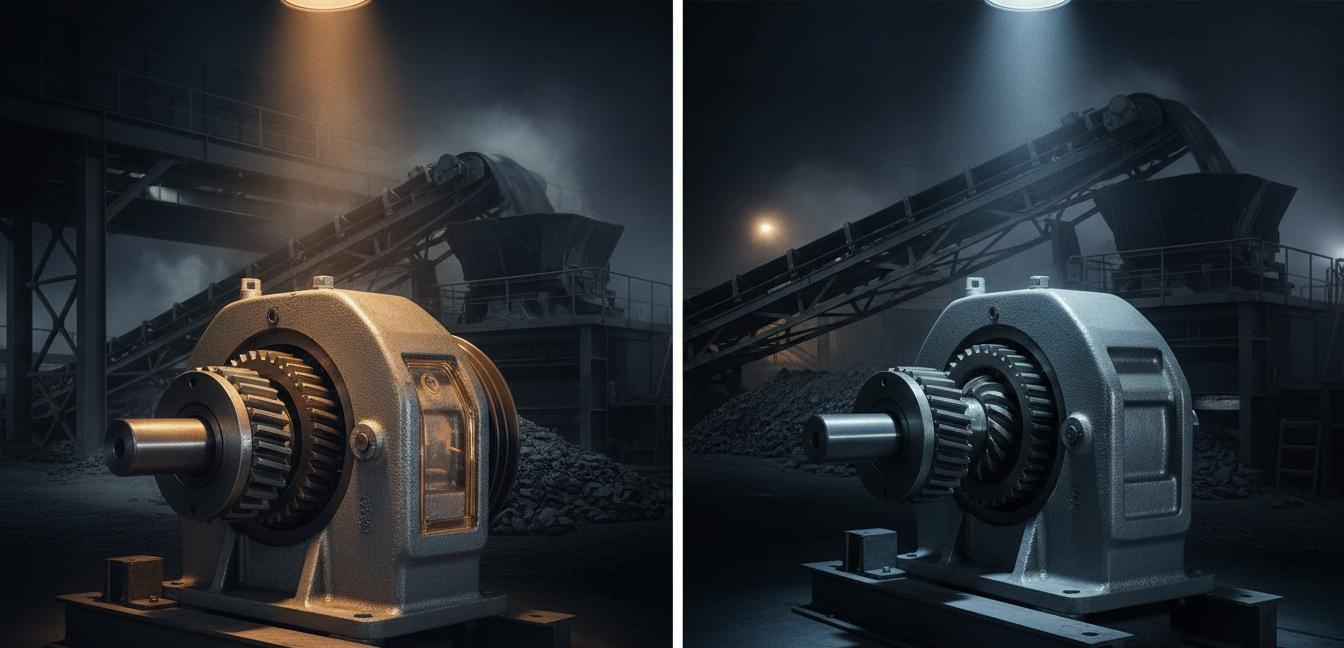 For a mining conveyor, choose a hydraulic planetary gearbox when the drive must handle high starting torque, frequent starts and stops, reversing, impact loading, compact mounting, and continuous heavy duty service. Choose a worm gearbox when the conveyor is smaller, slower, lightly loaded, and benefits from inherent resistance to backdriving. The reason is simple: because a planetary gearbox shares torque through multiple planet gears, it normally survives shock loads and high radial torque density better; therefore it is usually the preferred option for main haulage, feeder, and incline conveyor drives.
A worm gearbox can still be the right answer when the application values holding behavior more than mechanical efficiency. However, buyers should not treat “self-locking” as a certified brake. In mining, a conveyor that can store gravitational energy, carry personnel risk, or roll back under a loaded belt needs a properly selected brake, holdback, or backstop regardless of reducer type. For hydraulic drive packages, the planetary gearbox also integrates naturally with hydraulic motors, wet brakes, and overload protection, so it often gives a cleaner engineering path than adapting a worm reducer to a high-torque hydraulic system.
Quick Answer: Which Gearbox Fits Which Conveyor?
Use a hydraulic planetary gearbox for the conveyor positions that decide mine uptime: incline belts, mobile crushing conveyors, feeder breakers, reclaim conveyors, and high-start-torque transfer lines. Use a worm gearbox for smaller auxiliary conveyors, indexing equipment, gates, take-up adjustment drives, or low-duty systems where compact right-angle layout and holding resistance are useful.
In export projects I would be cautious about any single-line answer such as “planetary is always better.” It is not. A worm reducer can be quiet, economical, and convenient. But mining conveyors punish weak assumptions. Ore does not arrive politely. It surges, sticks, freezes, drops, and sometimes arrives as a lump that makes the entire drive train complain. That is where planetary gearing earns its reputation.
Planetary gearboxes normally cost more upfront than worm gearboxes, often by about 20% to 80% for comparable industrial torque classes, primarily because of tighter gear geometry, multiple load-sharing gears, bearing capacity, sealing, and brake integration. The purchase price can be misleading, because a worm gearbox with lower efficiency may require a larger motor, larger hydraulic power unit, more cooling, or more electrical energy over the same duty cycle.
A worm gearbox can cost less than a planetary gearbox, because its sliding-contact worm and wheel design is simpler in many low-ratio, low-power packages; therefore it remains attractive for non-critical conveyors with intermittent duty. The tradeoff is heat. Sliding contact generates more friction than rolling gear mesh. If the conveyor runs continuously for 16 hours to 24 hours per day, that lost efficiency becomes operating cost and thermal risk.
What Do These Two Gearboxes Mean in a Conveyor Drive?
A hydraulic planetary gearbox is a compact speed reducer that uses a sun gear, multiple planet gears, and a ring gear to transmit high torque from a hydraulic motor to a conveyor pulley or drive shaft. The planets divide the load across several gear meshes, which allows high torque density in a relatively small housing. This is why planetary units are common in winches, tracked machines, slewing drives, and heavy conveyor drives.
A worm gearbox is a right-angle speed reducer that uses a screw-like worm to drive a worm wheel, converting input rotation into slower output rotation with high reduction in a compact layout. Worm gearsets can resist backdriving at certain ratios and lead angles, but that behavior depends on friction, lubrication, wear, vibration, and operating temperature. It should be treated as a design characteristic, not a safety guarantee.
INI Hydraulic states that it designs and manufactures hydraulic winches, hydraulic motors, and planetary gearboxes for heavy machinery applications including mining and metallurgical machinery. That product fit matters here. A mining conveyor gearbox is rarely just a reducer; it is part of a drive package involving the hydraulic motor, couplings, brakes, torque arm, guards, cooling, seals, and site maintenance practices.
According to CEMA, belt conveyor design requires coordinated attention to power, belt tension, pulleys, idlers, take-up, and operating conditions. Gearbox selection therefore should not be isolated from conveyor calculations. Because the reducer sees the consequences of belt tension spikes and material surges, therefore gearbox selection must start from real conveyor duty rather than catalog torque alone.
Hydraulic Planetary Gearbox vs Worm Gearbox: Technical Comparison
The strongest practical difference is that planetary gearing is usually optimized for torque density and efficiency, while worm gearing is usually optimized for right-angle layout, high ratio in one stage, and backdrive resistance. The table below uses cautious engineering ranges. Exact values depend on ratio, lubrication, tooth geometry, bearing arrangement, housing material, thermal rating, and manufacturer design.
| Selection factor | Hydraulic planetary gearbox | Worm gearbox | Procurement implication |
|---|---|---|---|
| Typical reducer efficiency | About 90% to 97% for many spur/helical planetary stages, depending on stage count and design. | About 50% to 90%, depending heavily on ratio, lead angle, lubrication, speed, and load. | Planetary often reduces heat and energy loss in continuous duty. |
| Torque density | High torque in compact coaxial form because several planet gears share load. | Moderate to high torque, but thermal rating may limit continuous output. | Planetary is usually easier to package in mobile mining machines. |
| Shock load tolerance | Generally strong when bearings, carrier, and gears are sized for service factor and overload. | Can tolerate steady loads, but sliding contact and wheel material may be sensitive to overload heat and wear. | Planetary is preferred for lump impact, jams, and high starting torque. |
| Backdriving behavior | Usually backdrivable unless brake or holdback is added. | May resist backdriving at suitable ratios, but not reliably enough to replace a safety brake. | Do not remove the brake from a loaded incline conveyor just because a worm gearbox is selected. |
| Hydraulic motor integration | Very compatible with hydraulic motors, wet brakes, and compact drive packages. | Possible, but mounting, side load, brake, and heat checks need more care. | Planetary is usually cleaner for hydraulic conveyor drive modules. |
| Maintenance sensitivity | Requires clean lubricant, correct sealing, bearing inspection, and backlash monitoring. | Requires careful lubricant selection because sliding contact produces heat and wear. | Both need disciplined oil management in dusty mines. |
| Initial price | Often higher for the same nominal torque class. | Often lower for simple low-power and medium-ratio applications. | Worm may win small auxiliary drives, but TCO can reverse the decision in continuous duty. |
According to AGMA, gear rating depends on geometry, materials, lubrication, operating conditions, and application factors rather than one nominal torque number. That is the quiet detail many RFQs miss. A reducer that looks adequate at 45 kW on paper can fail early if it sees repeated jam starts, poor oil cleanliness, and misaligned mounting.
According to KHK Gears, worm gears use sliding action between the worm and wheel, which explains both their smooth operation and their efficiency limitations. Because worm gear efficiency depends strongly on friction conditions, therefore a worm reducer that is acceptable in intermittent duty may become too hot in a 24-hour mining conveyor application.
Mining Conveyor Selection Matrix
The best gearbox choice changes by conveyor role, not by brand preference. Use this matrix as a procurement screening tool before sending the final duty data to the gearbox manufacturer. It is not a substitute for a certified drive calculation, but it prevents the most expensive early mistakes.
| Conveyor scenario | Typical risk profile | Recommended gearbox direction | Reason for the recommendation |
|---|---|---|---|
| Incline conveyor carrying ore upward | Rollback, high start torque, heavy belt tension, brake dependency. | Hydraulic planetary gearbox with engineered brake or holdback. | High torque density and brake integration are more important than low purchase price. |
| Mobile crusher discharge conveyor | Shock loads, dust, vibration, changing material feed. | Hydraulic planetary gearbox. | Compact hydraulic drive packaging and overload tolerance are valuable. |
| Small sampling conveyor | Low power, intermittent duty, limited running hours. | Worm gearbox can be acceptable. | Lower initial cost and right-angle layout may outweigh efficiency loss. |
| Reversible transfer conveyor | Frequent direction changes, torque reversals, possible plugging. | Hydraulic planetary gearbox. | Planetary gearing is generally better for controlled reversing under high torque. |
| Take-up or adjustment drive | Low speed, intermittent movement, holding requirement. | Worm gearbox or planetary with brake, depending on safety class. | Backdrive resistance may be useful, but safety-critical holding still needs a verified brake. |
| Underground main haulage conveyor | High uptime requirement, strict safety review, difficult maintenance access. | Hydraulic planetary gearbox with documented service factor and brake design. | Efficiency, heat control, and maintainability dominate five-year cost. |
According to MSHA 30 CFR 75.1722, moving machine parts must be guarded to protect personnel from contact. Gearbox choice affects guarding geometry, access doors, brake inspection, and lubrication points. A compact planetary drive can simplify guards on mobile equipment, while a right-angle worm drive can simplify shaft layout in fixed auxiliary equipment.
Seven Engineering Factors Buyers Should Check
A gearbox quotation is only reliable when the supplier receives the real duty cycle, not only motor power and output speed. For mining conveyor systems, ask your engineering team to define the following seven items before comparing planetary and worm options.
1. Starting torque and breakaway load are often higher than running torque
Starting torque should be calculated from the loaded belt condition, not from the empty conveyor. Wet ore, frozen material, belt sag, and chute build-up can push breakaway torque far above steady-state running torque. Planetary gearboxes usually tolerate these events better when the carrier, bearings, and gear teeth are sized with a suitable service factor. Worm gearboxes may handle the nominal torque yet run into thermal or wear limits during repeated stalled starts.
2. Duty cycle changes the answer more than catalog ratio
A conveyor running 20 hours per day is a different machine from a conveyor running 20 minutes per shift. Planetary efficiency matters more as operating hours increase. Worm gear efficiency losses become heat, and heat accelerates oil oxidation and wheel wear. If the system runs continuously, even a 5 percentage point efficiency difference can become meaningful over a year. If it runs occasionally, the lower purchase price of a worm reducer may be perfectly rational.
3. Thermal rating is not optional in dusty mining environments
The gearbox must reject heat under the worst expected ambient temperature, dust coverage, and ventilation condition. A reducer tested in a clean workshop at 20°C may behave very differently beside a crusher in summer. Mining dust works like an unwanted blanket. It reduces heat transfer and contaminates breathers if filtration is weak. I would rather see a conservative thermal margin than a perfect-looking price. Hot gear oil is a warning, not a personality trait.
4. Backdrive resistance is useful but should not be confused with braking
A worm gearbox may resist backdriving, but a loaded incline conveyor should use a verified brake, holdback, or backstop selected for the stored energy of the system. This point is worth being blunt about. Self-locking behavior can change with vibration, wear, lubrication, and temperature. If a conveyor can roll backward and injure people or damage equipment, the safety function should be engineered, documented, and inspectable.
5. Shock loads require service factor, not optimism
Shock load should be handled with a defined service factor, hydraulic relief strategy, coupling selection, and jam-clearing procedure. The reducer is only one part of the shock path. A hydraulic planetary drive can pair well with pressure relief and controlled acceleration. That helps protect belts, pulleys, shafts, and gear teeth. A worm drive may still be used, but the buyer should ask for the allowable peak torque, duration, and number of events—not just the continuous output torque.
6. Maintenance access can decide the real winner
The better gearbox is the one your site can inspect, lubricate, and remove without heroic effort. In underground mines or mobile plants, a compact hydraulic planetary gearbox may reduce service time because it can combine motor, brake, and reducer in one package. In a fixed plant with easy access and modest load, a worm gearbox may be simpler for local technicians. The correct question is not “Which reducer is stronger?” The correct question is “Which reducer will still be maintained correctly after three years of dust, night shifts, and production pressure?”
7. Export projects need documentation as much as hardware
International procurement teams should request drawings, torque ratings, oil recommendations, sealing details, inspection intervals, and installation tolerances before approving the gearbox. According to ISO 9001:2015, quality management emphasizes controlled processes and documented information. For a mining conveyor, documentation is not paperwork decoration. It is how the buyer verifies that the selected reducer can be installed, inspected, and supported across borders.
Five-Year TCO Model for Procurement Teams
Total cost of ownership should include purchase price, energy or hydraulic power loss, cooling, downtime risk, spare parts, oil changes, brake components, and replacement labor over at least 5 years. A low-cost gearbox that causes one unplanned conveyor stoppage can become the most expensive line item in the project.
Here is a cautious calculation framework. Suppose a conveyor requires 40 kW of mechanical output for 4,000 operating hours per year. If one reducer package operates at 94% efficiency and another at 78% efficiency, the input power difference is approximately 8.7 kW. Over 20,000 hours in 5 years, that difference equals about 174,000 kWh of additional energy entering the system as loss, before considering cooling and hydraulic system effects. Insert your local electricity cost or diesel generator cost to complete the model.
In continuous duty, a planetary gearbox may have a higher purchase price but lower five-year energy and heat-management cost because its mesh efficiency is usually higher. In intermittent duty, a worm gearbox may have the lower five-year cost because energy loss is small in absolute terms. That is why procurement should avoid a one-size-fits-all rule.
| Cost line | Planetary gearbox input | Worm gearbox input | Buyer note |
|---|---|---|---|
| Purchase price | Quote price + brake + mounting kit. | Quote price + brake or holdback if required. | Compare complete drive packages, not bare reducers. |
| Energy or hydraulic loss | Output power divided by expected efficiency. | Output power divided by expected efficiency. | Use annual running hours and local energy cost. |
| Cooling requirement | Usually lower for comparable duty, but verify thermal rating. | May need larger housing, fan, oil cooler, or lower duty rating. | Heat is both a cost and reliability issue. |
| Downtime exposure | Lower if correctly sized for shock load and sealing. | Acceptable in low-duty positions; higher risk if overloaded thermally. | Assign a realistic cost per stopped production hour. |
| Maintenance labor | Oil checks, seal inspection, brake inspection, bearing monitoring. | Oil checks, temperature checks, worm wheel wear monitoring. | Site access can outweigh theoretical simplicity. |
For digital procurement teams, this table can become a supplier scorecard. Ask each vendor to fill in the assumed efficiency, allowable oil temperature, service factor, seal type, recommended oil viscosity, brake torque, and spare-part lead time. If a supplier cannot answer, pause. That silence is data.
Specification Checklist Before Requesting a Quote
The fastest way to receive a usable gearbox quotation is to send a complete conveyor duty sheet with torque, speed, duty cycle, environment, mounting, and safety requirements. For a hydraulic planetary gearbox inquiry to INI Hydraulic or any comparable manufacturer, include the following information.
- The conveyor type, belt width, belt speed in m/s, pulley diameter in mm, and required output speed in rpm should be stated clearly.
- The required continuous output torque in N·m and peak starting torque in N·m should be calculated for loaded-belt conditions.
- The expected starts per hour, stops per hour, reversing events, and jam-clearing procedure should be described because they affect service factor.
- The power source should be identified as hydraulic, electric, diesel-hydraulic, or hybrid because gearbox input interface and braking strategy depend on it.
- The mine environment should include ambient temperature range in °C, dust exposure, water spray, corrosive atmosphere, altitude, and installation angle.
- The safety requirement should specify whether a spring-applied hydraulic-release brake, mechanical backstop, or external holdback is required.
- The available mounting envelope should include center distance, shaft orientation, torque arm position, guard clearance, and maintenance access space.
- The documentation package should request dimensional drawings, lubrication instructions, spare parts list, inspection intervals, and packing requirements for export.
For mining conveyors, I would not approve a reducer solely from nominal power, because nominal power hides starts, stalls, shock, heat, and rollback risk. The more complete your duty sheet, the less likely the supplier is to oversimplify the design. This is especially important when comparing planetary and worm designs, because the failure modes are different.
Supply-chain transparency also matters. Ask where the castings, gears, bearings, seals, and brakes are controlled in the production process; ask what inspection records are available; and ask how export packaging protects machined surfaces during sea freight. INI Hydraulic’s public website emphasizes design and manufacturing experience in hydraulic winches, hydraulic motors, and planetary gearboxes, plus quality control and detection process capabilities. Buyers should connect those capabilities to project documents rather than relying on brochure language alone.
Which One Should You Choose?
Choose a hydraulic planetary gearbox when conveyor uptime, torque density, hydraulic integration, shock-load capacity, and continuous-duty efficiency are more important than the lowest initial reducer price. This is the typical answer for mining conveyors that move ore, feed crushers, climb inclines, reverse under load, or operate many hours per day.
Choose a hydraulic planetary gearbox when:
- The conveyor handles heavy ore, aggregate, coal, or metallurgical material with frequent load surges.
- The drive needs high starting torque, controlled acceleration, or repeated reversing under load.
- The system already uses hydraulic power and benefits from a compact hydraulic motor plus gearbox plus brake package.
- The conveyor is mobile, space-constrained, or exposed to vibration where compact coaxial packaging is valuable.
- The project evaluates five-year operating cost, not only first purchase price.
Choose a worm gearbox when:
- The conveyor is small, low-power, intermittent, and not critical to mine throughput.
- The layout needs a simple right-angle reducer and the thermal rating is safely above the actual duty.
- The application benefits from backdrive resistance, but a separate safety brake is used where required.
- The operating hours are low enough that efficiency loss has limited cost impact.
- The maintenance team is familiar with worm reducer lubrication and temperature checks.
Do not choose a planetary gearbox when:
A planetary gearbox may be excessive for a very small auxiliary conveyor, a hand-adjusted mechanism, or an intermittent indexing duty where the load is light and the budget is strict. Paying for torque density you will never use is not good engineering.
Do not choose a worm gearbox when:
A worm gearbox is a risky default for a heavily loaded incline conveyor, a crusher-feed conveyor, a reversible transfer conveyor, or any drive expected to run continuously near thermal limits. If the worm unit must be oversized dramatically to control heat, the apparent cost advantage can disappear.
My practical recommendation is this: for the mining conveyor drive that can stop production, start with a hydraulic planetary gearbox and make the worm gearbox prove that it is thermally, mechanically, and safely adequate. For the small auxiliary conveyor that does not threaten uptime, start with the worm gearbox and make the planetary option justify its higher price.
Need a project-specific gearbox review? Share your conveyor torque, speed, duty cycle, hydraulic motor data, and mounting envelope with INI Hydraulic through the planetary gearbox product page, and request a documented reducer selection rather than a generic catalog match.
FAQ
Is a planetary gearbox always more efficient than a worm gearbox?
A planetary gearbox is usually more efficient than a worm gearbox in comparable industrial reducer duty, but it is not automatically better in every application. Planetary gearboxes often operate around 90% to 97% efficiency, while worm gearboxes may range widely from about 50% to 90% depending on ratio, lead angle, lubrication, speed, and load. For continuous mining conveyors, the efficiency difference often matters because it becomes heat and operating cost.
Can a worm gearbox replace a brake on an incline conveyor?
A worm gearbox should not be treated as a certified brake for an incline mining conveyor. Some worm gearsets resist backdriving under certain conditions, but that behavior can change with vibration, lubrication, wear, temperature, and load. If rollback can injure people, damage equipment, or spill material, the conveyor should use a properly selected brake, holdback, or backstop.
Why are hydraulic planetary gearboxes common in mining equipment?
Hydraulic planetary gearboxes are common in mining equipment because they provide high torque density, compact packaging, good efficiency, and direct compatibility with hydraulic motors and wet brakes. Mining machines often need controlled starting, overload protection, and rugged drives in limited space. A planetary gearbox fits those requirements better than many right-angle worm reducers in high-duty positions.
What information should I send to a gearbox supplier for a conveyor quote?
Send the belt width, belt speed, pulley diameter, output speed, continuous torque, peak starting torque, starts per hour, reversing frequency, operating hours, ambient temperature, dust and water exposure, mounting space, brake requirement, and hydraulic motor data. A supplier cannot responsibly compare planetary and worm gearbox options without real duty-cycle information.
Which gearbox is better for a low-cost auxiliary conveyor?
A worm gearbox can be better for a low-cost auxiliary conveyor when the load is light, the duty cycle is intermittent, the thermal rating is adequate, and the right-angle layout simplifies installation. A planetary gearbox may be technically stronger, but it can be unnecessary if the conveyor is not critical to production and does not see shock loading.
How should I compare gearbox prices fairly?
Compare complete drive packages over five years, not only bare reducer prices. Include the gearbox, hydraulic motor or electric motor interface, brake or holdback, coupling, mounting hardware, cooling, energy loss, oil changes, spare parts, and expected downtime cost. In continuous duty, a more efficient planetary gearbox can offset a higher purchase price through lower heat and energy loss.
Post time: May-18-2026