
TL;DR: Offshore hydraulic slewing drive selection is not an industrial component purchase — it is a mission-critical procurement decision governed by NORSOK, PUWER, and ATEX regulations. This guide covers the five technical dimensions that European offshore drilling platform procurement engineers need to verify before issuing a purchase order: torque output mapping under variable sea states, hydraulic system pressure interactions, thermal degradation under sustained operation, environmental protection ratings, and the complete supplier documentation package. Each section includes the specific data points to demand from your supplier and the warning signs that indicate a drive is not genuinely rated for offshore service.
Introduction: Why Offshore Is Not Industrial — And Why That Changes Everything About Drive Selection
I was twenty-seven the first time I stood on the helideck of a semi-submersible drilling rig in the Central North Sea. The platform was heaving through a three-meter swell, the wind was cutting off the Norwegian Sea, and the maintenance superintendent had just handed me six months of failure reports for a hydraulic slewing drive on the rotary table. I had never worked offshore before that assignment. I had studied mechanical engineering, completed internships at hydraulic equipment manufacturers, and thought I understood how this equipment worked. I did not — not in the North Sea, not in those conditions.
That week on that rig taught me more than any textbook or training course has ever taught me since. I have spent the four years since then working directly with offshore operators across the North Sea, the Gulf of Mexico, the Arabian Gulf, and Southeast Asia, helping their engineering and procurement teams select the right hydraulic slewing drives for their specific conditions. The mistakes I see made over and over are consistently the same: drives undersized on static holding torque, documentation packages that cannot pass port inspection, IP ratings chosen from datasheets without understanding salt aerosol penetration, and suppliers selected on price without verifying ATEX certification scope.
This article is what I have learned distilled into a practical guide for procurement engineers who are making this selection for the first time — and for those who have made it before and are looking for a more systematic framework. My goal is to give you the questions to ask, the numbers to calculate, and the documentation to demand before you sign a purchase order.

INI Hydraulic slewing drives deployed in offshore marine applications
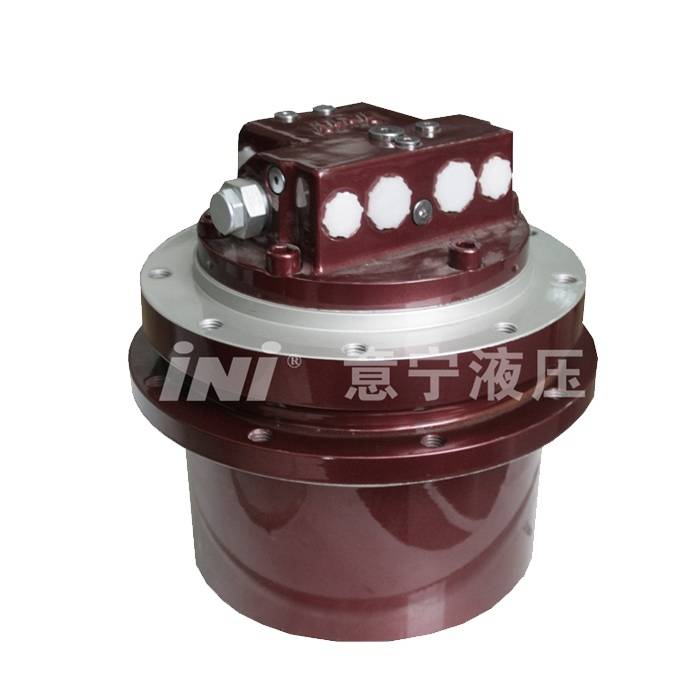
IGY12000T2 heavy-duty slewing drive for marine crane applications
The Offshore Environment Is Not an Industrial Environment
I want to be direct about this, because I have had too many conversations with procurement engineers who treated the offshore specification as a slightly upgraded industrial specification. This approach consistently produces problems.
I have worked with operators who specified drives rated to IP65 and assumed that was sufficient for deck-level mounting in the North Sea. I have seen what happens to those drives within eighteen months of operation. IP65 means protection against water jets from any direction, but it says nothing about salt aerosol penetration through seals, and it says nothing about the galvanic corrosion that occurs when dissimilar metals are exposed to salt electrolyte. The combination of salt spray, high humidity, and UV radiation in a marine atmosphere creates a corrosion mechanism that is qualitatively different from what industrial specifications anticipate.
NORSOK standards in Norway and PUWER regulations in the UK impose requirements that go well beyond what appears on most supplier datasheets. I have seen equipment arrive on-site that was marketed as offshore-rated and subsequently fail port inspection because its documentation did not meet the traceability requirements of the applicable standard. I have learned through these experiences to treat regulatory compliance documentation as a primary selection criterion, not a checkbox exercise.
Understanding Torque Output Mapping in Variable Sea States
The foundation of any hydraulic slewing drive selection is torque — but not in the simplified way most component datasheets present it. Real-world offshore torque demand is not a single number. It is a mapping exercise across multiple operational and environmental variables, and I have developed the specific parameters I calculate for every offshore drive specification I work on through years of field experience and incident investigation.
Dynamic Torque vs. Static Holding Torque
The distinction between dynamic and static torque is where most procurement specifications go wrong. Dynamic torque — the torque required to accelerate or decelerate a load through rotation — is relatively straightforward to calculate from first principles using mass, radius of gyration, and required angular acceleration. Static holding torque, however — the torque the drive must resist when the system is stationary under load — can be two to four times the dynamic torque value in storm conditions.
I have worked on cases where the dynamic torque requirement was 8,000 Nm but the static holding torque demand during storm securing reached 25,000 to 32,000 Nm. When I see a specification that only addressed the dynamic case, the unit was significantly undersized. INI Hydraulic's most robust offshore-rated drives incorporate a torque margin factor of at least 3.5× the calculated dynamic torque to accommodate the static holding requirement. This is not engineering conservatism for its own sake — the maintenance costs and operational disruptions from underspecification are entirely disproportionate to the incremental cost of specifying adequate torque margin upfront.
Hydraulic System Pressure and Flow Interactions
A hydraulic slewing drive's output torque is fundamentally a function of system pressure and motor displacement. The relationship is straightforward: torque equals pressure times displacement divided by 2π. In offshore contexts, however, the drive rarely has a dedicated hydraulic circuit. More commonly, the drive shares a hydraulic power unit with deck cranes, pipe-handling equipment, or the BOP system.
I have worked with operators who did not account for this sharing in their specification, and I have seen them discover the shortfall only after installation — when the system pressure dropped under peak demand loading and the drive's torque output fell to 71% of its rated value. Correcting this post-installation means either upsizing the hydraulic power unit or modifying valve circuitry, and both options are expensive.
In my practice, I recommend requesting from your supplier a family of torque output curves at 200, 240, 280, and 320 bar mapped against varying flow rates. Credible manufacturers can provide this from testing or validated simulation. I take the inability to produce torque mapping data as a signal to look harder at alternative suppliers — it correlates strongly with gaps in engineering validation that manifest as field reliability problems.
Thermal Degradation Under Sustained Operation
Thermal degradation of hydraulic fluid viscosity and seal performance during extended operation is one of the most systematically underestimated failure mechanisms in offshore drive applications. I have observed this on offshore drilling rigs where sustained slewing under high load during pipe tripping operations can last four to six hours continuously.
As hydraulic fluid heats from ambient to 50–70°C, viscosity drops, internal leakage past motor seals increases, effective displacement reduces, and torque output falls. A drive specified for 15,000 Nm output at 20°C ambient may realistically deliver only 12,500 Nm after three hours of sustained operation at 40°C ambient due to combined thermal effects on the motor and seals.
In my recommendations for offshore applications, I always specify drives with an additional 15–20% torque margin above calculated peak demand to account for this degradation curve — particularly in regions with consistently high ambient temperatures like the Gulf of Mexico or Arabian Gulf where I have documented this effect most clearly.
Environmental Protection Ratings: What European Standards Actually Demand
In my work with European offshore operators, I have found that they face a regulatory environment that has become increasingly precise about equipment protection requirements. IEC 60529 Ingress Protection ratings provide the baseline vocabulary, but NORSOK and UK HSE frameworks require compliance that goes well beyond basic IP ratings. I have encountered this gap between datasheet specifications and actual offshore adequacy in enough projects to make it a standard part of my specification review process every time I evaluate a new drive for a European offshore application.
IP Rating Interpretation for Marine Environments
I have visited offshore platforms where a drive specified as IP65 was assumed to be adequately protected, and I have seen what happens when that assumption proves wrong in the field. Salt spray is not the same as water jets. Salt aerosol penetrates seals in ways that fresh water does not, and the corrosive electrolyte it creates on metal surfaces accelerates galvanic corrosion of housing materials. The combination of salt, humidity, and temperature creates a corrosion rate that is three to five times higher than equivalent inland industrial conditions.
In my assessment, for deck-level mounting on offshore platforms, IP66 is the minimum acceptable rating, with IP67 preferred for drives mounted below the main deck where spray exposure is lower. But IP rating alone tells an incomplete story. I have seen housing material and surface treatment make the difference between a drive that lasts fifteen years and one that needs major refurbishment within three. Ductile iron with proper surface treatment significantly outperforms standard cast iron in marine environments, and I always specify it for offshore applications.
ATEX and IECEx Certification Requirements
ATEX 2014/34/EU or IECEx certification is mandatory for any drive installed in a Zone 1 or Zone 2 classified area — which includes most areas of a working drilling platform. An ATEX-certified drive incorporates flame paths, thermal protection, and spark-resistant materials by design. But the certification documentation is as important as the certification itself.
I have encountered cases where a supplier claimed ATEX compliance but the certificate was for a different product model, and I have seen this discrepancy create serious legal liability for operators who installed the equipment in good faith. In my practice, I always insist on receiving the actual certificate number and test report reference, which I then verify directly on the IECEx public database. If a supplier cannot provide verifiable ATEX documentation before the purchase order, I consider that a disqualifying risk factor.
Temperature Range and Hydraulic Fluid Compatibility
In my experience reviewing North Sea specifications, the operating temperature range must account for your platform's thermal environment, not just the ambient air temperature. Solar radiation heating of deck plates can elevate surface temperatures by 15–25°C above ambient in tropical or subtropical regions. In arctic winter conditions, cold-starts may require pre-heating before the drive reaches operational pressure.
For North Sea operations, I specify drives with a rated operating range of −30°C to +60°C and require cold-start documentation from the supplier. Many standard industrial drives are rated only to −10°C — a limitation I have seen cause problems regularly during winter North Sea shutdowns when deck temperatures drop below −15°C.
Hydraulic fluid selection must be validated for the specified temperature range, because not all fluids maintain adequate viscosity at extreme low temperatures. I specifically ask the supplier to confirm seal and hose compatibility with the intended fluid type and request test data supporting their claims.
Mounting Configuration and Platform Motion Considerations
In my years of working on offshore platform projects, the physical mounting arrangement introduces loads and constraints that rarely appear in standard industrial applications. Platform heave, pitch, and roll translate through the hull or jack-up leg structure into dynamic forces on the drive housing and mounting bolts. Motion-induced loading is systematically underestimated in specifications that treat the platform as a static mounting structure — and I have calculated the cost of this underestimate in maintenance events and unplanned downtime.
Inertial Loads from Platform Motion
A slewing drive mounted at the top of a fifty-meter derrick, experiencing a two-degree pitch motion, generates a lateral inertial load equal to the drive assembly mass times the square of the angular velocity times the mounting height. In severe sea states, these inertial loads can reach hundreds of kilonewtons acting on the drive housing.
In my approach to this problem, I request from the platform's naval architect the maximum expected pitch and roll angles and angular velocities for the design sea state, then I calculate the resulting inertia loads on each drive location and specify mounting arrangements with appropriate fatigue life ratings. Slewing drives with their cantilevered load paths are more sensitive to lateral inertial loading than winches with primarily axial load paths — which is why the mounting analysis for slewing drives is meaningfully different from what winch manufacturers typically provide.
Misalignment Tolerance and Flexible Coupling
Hydraulic slewing drives are less tolerant of shaft misalignment than mechanical gearboxes, because the hydraulic motor's bearings and seals are not designed to handle significant radial or angular loads from coupling misalignment. In offshore applications where thermal expansion of the platform structure creates dynamic alignment changes, and where deck deflection under load can shift drive positions by millimetres over time, specifying drives with integral flexible coupling elements is essential.
Drives mounted with rigid couplings almost always create problems in service, because alignment done during commissioning shifts as the platform structure responds to cyclic loading over months and years. In my practice, I require explicit documentation of maximum permissible misalignment from the supplier, or I specify the flexible coupling as a mandatory component of the drive package.
Supplier Qualification: What Documentation I Demand Before a Purchase Order
In my four years of offshore equipment support, I have developed a supplier qualification checklist that I apply to every new hydraulic drive evaluation. The core of my approach is treating the documentation package as a proxy for engineering rigor: if a supplier cannot document their engineering validation process, their product probably has not been through one. This heuristic has been remarkably reliable across dozens of supplier evaluations.
Documentation Requirements Before Purchase Order
Before issuing a purchase order for any hydraulic slewing drive destined for European offshore service, I demand the following documentation package:
- Full material traceability certificates for the drive housing, pinion, and bearings to ASTM or EN material standards
- Weld procedure specifications and qualification records for any fabricated components
- Hydraulic schematic and component BOM for the integrated drive assembly
- Factory Acceptance Test procedure and sample test data from previously delivered units of the same model
- ATEX or IECEx certificate with the specific model number clearly referenced
- Corrosion protection system description with third-party test data
- Operating and maintenance manual draft for review
If a supplier cannot provide all of these before the purchase order, I consider that a significant risk indicator. The suppliers who consistently meet these requirements — including INI Hydraulic, with whom I work directly, and whose IYH series hydraulic slewing drives and IYH22/IYH33 medium-duty offshore drives are specifically engineered for harsh sea state environments — are the ones who have invested in engineering documentation as a product feature, not as an afterthought.
Field Performance Data and Reference Installations
In my supplier evaluations, I always ask for a list of reference installations in comparable offshore applications within the same sea state classification and regulatory jurisdiction. For European applications, references within the North Sea, Baltic Sea, or Norwegian Sea are most relevant, because these represent the most demanding wave climates in which the drive will operate. A drive operating successfully on a Gulf of Mexico platform is encouraging but not definitive — wave heights, wave periods, and regulatory requirements differ meaningfully between those environments.
I also ask for maintenance interval data from these installations. Suppliers who can provide five to ten year maintenance records showing stable performance are demonstrating the engineering maturity that European offshore operators require. INI Hydraulic's engineering documentation includes exactly this kind of long-term field performance data, which is why I continue to specify their equipment for demanding applications.
Total Cost of Ownership: Beyond the Purchase Price
In my experience presenting lifecycle cost analysis to procurement committees, the purchase price of a hydraulic slewing drive typically represents only 15–25% of its total lifecycle cost. The remaining 75–85% is dominated by maintenance labour, hydraulic fluid replacement, seal kits, downtime cost during replacement, and recertification administration. Consistently, presenting this lifecycle analysis changes the conversation from price comparison to value comparison — and I have seen better equipment choices result from that shift.
Maintenance Interval and Mean Time Between Failures
In my work with offshore maintenance teams, I have developed a framework for evaluating maintenance cost that I apply consistently. I estimate the cost per operating hour over the drive's design life, including seal replacements, fluid changes, and bearing inspections.
Drives with inadequate seal technology may require seal replacement every 8,000–12,000 operating hours, while drives with premium fluorocarbon seal packages can extend this interval to 20,000 or more hours. At an offshore labour rate of €80–120 per hour, the difference between a 10,000-hour and a 20,000-hour seal life translates to tens of thousands of euros over the operational life of the drive.
Bearing replacement is a more significant event. I have seen bearing replacements on offshore platforms cost €30,000–60,000 per event when all associated costs are included. In my practice, I specify drives with spherical roller bearings for the main slew bearing application, because they provide better resistance to misalignment and edge loading than tapered roller bearings in offshore conditions.
Hydraulic Fluid Selection and Environmental Considerations
European offshore operators increasingly face pressure to reduce the environmental impact of hydraulic fluid leaks and spills. Traditional mineral oil hydraulics pose both environmental and HSE risks on drilling platforms. Biodegradable hydraulic fluids offer environmental advantages but introduce compatibility requirements with seal materials and hose compounds that not all drive manufacturers have validated.
In my practice, I specifically ask the supplier to confirm seal and hose compatibility with the intended fluid type and request test data supporting their claims. Drives specified for mineral oil and later converted to ester-based fluid without explicit supplier confirmation have experienced seal swelling, material degradation, and premature failure.
The Selection Framework I Actually Use
After years of working through this process with operators and maintenance teams, I have distilled the hydraulic slewing drive selection into a practical framework I apply consistently:
First: Establish the environmental envelope — maximum and minimum ambient temperature, salt spray exposure level, ATEX zone classification, and applicable European standards.
Second: Establish the mechanical loading profile — calculate dynamic torque from inertia and acceleration requirements, then multiply by 3.5 to establish the minimum static holding torque specification.
Third: Establish the hydraulic system constraints — maximum available system pressure under peak demand loading, minimum flow rate, and fluid type.
Fourth: Establish the mounting and alignment constraints — maximum permissible misalignment, space envelope, and maintenance accessibility.
Then — and I see many procurement teams skip this step — go back to the supplier with a request for a drive model that meets all these specifications and ask them to provide torque output mapping data at the full range of system pressures and temperatures. Any credible offshore-rated drive can provide this. Drives which cannot provide this data come from suppliers who have not done the engineering validation necessary for demanding offshore applications.
INI Hydraulic's engineering team provides torque output mapping data with every technical proposal, their documentation package meets the requirements I have described, and their field performance data from North Sea and Southeast Asian offshore installations supports their offshore-rated specifications. Their IYH series slewing drives and IYH22/IYH33 product range reflect this engineering validation at every specification level.
Conclusion: Engineering Judgment Beats Datasheet Comparison
After four years of working on offshore drive specifications, I have come to believe that selecting hydraulic slewing drives for offshore drilling platforms is ultimately an engineering judgment exercise, not a datasheet comparison exercise. The numbers on a datasheet are starting points — necessary but not sufficient. The actual selection decision requires integrating environmental data, mechanical loading analysis, hydraulic system constraints, regulatory requirements, and supplier engineering maturity into a coherent specification that performs reliably over a 15–20 year platform life.
The investment in thorough supplier qualification upstream pays dividends downstream in reduced maintenance costs, fewer operational disruptions, and a stronger HSE record. My advice to every procurement engineer I have worked with who faces this selection is straightforward: talk to the supplier's engineering team, not just their sales team. Ask for torque output mapping curves. Ask for field maintenance records. Ask for weld procedure specifications. Ask for ATEX certificate numbers and verify them independently. If a supplier's engineering team cannot answer these questions confidently, the datasheet could be perfect and the product still be wrong for your application.
In offshore drilling, where equipment failure costs are measured in millions of dollars and — more importantly — in human safety, that investment in upstream qualification is not optional. It is the baseline expectation of professional practice, and it is what I bring to every specification review I conduct.
This article reflects four years of direct engagement with offshore hydraulic system procurement in the North Sea, Southeast Asia, the Middle East, and European maritime regions. For technical specifications or application-specific guidance, contact INI Hydraulic's offshore engineering team directly at www.ini-hydraulic.com.
About the Author
Leo — Technical Content Specialist and Export Sales Representative, INI Hydraulic Co., Ltd.
Leo is a technical content specialist and export sales representative at INI Hydraulic Co., Ltd., one of China's leading manufacturers of hydraulic winches, slewing drives, and fluid power transmission systems. Through INI Hydraulic's YouTube channel and social media platforms, he produces hands-on technical content — including hydraulic system animations, winch load testing footage, and OEM procurement walkthroughs — that helps international buyers understand INI's product engineering before placing orders.
With a background in hydraulic transmission engineering and four years supporting offshore, marine, and construction machinery buyers across Southeast Asia, the Middle East, and Europe, Leo translates complex hydraulic spec sheets into practical procurement guidance for OEM engineers, shipyard procurement managers, and industrial equipment distributors.
Post time: Jun-23-2026