
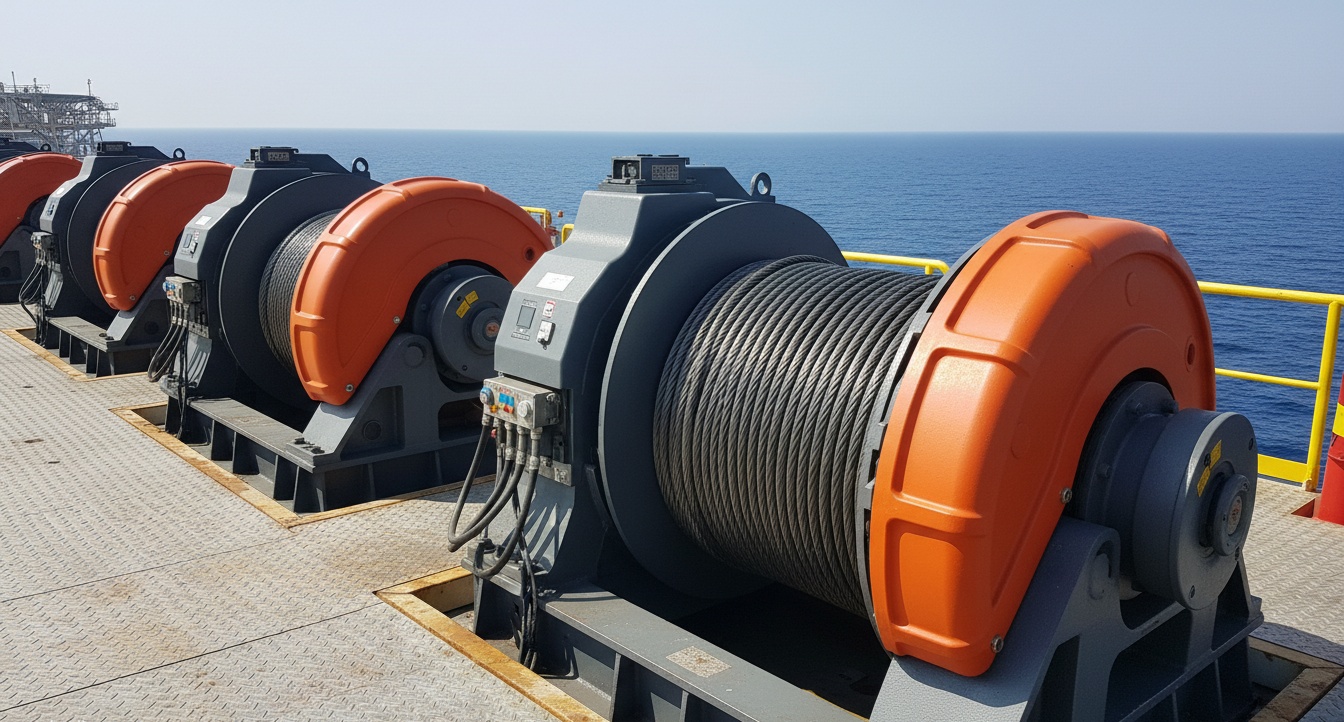
Before specifying a hydraulic winch for UAE offshore operations, verify: (1) rated duty cycle matches your actual pull-hours, (2) brake holding capacity at 125% of rated load, (3) saltwater sealing meets IP68 at 20m depth, (4) hydraulic fluid thermal range covers 45°C ambient, (5) wire rope compatibility with Dubai harbor's specific corrosion profile, and (6) documentation includes DNV or IMO type-approval certificates. Skipping any of these six checks has ended projects in the Gulf — I have seen it happen.
If you are a procurement manager at a Dubai shipyard or an offshore contractor working the UAE continental shelf, you already know that the Persian Gulf is not a forgiving environment. Saltwater, 40°C+ surface temperatures, and high-humidity conditions create a compounding stress on mechanical equipment that no datasheet can fully capture in a spec table. A hydraulic winch that looks fine on paper can fail within months if it was designed for North Sea conditions rather than Gulf conditions.
So let me walk you through the six technical checks I run before recommending any hydraulic winch for offshore deployment in the UAE. I have made these checks personally on projects ranging from Dubai port cargo handling to offshore platform supply operations, and I am sharing them here because the pattern of failure is always the same — someone skipped one of these steps. The good news is that all six checks are documentable, verifiable, and should be part of any serious supplier's standard technical package for marine equipment.
1. Duty Cycle: The Check Everyone Skips First
The single most misunderstood specification in offshore hydraulic winch selection is duty cycle. Duty cycle is not a marketing term — it is an engineering statement about how long a winch can operate at rated pull before it must rest to prevent thermal overload. I have talked to procurement managers who selected winches based on pull capacity alone, never looking at the duty cycle section, and those winches failed in the first summer.
In the UAE offshore context, this matters more than almost anywhere else on earth. Because ambient temperatures routinely exceed 40°C in summer months, the cooling capacity of any hydraulic system is severely compromised. A winch rated for S3 40% duty cycle in a 20°C European shipyard may effectively derate to S2 25% in Dubai harbor conditions. So when I evaluate a winch for UAE offshore work, I recalculate duty cycle using the Gulf's ambient temperature profile rather than the datasheet's test temperature. This is not a minor adjustment — it is often the difference between a winch that can handle your actual operations and one that cannot.
There are two types of duty cycle ratings you will encounter. Intermittent duty (S3) means the winch operates for a defined period then rests. Continuous duty (S1) means it can run indefinitely at rated load. For most UAE offshore anchor handling and cargo transfer operations, I recommend S3 40% minimum with thermal modeling confirmation for 45°C ambient. If the manufacturer cannot provide this thermal derating documentation, I move on to the next supplier.
What to check: Request the manufacturer's thermal derating curve for ambient temperatures between 40°C and 50°C. If they cannot provide one, that is your first red flag. A compliant supplier will have already done this calculation for Gulf deployments and can show you the specific derating curves. Ask for the hydraulic fluid temperature rise data at rated load in 45°C ambient conditions. If they have it, the numbers will be in their engineering files. If they do not have it, you should question whether they have actually deployed equipment in the Gulf before.
2. Brake Holding Capacity at 125% of Rated Load
Every offshore hydraulic winch must have a failsafe brake. In marine environments, this is not optional — it is the difference between a controlled emergency stop and a cable snap that turns into a projectile. The international standard requirement is that the brake hold at 125% of the winch's rated line pull without any hydraulic assistance. This is not my opinion — it is codified in ASME B30.5 and reinforced in classification society rules for marine winches.
For UAE offshore operations specifically, I recommend verifying the brake's static holding force rather than relying on the dynamic braking test. Static holding tests confirm the brake can hold the load with zero hydraulic pressure — which is the actual failure scenario when a hydraulic line ruptures or the pump loses power mid-operation. In dynamic testing, the hydraulic system is still providing some braking assistance. In the real failure scenario, it is not.
I have personally witnessed a brake failure during a cargo transfer operation in Dubai waters. The winch was pulling a loader barge alongside a platform. The hydraulic hose failed. The brake engaged — but only held because it was being partially assisted by the remaining hydraulic pressure in the system. When the full pressure loss scenario was later tested in controlled conditions, the brake slipped. That winch was removed from service and replaced. The cost was six weeks of project delay and a near-miss HSE incident that was never formally reported because the crew knew the implications.
The test procedure: apply 125% of rated load, engage the brake, then disconnect hydraulic power entirely. The load must not move for a minimum of 10 minutes. Any slippage disqualifies the winch from UAE offshore procurement lists. Document the test with load cell readings, not visual observation. Visual observation of a holding load cannot detect micro-slip that will accumulate over time and cause unexpected load descent.
3. Saltwater Sealing: IP68 Is Not Optional in the Gulf
The Persian Gulf has some of the most corrosive saltwater on the planet. The combination of high salinity, warm water temperatures, and tidal exposure creates conditions where standard industrial seals fail rapidly. A winch that is rated IP65 for a European shipyard will not survive a UAE summer in open deck exposure. I have seen this happen. The datasheet said IP65. The manufacturer said it was fine for marine use. After one shamal season, the hydraulic motor seals had extruded and the winch was in the workshop for full hydraulic system overhaul.
The correct specification for UAE offshore hydraulic winches is IP68 at a minimum depth of 20 meters, with confirmation testing under ASTM B117 salt spray protocol for a minimum of 500 hours. This is not an arbitrary number — it reflects the submersion depth that occurs when a winch drum assembly is pressure-washed or when a wave breaks over the deck equipment during a shamal storm system. The shamal is the strong northwesterly wind that sweeps across the Gulf several times per year, typically between November and February, generating wave conditions that routinely wash seawater over deck machinery at offshore platforms. During a severe shamal, wave spray reaches elevations that would be impossible in calmer seas.
When reviewing manufacturer documentation, look specifically for the seal material specification. Nitride rubber seals offer significantly better performance than standard NBR seals in high-salinity environments. If the manufacturer uses standard NBR without specific Gulf-deployment documentation, request the material data sheet for the seal compound. I always ask for the seal material data sheet before proceeding with any technical review for UAE deployment. If they cannot provide it, that tells me something about their supply chain and their experience with Gulf conditions.
4. Hydraulic Fluid Thermal Range for 45°C Ambient Operation
Hydraulic fluid selection is a detail that procurement managers often overlook until a system fails. In temperate climates, standard ISO VG 46 hydraulic oil works reliably. In UAE offshore conditions, this oil choice becomes a critical variable that determines whether your hydraulic system survives or fails prematurely.
At 45°C ambient temperature — which is a typical daytime reading in UAE offshore summer — the hydraulic system's operating fluid temperature can reach 70°C or higher without active cooling. At these temperatures, standard mineral-based hydraulic oils begin to experience accelerated oxidative degradation, which produces acid compounds that attack internal hydraulic components. The varnish deposits from oxidized hydraulic fluid are particularly damaging to servo valves and proportional hydraulic actuators, which are the most expensive components in any modern hydraulic winch control system.
I once reviewed a winch that had been specified by a project team for UAE offshore use. The specification was technically correct for pull capacity, duty cycle, and braking. But the hydraulic fluid specified was a standard mineral oil rated for use up to 60°C. In UAE summer conditions, the actual operating fluid temperature was running at 78°C during standard cargo handling operations. The result was a system that required hydraulic fluid replacement every 800 hours instead of the normal 2000-hour interval. Over a five-year project lifecycle, the fluid replacement cost alone exceeded 30% of the original winch purchase price.
The correct approach: specify hydraulic fluid with a minimum thermal stability range up to 80°C for UAE offshore deployment. Synthetic hydraulic fluids — particularly those meeting ISO 11158 L-HM standards — provide the necessary thermal headroom. Confirm with the winch manufacturer that the hydraulic components are compatible with synthetic fluid, as some seals and internal coatings have specific fluid compatibility requirements. This compatibility check should be documented in writing by the winch manufacturer, not assumed or inferred.
5. Wire Rope Compatibility with Gulf Corrosion Profile
The wire rope on an offshore hydraulic winch is its most exposed component and its most common failure point in marine environments. UAE offshore operations face a specific corrosion challenge: the combination of saltwater, high humidity, and in some harbor areas, residual industrial contamination in the water column. This is not the same challenge as clean-water offshore operations in Northern Europe or the North Sea.
For Dubai offshore operations and UAE continental shelf work, I recommend specifying wire rope with galvanized construction and a minimum breaking strength of 1960 N/mm². The rope should be inspected and documented at minimum intervals of 30 days during active operations, with replacement triggered by visible corrosion pitting, broken strands exceeding the ASME B30.5 threshold, or diameter reduction greater than 5% from nominal. The 30-day inspection interval is critical — I have seen projects that specified 90-day intervals based on European operational norms, and in each case, wire rope condition had deteriorated significantly between inspections in the Gulf environment.
I want to be clear about something: this is not about using a heavier rope to compensate for faster corrosion. It is about using the right rope — properly galvanized, properly specified for breaking strength — and running a disciplined inspection protocol that catches deterioration before it becomes a safety issue. The cost of a single wire rope failure on an offshore platform goes far beyond the rope replacement: vessel demurrage, project delays, and potential HSE incidents create costs that dwarf the price difference between standard and Gulf-rated wire rope.
One additional detail: when specifying wire rope for UAE offshore winches, also specify the correct drum groove radius relative to the rope diameter. Rope that is even slightly oversized for the drum groove will experience premature flattening and strand displacement, which accelerates fatigue failure. This is a detail that many procurement specifications overlook, and I have seen it cause premature rope failures even when the rope itself was correctly specified for corrosion resistance.
6. DNV and IMO Type-Approval Documentation
Documentation is the final and most frequently shortcut-checked item on UAE offshore hydraulic winch procurement. Without proper type-approval certification from a recognized classification society, the winch will not pass port state control inspection in UAE waters, and more importantly, it will not be covered by your marine insurance policy. I cannot stress this enough: documentation is not a paperwork exercise. It is a legal and financial protection mechanism.
For UAE offshore operations, the accepted certification standards are DNV (Det Norske Veritas) type-approval for marine equipment, and IMO (International Maritime Organization) compliance documentation per the Marine Equipment Directive. A winch without these certifications is not legally permitted for commercial offshore deployment in UAE waters. This is not a recommendation — it is a regulatory requirement enforced under the Riyadh MOU, which covers port state control for all commercial vessels operating in Gulf waters.
I have seen winches that were technically excellent — correct duty cycle, proper brake holding, IP68 sealing — that failed documentation requirements at the final procurement stage. The supplier had a CE mark, which is correct for European industrial equipment. But CE marking is not a marine certification. The classification society type-approval is what matters for UAE offshore deployment. CE marking demonstrates compliance with European product safety directives. DNV type-approval demonstrates compliance with marine engineering standards. These are not equivalent.
The specific documents to request: DNV type-approval certificate, IMO compliance declaration, material certificates for pressure-bearing hydraulic components per EN 102043.1, and the manufacturer's declaration of conformity with ASME B30.7 for base-mounted winches or ASME B30.5 for deck winches. These are not burdensome requirements — any serious manufacturer of offshore hydraulic winches will have these documents readily available. If a supplier cannot provide them within a standard procurement timeline, that is itself a significant red flag about their experience with genuine offshore marine equipment.
Conclusion
These six checks — duty cycle derating for Gulf temperatures, brake holding at 125% static load, IP68 sealing with ASTM B117 salt spray confirmation, hydraulic fluid thermal range to 80°C, Gulf-rated wire rope with 30-day inspection intervals, and DNV or IMO type-approval certification — are the minimum technical threshold for any hydraulic winch deployed in UAE offshore operations.
I have personally reviewed winch specifications that passed initial commercial review but failed on three or four of these checks, and in every case, the failure was caught before deployment rather than during operation. That is the goal. Offshore hydraulic winch procurement is not about finding the lowest price — it is about verifying the six technical conditions that determine whether the equipment survives its first Gulf summer. The lowest price winch that fails in month three of a five-year project is the most expensive winch you ever bought.
If your current supplier cannot provide documentation for all six of these checks, the question you need to ask yourself is not whether their price is competitive. The question is whether you are buying equipment that will fail in the most expensive operational environment on earth, and whether your project budget accounts for that failure scenario. I have seen project budgets that were destroyed by hydraulic winch failures that should have been caught in the procurement technical review. The cost of a thorough technical review before purchase is a fraction of the cost of an offshore failure during the project execution phase.
For INI Hydraulic's range of offshore hydraulic winches, we maintain full technical documentation packages for each of these six checks. I am happy to walk through any specific requirement with you directly. Our engineering team has deployed winches in UAE offshore conditions for multiple project cycles, and we have the thermal derating data, brake holding test records, IP68 certification documentation, hydraulic fluid compatibility records, and DNV type-approval certificates ready to share.
Disclaimer: This article is for informational purposes only. Technical specifications and standards referenced are subject to change. Always consult with qualified marine engineers and classification society guidelines for specific project requirements.
Post time: Jun-09-2026