
TL;DR:
- A qualified slewing drive order starts with verified output torque, axial load, radial load, and tilting moment data.
- Buyers should check sealing, gear accuracy, brake performance, hydraulic motor compatibility, and documentation before paying a deposit.
- The safest supplier choice is a slewing drive manufacturer that can support customization, inspection records, spare parts, and application troubleshooting.
- For excavators and heavy machinery, small specification gaps can create downtime that costs far more than the initial price difference.
Before ordering a slewing drive, buyers should verify seven factors: application load, output torque, gear and bearing structure, sealing level, hydraulic compatibility, quality documentation, and lifecycle support. These checks matter because a slewing drive is not a catalog commodity; it is a safety-critical rotary transmission that must carry load, transmit torque, absorb shock, and remain controllable under dust, water, vibration, and operator abuse. A reliable slewing drive manufacturer should help the buyer translate machine conditions into engineering data, not simply quote the lowest price from a model table. If the drive is used on an excavator, crane, aerial platform, marine deck machine, or mining machine, a wrong choice can cause backlash growth, oil leakage, bearing wear, gear pitting, brake slip, and unscheduled shutdown. INI Hydraulic manufactures hydraulic slewing devices, hydraulic motors, winches, planetary gearboxes, and hydraulic systems for demanding machinery applications, and the same selection logic applies: the product must fit the real working cycle, not an optimistic drawing.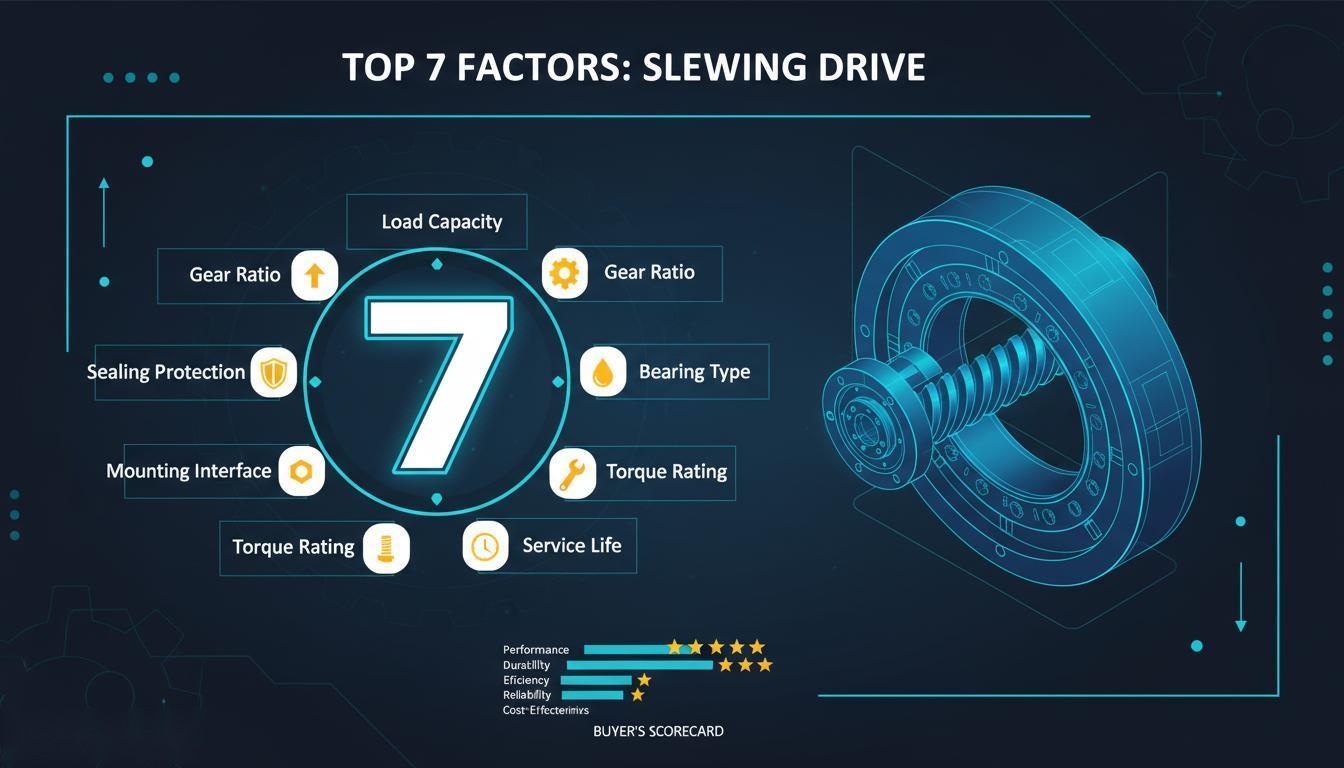
1. Does the Slewing Drive Match the Real Load Case?
The first factor to check is the complete load case: axial load, radial load, tilting moment, duty cycle, shock factor, and required service life. A slewing drive can look strong on a static torque table, yet fail early when the machine applies combined loads in a dirty jobsite. Because slewing drives often support rotating structures, the buyer should never evaluate torque alone. The bearing raceway, gear teeth, housing stiffness, mounting bolts, and hydraulic motor all see different stress during acceleration, braking, digging, swinging, parking, and impact.
For excavator slewing applications, the tilting moment is often more important than nominal rotation torque because digging loads can shift the upper structure abruptly. A 12-ton excavator that slews smoothly during no-load testing may behave very differently when the bucket catches a rock, the operator counter-rotates the house, and the ground is uneven. That is why the load case should include both normal working conditions and occasional overload events.
Buyers should ask the supplier to state the safety factor used for the bearing and gear set. The number does not have to be identical for every project, but it must be discussed openly. For example, an industrial indexing table running indoors for 8 hours per day may accept a different design margin than a marine deck machine exposed to salt spray and emergency shock loads. According to ISO 6336, gear load capacity analysis depends on contact stress, bending stress, lubrication, geometry, and material condition, so a single torque value cannot represent the whole risk profile.
2. Is the Output Torque Specified Under the Right Conditions?
The second factor is usable output torque, including starting torque, continuous torque, peak torque, and the hydraulic pressure or motor displacement used to calculate it. Buyers often compare two quotations by the largest torque number in bold text. That is dangerous because torque can be stated under different assumptions: theoretical motor torque, gearbox output torque before losses, maximum intermittent torque, or recommended continuous working torque.
A practical specification should answer four questions. What pressure was used, such as 16 MPa, 20 MPa, or 25 MPa? What hydraulic motor displacement was assumed? What mechanical efficiency was applied? How long can the unit sustain the stated torque without overheating or damaging the gear flank? A torque value without pressure, flow, efficiency, and duty-cycle conditions is incomplete and should not be used for supplier comparison.
Because hydraulic slewing drives are commonly paired with hydraulic motors, the torque curve changes with system pressure and flow. If the buyer’s machine uses a pump with limited flow, the drive may deliver enough torque but rotate too slowly. If the system pressure is high but relief valve setting is unstable, the drive may experience shock spikes that damage gear teeth. Because pressure creates torque and flow creates speed, both must be checked together.
INI Hydraulic’s hydraulic slewing product page describes compact structure, high working pressure, good stability, light weight, and easy maintenance for excavator slewing solutions. Those are useful application characteristics, but the final model choice should still be tied to the buyer’s pressure, flow, duty cycle, and machine class.
3. How Good Are the Gear, Bearing, and Housing Design?
The third factor is mechanical architecture: gear tooth geometry, bearing capacity, housing stiffness, heat treatment, and machining accuracy. A slewing drive is a compact system where several small engineering choices decide long-term reliability. If the gear hardness is inconsistent, backlash may increase. If the housing lacks stiffness, the load may not distribute evenly. If the bearing raceway is not protected from contamination, rotation will become rough and noisy.
Buyers should ask what type of gear set is used, how the teeth are heat-treated, what inspection method is used for gear contact, and how backlash is controlled before shipment. In practical terms, backlash is not automatically bad; every mechanical drive needs operating clearance. The problem is uncontrolled backlash growth. Backlash should be specified as an acceptable range, measured at defined positions, and recorded before delivery. If the project is for precision positioning, the acceptable backlash range should be agreed before production, not argued about after installation.
Gear surface treatment matters because slewing drives often work at low speed and high load. Low-speed gear contact can be unforgiving when lubrication is poor or shock load is high. According to AGMA gear standards resources, gear rating depends on geometry, material, manufacturing accuracy, lubrication, and application factor. This is why two drives with similar outer dimensions may perform very differently in field service.
4. Can the Sealing and Lubrication Survive the Working Environment?
The fourth factor is protection against dust, water, mud, salt spray, and lubricant failure. Slewing drives rarely fail in a clean laboratory. They fail beside concrete dust, quarry mud, rainwater, seawater, welding debris, and operators with pressure washers. Because contamination attacks bearings and gear teeth slowly, buyers may not notice the problem until rotation noise increases or the machine starts to vibrate.
For outdoor construction machinery, the sealing system should be selected for the actual environment. A standard dust seal may be acceptable for a factory turntable, but not enough for a demolition excavator. For marine or offshore machines, corrosion protection becomes more important. According to ASTM B117, salt spray testing is commonly used to evaluate corrosion resistance under controlled exposure conditions, including a 35°C test chamber environment. That does not perfectly reproduce every field condition, but it gives buyers a structured way to discuss coating and corrosion expectations.
A buyer should ask for the recommended lubricant type, filling quantity, relubrication interval, and grease point layout before ordering. If lubrication access is blocked after the drive is installed, maintenance will be skipped. I have watched this happen on compact equipment where the design team forgot that a technician’s hand still needs space. The result is predictable: dry operation, accelerated wear, and warranty arguments.
Ask whether the slewing drive is shipped pre-lubricated, whether additional grease is required after installation, and whether the lubricant is suitable for the buyer’s temperature range. Cold climates may require different grease behavior than tropical mining sites. For machines washed frequently, the supplier should explain whether seals can resist water intrusion and what cleaning practices are not recommended.
5. Is the Hydraulic Motor and Brake System Compatible?
The fifth factor is hydraulic compatibility, including motor displacement, flow demand, pressure rating, brake type, counterbalance behavior, port size, and oil cleanliness. This is especially important when buying from a slewing drive manufacturer for excavators or construction machinery, because the slewing unit must work with the machine’s existing hydraulic circuit.
Hydraulic matching is not just a matter of choosing a motor with the correct flange. The buyer should verify rated pressure, peak pressure, drain line requirements, case pressure limit, allowable back pressure, and whether the motor includes a brake or valve block. If a brake is used, the buyer must know release pressure, holding torque, response time, and fail-safe behavior. A brake that holds well in the catalog but releases poorly in the machine can create heat, noise, and unsafe control delay.
Because oil cleanliness affects hydraulic motor life, the supplier should state recommended filtration. According to ISO 4406, hydraulic fluid cleanliness can be expressed through particle count codes, which helps maintenance teams define filtration targets instead of guessing. This matters because a slewing drive can be mechanically strong but still fail from contaminated oil damaging the motor or valve components.
Buyers should also discuss rotation speed control. Excavator operators expect smooth start and stop behavior. If the slewing drive accelerates too abruptly, the machine feels harsh. If it creeps or drifts under load, the operator loses confidence. In my view, controllability is one of the most underrated purchasing criteria. It does not always appear in a price comparison sheet, but it affects operator fatigue every day.
6. What Inspection Documents Should the Manufacturer Provide?
The sixth factor is quality evidence: material records, machining inspection, gear contact checks, pressure testing, leakage testing, no-load running test, and final inspection report. A serious buyer should not accept only a product photo and a packing list. Documentation is not bureaucracy; it is risk control.
For a custom slewing drive, the buyer should request a drawing for approval before production. The drawing should show mounting dimensions, output interface, oil ports, motor orientation, brake or valve block arrangement, rotation direction, weight, and installation notes. The buyer should also ask which dimensions are critical to function and what tolerances apply. If the mounting dimensions are wrong by even 1.0 mm in a tight machine frame, the installation cost can exceed the savings from a cheaper quotation.
Before shipment, the supplier should record visual inspection, rotation smoothness, backlash or clearance check, oil leakage inspection, and pressure-related functional testing when applicable. If painting or coating is required, coating thickness or surface preparation details should be documented. For export buyers, packaging should also be discussed because corrosion during sea freight can damage an otherwise good product.
INI Hydraulic’s website highlights research capability, equipment and instruments, detection process, patent certificates, and quality control ability. Buyers should turn these strengths into project requirements: ask which tests will be performed on the ordered model and what report will be supplied with the goods.
7. Can the Supplier Support Customization, Spare Parts, and Field Problems?
The seventh factor is lifecycle support, not only the purchase price. A slewing drive is often installed deep inside valuable equipment. When it fails, the buyer does not only pay for a replacement part. They pay for machine downtime, technician travel, lifting equipment, lost rental income, delayed projects, and unhappy operators. Because of that, a responsible procurement decision should include spare parts availability, technical response time, and failure analysis capability.
For OEM buyers, customization may include output flange design, motor mounting orientation, gear ratio, brake configuration, port layout, coating, sensor preparation, or dimensional changes. INI Hydraulic states that customizing to optimize customers’ equipment designs is a core way it serves the market. That matters for machinery builders because a standard catalog drive may fit mechanically but still create awkward hose routing, service access problems, or packaging conflicts.
A good slewing drive manufacturer should be willing to review drawings, challenge weak assumptions, and recommend changes before production. I prefer suppliers who say, “This will not work well under shock load,” over suppliers who say yes to everything. The first supplier may slow the project for two days. The second may cost the project two months later.
Buyers should ask these support questions before ordering: How long are spare seals, motors, brakes, and gear components available? Can the supplier provide replacement drawings after five years? How are warranty cases handled? What photos, videos, oil samples, or operating data are needed for failure analysis? Can the manufacturer support urgent replacement for critical machines? These questions separate a transactional seller from an engineering partner.
Supplier Evaluation Checklist Before Placing the Order
Use the following checklist before selecting a slewing drive manufacturer, especially when the drive will be used in excavators, construction machinery, marine equipment, or industrial machines.
| Check Item | What to Confirm | Why It Matters |
|---|---|---|
| Load Case | Axial load, radial load, tilting moment, shock factor, duty cycle. | Prevents undersized bearing and gear selection. |
| Torque | Starting, continuous, and peak torque at stated pressure and flow. | Avoids misleading catalog comparison. |
| Gear Quality | Heat treatment, backlash range, contact inspection, housing stiffness. | Controls noise, wear, and long-term accuracy. |
| Sealing | Dust, water, mud, salt spray, lubricant access, grease interval. | Reduces contamination-related failure. |
| Hydraulics | Motor displacement, pressure rating, brake release, port layout, filtration. | Ensures smooth and safe machine control. |
| Documentation | Approval drawing, inspection report, pressure test, packing record. | Creates traceability and reduces dispute risk. |
| Support | Customization, spare parts, failure analysis, urgent replacement. | Protects the buyer after installation. |
Why Work With INI Hydraulic for Hydraulic Slewing Applications?
INI Hydraulic is a relevant partner for buyers who need hydraulic slewing solutions because the company combines hydraulic motors, planetary gearboxes, slewing drives, winches, and hydraulic systems under one manufacturing background. For buyers, that integration is useful. Slewing problems are rarely isolated. A slow swing complaint may involve the hydraulic pump, motor displacement, gear ratio, brake release, valve settings, or operator habits. A manufacturer with broader hydraulic and transmission experience can usually diagnose these interactions faster.
INI Hydraulic has more than 30 years of experience in hydraulic winches, hydraulic motors, planetary gearboxes, and related machinery accessories. Its hydraulic slewing devices are presented for excavator slewing solutions and are described as compact, stable, high-pressure, light-weight, and easy to maintain. For OEMs and equipment rebuilders, the practical next step is to share the machine model, expected load, hydraulic pressure and flow, installation drawing, and working environment so the engineering team can recommend a suitable unit.
The best purchasing result is not the cheapest slewing drive; it is the drive that rotates safely, fits cleanly, survives the duty cycle, and remains serviceable. That is the standard buyers should use when evaluating any slewing drive manufacturer.
FAQ: Ordering a Slewing Drive
What information should I send to a slewing drive manufacturer?
You should send machine type, required output torque, rotation speed, axial load, radial load, tilting moment, hydraulic pressure, hydraulic flow, duty cycle, mounting drawing, working environment, and any brake or valve requirements. If some values are unknown, send the machine model and application photos so the supplier can help estimate the missing data.
Is maximum torque enough for model selection?
No. Maximum torque alone is not enough because it may be an intermittent or theoretical value. Buyers should confirm continuous torque, starting torque, peak torque duration, hydraulic pressure, flow demand, and mechanical efficiency before comparing models.
How much backlash is acceptable in a slewing drive?
The acceptable backlash depends on the machine function. Excavator slewing may tolerate more clearance than a precision positioning table, but the range should be agreed before production and measured before delivery. Uncontrolled backlash growth is more concerning than a defined initial clearance.
Why does sealing matter so much?
Sealing matters because dust, mud, water, and salt can contaminate lubricant and accelerate gear or bearing wear. A drive that works well in a clean workshop may fail early in quarry, marine, demolition, or mining environments if the sealing system is not matched to the job.
Can INI Hydraulic customize hydraulic slewing drives?
INI Hydraulic states that customization for customers’ equipment designs is part of its market approach. Buyers should provide drawings, hydraulic conditions, and working requirements so the engineering team can evaluate suitable customization options.
LinkedIn Summary Version
Before ordering a slewing drive, buyers should not compare suppliers by price and maximum torque alone. A reliable evaluation should check seven factors: real load case, usable torque, gear and bearing structure, sealing and lubrication, hydraulic motor and brake compatibility, inspection documentation, and lifecycle support. For excavators and heavy machinery, the risk is not only product failure; it is machine downtime, operator complaints, and expensive field service. INI Hydraulic supports hydraulic slewing applications with experience in hydraulic motors, planetary gearboxes, winches, and hydraulic systems, making it a practical partner for buyers who need engineered selection rather than a generic catalog quote.
Post time: May-12-2026