
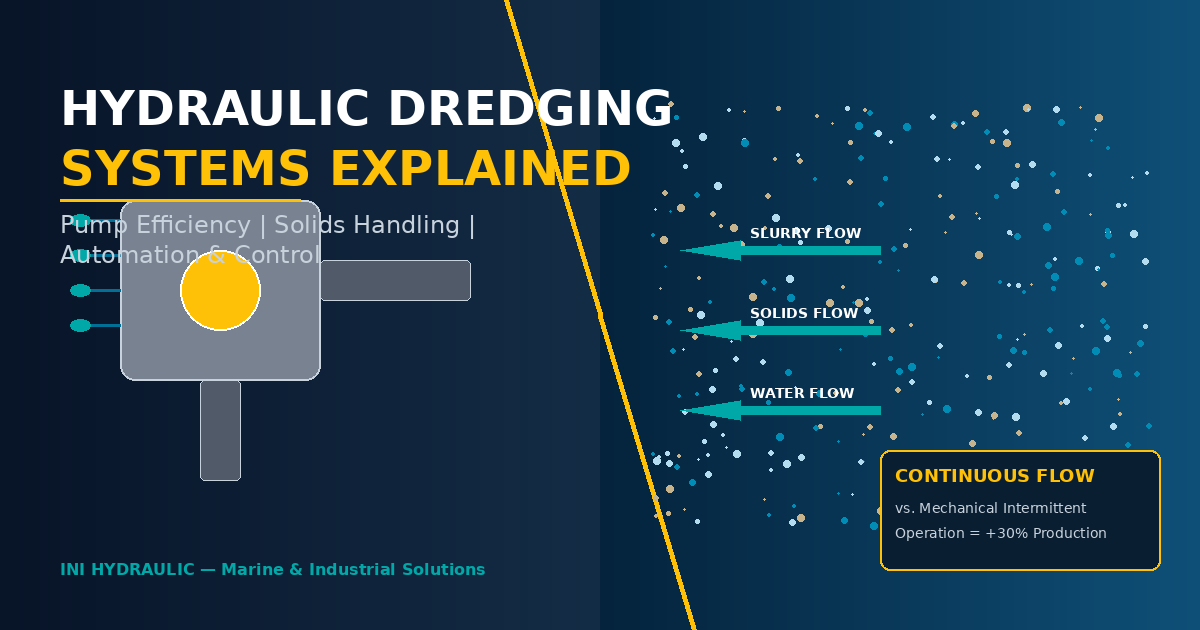
Hydraulic power systems dominate the dredging equipment market with a 72.64% market share , delivering up to 70% solids concentration handling, stepless speed regulation, and automatic overload protection that mechanical systems cannot match. For B2B procurement decision-makers, hydraulic dredging solutions translate directly into higher production rates, lower downtime, and measurable ROI across harbor maintenance, land reclamation, and mining applications.
1. The Hydraulic Advantage: Why 72% of the Market Chooses It
The global dredging equipment market is projected to reach USD 10.5 billion by 2035, growing at a 5.6% CAGR . Within this expanding market, hydraulic dredgers hold a commanding 72.64% share by dredging type — not by accident, but by proven performance metrics that consistently outperform mechanical alternatives.
Hydraulic dredging systems utilize powerful centrifugal pumps creating suction to extract underwater materials, offering continuous operation capabilities that reduce project timelines significantly . Unlike mechanical dredgers that rely on physical excavation with buckets or clamshells, hydraulic systems pump material through pipelines in a seamless flow — eliminating the start-stop cycles that plague mechanical operations.
Key Procurement Insight: When evaluating dredging equipment for large-scale projects (harbor deepening, land reclamation, reservoir maintenance), the continuous-flow advantage of hydraulic systems typically delivers 20–30% faster project completion compared to mechanical alternatives of equivalent power rating.
2. Five Core Efficiency Mechanisms of Hydraulic Power in Dredging
2.1 Continuous Pumping vs. Intermittent Excavation
Mechanical dredgers operate in cycles: lower bucket → excavate → raise → swing → dump → return. Each cycle includes non-productive time. Hydraulic dredgers, by contrast, maintain continuous sediment transport through pipeline systems once operational .
Production Benchmark Data (Hull-mounted dredge pumps, 30' depth, 1,000' discharge, well-graded coarse sand)
| Discharge Diameter | Impeller Diameter | Prime Mover HP | Peak Production (tons/hr) | Average Production (tons/hr) |
|---|---|---|---|---|
| 12" | 32" | 540 | 436 | 327 |
| 14" | 36" | 700 | 601 | 451 |
| 16" | 40" | 950 | 730 | 548 |
| 18" | 44" | 1,125 | 852 | 639 |
These figures represent transport-system-only benchmarks. Real-world production varies with depth, discharge elevation, pipe diameter, material gradation, and pipeline length — all variables that hydraulic systems handle with greater adaptability than mechanical units.
2.2 Stepless Speed Regulation & Precision Control
Hydraulic transmission systems offer minimal movement inertia and fast reaction speeds, enabling submersible slurry pumps to achieve a wide range of stepless speed regulation . This is critical for dredging operations where sediment consistency changes constantly — from fluid slurry near the water column to compacted clay on the seabed.
Engineering Note: The ability to modulate pump speed in real-time prevents cavitation damage, reduces wear on impeller and casing, and maintains optimal efficiency across varying suction conditions. Electric drive systems typically offer 2–4 fixed speeds; hydraulic systems offer infinite variability within the operating range.
2.3 Automatic Overload Protection
Hydraulic systems incorporate automatic overload protection — when resistance exceeds calibrated thresholds, the system reduces output rather than forcing operation . This prevents:
-
Motor burnout (a common failure mode in electrically driven pumps)
-
Mechanical seal damage from pressure spikes
-
Structural fatigue in pump housings and pipelines
For operations in remote locations (offshore platforms, inland waterways without grid power), this self-protecting characteristic is not merely convenient — it is operationally essential.
2.4 High Solids Concentration Handling
Modern hydraulic submersible dredging pumps can process up to 50% solid materials by volume, with maximum solid-liquid extraction density reaching 70% . This directly impacts operational economics:
| Metric | Hydraulic Dredging | Mechanical Dredging |
|---|---|---|
| Solids concentration capability | Up to 70% | Typically 15–25% |
| Energy per cubic meter of solids moved | Lower (less water transported) | Higher (more water in each cycle) |
| Pipeline transport distance | Up to 2,700 ft without booster | Requires barge/ truck transport |
| Secondary handling | Minimal | Significant (offloading, dewatering) |
Higher solids concentration means using energy to move solids instead of water, enabling smaller diesel engines and reduced discharge pipe diameters while maintaining equivalent daily production — a direct cost reduction per cubic meter .
2.5 Integration with Excavator Hydraulic Systems
Hydraulic dredging pumps mounted as excavator attachments leverage the existing auxiliary hydraulic system of the host machine . This "plug-and-pump" architecture delivers:
-
Rapid deployment: No separate power unit required; connect to excavator auxiliary hydraulics
-
Mobility: Full range of excavator boom/arm movement for precise positioning
-
Remote operation capability: Excavator-mounted systems access areas impossible for standalone dredgers
-
Dual-use asset: Excavator remains available for conventional earthmoving when dredging is not required
3. Hydraulic System Architecture: Components That Drive Efficiency
3.1 The Dredge Pump: Heart of the System
Hydraulic dredge pumps are specialized centrifugal pumps optimized for slurry transport. Key design features include :
-
High-chromium alloy wet parts (27% Cr white iron or higher) for abrasion resistance
-
Double mechanical seals to prevent water ingress and extend service intervals
-
Computational Fluid Dynamics (CFD) optimized impeller and volute geometry to reduce local wear effects
-
Low rotational speed, high efficiency design philosophy — trading RPM for torque and longevity
Efficiency Formula (Delft University of Technology pump theory)
η=ηv⋅ηh⋅ηm=PQ⋅pm
Where:
-
ηv = Volumetric efficiency (flow rate through pump / flow rate through impeller)
-
ηh = Hydraulic efficiency (actual pump pressure / theoretical pump pressure)
-
ηm = Mechanical efficiency (power supplied to impeller / power input to shaft)
Modern hydraulic dredge pumps achieve overall efficiencies of 70–84% depending on size and operating point .
3.2 Agitators and Cutter Heads: Breaking the Bond
For compacted or consolidated sediments, hydraulic dredging systems integrate:
-
Dual-blade or multi-agitators on the pump suction to fluidize settled solids
-
Hydraulic excavator/cutter heads (3–22 kW) for hard-packed soil where mechanical excavation would otherwise be required
-
High-pressure water jet rings as alternative cutting mechanisms for dry or clay materials
These attachments are hydraulically driven from the same power source as the pump, ensuring synchronized operation and eliminating the complexity of managing multiple power systems.
3.3 Hydraulic Power Unit (HPU): The Force Multiplier
For larger pump models or pumping distances exceeding 2,000 feet, a dedicated Hydraulic Power Unit (HPU) is recommended for optimal productivity . The HPU:
-
Provides consistent hydraulic pressure independent of excavator auxiliary circuit limitations
-
Enables operation of larger displacement pumps (up to 500+ m³/hr capacity)
-
Supports extended discharge distances with booster pump integration
4. Real-World Efficiency Impact: Variable Analysis
Dredging efficiency is not static — it responds dynamically to operational parameters. DSC Dredge benchmarking data reveals how hydraulic systems perform under varying conditions
Depth Impact (30' vs. 43' Dredging Depth)
| Discharge Diameter | 30' Depth (tons/hr) | 43' Depth (tons/hr) | Production Reduction |
|---|---|---|---|
| 12" | 327 | 255 | 22% |
| 14" | 451 | 359 | 20% |
| 16" | 548 | 441 | 20% |
| 18" | 639 | 521 | 18% |
Deeper dredging increases suction pipe length and friction, reducing available atmospheric pressure for slurry movement. Hydraulic systems mitigate this through higher prime mover power and optimized impeller diameter matching.
Discharge Elevation Impact (30' vs. 60' Terminal Elevation)
| Discharge Diameter | 30' Elevation (tons/hr) | 60' Elevation (tons/hr) | Production Reduction |
|---|---|---|---|
| 12" | 327 | 313 | 4% |
| 14" | 451 | 419 | 7% |
| 16" | 548 | 501 | 9% |
| 18" | 639 | 581 | 9% |
Rule of thumb: Every 5 feet of added elevation is equivalent to approximately 100 feet of horizontal pipe friction
. Hydraulic systems with higher pressure ratings maintain better production rates at elevated discharge points compared to lower-pressure alternatives.
Pipeline Length Impact (1,000' vs. 2,500')
| Discharge Diameter | 1,000' Distance (tons/hr) | 2,500' Distance (tons/hr) | Efficiency at 2,500' |
|---|---|---|---|
| 12" | 327 | 226 | 69% |
| 14" | 451 | 257 | 57% |
| 16" | 548 | 329 | 60% |
| 18" | 639 | — | 77% (est.) |
Extended discharge pipelines dramatically increase friction losses. The solution: booster pumping stations — adding a hydraulic booster pump at intermediate points is often less expensive than the production loss from operating on excessively long single-stage pipelines
Pipe Size Selection: The Million-Dollar Mistake
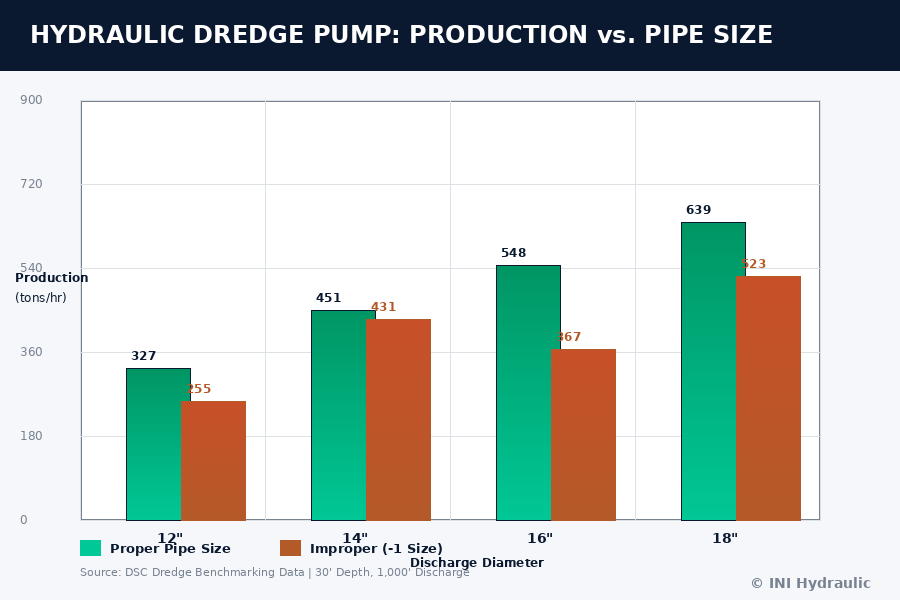
Improper pipe sizing is one of the most costly errors in dredging operations. Using one pipe size smaller than recommended
| Pump Size | Proper Pipe | Improper Pipe | Production Loss | Efficiency Loss |
|---|---|---|---|---|
| 14" | 14" SDR 17 | 12" SDR 17 | 20 tons/hr (4%) | Minimal |
| 16" | 16" SDR 17 | 14" SDR 17 | 181 tons/hr (33%) | 74.7% vs. 75.6% |
| 18" | 18" SDR 17 | 16" SDR 17 | 116 tons/hr (18%) | Significant |
For a 16" dredge operating on undersized 14" pipe, the 181 tons/hr production loss translates to millions in lost revenue annually for commercial operations. Hydraulic system designers must rigorously match pipe diameter to pump discharge diameter and anticipated slurry velocity.
5. Automation & Real-Time Monitoring: The Next Efficiency Frontier
Modern hydraulic dredging systems integrate sensor technology and IoT platforms for continuous performance optimization :
-
Smart sensors measure sediment concentration, pump pressure, and flow rate in real-time
-
GPS-guided dredging maintains precise positioning, reducing over-dredging and fuel consumption
-
Data-driven decision-making via flow meters, pressure sensors, and dredge monitoring software
-
Predictive maintenance algorithms that extend pump wear-part life and reduce unplanned downtime
These innovations build upon the inherent controllability of hydraulic power — the stepless regulation and fast response characteristics that make hydraulics the ideal platform for closed-loop automation.
6. Application-Specific Efficiency Gains
| Application | Hydraulic Advantage | Typical Efficiency Gain |
|---|---|---|
| Harbor & Port Maintenance | Continuous operation in tidal conditions; minimal environmental turbidity | 25–35% faster completion vs. mechanical |
| Land Reclamation (34.19% market share ) | High-volume, long-distance pumping to fill sites | 40% reduction in transport costs |
| River & Canal Dredging | Mobility on floating platforms; access to shallow draft areas | 30% improvement in daily production |
| Mining & Tailings | Handling abrasive slurries up to 70% solids concentration | 50% reduction in water handling costs |
| Environmental Remediation | Precision control for selective sediment removal | Reduced resuspension; regulatory compliance |
7. Maintenance & Total Cost of Ownership
Hydraulic dredging systems, when built with robust materials (high-chrome alloys, reinforced hoses, abrasion-resistant wear parts), deliver extended service life with minimal repair requirements . Key TCO factors:
-
Wear parts: Dredge pump impellers, casings, and suction liners are the highest-wear components. Hydraulic systems with lower RPM designs (vs. high-speed electric pumps) typically achieve 2–3x longer wear-part life
-
Seal integrity: Double mechanical seal designs prevent the water ingress that renders submersible pumps inoperable
-
System integration: Single hydraulic power source for pump, agitator, and cutter reduces maintenance points vs. multi-system architectures
8. FAQ: Hydraulic Power in Dredging Equipment
Q1: What is the maximum solids concentration a hydraulic dredging pump can handle? A: Modern hydraulic submersible dredging pumps can handle solid concentrations up to 70% by weight , significantly higher than conventional centrifugal pumps designed for clear water applications.
Q2: How far can hydraulic dredging systems pump material without a booster? A: Excavator-mounted hydraulic dredging pump attachments can pump slurry up to 2,700 feet without a booster pump . For larger models and distances beyond 2,000 feet, a dedicated Hydraulic Power Unit (HPU) is recommended for optimal productivity.
Q3: Are hydraulic dredging systems more expensive to operate than mechanical systems? A: While initial capital investment is typically higher, hydraulic systems deliver lower operational costs through continuous operation (less downtime), reduced labor requirements, and direct pipeline transport eliminating secondary handling . For large-scale projects, the total cost of ownership favors hydraulics.
Q4: Can hydraulic dredging pumps operate in remote locations without electrical infrastructure? A: Yes. Hydraulic dredging pumps connected to excavators or diesel-driven HPUs operate independently of electrical grid access — a critical advantage for remote mining sites, undeveloped waterways, and offshore projects .
Q5: What causes the most significant production loss in hydraulic dredging operations? A: Improper discharge pipe sizing is the most common and costly error. Using a pipe one size smaller than the pump discharge diameter can reduce production by up to 33% (181 tons/hr on a 16" system)
. Proper pipe selection is essential for achieving rated efficiency.
9. Conclusion: The Hydraulic Imperative for Modern Dredging
Hydraulic power is not merely an alternative to mechanical or electric drive in dredging — it is the dominant technology for good reason. The combination of continuous flow operation, stepless speed control, automatic overload protection, high solids handling, and seamless excavator integration delivers measurable efficiency advantages that translate directly into project economics.
For procurement professionals and project engineers evaluating dredging equipment, the data is clear: hydraulic systems offer superior production rates, lower per-cubic-meter operating costs, and greater adaptability across diverse sediment conditions and project scales. As the dredging equipment market grows toward USD 10.5 billion by 2035 , the hydraulic advantage will only expand with the integration of IoT monitoring, GPS precision, and predictive maintenance — all built upon the responsive, controllable foundation that hydraulic power provides.
About the Author: The INI Hydraulic Engineering Team brings 20+ years of experience in hydraulic system design for marine and industrial applications. Our hydraulic winches, power units, and custom hydraulic solutions support dredging operations across 40+ countries.
Related Reading:
-
Hydraulic Winch Selection Guide for Marine Applications (internal link)
-
Hydraulic Power Unit Design for Offshore Equipment (internal link)
Post time: Apr-25-2026